《国际紧急经济权力法》

Search documents
美对全球15%关税预计本周生效
第一财经· 2026-03-04 13:25
Core Viewpoint - The article discusses the implementation of a new 15% global import tariff by the U.S. government, following a Supreme Court ruling that deemed previous tariff measures under the International Emergency Economic Powers Act as lacking legal authority [2]. Group 1: Tariff Implementation - The new 15% global import tariff is expected to take effect sometime this week [2]. - This tariff rate was announced by President Trump after the Supreme Court ruling on February 20, which found that the previous tariffs lacked clear legal authorization [2]. Group 2: Legal Context - On February 20, the U.S. Supreme Court ruled 6-3 to uphold a lower court's decision that the Trump administration exceeded its legal authority by imposing tariffs under the International Emergency Economic Powers Act [2]. - The ruling was a result of lawsuits filed by businesses and 12 states, arguing that the unilateral imposition of import taxes was unprecedented [2]. Group 3: Legislative Response - Following the Supreme Court's decision, President Trump announced a new 10% global import tariff under Section 122 of the Trade Act of 1974, which is set to last for 150 days [2]. - On February 21, Trump increased the tariff rate from 10% to 15% via a post on his social media platform [2].


美贸易代表:美对部分国家加征的“全球进口关税”税率或达15%
Yang Shi Xin Wen· 2026-02-25 13:57
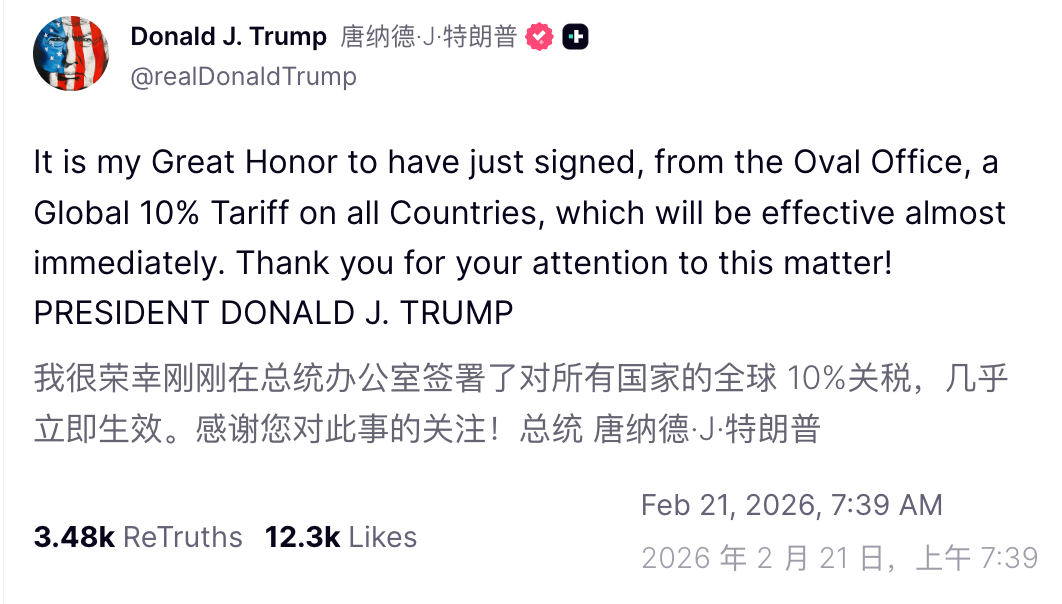
Core Viewpoint - The U.S. Trade Representative, Jamison Greer, announced an increase in the "global import tariff" rate from 10% to 15% or higher for certain countries, without specifying which trade partners would be affected [1] Group 1: Legal Context - On February 20, the U.S. Supreme Court ruled that the large-scale tariff measures implemented by the Trump administration under the International Emergency Economic Powers Act lacked clear legal authorization [1] - The Supreme Court upheld a lower court's decision with a 6-3 vote, stating that Trump's use of the International Emergency Economic Powers Act to impose tariffs exceeded his statutory authority [1] - The ruling was made in response to lawsuits filed by businesses and 12 states, which argued that Trump's unilateral imposition of import taxes was unprecedented [1] Group 2: Policy Changes - Following the Supreme Court's ruling, Trump announced a new "global import tariff" of 10% for 150 days, citing the Trade Act of 1974, Section 122, to replace the tariffs deemed illegal by the court [1] - On February 21, Trump further stated on his social media platform that the import tariff rate on global goods would be raised from 10% to 15% [1]
未知机构:关税被判无效后特朗普有哪些后手事件背景一当地时间2月20日美国最高-20260224
未知机构· 2026-02-24 05:25
Summary of Key Points Industry or Company Involved - The discussion revolves around the U.S. trade policies under the Trump administration, specifically focusing on tariffs and their legal implications. Core Points and Arguments - On February 20, the U.S. Supreme Court ruled that the large-scale tariff measures implemented by the Trump administration under the International Emergency Economic Powers Act lacked clear legal authorization [1] - On the same day, President Trump announced plans to sign an order to impose an additional 10% tariff on global goods, based on the Trade Act of 1974, Section 122, on top of existing tariffs [1] Other Important but Possibly Overlooked Content - The adjustment of U.S. tariffs can be facilitated through three main tools: six types of executive actions, congressional legislation, and treaty negotiations or terminations [2]
特朗普遭遇美国最高法院“背刺”
财富FORTUNE· 2026-02-23 13:05
Core Viewpoint - Trump's new tariff plan has triggered renewed market concerns, leading to a decline in the dollar and U.S. stock index futures since the 20th [1] Group 1: Legal and Political Context - The U.S. Supreme Court ruled last Friday that several of Trump's tariff measures were illegal, undermining his ability to exercise unprecedented power in trade [1][6] - Trump invoked the International Emergency Economic Powers Act (IEEPA) to impose tariffs on non-trade issues, such as a 10% to 25% tariff on Mexico, Canada, and China, allegedly to combat drug trafficking [3][4] Group 2: Trump's Response and Future Implications - Following the Supreme Court ruling, Trump reacted by announcing a new 10% tariff on all imports, later increasing it to 15%, which is the maximum allowed under the Trade Act of 1974 [6][7] - Trump's aggressive tariff strategy is expected to create job and investment opportunities, particularly in key industries like steel and automotive, which may influence the upcoming midterm elections [7] Group 3: International Reactions - The European Parliament's International Trade Committee Chairman proposed to suspend the approval of trade agreements with the U.S. due to the chaos caused by the Supreme Court ruling [7][8] - South Korea plans to review the ruling and continue friendly negotiations regarding a previously agreed tariff deal worth $350 billion [8] - India canceled plans to negotiate a reduction in tariffs from 25% to 18% in light of the new maximum tariff rate of 15% [9] - China is conducting a comprehensive assessment of the ruling's implications and urges the U.S. to cancel unilateral tariff measures [10]
美国突然宣布:明起暂停征收此项关税!特朗普大规模关税违法!
Xin Lang Cai Jing· 2026-02-23 09:20
Group 1 - The U.S. Customs and Border Protection (CBP) will stop collecting tariffs imposed under the International Emergency Economic Powers Act (IEEPA) starting February 24 [1] - The suspension of these tariffs will not affect any other tariffs imposed by the Trump administration [1] - The U.S. Supreme Court ruled on February 20 that the large-scale tariff policy implemented by the Trump administration under the IEEPA was illegal [1] Group 2 - Following the Supreme Court ruling, Trump announced a 10% import tariff on global goods for 150 days under Section 122 of the Trade Act of 1974 to replace the tariffs deemed illegal [1] - On February 21, Trump stated on social media that the previously announced global import tariff rate would be increased from 10% to 15% [1]
玉渊谭天:美国对华哪些关税被停止征收?
Hua Er Jie Jian Wen· 2026-02-22 07:45
Group 1 - The core viewpoint of the articles discusses the implications of the U.S. tariffs on China under the International Emergency Economic Powers Act (IEEPA), particularly focusing on the "fentanyl tariff" and the "reciprocal tariff" [1] - The current tariff rate on China is 10% for both the fentanyl and reciprocal tariffs, with an additional 24% rate on the reciprocal tariff being postponed [1] - Following a ruling by the U.S. Supreme Court, it is indicated that the tariffs imposed under IEEPA may be automatically canceled, affecting the overall tariff arrangement between the U.S. and China [1] Group 2 - If the U.S. were to cease these measures or lower the tariff rates, China may consider reassessing and adjusting its own measures accordingly [1] - Conversely, if the U.S. continues to impose new tariffs through other legal means, China will evaluate the necessity of corresponding actions [1]
【环球财经】特朗普:“全球进口关税”从10%提高至15%
Xin Hua She· 2026-02-22 05:53
Group 1 - The core point of the news is that President Trump announced an increase in the global import tariff rate from 10% to 15%, effective immediately, following a Supreme Court ruling that limited the president's authority to impose large-scale tariffs [1] - The Supreme Court ruled that the International Emergency Economic Powers Act does not authorize the president to impose large tariffs, which represents a significant setback for the Trump administration's tariff policy [1] - Trump signed an executive order to terminate previously imposed tariffs under the International Emergency Economic Powers Act, and announced a new global import tariff of 10% for 150 days under the Trade Act of 1974, which allows for a maximum tariff of 15% in cases of trade imbalance [1] Group 2 - U.S. Trade Representative Jamison Greer stated that existing trade agreements with other countries must be adhered to, even if they involve higher tariff rates, citing Malaysia and Cambodia as examples where tariffs will remain at 19% [2]
美国政府关税政策被判违法,主要原告发声:政府没有理由不退还关税
Huan Qiu Wang· 2026-02-21 03:52
Core Viewpoint - The U.S. Supreme Court ruled that the Trump administration's tariff policy was illegal, leading to calls for the return of tariffs collected from companies like Learning Resources [1][3]. Company Summary - Learning Resources, a U.S. educational toy company based in Illinois, was a major plaintiff in the Supreme Court case, with CEO Waldenberg being a key figure [1][3]. - Waldenberg stated that the government has no reason not to refund the tariffs, emphasizing that the funds taken were theirs and should be returned [3]. - The company incurred over $10 million in tariff expenses due to the International Emergency Economic Powers Act (IEEPA) in 2025, and the lawsuit was aimed at protecting family businesses rather than political motives [3]. Industry Summary - The Supreme Court's decision represents a significant setback for the Trump administration's tariff policies, with potential implications for the return of billions in tariffs to U.S. companies [3]. - The ruling may lead to prolonged legal battles regarding whether the federal government is obligated to refund the tariffs, with former President Trump acknowledging that this could result in years of litigation [3].

美最高法院裁定特朗普政府大规模关税违法
Xin Hua She· 2026-02-21 01:56
Core Viewpoint - The U.S. Supreme Court ruled that the International Emergency Economic Powers Act does not authorize the president to impose large-scale tariffs, significantly undermining the tariff policies of the Trump administration [1][2]. Group 1: Court Ruling - The Supreme Court made a 6-3 decision, indicating a major setback for the Trump administration's tariff policies [2]. - The ruling follows a series of legal challenges against the Trump administration's use of the International Emergency Economic Powers Act to impose tariffs without congressional approval [2]. Group 2: Legal Background - The Trump administration, which took office in January 2025, had issued a series of tariff measures through executive orders citing the International Emergency Economic Powers Act [2]. - The U.S. International Trade Court ruled in May 2025 that the Trump administration's actions were illegal and prohibited the enforcement of tariffs imposed on multiple countries [2]. - The U.S. Court of Appeals upheld the International Trade Court's ruling in August 2025 but did not immediately bar the Trump administration from continuing to impose tariffs under the Act [2].
关税政策被最高院推翻后不退场,特朗普火速推出10%替代方案
Jin Shi Shu Ju· 2026-02-21 01:54
Core Viewpoint - The U.S. Supreme Court ruled against Trump's global tariff policy, deeming it illegal and undermining a significant tool for reshaping trade agreements and imposing tariffs on foreign imports [1][2]. Group 1: Court Ruling and Implications - The ruling was made with a 6-3 vote, led by Chief Justice John Roberts, stating that Trump overstepped his authority by implementing tariffs without explicit Congressional authorization [2]. - The tariffs in question represent a substantial portion of the total tariffs imposed by Trump, with an estimated revenue of $1.5 trillion over the next decade, accounting for 70% of the total tariffs from his second term [1]. - The court did not address whether the government must refund the tariffs already collected, leading to potential legal battles from businesses seeking to reclaim these funds [5]. Group 2: Legal and Political Context - This ruling marks the first time the Supreme Court has overturned a policy from Trump's second term, despite a conservative majority that has generally supported his use of executive power [2]. - The court rejected Trump's argument that the International Emergency Economic Powers Act implicitly authorized such tariffs, emphasizing that no previous president had used this law to impose tariffs on such a scale [2][4]. - The ruling highlighted the need for clear legislative language if Congress intends to grant new powers to the executive branch regarding significant economic issues [6]. Group 3: Reactions and Future Actions - Trump expressed strong disapproval of the ruling, labeling it "bad and absurd," and indicated plans to impose a new 10% global tariff using other legal avenues [1][3]. - The White House announced a temporary import tax of 10% on goods entering the U.S., effective in 150 days, with certain exemptions for critical minerals and energy products [1]. - Legal experts suggest that while the government can attempt to implement tariffs under different laws, these alternatives may not provide the same flexibility as the previously overturned measures [4].