
全球进口关税

Search documents
美国法院裁定退关税,能退回吗?什么时候才能退?
第一财经· 2026-03-05 10:02
Core Viewpoint - The article discusses a recent ruling by the U.S. International Trade Court that prohibits the U.S. Customs and Border Protection from collecting tariffs based on the International Emergency Economic Powers Act (IEEPA), potentially leading to refunds of up to $175 billion for U.S. importers [3][8]. Group 1: Legal Ruling and Implications - The U.S. International Trade Court ruled that U.S. importers are entitled to refunds for tariffs collected under the IEEPA, following a Supreme Court decision that limited the Trump administration's authority to impose such tariffs [3][7]. - The ruling specifically affects cases like that of Atmus Filtration, which claims entitlement to tariff refunds [3][7]. - Major companies, including FedEx and L'Oréal, have filed lawsuits against the federal government for refunds of tariffs collected under the IEEPA [3][8]. Group 2: Financial Impact and Refund Process - The U.S. government may need to refund up to $175 billion in tariffs, with $134 billion already collected under the IEEPA by the end of 2025 [8]. - The Customs and Border Protection typically determines the tariff amounts within 314 days after import, allowing importers 180 days to protest the amounts [7]. - The refund process is expected to be complex, as the Customs and Border Protection's systems are not designed for large-scale refunds, potentially leading to delays [8][11]. Group 3: Ongoing Legal and Administrative Challenges - Over 1,000 companies have joined lawsuits seeking refunds, indicating widespread concern over the legality of the tariffs [10]. - Legal experts suggest that the battle over refunds could be prolonged, with expectations that the government may delay the process [11]. - The U.S. Treasury Secretary announced new global import tariffs of 15%, which are set to take effect soon, adding further complexity to the trade landscape [12].

美对全球15%关税预计本周生效
第一财经· 2026-03-04 13:25
Core Viewpoint - The article discusses the implementation of a new 15% global import tariff by the U.S. government, following a Supreme Court ruling that deemed previous tariff measures under the International Emergency Economic Powers Act as lacking legal authority [2]. Group 1: Tariff Implementation - The new 15% global import tariff is expected to take effect sometime this week [2]. - This tariff rate was announced by President Trump after the Supreme Court ruling on February 20, which found that the previous tariffs lacked clear legal authorization [2]. Group 2: Legal Context - On February 20, the U.S. Supreme Court ruled 6-3 to uphold a lower court's decision that the Trump administration exceeded its legal authority by imposing tariffs under the International Emergency Economic Powers Act [2]. - The ruling was a result of lawsuits filed by businesses and 12 states, arguing that the unilateral imposition of import taxes was unprecedented [2]. Group 3: Legislative Response - Following the Supreme Court's decision, President Trump announced a new 10% global import tariff under Section 122 of the Trade Act of 1974, which is set to last for 150 days [2]. - On February 21, Trump increased the tariff rate from 10% to 15% via a post on his social media platform [2].

美贸易代表:美对部分国家加征的“全球进口关税”税率或达15%
Sou Hu Cai Jing· 2026-02-26 11:10
Core Viewpoint - The U.S. is increasing the global import tariff rate from 10% to 15% or higher, following a Supreme Court ruling that deemed previous tariff measures under the International Emergency Economic Powers Act as lacking legal authority [3]. Group 1: Tariff Changes - The U.S. Trade Representative, Jamison Greer, announced the increase in global import tariffs, although specific trade partners were not disclosed [3]. - Following the Supreme Court's ruling, President Trump announced a new global import tariff of 10% for 150 days, which is intended to replace the previously invalidated tariffs [3]. - On February 21, Trump stated via social media that the import tariff rate would be raised to 15% [3]. Group 2: Legal Context - The Supreme Court ruled 6-3 that the Trump administration's use of the International Emergency Economic Powers Act to impose tariffs exceeded its legal authority [3]. - The ruling was based on lawsuits filed by businesses and 12 states, which argued that the unilateral imposition of import taxes was unprecedented [3].
上海发布“沪七条”房地产优化政策
Dong Zheng Qi Huo· 2026-02-26 00:48
1. Report Industry Investment Ratings No relevant content provided. 2. Core Views of the Report - The global market risk appetite continues to rise due to the increased difficulty of the US - Iran nuclear agreement negotiations. The real - effect of Shanghai's real - estate policy on the market should be rationally viewed. The short - term bond market is volatile, and there is a long - term adjustment risk. The prices of various commodities have different trends and influencing factors, and corresponding investment suggestions are put forward for each commodity [17][20][24] 3. Summary by Directory 3.1 Financial News and Comments 3.1.1 Macro Strategy (Gold) - The US may raise the "global import tariff" on some countries to 15%. Gold prices are supported by the weakening of the US dollar index, US tariff policies, and the uncertainty of US - Iran negotiations. However, the short - term interest rate cut willingness of the Fed is low, and gold prices continue to fluctuate. Silver is supported by low inventory, but its upward trend may not last [12] - Investment advice: Precious metals will continue to fluctuate in the short term, and the upward trend of silver may be difficult to sustain [13] 3.1.2 Macro Strategy (Foreign Exchange Futures - US Dollar Index) - Cuba fired at a US speedboat, and the US envoy requires the Iran nuclear agreement to be permanent, increasing the negotiation difficulty. The EU is evaluating that the new US tariffs may be higher than the 15% upper limit of the agreement. The global market risk preference continues to rise [14][15][17] - Investment advice: The US dollar will continue to fluctuate [18] 3.1.3 Macro Strategy (Stock Index Futures) - Shanghai issued the "Seven - Point Plan for Shanghai" to optimize real - estate policies, reducing the home - purchase threshold and releasing a positive policy signal. The real - estate sector rose, but the increase was limited. In the context of an aging population and income pressure, residents' ability to increase leverage is limited [19][20] - Investment advice: Hold stock index long positions in a balanced manner [21] 3.1.4 Macro Strategy (Treasury Bond Futures) - Shanghai optimized real - estate policies, and the central bank conducted 4095 billion yuan of 7 - day reverse repurchase operations, with a net investment of 95 billion yuan on that day. The real - estate policy has limited negative impact on the bond market. In the short term, the bond market sentiment is not likely to turn weak, and there is still rebound momentum in some periods. In the long term, the bond market is not optimistic [23][24] - Investment advice: The bond market will fluctuate in the short term, and there is still an adjustment risk in the long term [25] 3.2 Commodity News and Comments 3.2.1 Black Metals (Coking Coal/Coke) - The coking coal market in Lvliang is oscillating. After the Spring Festival, the supply of coking coal has increased, but the demand is weak. The coke market also has problems such as inventory accumulation and weak demand. The market will maintain an oscillating pattern in the short term [26][27] - Investment advice: The market will maintain an oscillating pattern in the short term [28] 3.2.2 Black Metals (Rebar/Hot - Rolled Coil) - Australia made an anti - dumping final review ruling on Chinese rebar, and Mexico launched an anti - dumping investigation on Chinese cold - rolled coils. After Shanghai relaxed real - estate purchase restrictions, steel prices rose, but the fundamental pressure is still obvious. The steel price is in the stage of oscillating and bottom - grinding in the short term [30][32] - Investment advice: The steel price will oscillate in the short term. Pay attention to the opportunity of undervalued prices [33] 3.2.3 Agricultural Products (Cotton) - As of February 21, 2026, Brazil's cotton planting was 99.9% complete. After the festival, textile enterprises are resuming work. Some spinning enterprises have raised yarn prices, but the increase is less than that of cotton. The downstream market's acceptance of raw material price increases needs to be observed. The commercial cotton inventory is lower than last year, and the market is worried about the tight supply in the later period [34][36][37] - Investment advice: Zheng cotton is expected to be difficult to fall in the short term, and the market will be mainly oscillating strongly. Pay close attention to the macro - situation and downstream enterprise conditions [37] 3.2.4 Agricultural Products (Soybean Meal) - Argentina's weather will be drier this week, and the condition of soybean crops is declining. Brazil's soybean harvest is behind schedule, but exports are stable. In China, factors such as new purchases of US soybeans, reserve sales, and customs policies need to be focused on [38] - Investment advice: Temporarily view soybean meal with an oscillating mindset [40] 3.2.5 Agricultural Products (Soybean Oil/Rapeseed Oil/Palm Oil) - Indonesia urges the EU to restore market access for Indonesian palm oil products. From February 1 - 20, Malaysia's palm oil production and exports decreased. The palm oil market may decline in production and exports in February, and the inventory is expected to fall to 250 - 260 million tons. In March, production is expected to remain low, and attention should be paid to the replenishment demand in the sales area [41][42][43] - Investment advice: The palm oil inventory in Malaysia is expected to decline in February, and attention should be paid to the replenishment demand in the sales area in March [43] 3.2.6 Agricultural Products (Corn) - From February 12 - 18, 2026, the consumption of corn by deep - processing enterprises decreased. The progress of farmers selling corn is faster than in previous years. The downstream inventory is at a relatively high level, and the demand support may weaken. The corn futures price is expected to oscillate strongly [44][45] - Investment advice: Be vigilant against the technical correction risk after the optimistic sentiment fades. The corn futures price is expected to oscillate strongly [45] 3.2.7 Non - ferrous Metals (Lithium Carbonate) - Zimbabwe suspended the export of all raw ores and lithium concentrates. It is estimated that the monthly supply will be affected by 12,000 tons of LCE. In the short term, the impact on domestic smelters is controllable, but it will intensify the de - stocking. In the long term, it will affect the annual stocking trend. Be vigilant against the negative feedback from the demand side [46][47] - Investment advice: Adopt a bullish mindset in the short term, and pay attention to the price correction after the supply increases in the medium term [48] 3.2.8 Non - ferrous Metals (Lead) - On February 24, the LME 0 - 3 lead was at a discount of $49.85 per ton. The Shanghai lead price oscillated at a low level. The downstream consumption is lacking, and the inventory is high. The lead price will oscillate weakly, but the decline space is limited due to the cost support [49][50] - Investment advice: Observe in the short term and consider long positions in the medium term [50] 3.2.9 Non - ferrous Metals (Zinc) - On February 24, the LME 0 - 3 zinc was at a discount of $31.93 per ton. The zinc price oscillated. The LME inventory decreased, and the domestic inventory increased. The downstream start - up speed is slow. The zinc price is recommended to be treated with a bullish mindset, and continue to hold the Call [51] - Investment advice: Adopt a bullish mindset for the single - side trading, and continue to hold the previous Call. Observe for arbitrage [51] 3.2.10 Non - ferrous Metals (Copper) - In 2025, the global refined copper market had a surplus of 380,000 tons. European copper processing enterprises warned about the shortage of raw material supply. Chile's new government may adjust mining policies. The macro - sentiment is warming up, which will support the non - ferrous metal prices. The short - term copper price is likely to oscillate strongly [52][53][56] - Investment advice: Adopt a bullish mindset for the single - side trading and continue to buy on dips. Observe for arbitrage [56] 3.2.11 Non - ferrous Metals (Tin) - On February 24, the LME 0 - 3 tin was at a discount of $10 per ton. The supply of tin ore is expected to be tight in the long term. The downstream enterprises have not fully resumed work, and the spot market is cold. The tin price is expected to oscillate strongly and widely [57][58] - Investment advice: The tin price is expected to oscillate strongly and widely. Pay attention to the macro - situation, supply recovery, and post - festival consumption [58] 3.2.12 Energy and Chemicals (Crude Oil) - OPEC+ is considering a small increase in production. The EIA commercial crude oil inventory increased significantly. The oil price oscillated weakly, and the market is concerned about the progress of the US - Iran negotiations [59][60][61] - Investment advice: Pay close attention to the changes in the US - Iran situation in the short term [62] 3.2.13 Energy and Chemicals (Liquefied Petroleum Gas) - Saudi Aramco cancelled the March loading plan due to force majeure, which stimulated the international market price to rise. The international market is expected to be strong in the short term [63] - Investment advice: The price is expected to be strong in the short term [65] 3.2.14 Energy and Chemicals (Asphalt) - The capacity utilization rate of domestic heavy - traffic asphalt increased. The downstream demand has not fully recovered, and the market is in a weak state. The short - term asphalt price still has support [65][66] - Investment advice: The asphalt price will oscillate in the short term [67] 3.2.15 Energy and Chemicals (LLDPE) - The inventory of polyethylene social sample warehouses and production enterprises increased. The inventory accumulation speed is normal during the holiday, and the subsequent de - stocking speed needs to be observed [68][69][70] - Investment advice: Observe the de - stocking speed and geopolitical issues [71] 3.2.16 Energy and Chemicals (Methanol) - The methanol port inventory increased slightly. The unloading and提货 speed are slow. Iranian devices are restarting. Before the geopolitical issues are resolved, continue to observe methanol. After the issues are resolved, consider short - selling or 5 - 9 reverse arbitrage [72][74] - Investment advice: Observe methanol before the geopolitical issues are resolved, and consider short - selling or 5 - 9 reverse arbitrage after the issues are resolved [75] 3.2.17 Energy and Chemicals (Styrene) - The inventory of styrene in East China ports increased significantly. The pure benzene port inventory is high, and the de - stocking is difficult before mid - March. The styrene is suppressed by potential supply increases. Pay attention to the actual inventory accumulation in February and the change of trading logic [76][77] - Investment advice: The pure benzene price may rise after short - term oscillation. The styrene is suppressed by supply increases. Pay attention to inventory accumulation and trading logic changes [78] 3.2.18 Energy and Chemicals (Urea) - The urea enterprise inventory increased significantly during the Spring Festival. The international urea price is easy to rise. The domestic supply is abundant, and the demand for spring plowing is approaching. The urea price is expected to be strong, but policy intervention should be noted [79][81] - Investment advice: Market participants should replenish inventory based on rigid demand and reduce speculative operations. The urea futures market should be treated with an oscillating mindset [82] 3.2.19 Shipping Index (Container Freight Rate) - The opening price of MSK from Shanghai to Rotterdam in the 11th week decreased, and the shipping capacity pressure still exists. The spot freight rate in March is expected to decline. The market sentiment has shifted from expectation - driven to reality - driven [83] - Investment advice: Pay attention to the opportunity of short - selling the 04 contract at high prices in the short term [83]
美贸易代表:美对部分国家加征的“全球进口关税”税率或达15%
Yang Shi Xin Wen· 2026-02-25 13:57
Core Viewpoint - The U.S. Trade Representative, Jamison Greer, announced an increase in the "global import tariff" rate from 10% to 15% or higher for certain countries, without specifying which trade partners would be affected [1] Group 1: Legal Context - On February 20, the U.S. Supreme Court ruled that the large-scale tariff measures implemented by the Trump administration under the International Emergency Economic Powers Act lacked clear legal authorization [1] - The Supreme Court upheld a lower court's decision with a 6-3 vote, stating that Trump's use of the International Emergency Economic Powers Act to impose tariffs exceeded his statutory authority [1] - The ruling was made in response to lawsuits filed by businesses and 12 states, which argued that Trump's unilateral imposition of import taxes was unprecedented [1] Group 2: Policy Changes - Following the Supreme Court's ruling, Trump announced a new "global import tariff" of 10% for 150 days, citing the Trade Act of 1974, Section 122, to replace the tariffs deemed illegal by the court [1] - On February 21, Trump further stated on his social media platform that the import tariff rate on global goods would be raised from 10% to 15% [1]
欧洲议会暂停批准欧美贸易协议,呼吁美国澄清不确定性
Feng Huang Wang· 2026-02-23 22:39
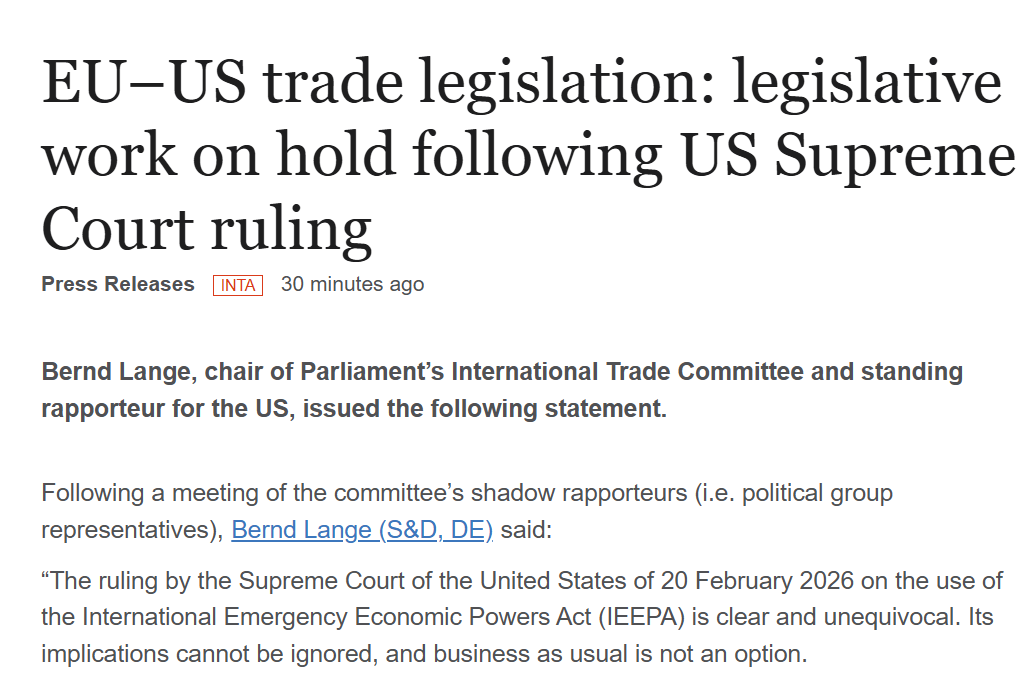
Group 1 - The European Parliament's International Trade Committee Chairman Bernd Lange stated that a majority of members have agreed to suspend the procedures for the US-EU trade agreement until clarity, stability, and legal certainty in US-EU trade relations are restored [1] - The US Supreme Court recently ruled that tariffs imposed by Trump under the Emergency Economic Powers Act were illegal, which has significant implications for the previously agreed trade deal reached in July 2025 [3] - Following the Supreme Court ruling, Trump announced the imposition of "global import tariffs" under the Trade Act of 1974, currently executing a "maximum of 15% for up to 150 days" [5] Group 2 - Lange emphasized that the Supreme Court's ruling is clear and its impact cannot be ignored, indicating that the key tool for negotiating and executing the "Turnberry Agreement" is no longer available [5] - The new tariffs will lead to an effective tax rate close to 30% on European cheese imports to the US, significantly deviating from the terms of the "Turnberry Agreement" which capped tariffs at 15% [5] - The EU has chosen to press the "pause button" again in response to the significant changes in US tariffs, reflecting ongoing tensions in US-EU trade relations [5][6]
马年春节前后部分重要新闻一览
Xin Lang Cai Jing· 2026-02-23 12:31
Group 1 - In January, non-bank deposits increased by 2.56 trillion yuan year-on-year, with household deposits decreasing by 3.39 trillion yuan [1] - The increase in non-financial enterprise deposits was 2.61 trillion yuan, while household deposits rose by 2.13 trillion yuan [1] - Analysts attribute these trends to the impact of the Spring Festival and a shift in household savings behavior [1] Group 2 - On February 18, Takashi Suga was elected as Japan's 105th Prime Minister, forming a new cabinet with all previous members retained [2] - Suga was previously elected as the president of the Liberal Democratic Party on October 4 and became Prime Minister on October 21 [2] - The House of Representatives was dissolved following a cabinet meeting on January 23 [2] Group 3 - Su Yiming won the first gold medal for the Chinese delegation at the Milan Winter Olympics in men's snowboard slopestyle with a score of 82.41 [3] Group 4 - The Federal Reserve's January meeting minutes revealed significant internal divisions regarding future monetary policy directions, despite a consensus to maintain the current interest rate [4] - Most officials warned that the process of bringing inflation back to the 2% target may be slower and more uneven than expected [4] Group 5 - Samsung Electronics is negotiating prices for its next-generation AI high-bandwidth memory chips, with quotes rising by up to 30% compared to the previous generation [5] - This price increase has drawn significant attention from the global semiconductor supply chain [5] - Analysts suggest that ongoing supply constraints and technological barriers are allowing leading manufacturers to regain pricing power in the high-end market [5] Group 6 - President Trump announced an increase in the "global import tariff" rate from 10% to 15%, effective immediately [6] - This decision follows a Supreme Court ruling that limited the president's authority to impose large-scale tariffs under the International Emergency Economic Powers Act [6] Group 7 - In 2026, China's annual box office revenue surpassed 80 billion yuan, ranking first globally among single markets [7] - The total box office for the Spring Festival has exceeded 54 billion yuan, with top films including "Fast Life 3" and "Silent Awakening" [7]
“全球进口关税”从10%提高至15%
Xin Lang Cai Jing· 2026-02-22 17:58
Core Viewpoint - President Trump announced an increase in the "global import tariff" rate from 10% to 15%, effective immediately, following a Supreme Court ruling that limited his authority to impose large-scale tariffs [1] Group 1: Tariff Announcement - The global import tariff will now be set at 15%, up from the previous 10% [1] - This tariff is based on the Trade Act of 1974, Section 122, which allows the government to impose tariffs in cases of trade imbalance, with a maximum rate of 15% for a duration of 150 days unless Congress approves an extension [1] Group 2: Legal Context - The Supreme Court ruled that the International Emergency Economic Powers Act does not authorize the President to impose large-scale tariffs [1] - The announcement of the tariff increase came immediately after the Supreme Court's decision, indicating a strategic response to the ruling [1]
【环球财经】特朗普:“全球进口关税”从10%提高至15%
Xin Hua She· 2026-02-22 05:53
Group 1 - The core point of the news is that President Trump announced an increase in the global import tariff rate from 10% to 15%, effective immediately, following a Supreme Court ruling that limited the president's authority to impose large-scale tariffs [1] - The Supreme Court ruled that the International Emergency Economic Powers Act does not authorize the president to impose large tariffs, which represents a significant setback for the Trump administration's tariff policy [1] - Trump signed an executive order to terminate previously imposed tariffs under the International Emergency Economic Powers Act, and announced a new global import tariff of 10% for 150 days under the Trade Act of 1974, which allows for a maximum tariff of 15% in cases of trade imbalance [1] Group 2 - U.S. Trade Representative Jamison Greer stated that existing trade agreements with other countries must be adhered to, even if they involve higher tariff rates, citing Malaysia and Cambodia as examples where tariffs will remain at 19% [2]
特朗普提高关税日本白高兴了
Xin Lang Cai Jing· 2026-02-22 03:30
Core Viewpoint - President Trump announced an increase in the global import tariff rate from 10% to 15%, effective immediately, following a Supreme Court ruling [1] Group 1: Tariff Changes - The global import tariff rate will rise from 10% to 15% as per Trump's announcement on social media [1] - This increase is a response to a Supreme Court ruling and will apply to multiple countries [1] - The U.S. government plans to establish and announce new "legitimate tariffs" in the coming months [1] Group 2: Impact on Japan - A senior White House official indicated that the previously applicable 15% "reciprocal tariff" on Japan would be canceled and replaced with the new 10% global uniform rate [1] - Trump's sudden announcement of the tariff increase to 15% came just hours after the initial news regarding Japan's tariff adjustment [1]