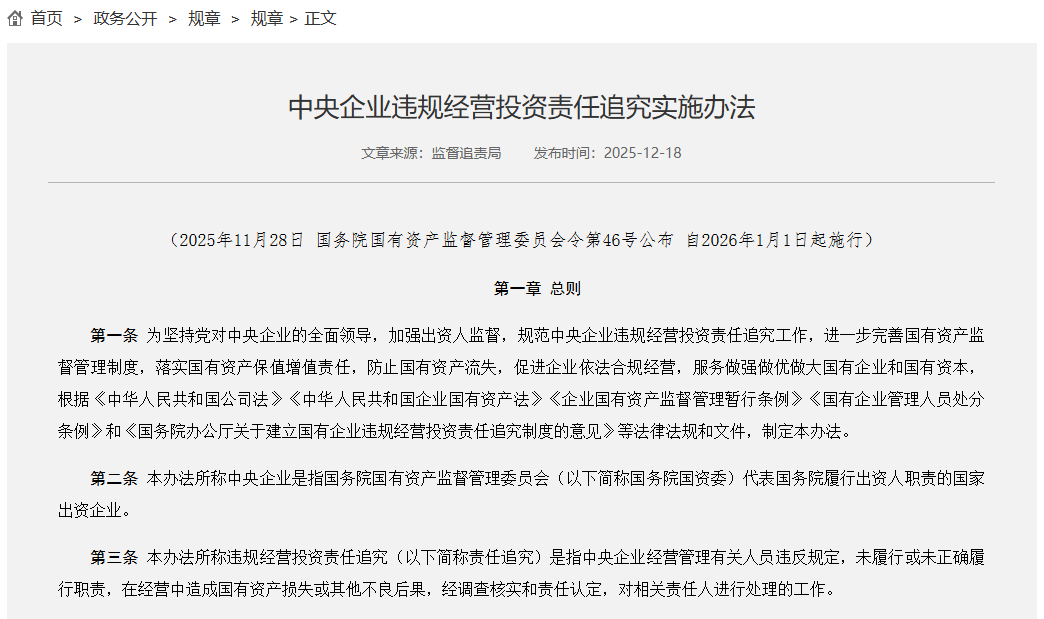
中央企业违规经营投资责任追究

Search documents
国务院国资委权威解答!关于《中央企业违规经营投资责任追究实施办法》相关问题的咨询
Xin Lang Cai Jing· 2026-02-05 12:18
Group 1 - The core viewpoint of the article revolves around the guidelines and clarifications provided by the State-owned Assets Supervision and Administration Commission (SASAC) regarding performance evaluation and industry benchmarking for state-owned enterprises [3][26]. - The 2025 version of the "Enterprise Performance Evaluation Standard Values" includes classifications based on the national economic industry classification standard, covering 10 major industry categories, 48 medium categories, and 107 small categories [3][26]. - Enterprises with multiple business segments can select industry standard values based on their main business or use a weighted calculation of multiple main business standard values according to asset proportions [3][26]. Group 2 - The definition of "two ends outside" trade refers to transactions where both the original procurement and final sales occur outside the central enterprise group, aimed at earning price differences [5][28]. - The "Central Enterprises Violating Business Investment Responsibility Pursuit Implementation Measures" outlines responsibilities for higher-level enterprise personnel in cases of significant asset losses or adverse consequences [6][29]. - The "Enterprise State-owned Assets Transaction Supervision and Management Measures" specifies that the conversion of enterprise debt to equity primarily refers to the conversion of financial institution debts into enterprise equity [7][30]. Group 3 - The recent audit report's validity for state-owned enterprise capital and equity ratio determination is defined as an audit report with a benchmark date within the last year [9][31]. - The guidelines state that non-public agreements for state-owned asset transactions must reflect principles of strengthening state asset supervision and safeguarding state asset security [10][33]. - The regulations clarify that state-owned enterprises and their subsidiaries participating in capital increase activities must not provide loans or guarantees to other shareholders [21][43].


事关转包、违规分包等责任追究!国务院国资委发文!
Xin Lang Cai Jing· 2025-12-22 11:20
Core Viewpoint - The State-owned Assets Supervision and Administration Commission (SASAC) has issued the "Implementation Measures for Accountability of Central Enterprises for Violating Business Investment" (Order No. 46), effective from January 1, 2026, which outlines 98 specific accountability scenarios across 13 areas including engineering contracting and fixed asset investment [1][6]. Summary of Key Points Accountability Scope - The measures specify that central enterprise management personnel who violate regulations and fail to fulfill their responsibilities, resulting in state asset losses or other adverse consequences, will be held accountable under 98 specific scenarios across 13 areas [3][9]. Asset Loss and Adverse Consequences - The measures categorize asset loss levels: losses below 5 million yuan are considered general, losses between 5 million and 50 million yuan are classified as significant, and losses above 50 million yuan are deemed major. Adverse consequences are also classified into three categories: general, significant, and major, based on the severity of the violation and its impact [3][9]. Responsibility Identification - The measures delineate responsibility based on job roles into direct, supervisory, and leadership responsibilities. They also outline conditions and procedures for exemption from accountability for compliant business investment activities [4][10]. Accountability Processing - The measures detail six methods for accountability processing, including criticism, organizational handling, salary deductions, restrictions, disciplinary actions, and referrals to disciplinary inspection or judicial authorities. They also specify conditions for increased or reduced penalties and procedures for exemption from penalties [4][10]. Key Changes from Previous Regulations - Compared to the previous Order No. 37, the new measures emphasize five key areas: 1. Enhanced political leadership by the Party over central enterprises. 2. Broader coverage of accountability scenarios, increasing from 72 to 98. 3. Inclusion of compliance exemption clauses to encourage innovation and exploration in strategic emerging industries. 4. Improved coordination between various supervisory mechanisms. 5. Clearer and more standardized accountability procedures [6][12][13][14].
国资委新规明确98种央企违规情形
Xin Lang Cai Jing· 2025-12-21 13:35
Core Viewpoint - The State-owned Assets Supervision and Administration Commission (SASAC) has released the "Implementation Measures for Accountability in Violation of Operating Investments by Central Enterprises," effective from January 1, 2026, to strengthen accountability and responsibility in state-owned enterprises [1][2]. Group 1: Key Provisions of the Measures - The measures specify 98 scenarios of accountability for central enterprise management personnel who violate regulations, leading to losses of state assets or other adverse consequences, covering 13 areas including financial operations, technological innovation, fixed asset investment, and equity investment [1][2]. - Losses are categorized into three levels: general asset losses (below 5 million), larger asset losses (5 million to 50 million), and major asset losses (above 50 million) [1]. - Adverse consequences are classified into three categories: general, larger, and major, corresponding to varying degrees of severity and impact [1]. Group 2: Objectives and Background - The SASAC aims to enhance the effectiveness of accountability in state-owned enterprise regulation, ensuring a stronger awareness of responsibility and constraints in operating investments [2][3]. - The new measures are seen as a crucial step in rectifying issues identified in central inspections and improving the regulatory framework for state-owned assets [2]. - The previous version of the measures, issued in 2018, laid the groundwork for accountability but has been revised to address emerging issues and enhance coverage [2][3]. Group 3: Changes from Previous Regulations - Compared to the previous version, the new measures have expanded the scenarios for accountability from 72 to 98, focusing on common issues faced by enterprises [3]. - The new measures include provisions for compliance exemptions in operational investments, encouraging exploration in strategic emerging industries and technological innovation [3]. - The SASAC plans to continue refining the accountability process to ensure clarity, orderliness, and comprehensive coverage, fostering a culture of responsibility within central enterprises [3].
5000万以上为重大资产损失,国资委新规明确98种央企违规情形
Di Yi Cai Jing· 2025-12-21 05:10
Core Viewpoint - The State-owned Assets Supervision and Administration Commission (SASAC) has released the "Implementation Measures for Accountability of Central Enterprises for Violating Business Investment" (Order No. 46), effective from January 1, 2026, to establish a long-term incentive and accountability mechanism for state-owned enterprises [2] Group 1 - The new measures specify that central enterprise management personnel will be held accountable for causing losses to state assets or other adverse consequences due to violations in 13 areas, including financial operations, technological innovation, fixed asset investment, and equity investment, with a total of 98 specific accountability scenarios [2][4] - Asset loss classifications are defined as follows: losses below 5 million yuan are considered general, losses between 5 million and 50 million yuan are classified as significant, and losses above 50 million yuan are categorized as major [2] - Other adverse consequences are categorized into three levels: general, significant, and major, based on the severity of the violation and its impact on the enterprise, industry, or national level [2] Group 2 - In the financial operations sector, specific violations include engaging in trust, leasing, factoring, and fund operations that do not support the main business, as well as illegal fundraising activities [3] - The SASAC aims to enhance the effectiveness of accountability in state-owned asset supervision, ensuring that central enterprises operate legally and develop in a high-quality manner [3][5] - The new measures build upon the previous Order No. 37, expanding the accountability scenarios from 72 to 98 and emphasizing a problem-oriented approach to cover common issues faced by enterprises [4]

5000万以上为重大资产损失!国资委新规明确98种央企违规情形
Di Yi Cai Jing Zi Xun· 2025-12-21 05:01
Core Viewpoint - The State-owned Assets Supervision and Administration Commission (SASAC) has released the "Implementation Measures for Accountability in Violation of Operating Investments by Central Enterprises," effective from January 1, 2026, to enhance accountability and responsibility in state-owned enterprises [2][3]. Group 1: Accountability Measures - The new measures specify 98 scenarios across 13 categories where management personnel of central enterprises can be held accountable for losses or adverse outcomes related to state assets, including financial operations, technological innovation, fixed asset investments, and equity investments [2][4]. - Losses are categorized as follows: general asset losses below 5 million yuan, significant losses between 5 million and 50 million yuan, and major losses exceeding 50 million yuan [2][4]. Group 2: Financial Business Regulations - In the financial sector, the measures outline six types of violations that will lead to accountability, including improper conduct in trust, leasing, factoring, and fund operations, as well as illegal public deposit absorption and participation in informal lending [3][4]. Group 3: Historical Context and Revisions - The new measures build upon the previous "Implementation Measures for Accountability in Violation of Operating Investments (Trial)" issued in 2018, which had 72 scenarios across 11 categories, now expanded to 98 scenarios [4]. - The revisions were made after extensive consultations with central enterprises, local state-owned asset supervision commissions, and relevant government departments, emphasizing a problem-oriented approach [4]. Group 4: Future Directions - SASAC aims to further refine the accountability process to ensure clarity in responsibilities and procedures, fostering an environment where accountability is emphasized, and high-quality development within central enterprises is promoted [5].

5000万以上为重大资产损失!国资委新规明确98种央企违规情形
第一财经· 2025-12-21 04:51
Core Viewpoint - The article discusses the implementation of the "Implementation Measures for Accountability of Central Enterprises for Violating Business Investment" by the State-owned Assets Supervision and Administration Commission (SASAC), effective from January 1, 2026, aimed at enhancing accountability and responsibility in state-owned enterprises [3][4]. Summary by Sections Accountability Measures - The new measures specify 98 scenarios across 13 categories where central enterprise management personnel can be held accountable for losses or adverse outcomes due to non-compliance with regulations, including areas like financial operations, technological innovation, fixed asset investment, and equity investment [3][5]. - Losses are categorized as follows: general asset losses below 5 million yuan, significant losses between 5 million and 50 million yuan, and major losses exceeding 50 million yuan [4]. Financial Business Regulations - Specific violations in financial operations that will lead to accountability include engaging in trust, leasing, factoring, and fund businesses improperly, as well as illegal fundraising and participation in private lending [4]. Enhancements Over Previous Regulations - Compared to the previous version (No. 37), the new measures have expanded the scope of accountability scenarios from 72 to 98, focusing on common issues faced by enterprises [5]. - The new measures also introduce compliance exemption clauses for due diligence in business investments, encouraging innovation while ensuring accountability [5]. Future Directions - SASAC plans to continue refining the accountability process to ensure it is comprehensive, clear, and effective, fostering an environment where responsibilities are clearly defined and enforced [5].

明确98种情形,国资委加强央企违规经营投资责任追究
Di Yi Cai Jing Zi Xun· 2025-12-21 04:41
Core Viewpoint - The State-owned Assets Supervision and Administration Commission (SASAC) has released the "Implementation Measures for Accountability in Violation of Operating Investments by Central Enterprises," effective from January 1, 2026, to strengthen accountability and responsibility in state-owned enterprises [1][2]. Group 1: Accountability Measures - The new measures specify 98 scenarios across 13 categories where management personnel of central enterprises can be held accountable for losses or adverse outcomes due to non-compliance with regulations [1][3]. - Losses are categorized as follows: general asset losses below 5 million yuan, significant losses between 5 million and 50 million yuan, and major losses exceeding 50 million yuan [1]. Group 2: Financial Business Regulations - In the financial sector, specific violations include engaging in trust, leasing, factoring, and fund businesses contrary to regulations, as well as illegal public deposit absorption and participation in private lending [1]. Group 3: Enhancements Over Previous Regulations - Compared to the previous version (No. 37), the new measures have expanded the accountability scenarios from 72 to 98, focusing on common issues faced by enterprises [3]. - The new measures also introduce compliance exemption clauses to encourage exploration in strategic emerging industries and technological innovation while ensuring accountability [3]. Group 4: Future Directions - SASAC aims to enhance the standardization, precision, and legality of accountability work, creating a clear and orderly mechanism that promotes high-quality development within central enterprises [2][3].
国务院国资委加强中央企业违规经营投资责任追究
Zheng Quan Ri Bao· 2025-12-18 15:43
Core Viewpoint - The State-owned Assets Supervision and Administration Commission (SASAC) has released the "Implementation Measures for Accountability of Central Enterprises for Violating Business Investment" (Order No. 46), which outlines specific accountability scenarios for central enterprises that cause losses to state assets or other adverse consequences due to non-compliance with regulations [1][2]. Group 1: Accountability Framework - The new measures expand the accountability scenarios from 11 categories and 72 types to 13 categories and 98 types, focusing on common issues faced by enterprises, including financial operations, technological innovation, fixed asset investment, and equity investment [1][2]. - The measures categorize asset loss levels: losses below 5 million yuan are considered general, losses between 5 million and 50 million yuan are classified as significant, and losses above 50 million yuan are deemed major [2]. - Other adverse consequences are classified into three categories: general, significant, and major, based on the severity of the violation and its impact on the enterprise, industry, or society [2]. Group 2: Legal and Compliance Aspects - The accountability for violations is divided into direct responsibility, supervisory responsibility, and leadership responsibility based on job duties [2]. - There are provisions for exemption from liability if the enterprise operates in compliance with laws, fulfills fiduciary duties, does not seek illegal benefits, and does not cause major asset losses or adverse consequences [2][3]. - The SASAC emphasizes the importance of a structured accountability mechanism to enhance the supervision of state assets and prevent their loss, promoting a culture of responsibility within central enterprises [3].
央企经营投资“红线”明确!这些违规情形将追责
Zhong Guo Zheng Quan Bao· 2025-12-18 15:32
Core Viewpoint - The State-owned Assets Supervision and Administration Commission (SASAC) has released the "Implementation Measures for Accountability of Central Enterprises for Violating Business Investment," which outlines specific accountability scenarios for management personnel in central enterprises that lead to losses of state-owned assets or other adverse consequences [1][2]. Group 1: Accountability Scenarios - The number of accountability scenarios has increased from 72 to 98, covering 13 areas including group control, risk management, procurement management, project contracting, financial business, technological innovation, fund management, property rights management, fixed asset investment, equity investment, restructuring, overseas investment, and other accountability scenarios [2][3]. - The new measures emphasize a problem-oriented approach, enhancing the coverage of accountability scenarios to address common issues faced by enterprises, such as improper management structures and violations of subcontracting regulations [3]. Group 2: Responsibility Classification and Consequences - The measures classify asset loss into three categories: general asset loss (below 5 million yuan), significant asset loss (5 million to 50 million yuan), and major asset loss (above 50 million yuan) [4]. - Other adverse consequences are categorized into general, significant, and major, based on the severity of the violation and its impact on the enterprise, industry, or national level [4]. - Responsibility for violations is divided into direct, supervisory, and leadership responsibilities, with conditions for exemption from accountability specified for compliance in strategic innovation and restructuring [4]. Group 3: Enforcement and Compliance - The accountability measures include six types of disciplinary actions, such as criticism, organizational handling, salary deductions, restrictions, and referrals to disciplinary inspection or judicial authorities [4]. - The measures also establish a lifetime accountability for major decisions, ensuring that accountability persists even after personnel retire or leave their positions [4]. - The SASAC aims to create a clear and standardized accountability mechanism that promotes high-quality development of central enterprises within a legal and compliant framework [6].
事关央企违规经营投资 国务院国资委明确
Shang Hai Zheng Quan Bao· 2025-12-18 14:02
Core Viewpoint - The State-owned Assets Supervision and Administration Commission (SASAC) has released the "Implementation Measures for Accountability in Violation of Business Investment by Central Enterprises," which outlines specific accountability measures for various types of violations in central enterprises [1][3]. Group 1: Accountability Measures - The measures consist of 8 chapters and 91 articles, detailing 98 types of accountability scenarios across 13 areas, including group control, risk management, procurement, engineering construction, financial operations, technological innovation, fund management, property management, fixed asset investment, equity investment, restructuring, overseas investment, and other scenarios [3]. - Asset loss classifications are defined as follows: losses under 5 million yuan are considered general, losses between 5 million and 50 million yuan are classified as significant, and losses over 50 million yuan are categorized as major [3]. Group 2: Specific Violations - In financial operations, violations include failing to follow decision-making and review procedures for investments in financial institutions, engaging in unauthorized financial activities, and illegally absorbing public deposits [4]. - In technological innovation, violations encompass the sale or procurement of counterfeit products, falsifying progress on innovation tasks, and misreporting R&D expenditures [4]. - Fund management violations include breaching decision-making and approval processes for fund usage, unauthorized fundraising, and financial mismanagement leading to fund misappropriation [4]. - In equity investment, violations involve inadequate due diligence, improper financial audits, and failure to exercise shareholder rights after significant changes [4]. Group 3: Risk Management and Future Steps - Risk management violations include failing to implement compliance management and internal control systems, leading to significant deficiencies in risk management [5]. - SASAC plans to enhance the accountability framework to ensure comprehensive coverage, clear responsibilities, and orderly processes, promoting a culture of accountability within central enterprises [5]. - The new measures will take effect on January 1, 2026 [6].