产业AI

Search documents
广联达(002410) - 002410广联达投资者关系管理信息20260324
2026-03-24 10:14
Financial Performance - In 2025, the company achieved a revenue of CNY 6.068 billion, a year-on-year decrease of 2.17% [2] - Net profit attributable to shareholders reached CNY 405 million, a significant increase of 61.77% year-on-year [2] - Total expenses decreased by 5.63% compared to 2024, amounting to a reduction of CNY 273 million [3] Business Segments Digital Cost Business - Revenue was CNY 4.779 billion, down 4.16% year-on-year, with new cloud contracts totaling CNY 3.38 billion, a decline of 1.3% [3] - The segment is adapting to industry changes, focusing on high-quality bidding and cost control [3] Digital Construction Business - Revenue increased to CNY 846 million, a growth of 7.58% year-on-year, with gross margin rising from 35.87% to 58.33% [3] - The growth is attributed to better resource allocation and a focus on core markets and clients [3] Digital Design Business - Revenue was CNY 71.17 million, a decline of 21.04% year-on-year, with a focus on improving product value and establishing benchmarks [4] Overseas Business - Revenue reached CNY 240 million, a growth of 18.18% year-on-year, with a focus on expanding in Asia and Europe [4] Strategic Outlook - The company aims to solidify its existing business while expanding into new areas, targeting revenue and profit growth in 2026 [6] - Key strategies include enhancing cost management, refining construction processes, and integrating AI into operations [6] AI Integration - The company is focusing on integrating AI into its products, with a goal of enhancing efficiency and creating new revenue streams [10] - AI applications are being developed across various business segments, aiming for significant value upgrades in the next 2-3 years [10] Market Trends - The construction industry is shifting from expansion to quality improvement, with a growing emphasis on urban renewal and infrastructure [5] - The introduction of new pricing policies is expected to drive demand for the company's products, particularly in the digital cost segment [8] Financial Metrics - Operating costs decreased by 11.84%, while management expenses fell by 12.96% due to improved efficiency [7] - Cash flow from operating activities saw a decrease, primarily due to reduced loan recoveries [7] Future Business Models - The company is exploring new business models, including WAAS and RAAS, to adapt to changing market demands [13] - The focus will be on leveraging AI capabilities to enhance service delivery and meet diverse customer needs [15]

AI除幻第一股诞生,高瓴君联赚疯,这家公司,押中OpenClaw万亿美元赛道
3 6 Ke· 2026-02-26 04:10
Core Viewpoint - The article highlights the emergence of Haizhi Technology as a leader in the AI sector, emphasizing its focus on process automation rather than merely conversational AI, aligning with the broader industry trend towards automation in business processes [1][2]. Group 1: Haizhi Technology's Market Position - Haizhi Technology achieved an unprecedented oversubscription of 4068 times during its IPO, marking it as the "subscription king" of the Hong Kong stock market for the year 2026 [1]. - The company is recognized as the "first stock to dispel AI illusions," focusing on practical applications of AI that enhance operational efficiency [2]. - Institutional investors, including Hillhouse Capital and Junlian Capital, have shown strong interest in Haizhi Technology, indicating a shift towards rational investment in AI [1]. Group 2: Industry Trends and Predictions - The article discusses the rise of the Agent industry, with OpenClaw signaling the beginning of a new era for personalized agents, which are expected to replace traditional app stores [3][4]. - There is a consensus that future applications will be dominated by agents, with predictions that 80% of current apps may become obsolete due to new agent service architectures [8]. - The article argues that the notion of "everyone having an agent" is misleading, as the true goal of industrial AI is process automation rather than individual assistance [9]. Group 3: AI in Business Processes - The core value of AI in enterprises lies in its ability to automate processes, ensuring compliance and efficiency, rather than merely providing conversational capabilities [10][12]. - The article emphasizes that AI's role in businesses will shift from being a tool for individual tasks to managing entire workflows autonomously [16][19]. - Future business operations will see AI taking the lead in process execution, with human roles evolving to support and optimize AI systems [29]. Group 4: Challenges and Future Directions - The article outlines two phases of industrial AI development: the initial phase focused on fine-tuning large models and the current phase centered on building agents, both facing significant challenges [30][35]. - Many enterprises are moving away from simplistic AI applications and are seeking more integrated solutions that understand their unique operational environments [39][40]. - The future of industrial AI will depend on establishing a robust knowledge system that connects data, computation, and processes, termed "AI Ready," which is crucial for enhancing efficiency [41][59].


产研“双向奔赴” 全产业AI“破壁生长”
Xin Lang Cai Jing· 2026-02-03 19:46
Core Insights - The integration of artificial intelligence (AI) with various industries is seen as a strategic engine for driving industrial upgrades and shaping new competitive advantages for the country [1][2] - The current phase of AI technology transitioning from laboratory to large-scale industrial application is critical, with a focus on overcoming the "last mile" challenge of value creation [1][2] - A recent seminar highlighted the importance of deep integration between AI and industry, discussing practical paths and future directions for AI to drive the transformation and upgrading of China's real economy [1][2] Policy and Market Context - The "AI + Industry Development" initiative has entered a golden period due to overlapping policy benefits and market demand, with clear roadmaps established by government directives [2] - The State Council's policies emphasize the importance of AI in industrial development, marking it as a core task for future growth [2] Challenges in AI and Industry Integration - Four major challenges were identified in the integration of AI with industry: 1. Mismatch between the speed of AI technology development and actual industrial needs [3] 2. Data silos preventing efficient data flow and value creation [3] 3. Discrepancy between the demand for intelligent solutions and the services available in the market [3] 4. Difficulty in forming sustainable business models due to many AI technologies remaining at the conceptual stage [3] Development of Industry-Specific AI Models - The emergence of industry-specific AI models, such as "Wanlian Moer," aims to address the unique needs of various sectors by integrating comprehensive industry knowledge and decision-making processes [4][5] - These models are designed to provide tailored solutions across multiple industries, breaking the limitations of generic and vertical AI models [4][5] Innovations and Features of Wanlian Moer - Wanlian Moer has launched over 20 intelligent agents and is developing more than 100 functions, covering the entire business chain from R&D to management [5][6] - A notable feature includes the ability to generate visual representations of complex data, enhancing decision-making efficiency [6] - The model boasts an accuracy rate of over 90% in answering industry-related questions, positioning it as a leader in the field [6] Future Directions and Collaborative Efforts - The establishment of the "Industrial Artificial Intelligence Research and Application Expert Committee" aims to promote the development and application of industry AI models [6] - Experts emphasize the need for AI applications to be driven by real-world scenarios, advocating for a shift from reactive to proactive AI systems [7][8] - The future of AI in industry will depend on creating replicable, profitable, and sustainable AI paradigms that effectively integrate industry knowledge and capabilities [7][8]
中国十大AI巨头,阿里领衔,BAT之外还有谁?
Sou Hu Cai Jing· 2025-12-20 23:38
Core Insights - China has emerged as the most innovative market globally, particularly with the launch of the Sci-Tech Innovation Board, which has unleashed the potential of innovation-driven companies in AI and IoT [1][19] - Major technology giants are shifting their strategic focus towards AI and IoT, leading to widespread applications of AI across various sectors such as urban management, security, finance, manufacturing, and healthcare [1][19] Company Summaries Alibaba - Alibaba's market capitalization is $449.2 billion (approximately ¥3.17 trillion), making it the largest listed company in Asia [2][20] - The company has transformed from a pure e-commerce giant to a technology innovation enterprise, leading in IoT, cloud services, and AI applications [2][20] - At the Hangzhou Cloud Conference, Alibaba announced that its AI is called over 1 trillion times daily, serving 1 billion people globally, processing 1 billion images, 1.2 million hours of video, 550,000 hours of voice, and 500 billion natural language sentences [2][20] Tencent - Tencent's market capitalization is HK$3.047 trillion (approximately ¥2.75 trillion) [5][23] - The company has initiated a strategic upgrade focusing on cloud and smart industries, aiming to assist various sectors in digital transformation [5][23] - Tencent AI has been applied in over a hundred industries, including education, retail, industrial, government finance, and healthcare, enhancing efficiency and accuracy in areas like smart healthcare [7][25] Huawei - Huawei's estimated market value is ¥1.78 trillion, supported by significant R&D investments totaling nearly ¥500 billion over the past decade [8][26] - The company envisions a future of interconnected and intelligent devices, leveraging 5G and AI technologies to create a vast ecosystem [8][26] - Huawei plans to invest $1.5 billion over the next five years to develop its industrial ecosystem and continue advancing its AI capabilities [8][26] Ant Group - Ant Group, part of Alibaba, is valued at $160 billion (approximately ¥1.13 trillion), making it the largest unicorn globally [9][27] - The company integrates AI into financial services, enhancing accessibility and efficiency in financial technology [9][27] - Ant Group's intelligent platforms support extensive data processing capabilities, significantly improving risk assessment and credit rating applications [9][27] ByteDance - ByteDance is valued at $75 billion (approximately ¥530 billion), making it one of the most valuable unicorns after Ant Group [10][28] - The company has successfully utilized AI algorithms to drive its information flow products, establishing a strong position against major competitors [10][28] Industrial Fulian (Foxconn) - Industrial Fulian has a market capitalization of ¥321.3 billion and is transitioning towards smart manufacturing and industrial internet [11][29] - The company has implemented over 80,000 robots, significantly reducing labor costs and increasing production efficiency [11][29] Hikvision - Hikvision's market capitalization is ¥297.4 billion, leading the smart security industry with substantial revenue growth from ¥3.6 billion in 2010 to ¥49.8 billion in 2018 [12][30] - The company has integrated AI into its products, enhancing capabilities in data collection and analysis [12][30] - Hikvision's innovative business segments, including smart home and robotics, have shown rapid growth, contributing to its long-term development [13][31] Baidu - Baidu's market capitalization is $36.1 billion (approximately ¥255.3 billion) and is recognized as an early adopter of AI technology among the major internet companies [14][32] - The company has developed a comprehensive deep learning platform, serving over 1.5 million developers and facilitating AI applications across various industries [14][32] Xiaomi - Xiaomi's market capitalization is HK$216.3 billion (approximately ¥195.1 billion), recognized as one of the fastest-growing tech companies globally [15][33] - The company has launched a dual strategy focusing on smartphones and AIoT, with significant growth in its IoT platform, connecting over 196 million devices [15][33] DJI - DJI is valued at $24 billion (approximately ¥169.7 billion) and is a leading player in consumer technology, particularly in the drone industry [16][34] - The company has expanded its applications of AI in various sectors, including agriculture and construction, enhancing operational efficiency [16][34] Industry Trends - The AI sector is experiencing unprecedented growth, with significant investments from technology giants, leading to rapid advancements and widespread adoption [17][35] - China's vast user base, data resources, and application scenarios are propelling the development of AI, positioning Chinese tech companies as leaders in the global market [18][36]


产业互联网千峰奖揭晓,欧冶云商入选深度价值链60强
Xin Lang Cai Jing· 2025-12-18 14:24
Core Insights - The article highlights that Ouyeyunshang has been recognized in the "Deep Value Chain Top 60" at the 2025 Yibang Industry Internet Annual Conference for its continuous efforts in digitalization and innovation within the steel industry [1][8]. Group 1: Event Overview - The 2025 Yibang Industry Internet Annual Conference was held with the theme "Unlocking New Cycles," gathering over 600 executives, investors, and experts to discuss key topics such as artificial intelligence, supply chain upgrades, and platform innovation [5][12]. - The selection of the Qianfeng Award is particularly noteworthy as the industry internet transitions to a phase focused on "verifiable and sustainable value" [5][12]. Group 2: Ouyeyunshang's Achievements - Ouyeyunshang has been recognized for its focus on user needs, optimization of channel networks, and enhancement of digital technology applications, particularly in energy service innovation [5][12]. - The evaluation committee noted Ouyeyunshang's significant achievements in enabling precise matching, safety, controllability, and green low-carbon initiatives within the steel supply chain [5][12]. Group 3: Qianfeng Award Details - The Qianfeng Award, initiated by Yibang Power in 2019, selects companies with long-term value and scalability potential from an investor's perspective [5][12]. - The 2025 evaluation committee included nearly 60% participation from state-owned funds, ensuring professionalism and fairness through a multi-step selection process [5][12]. Group 4: Future Directions - Ouyeyunshang aims to continue focusing on value creation and deepening the integration of digital technology in supply chain scenarios to support high-quality and sustainable development in the steel industry [6][13]. - The company is positioned to expand the depth and breadth of the industrial internet through technological empowerment, model innovation, and ecosystem co-construction [6][13].

低调霸榜全球最难SQL榜单超两月,国产AI这次选择高调开源!
量子位· 2025-12-14 07:12
Core Viewpoint - Ant Group's AI division, Ant Financial Technology, has made significant strides in the AI data analysis field, recently achieving top rankings in global SQL benchmarks and announcing the open-source release of its Agentar-SQL series, which includes comprehensive frameworks for real-time text-to-SQL conversion and other data capabilities [2][4][5]. Group 1: Achievements and Innovations - Ant Group's Agentar-Scale-SQL achieved a dual first-place ranking in the BIRD benchmark with an execution accuracy of 81.67% and execution efficiency of 77% [5]. - The average query accuracy of Ant Group's Agentar SQL tools exceeded 92% during a trial with a major city commercial bank, representing over a threefold improvement compared to traditional query methods [7]. - Ant Group's AI solutions have been adopted by 100% of state-owned commercial banks and over 60% of local commercial banks in China, indicating a strong market presence [18]. Group 2: Strategic Focus and Market Approach - Ant Group's CEO emphasized that the true value of AI lies in its ability to address real-world industry challenges rather than just technological advancement [9]. - The company has adopted a unique "pay-for-performance" model, reducing the barriers for small and medium-sized institutions to implement AI by allowing them to pay based on tangible business outcomes [42][43]. - Ant Group has established deep partnerships with 300 collaborators, serving over 13,000 end customers, and has upgraded its "Xinglan Plan" to enhance partner capabilities across various dimensions [45][47]. Group 3: Broader Applications and Future Directions - The AI methodologies developed in the financial sector are being adapted for broader applications, such as in public transportation and energy sectors, showcasing the versatility of Ant Group's AI capabilities [27][30][37]. - Ant Group's AI solutions have gained international recognition, serving over a hundred overseas financial institutions and being selected for the Hong Kong Monetary Authority's generative AI sandbox project [48][49]. - The company is positioned as a leader in the AI industry, with its technology being recognized for its robustness and applicability in various sectors beyond finance [20].

蚂蚁数科升级“星澜计划”,携手300家合作伙伴加速AI产业落地
Jin Rong Jie· 2025-12-11 07:21
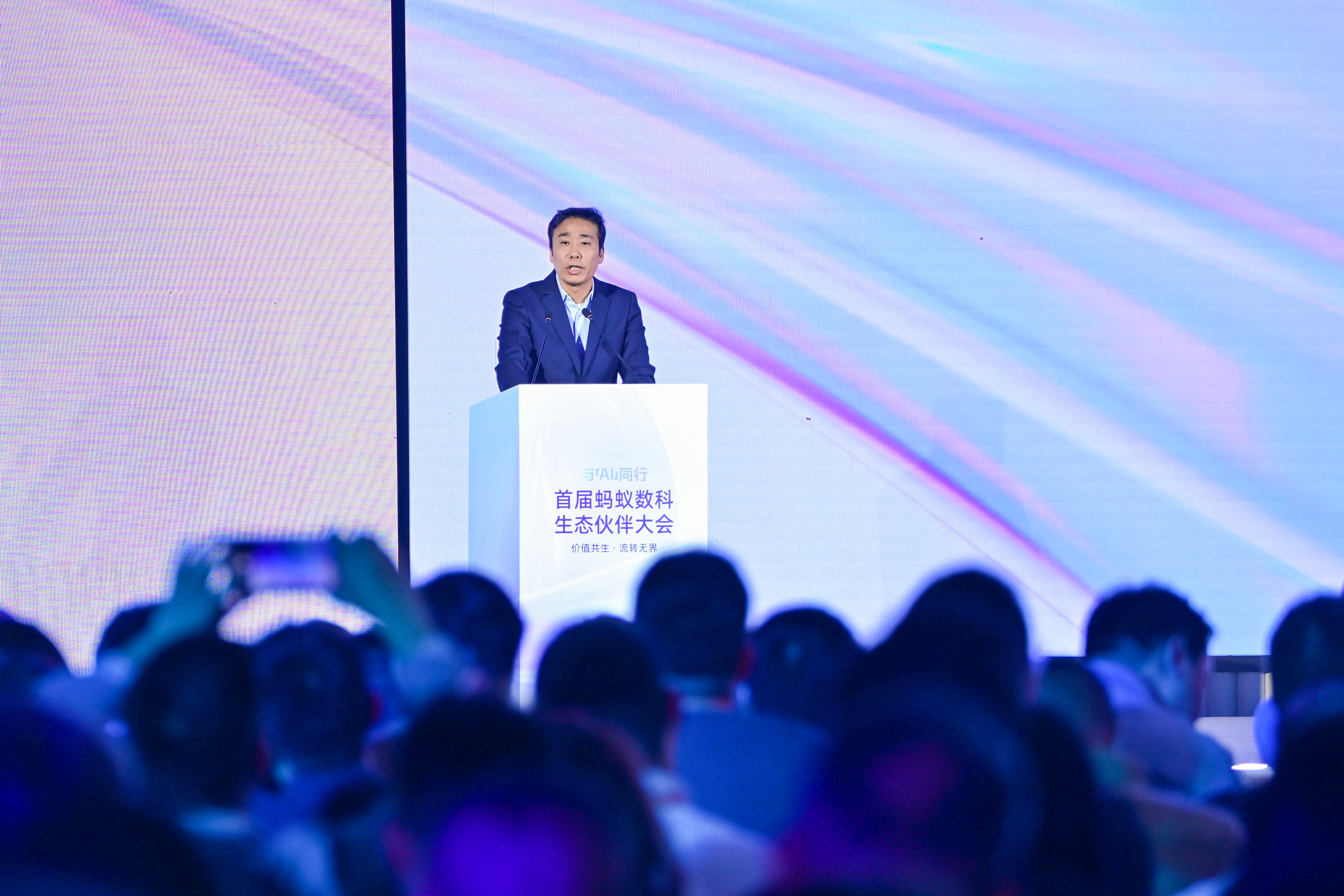
Core Insights - The true value of AI lies not only in its advanced technology but also in its ability to address real-world problems in various industries, as emphasized by Ant Group's CEO Zhao Wenbiao at the Ecological Partner Conference [1] Group 1: AI Implementation and Industry Focus - Ant Group has focused on "technology landing" over the past year, successfully integrating AI into real business scenarios across key sectors such as finance, energy, transportation, and manufacturing, collaborating with nearly 20 leading partners to launch over 100 intelligent joint solutions [4] - The company has strategically targeted the financial sector, which has the highest data thresholds and compliance requirements, becoming the preferred partner for AI transformation in this industry, covering 100% of state-owned joint-stock banks and over 60% of local commercial banks [5] - The collaboration with Ningbo Bank has led to the development of an intelligent decision-making system that significantly improved the accuracy of complex problem responses from 68% to 91%, with response times reduced to milliseconds [5] Group 2: Technological Innovations and Applications - The AI mobile banking application launched by Shanghai Bank, powered by Ant Group's technology, allows users to perform high-frequency transactions through natural language interactions, marking a significant shift in user experience [6] - Ant Group's AI capabilities have extended beyond finance to public services, exemplified by the "Little Blue Whale" intelligent bus system in Nanjing, which has optimized public transport scheduling and improved operational efficiency [7][8] - The EnergyTS model released in March has enabled large-scale applications in the energy sector, enhancing investment decision efficiency by over 60 times and improving operational and trading outcomes by more than 10% [9] Group 3: Comprehensive Technology and Global Expansion - Ant Group has developed a full-stack product matrix focusing on business growth, user experience, and risk management, validated by its performance in global benchmarks [9] - The company has been recognized as a leader in the IDC MarketScape for its comprehensive technology capabilities and deep experience in the financial sector, and it is expanding its AI solutions globally [10] - The "Star Plan" launched by Ant Group aims to enhance partner capabilities across four dimensions, fostering a collaborative ecosystem to drive the large-scale implementation of industrial AI [11][14]
2025产业互联网发展报告
Sou Hu Cai Jing· 2025-12-05 14:14
Core Insights - The 2025 Industrial Internet Development Report indicates that the industrial internet is entering a growth phase characterized by large-scale value creation, with a focus on industrial AI, deep value chains, and international expansion as key transformative directions [1][7]. Group 1: Annual Progress of the Industrial Internet - The industrial internet is transitioning from a capital-closed effect phase to a growth phase driven by large-scale value creation, with industrial AI, international expansion, and deep supply chains as critical keys to unlocking this new cycle [7]. - Nearly 80% of enterprises are experiencing growth, with a notable trend where the number of profitable companies exceeds those with revenue growth [17][21]. - The software and information technology sector accounts for 39% of the industrial internet landscape, highlighting its foundational role in driving digital transformation [10]. Group 2: Capital Market Trends - The capital market is witnessing a surge in investment in embodied intelligence, with state-owned funds becoming significant partners, focusing on industrial collaboration and regional economic contributions [1][24]. - In 2025, over 70 investment events were recorded in the industrial internet sector, with embodied intelligence receiving more than 63% of the total funding, indicating a strong market interest in this area [25][27]. - State-owned capital is increasingly becoming a crucial funding source, covering key areas such as digital supply chains and industrial digital technology, thus promoting regional digitalization and cluster development [27][29]. Group 3: Policy Trends and Practices - The policy focus is shifting from "cloud adoption" to "AI+", emphasizing the value of data assetization and prioritizing industrial e-commerce as a key area [1]. - The report highlights a significant trend towards the integration of AI in operational processes, with companies increasingly adopting AI technologies across various business functions [42][43]. Group 4: New Models and Cases - The report outlines that over 50% of enterprises are investing in AI innovation, while 74% are focused on restructuring their value chains through digital platforms [32]. - Various companies are actively pursuing international expansion, leveraging digital infrastructure and localized operations to tap into global markets [38][39]. - The application of AI technologies is becoming a core component of business processes, enhancing efficiency and decision-making across supply chains and operational workflows [42][43].

三战IPO!80后川大系实控人带着“AI独角兽”又出手了……
Sou Hu Cai Jing· 2025-11-28 09:51
Core Viewpoint - Nobikang, an AI technology company, is making its third attempt to list on the Hong Kong Stock Exchange, with significant attention from the capital market due to its solid financial performance and the backing of leading investment bank CICC [2][4]. Company Overview - Founded by Liao Yu, Nobikang has faced a challenging path to IPO, having submitted three applications, with the first two failing due to market conditions and profitability concerns [2]. - The company has shown consistent profitability, reporting revenue of 232 million yuan and a net profit of 40 million yuan in the first half of 2025, continuing a three-year trend of profitability [2][8]. Financial Performance - Nobikang's revenue is projected to grow from 253 million yuan in 2022 to 400 million yuan in 2024, with profits increasing from 63.16 million yuan to 115 million yuan during the same period, maintaining a profit margin between 25% and 29% [8][9]. - The company achieved a post-investment valuation of 2.13 billion yuan following its D and D+ round funding, raising a total of 1.3 billion yuan [2]. Market Position and Strategy - Nobikang differentiates itself by focusing on infrastructure sectors such as transportation and energy, rather than following the trend of high-cost consumer AI applications [5][9]. - The AI+ transportation solutions market in China reached 238.4 billion yuan in 2023, with a projected compound annual growth rate (CAGR) of 17.7% through 2028, while the AI+ energy solutions market is expected to grow from 500 billion yuan to 1.1 trillion yuan, with a CAGR of 19% [5]. Competitive Advantages - The company serves over 80% of China's railway bureaus and has become the second-largest provider of AI+ power system detection solutions in China, establishing a competitive barrier through its expertise in high-standard, complex infrastructure environments [9]. Challenges Ahead - Nobikang faces three main challenges: high customer concentration risk, difficulties in expanding into new industries, and the sustainability of its profit growth [10]. - The reliance on a few major clients raises concerns about the stability of its revenue, while the long certification cycles in the infrastructure sector may hinder rapid expansion into other high-value industries [10]. Conclusion - The third attempt at an IPO is seen as having a higher probability of success due to the solid financial fundamentals and strategic market positioning of Nobikang, which aligns with current investor interests in technology-driven companies [10][11].

赛迪顾问报告:预计2025至2027年中国数字建筑产业规模稳步增长
Xin Hua Cai Jing· 2025-10-30 15:00
Core Viewpoint - The digital construction industry in China is expected to grow steadily from 62.04 billion yuan in 2025 to 98.85 billion yuan by 2027, driven by advancements in AI, BIM, and other technologies [1][3]. Group 1: Industry Growth and Technology Integration - The digital construction industry is projected to expand significantly, with AI permeating various stages of the construction lifecycle, enhancing efficiency and cost savings [1][3]. - Technologies such as BIM, cloud computing, big data, and industrial AI are providing robust support for the digital construction industry, broadening application scenarios [3][4]. - The digitalization of planning and design is emerging as a crucial segment, with software solutions evolving to cover the entire construction lifecycle [3][4]. Group 2: Market Dynamics and Future Trends - The construction digitalization market is experiencing growth due to a combination of technological, policy, and demand factors, characterized by refined management and intelligent construction [4][5]. - The report highlights the importance of high-quality data, reliable models, and valuable scenarios in driving the application of industrial AI across various levels of the construction industry [4][5]. - Key players in the BIM software market are emerging, with a focus on enhancing industrial software development and core technology breakthroughs to support the digital transformation of the construction industry [5].