银行数字化转型

Search documents
赞同科技IPO被终止审核!业绩下滑可能是主因,曾申报科创板IPO
梧桐树下V· 2026-03-01 05:59
文/西风 2月27日,北交所公布对赞同科技北交所IPO终止审核的决定,直接原因是公司提交了撤回申请。公司申报北交所IPO于2025年6月30日获得受理,7月28日公布首轮 问询函但一直未见首轮问询的回复。 | 代码 | 874162 | 简称 | 赞同科技 | | --- | --- | --- | --- | | 公司全称 | 赞同科技股份有限公司 | 受理目期 | 2025-06-30 | | 审核状态 | 终止 | 更新日期 | 2026-02-27 | 赞同科技注册地上海市闵行区,成立于 2016 年 6 月 27 日。公司股票于 2025 年 2 月 26 日挂牌新三板,证券代码874162。公司目前注册资本为2.1亿元。公司控股 股东为上海赞优投资咨询有限公司,实际控制人为王宇晖、陈波。 一、银行 IT 解决方案提供商 公司是国内具有较高知名度和影响力的银行 IT 解决方案提供商,助力银行等金融机构数字化转型及开展金融软件自主创新。发行人主要向以银行为主的金融机构 提供软件开发及服务、咨询服务、运维服务等信息化服务。 发行人提供的银行 IT 解决方案(含基础软件平台和应用解决方案)涵盖了智慧网点( ...


Banca Monte dei Paschi di Siena (OTCPK:BMDP.F) Update / briefing Transcript
2026-02-27 09:02
Summary of Banca Monte dei Paschi di Siena (MPS) Conference Call - February 27, 2026 Company Overview - **Company**: Banca Monte dei Paschi di Siena (OTCPK:BMDP.F) - **Industry**: Banking and Financial Services - **Key Event**: Presentation of the MPS Business Plan for 2026-2030 Core Points and Arguments Business Plan and Strategy - The business plan aims to create sustainable value and profitable growth for stakeholders, emphasizing client service as a core principle [2][3] - The integration of MPS and Mediobanca is expected to unlock EUR 700 million in synergies, with a focus on corporate investment banking and high-end private banking [4][5] - The group is projected to achieve revenues of EUR 9.5 billion by 2030, with a cost-income ratio below 40% and net profit reaching EUR 3.7 billion [7][35] Financial Performance and Projections - In 2025, the company surpassed previous targets, achieving EUR 8 billion in revenues and serving over 7 million clients [6][34] - The plan anticipates a compound annual growth rate (CAGR) of 4.6% in operating income from EUR 7.6 billion in 2025 to EUR 9.5 billion in 2030 [35][37] - Adjusted net profit is expected to increase from EUR 2.3 billion in 2025 to EUR 3.7 billion in 2030, with a return on tangible equity (ROTE) of 18% by 2030 [36][37] Revenue Breakdown - Revenue contributions by segment are projected as follows: - Retail and Commercial Banking: 30% - Corporate Investment Banking: 21% - Asset Gathering and Wealth Management: 30% - Private Banking: 14% - Consumer Finance: 19% [10] Technology and Innovation - The company plans to invest EUR 1 billion in IT from 2026 to 2030 to modernize and secure its operations, enhancing customer experience and operational efficiency [12][30] - AI technology is expected to improve productivity and customer service, with 90% of client requests resolved end-to-end [12] Market Position and Competitive Advantage - The merger positions the group as Italy's third-largest bank, with a strong competitive force in the market [6][52] - The integration of Mediobanca's capabilities with MPS's commercial reach is expected to enhance advisory services and create a comprehensive corporate investment banking platform [27][28] Dividend Policy and Shareholder Returns - The plan includes a commitment to distribute approximately EUR 16 billion in dividends between 2026 and 2030, representing over 60% of the market cap [53][51] - A 100% payout ratio is expected, with discussions on potential interim dividends and stock option plans for management [57][60] Important but Overlooked Content - The company emphasizes the importance of retaining and empowering its workforce, with over 1,000 new hires and extensive training programs planned [14][32] - The focus on ESG (Environmental, Social, and Governance) is highlighted as a growth driver, integrating sustainable finance and community engagement into the business model [32] Conclusion - Banca Monte dei Paschi di Siena is positioning itself for significant growth through strategic integration, technological investment, and a strong focus on client service, with ambitious financial targets set for 2030. The commitment to shareholder returns and sustainable practices further enhances its market appeal.
焦点热文:银行动账短信收费模式开启:减扰还是增效
Xin Hua Cai Jing· 2026-02-12 09:26
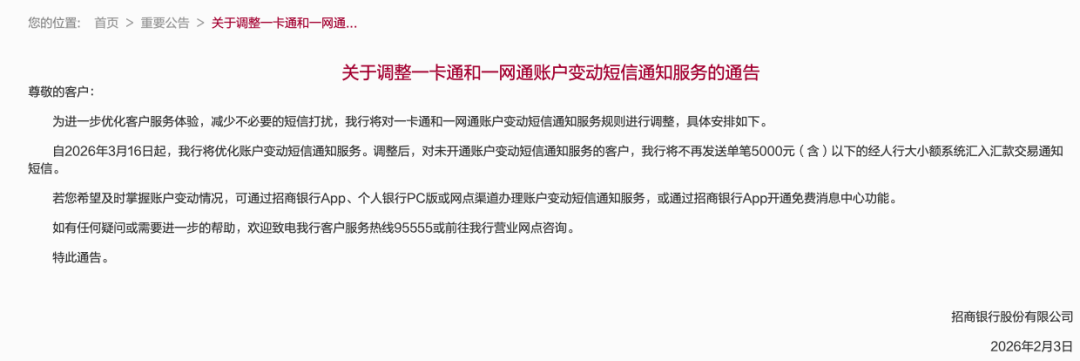
单笔小额动账短信步入付费时代,银行作出调整并非单纯为了增收,而是在息差收窄背景下,为精细管 控运营成本、将有限资源投入更具竞争力业务领域所采取的措施。与此同时,这也折射出银行业正加速 将服务重心转向银行App等数字化渠道的深刻战略转变。一场围绕金融服务效率与成本的变革正悄然上 演。 (资料图 片) 银行调整小额动账短信服务 "您尾号XXX账户完成快捷支付,支出金额9.9元,余额5000元。"曾几何时,此类动账短信是众多消费 者掌握银行账户资金动态的"标配"。但也有不少消费者反馈"每天收到的信息太繁杂",不堪其扰。如 今,招商银行、中信银行等多家银行出手,调整动账短信提醒服务,上调免费动账短信的起点金额。多 家银行表示,此举是为了优化客户服务体验、减少不必要的短信打扰。 意为优化客户服务体验 此次银行调整并非偶然,自2025年以来便有多家银行表示,为优化客户服务体验,调整动账短信通知服 务。中国银行自2025年4月起,对享受终身免费短信动账通知服务的个人客户,调整其账户变动触发短 信通知的默认交易起点金额为100元。如客户确有低于100元的小额交易通知需求,可通过该行网点柜 台、智能柜台、手机银行、个人网上银行 ...

银行动账短信收费模式开启:减扰还是增效?
Zhong Guo Zheng Quan Bao· 2026-02-12 02:45
招商银行表示,若客户希望及时掌握账户变动情况,可通过该行App、个人银行PC版或网点渠道办理账 户变动短信通知服务。记者咨询招商银行客服得知,该行一卡通短信通知服务的收费标准为每月3元, 首次开通的前三个月(含开通当月)免费。按月收费,暂无包年收费方式。 招商银行客服表示,金葵花及以上级别客户、65岁(含)以上老年客户等的短信通知服务免费。招商银 行App动账通知服务也是免费的。除了招商银行,中信银行表示,自2月1日起,个人金融短信通服务全 面升级。对于借记卡,贵宾级(含)以上客户、新市民客户免收服务费。动账短信发送起点金额为300 元,官方微信免费提供0元起点动账提醒服务。 中小银行的步伐紧跟行业趋势。例如,新疆农商银行发布公告称,该行根据业务发展需求等,自4月下 旬起,将调整动账提醒短信起点金额,由0元提高至100元(含)。 "您尾号XXX账户完成快捷支付,支出金额9.9元,余额5000元。"曾几何时,此类动账短信是众多消费 者掌握银行账户资金动态的"标配"。但也有不少消费者反馈"每天收到的信息太繁杂",不堪其扰。如 今,招商银行、中信银行等多家银行出手,调整动账短信提醒服务,上调免费动账短信的起点金额。 ...

银行动账短信收费模式开启:减扰还是增效
Zhong Guo Zheng Quan Bao· 2026-02-11 20:23
Core Viewpoint - Banks are adjusting their transaction notification services by raising the threshold for free SMS alerts, reflecting a strategic shift towards digital channels and cost management in response to narrowing interest margins [1][4]. Group 1: Bank Adjustments - Starting from March 16, 2025, China Merchants Bank will no longer send SMS notifications for transactions below 5,000 yuan, aiming to optimize customer service and reduce unnecessary notifications [1]. - Other banks, such as CITIC Bank and Xinjiang Rural Commercial Bank, are also raising their SMS notification thresholds, with CITIC Bank setting it at 300 yuan and Xinjiang Rural Commercial Bank at 100 yuan [2][3]. Group 2: Customer Experience - Banks are encouraging customers to use their apps and online platforms for transaction notifications, which are offered for free, as a way to enhance customer experience and reduce reliance on SMS [2][3]. - Some customers express discomfort with the transition from free to paid SMS services, while younger customers are less affected as they primarily use mobile banking for account monitoring [3]. Group 3: Industry Trends - The shift from free SMS notifications to a paid model is part of a broader trend in the banking industry towards digital transformation, as banks seek to cut costs and focus on more competitive business areas [4]. - The development of mobile banking and digital channels allows banks to provide a range of services beyond transaction notifications, including account inquiries and online customer service [4].


管控成本、做活App,银行免费动账短信加速“退场”
第一财经· 2026-02-10 14:46
Core Viewpoint - The article discusses the increasing threshold for free transaction SMS notifications by banks, indicating a shift from universal service to tiered offerings due to cost pressures and a push towards digital channels [3][4][10]. Group 1: Changes in SMS Notification Services - Since 2025, multiple banks have raised the minimum amount for free transaction SMS notifications, with China Merchants Bank increasing the threshold to 5000 yuan [3][4]. - Other banks, including China Bank and Minsheng Bank, have also adjusted their thresholds, generally ranging from 100 to 500 yuan for free SMS notifications [5][6]. - Smaller banks, such as Guangxi Pingguo Rural Bank, have set their thresholds at 200 yuan, aligning with the trend towards financial technology [5][6]. Group 2: Cost Implications of SMS Services - The cost of providing free SMS services is significant, with banks incurring substantial expenses due to high customer volumes and frequent usage [6][8]. - For instance, a bank with 100 million customers sending one free SMS per month could face operational costs exceeding 36 million yuan annually [8]. - Banks are now charging fees for SMS notifications, typically around 2 to 3 yuan per month per card, which helps cover the costs of SMS procurement [8][10]. Group 3: Digital Transformation and Customer Engagement - The increase in SMS notification thresholds is not solely driven by cost but also reflects banks' digital transformation strategies [10]. - Banks are encouraging customers to use digital channels like apps and WeChat for notifications, which have lower marginal costs compared to SMS [10][11]. - The shift aims to enhance service efficiency and customer engagement, with a potential future model of "large transactions free, small transactions paid" emerging in the industry [10][11].



管控成本、做活App,银行免费动账短信加速“退场”
Di Yi Cai Jing· 2026-02-10 10:51
Core Viewpoint - The traditional free SMS notification service for bank account transactions is undergoing significant changes, with banks raising the threshold for free notifications, prompting customers to pay for services if they wish to continue receiving them [1][2][6] Group 1: Changes in SMS Notification Services - Starting from March 16, 2025, China Merchants Bank will raise the threshold for free SMS notifications to transactions of 5000 yuan or more, with a monthly fee of 3 yuan for those who wish to continue receiving notifications [2][3] - Other banks, including China Bank and Minsheng Bank, have also increased their thresholds for free SMS notifications, with ranges between 100 yuan and 500 yuan [3][4] - Smaller banks, such as Guangxi Pingguo National Village Bank, have set their thresholds at 200 yuan, indicating a trend towards higher thresholds across the industry [2][3] Group 2: Cost Implications - The cost of providing SMS services is significant, with banks paying per message sent, leading to substantial operational costs due to the large customer base [4][5] - For instance, if a bank with 100 million customers sends one free SMS per customer per month at an average cost of 0.03 yuan, the monthly cost would be approximately 3 million yuan, totaling over 36 million yuan annually [5][6] - Banks are adjusting their free SMS thresholds as part of a strategy to manage costs amid narrowing net interest margins, with many banks charging between 2 to 3 yuan per month for SMS services [6][7] Group 3: Digital Transformation and Customer Engagement - The increase in SMS notification thresholds is not solely a cost-saving measure but also aligns with banks' digital transformation strategies, encouraging customers to use digital channels like apps and WeChat for notifications [7][8] - This shift aims to enhance service efficiency and reduce the frequency of SMS notifications, which are considered value-added services rather than mandatory ones [7][8] - Industry experts predict a future trend where large transactions continue to receive free SMS notifications, while small transactions will default to app or WeChat notifications, with paid SMS services available for those who opt for them [8]
天津银行“回A”心病
Xin Lang Cai Jing· 2026-02-09 18:14
Core Viewpoint - Tianjin Bank is facing significant challenges as it approaches its 30th anniversary, particularly regarding its long-delayed A-share listing and the need for performance recovery and digital transformation [1][2][3] A-share Listing Challenges - Tianjin Bank has been attempting to return to the A-share market since 2015 but has faced continuous delays due to the lack of necessary external approvals, making it the only city commercial bank in four direct-controlled municipalities yet to achieve this [2][3] - The bank's A-share listing journey has been complicated by a tightening IPO environment in the A-share market, which has seen no new bank listings since January 2022 [2][4] Financial Performance and Growth - The bank's net profit has fluctuated significantly over the past decade, peaking at 49.16 billion yuan in 2015 before entering a period of decline, with a low of 31.96 billion yuan in 2021, reflecting a 25.8% year-on-year drop [5][6] - As of the end of 2024, Tianjin Bank's net profit rebounded to 38.02 billion yuan, with a 5.47% year-on-year increase in the first three quarters of 2025 [6][7] Asset Scale and Market Position - By the end of Q3 2025, Tianjin Bank's total assets reached 968.9 billion yuan, marking a 4.63% increase from the beginning of the year, but still lagging behind other city commercial banks in direct-controlled municipalities [7][8] Shift in Lending Strategy - The bank has shifted its focus from aggressive personal loan growth to increasing corporate loans, with personal loans dropping to 18.4% of total loans by mid-2025, while corporate loans rose to 75.3% [10][11] - This strategic pivot was a response to rising risks in personal lending, particularly in the consumer loan segment, which saw a significant increase in non-performing loans [10][12] Future Growth and Strategic Initiatives - As it approaches its 30th anniversary, Tianjin Bank is exploring new growth avenues, including entering the consumer finance sector through a partnership with JD.com [13][14] - The bank is also enhancing its governance and digital capabilities to improve operational efficiency and risk management, aiming to better serve the local economy [14][15]
又一位75后行长获批、来自行外引进,具有直销银行、网金等领域经验
Xin Lang Cai Jing· 2026-02-09 05:02
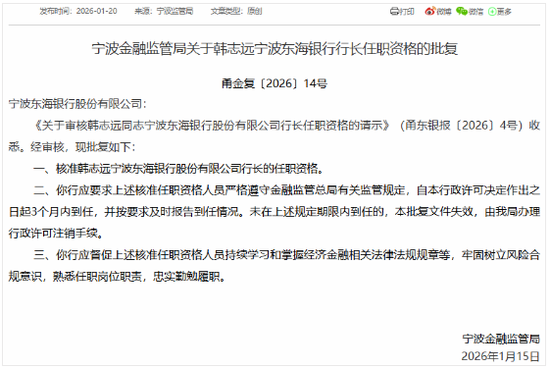
来源:银行科技研究社 作者:薛小易 近日,宁波东海银行新任行长正式就任,其此前为该行通过公开招募引进的副行长,此番系升任行长。 由行外引进的75后副行长升任,具有直销银行、网金等领域经验 1月20日,宁波金融监管局批复显示,韩志远任宁波东海银行行长的任职资格获批。 据《银行科技研究社》了解,韩志远出生于1975年10月,本科学历,硕士学位。曾任东亚银行总行市场 策划部总经理、信用卡中心副总经理、零售及小微部总经理,晋城银行总行产业金融总部总裁、总行投 行委员会委员,中原银行总行网络银行业务总监兼直销银行部总经理,上海华瑞银行数字零售金融业务 总部总监、总行行长助理等职;2022年10月加入宁波东海银行,同年12月起任该行副行长,直至近期升 任行长。 值得注意的是,宁波东海银行曾多次公开招募总行副行长,韩志远即为该行通过公开招募引进的副行 长。 2022年8月,宁波东海银行发布招聘公告,招募总行副行长1名,负责零售金融等条线经营管理工作。要 求其具有一定的银行数字化转型经验,并对于金融科技的应用熟悉;对应聘者的年龄要求为"原则上 1975年1月1日以后出生",以招募发布的时间2022年8月计算,即要求应聘者为4 ...
多家银行上调短信通知起点,最高至5000元
2 1 Shi Ji Jing Ji Bao Dao· 2026-02-06 13:00
Core Viewpoint - The banking industry is tightening cost control measures by increasing the threshold for transaction notification SMS services, with some banks raising the limit to 5000 yuan, marking the beginning of a paid SMS notification era for small transactions [1][2]. Group 1: Changes in SMS Notification Services - Multiple banks, including China Merchants Bank, have announced adjustments to their SMS notification services, with a new threshold of 5000 yuan for free notifications, which is among the highest in the industry [2][3]. - Other banks, such as Minsheng Bank and Bank of China, have also raised their SMS notification thresholds to 300 yuan and 100 yuan respectively, indicating a trend across the banking sector [3][4]. - The adjustments reflect a broader movement among banks to manage operational costs more effectively, particularly in light of the expenses associated with SMS notifications [6][13]. Group 2: Cost Savings and Digital Transition - Banks are expected to save significant costs by reducing the number of SMS notifications sent, as each message incurs a fee from telecom operators [6][9]. - The average cost for SMS services varies, with larger banks typically securing lower rates due to their scale, while smaller banks face higher costs [8][9]. - The shift towards digital notification methods, such as mobile banking apps and WeChat services, is becoming more prevalent, reducing reliance on traditional SMS notifications [12][14]. Group 3: Financial Implications - The banking sector's net interest margin remains stable at 1.42%, with expectations of continued optimization in asset-liability structures and a gradual decline in interest margins [14][15]. - The cost structure for SMS notifications suggests that charging customers around 3 yuan per month can cover operational costs, especially if the average customer receives fewer than 100 notifications monthly [11][10].