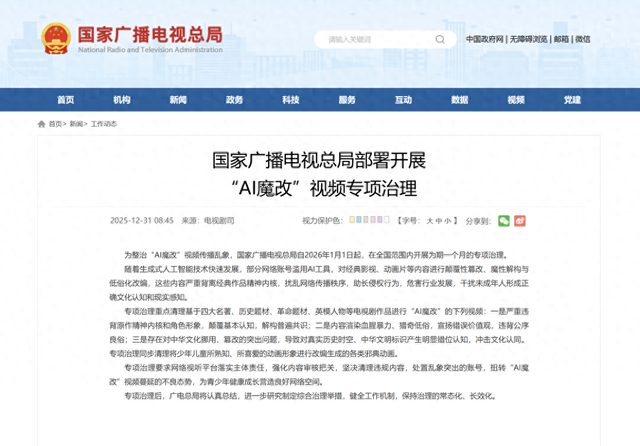
AI魔改

Search documents
锐评|诸葛亮带货?AI魔改不能走火入魔
Xin Lang Cai Jing· 2026-02-25 18:25
Core Viewpoint - The rise of AI-generated parody videos featuring historical figures, such as "Zhuge Liang live-streaming sales," reflects a trend where creators prioritize entertainment and monetization over respect for historical accuracy and cultural integrity [1][3]. Group 1: AI-Generated Content and Its Impact - AI-generated videos are increasingly using historical figures in absurd contexts, creating a stark contrast between serious historical narratives and modern entertainment, which attracts viewer attention [3]. - The focus of creators has shifted from quality content to maximizing views and revenue, leading to a proliferation of bizarre and outrageous portrayals [3]. - A complete operational system for producing and disseminating AI parody videos has emerged, with individuals profiting from teaching others how to create such content [3]. Group 2: Cultural and Educational Concerns - The prevalence of AI-generated content poses risks of copyright infringement and the potential distortion of public cultural memory and historical knowledge [4]. - The trivialization of serious narratives and the commodification of classic figures may weaken respect for history and culture, particularly affecting minors who are still developing their understanding [4]. - Reports indicate that children may take these parody videos seriously, leading to confusion in their understanding of historical facts [4]. Group 3: Regulatory Response - In response to the chaos caused by AI-generated content, the National Radio and Television Administration has initiated a month-long special governance action to enforce content review and platform responsibility [4]. - The governance action aims to curb the rampant production of AI parody videos, emphasizing the critical role of platforms in regulating content and ensuring quality [4]. - As AI technology evolves, platforms are urged to clarify the boundaries of content creation and enhance their oversight capabilities [4].

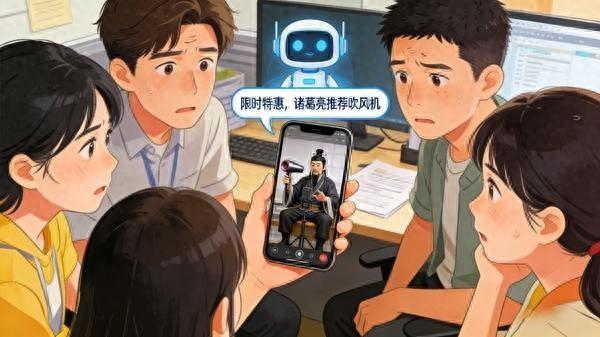
当“诸葛亮”开始直播带货:透视“AI魔改”如何收割流量
Zhong Guo Qing Nian Bao· 2026-02-25 01:38
Core Viewpoint - The rise of "AI magic modification" videos, which distort classic literary and historical figures, has raised concerns about their negative impact on youth, prompting the National Radio and Television Administration to initiate a month-long special governance campaign starting January 1, 2026, to address this issue [1][7]. Group 1: Concerns from Parents and Society - Parents express worries about the "AI magic modification" phenomenon, fearing it may mislead children regarding historical knowledge and cause emotional distress [2]. - Comments from viewers indicate a growing dissatisfaction with the lack of substance in these videos, describing them as "boring" and "unpleasant" after initial novelty wears off [2]. Group 2: Mechanisms of Content Creation and Distribution - The production and dissemination of "AI magic modification" videos have developed into a systematic operation, where creators utilize AI tools to generate content that contrasts sharply with original narratives, aiming to capture viewer attention [3][4]. - The core strategy for creators is to leverage trending topics and create content that features strong contrasts and novelty, which effectively attracts immediate online attention [3][5]. Group 3: Monetization Strategies - The ultimate goal driving the creation of "AI magic modification" content is monetization, with creators relying on view counts for platform subsidies and potential advertising deals as their follower base grows [4][5]. - A growing trend involves teaching others how to create such content, with established creators offering paid courses that cover the entire process from material acquisition to AI generation and editing [4]. Group 4: Regulatory Actions and Industry Response - The National Radio and Television Administration has initiated a special governance campaign to address the spread of "AI magic modification" videos, emphasizing the responsibility of online platforms to manage content safety and direction [6][7]. - As part of the governance efforts, platforms have reported significant actions taken, including the removal of 23,000 related videos and the handling of over 100 accounts for violations, with ongoing commitments to enhance content monitoring and user reporting mechanisms [7].
警惕“AI魔改”给青少年带来认知混淆
Zhong Guo Qing Nian Bao· 2026-02-24 22:31
Core Viewpoint - The rise of "AI magic modification" content on short video platforms raises concerns about cultural heritage, legal boundaries, and technological ethics, highlighting the need for effective governance and legal frameworks [1][2]. Group 1: Legal Risks of AI Magic Modification - "AI magic modification" involves two main types of works: those in the public domain and those still under copyright protection, each presenting different legal risks [1][2]. - Modifying classic works in the public domain can infringe on the author's right to protect the integrity of their work, even after copyright expiration [1]. - Modifying copyrighted works, such as contemporary films, can violate multiple rights including reproduction, adaptation, and integrity rights, complicating legal issues [2]. Group 2: Impact on Youth and Cultural Memory - The realistic nature of AI-generated content can mislead minors, who may struggle to distinguish between fiction and reality, potentially eroding cultural memory and historical facts [3]. - The phenomenon of "AI magic modification" can undermine a nation's cultural confidence by trivializing significant literary and historical works [3]. Group 3: Regulatory and Governance Challenges - Traditional governance frameworks are challenged by the rapid spread and low production barriers of AI-generated content, necessitating new strategies for regulation [4][5]. - Regulatory bodies are actively working to address these challenges, including the implementation of identification measures for AI-generated content [4]. Group 4: Recommendations for Governance - Experts suggest a multi-faceted governance approach involving platforms, regulatory bodies, and industry organizations to create a cooperative system for managing AI content [6]. - There is a call for the development of more intelligent AI recognition systems to handle the volume of content while ensuring necessary human oversight for sensitive topics [5][6]. - The legal framework is deemed sufficient, but effective enforcement and application of existing laws are crucial for balancing innovation and protection of cultural heritage [6][7].
2500亿美元!SpaceX收购xAI;千问App投入30亿开启春节攻势;小鹏全球首款AI汽车正式开启海外大规模发运丨邦早报
创业邦· 2026-02-03 00:09
Group 1 - Qianwen App announced an investment of 3 billion to launch a Spring Festival campaign, integrating with Alibaba's ecosystem including Taobao, Damai, Feizhu, and Hema, set to go live on February 6 [2] - Tencent's internal communication addressed concerns regarding the Yuanbao "Spring Festival Red Packet" sharing, emphasizing that the design allows for "no-threshold" receipt, distinguishing it from malicious marketing practices [3][3] - SpaceX acquired xAI for $250 billion, based on a recent funding round that valued xAI at $230 billion, highlighting the significant financial movements within the AI sector [3] Group 2 - Waymo raised $16 billion in its latest funding round, achieving a valuation of $126 billion, nearly doubling in less than two years, indicating strong investor confidence in autonomous vehicle technology [8] - Snowflake entered a $200 million partnership with OpenAI to integrate advanced AI models into its cloud data platform, reflecting the growing reliance on AI for data insights [9] - Tesla announced the upcoming mass production of its humanoid robot by the end of 2026, with an expected annual output of 1 million units, showcasing advancements in robotics [9] Group 3 - Mercedes-Benz adjusted the suggested retail prices of some models by approximately 10%, aiming to improve cash flow for dealers [15] - Zhijidongli completed a $200 million Series B financing round, with participation from various notable investors, indicating strong interest in the company's growth potential [15] - National Semiconductor's 2nm production capacity has been fully booked, with major tech companies planning to utilize this advanced technology in upcoming products [12]

多平台公布涉“AI魔改”违规视频最终处置结果
Jing Ji Guan Cha Wang· 2026-02-02 11:10
Core Viewpoint - The National Radio and Television Administration will implement a month-long "AI Modification" video governance action starting January 1, 2026, focusing on content modifications related to classic literature, historical themes, revolutionary themes, and model figures [1] Group 1: Governance Action - The "AI Modification" governance action will be conducted nationwide for one month [1] - The action aims to address violations related to the modification of specific types of television content [1] Group 2: Platform Responses - Douyin reported that during the governance period, it processed a total of 6,713 videos related to "AI Modification" violations [1] - Xiaohongshu cleaned up 1,394 pieces of "AI Modification" content and dealt with 61 violating accounts since the start of the governance action [1]
快手将对“AI魔改”视频展开常态化治理
Xin Lang Cai Jing· 2026-02-02 08:22
Core Viewpoint - Kuaishou announced a special governance initiative targeting "AI-modified" videos, set to begin on January 1, 2026, focusing on combating malicious alterations and inappropriate adaptations of classic films and animations [1] Group 1: Governance Initiative - The special governance will last for one month, specifically addressing violations related to the use of AI technology [1] - During the governance period, Kuaishou has already dealt with 5,576 pieces of violating content and issued warnings to 11 accounts [1] - The platform plans to implement ongoing governance measures for "AI-modified" videos following the initial initiative [1]

“魔改”整治正当时
Xin Lang Cai Jing· 2026-01-28 22:02
Core Viewpoint - The National Radio and Television Administration has initiated a one-month "AI Magic Modification" video governance action to regulate AI-generated content based on classic literature and historical themes, marking a significant step in the regulation of AI applications in content creation [1][2] Group 1: Regulatory Actions - The governance action focuses on rectifying AI-modified content related to the Four Great Classical Novels, historical themes, revolutionary subjects, and model figures, with platforms implementing varying degrees of penalties for violations [1] - The initiative aims to provide necessary institutional safeguards for a clear and orderly digital cultural space [1] Group 2: Impact of AI Video Generation - The proliferation of AI video generation technology has lowered creative barriers and sparked creativity, but it has also led to the emergence of a gray area with "AI magic modification" videos [1] - Numerous "second creation tutorials" are available on short video platforms, promoting the idea of easy video creation for significant financial gain, which has resulted in the mass production of "AI magic modification" videos [1] Group 3: Cultural and Ethical Concerns - The production of "magic modification" videos often distorts historical figures, events, and classic literary works, infringing on original creators' intellectual property and undermining the seriousness of cultural transmission and historical accuracy [1][2] - The spread of low-cost, mass-produced "magic modification" content threatens the healthy development of the cultural industry's innovation ecosystem [2] Group 4: Goals and Challenges - The governance action aims to distinguish between fiction and fact, protect intellectual property, and maintain public order and morals [2] - The challenge lies in creating a cooperative ecosystem involving regulatory bodies, platforms, industry self-discipline, ethical design by developers, and enhanced media literacy among the public [2]
魔改就该戴上“紧箍”
Xin Lang Cai Jing· 2026-01-22 22:14
Core Viewpoint - The National Radio and Television Administration has initiated a nationwide "AI Magic Modification" video governance program starting January 1, aimed at addressing concerns over the misuse of AI technology in altering classic literature and historical narratives [1][2]. Group 1: AI Modification Concerns - The initiative targets the disruptive and vulgar reinterpretation of classic works, including the Four Great Classical Novels and historical figures, to establish ethical boundaries for technology application [1]. - Current AI modifications often disregard the original context and character integrity, leading to absurd and confusing representations that deviate significantly from traditional cultural symbols [2][3]. Group 2: Cultural and Ethical Implications - The transformation of cultural heroes through AI should respect their inherent qualities and the collective memory they represent; otherwise, it risks trivializing significant cultural narratives and beliefs [2]. - The rapid production of absurd content through AI technology can desensitize audiences, pushing creative expressions towards more extreme and nonsensical interpretations [2][3]. Group 3: Regulatory Response - The special governance initiative serves as a necessary measure to guide AI technology towards a path of respect and creativity, countering the trend of nihilistic deconstruction of meaningful narratives [3].
多平台公布涉“AI魔改”违规视频第三批处置结果
Jing Ji Guan Cha Wang· 2026-01-22 14:55
Group 1 - The core viewpoint of the article is the initiation of a nationwide "AI modification" video governance action starting January 1, 2026, focusing on the regulation of content based on classic literature, historical themes, revolutionary themes, and model figures [1] Group 2 - Weibo has intercepted and cleared over 60 various types of illegal videos and has imposed temporary to permanent bans on 5 accounts based on the severity of violations [2] - WeChat has processed a total of 1,187 illegal short video contents this week in accordance with national laws and regulations [3] - Douyin has dealt with a total of 2,010 illegal videos related to "AI modification" this week [4] - Baidu has inspected and cleared 195 illegal videos related to "AI modification" and banned 2 accounts from January 16 to January 22 [5] - Kuaishou has processed a total of 1,583 illegal contents this week [6] - Bilibili has strictly intercepted and dealt with over 900 illegal articles related to "AI modification" this week [7]
给“AI魔改”戴上“紧箍咒”
Xin Lang Cai Jing· 2026-01-16 12:56
Core Viewpoint - The article discusses the rise of "AI modified" videos that distort classic literature and historical figures, leading to a crackdown by the National Radio and Television Administration starting January 1, 2026, to address the chaos surrounding their dissemination [1][2]. Group 1: AI Modified Videos and Their Impact - "AI modified" videos are not merely harmless entertainment but involve significant alterations to classic works and historical figures, often resulting in vulgar and violent content [2][5]. - The proliferation of these videos poses three main dangers: undermining the core spirit of classic works, misguiding youth's values, and disrupting the content industry by pushing out original works [5][6]. Group 2: Legal and Regulatory Concerns - The creation of "AI modified" videos may infringe on copyright laws, as significant alterations to protected works require permission from original rights holders [6][9]. - The National Radio and Television Administration's initiative aims to clarify the boundaries between legitimate creative expression and malicious modifications, ensuring that innovation respects historical integrity and promotes positive values [8][10]. Group 3: Industry Response and Future Directions - Major platforms like Douyin, Kuaishou, and Bilibili have reported the removal of numerous "AI modified" videos, indicating a collective effort to maintain content quality and protect cultural heritage [8]. - The ongoing governance efforts are seen as a starting point, with plans for continuous regulation to adapt to the rapid evolution of AI technology in content creation [10].