
Reasoning Models

Search documents
Why Harvey is Using RL Environments
Greylock· 2025-12-09 23:45
Is data a big moat for RV. >> Yeah, I think there's two types of data. And so when we started the company, I think everyone thought of legal data as case law. >> And we've now partnered with Lexus and I think having access to case law and these other data sets is super valuable.But I don't think that is when we think of like the data mode that we think we're going to have as a company. The data that I think is really valuable that I think now people are realizing is valuable is the RLHF data or the reasonin ...


Transformer作者重磅预言:AI无寒冬,推理革命引爆万亿市场
3 6 Ke· 2025-11-14 11:51
Core Insights - The article discusses the ongoing debate in the AI industry regarding the future of large language models (LLMs) and the emergence of reasoning models, highlighting differing opinions among experts [1][4][11]. Group 1: AI Development and Trends - The introduction of reasoning models is seen as a significant breakthrough following the Transformer architecture, which has been influential in AI development since 2017 [3][4]. - Łukasz Kaiser predicts that the next one to two years will see rapid advancements in AI, driven by improvements in GPU and energy resources rather than algorithms [1][17]. - The AI industry is currently engaged in a multi-trillion dollar race towards achieving artificial general intelligence (AGI), with many believing that the combination of LLMs, data, GPUs, and energy will lead to its realization [4][11]. Group 2: Criticism of LLMs - Richard Sutton and Yann LeCun express skepticism about the future of LLMs, suggesting that they have reached a dead end and have not learned from past mistakes [11][13]. - Critics argue that LLMs have inherent limitations in their improvement capabilities, which may be closer than previously thought [13][15]. - François Chollet has initiated the ARC Prize to redirect focus towards more promising paths to AGI, indicating a belief that LLMs are not the right approach [15]. Group 3: Advancements in Reasoning Models - Kaiser counters the notion that LLMs are a dead end, emphasizing that reasoning models require significantly less training data and can accelerate research processes [17][19]. - Reasoning models are capable of self-reflection, dynamic resource allocation, and generating multiple reasoning paths, marking a shift from traditional LLMs [19][23]. - The first reasoning model, o1, has already shown superior performance in reasoning-intensive tasks compared to the strongest general model, GPT-4o [21]. Group 4: Future Directions and Challenges - Kaiser believes that while AI capabilities will continue to grow, there will still be areas where human involvement is irreplaceable, particularly in physical world tasks [27]. - The focus should be on the transformative potential of reasoning models, which can handle specific job tasks effectively and improve overall efficiency [28][30]. - The development of multi-modal training methods is underway, which could significantly enhance AI's understanding of both abstract and physical worlds [40][42].

X @TechCrunch
TechCrunch· 2025-09-02 15:14
Safety Measures - OpenAI plans to route sensitive conversations to reasoning models like GPT-5 [1] - OpenAI will roll out parental controls within the next month [1] Response to Incidents - These actions are in response to recent safety incidents involving ChatGPT failing to detect mental distress [1]
X @The Economist
The Economist· 2025-08-01 06:40
AI Development Focus - Some argue for prioritizing new types of reasoning models in intelligence agencies [1] - Others warn that China might be racing ahead on current AI models [1]
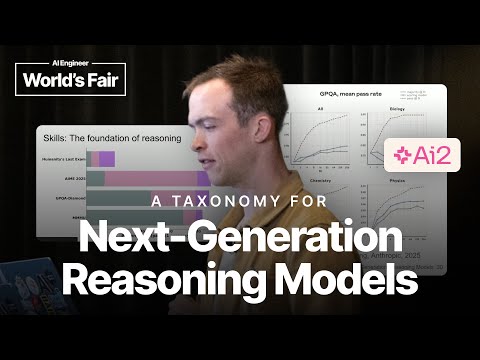
A Taxonomy for Next-gen Reasoning — Nathan Lambert, Allen Institute (AI2) & Interconnects.ai
AI Engineer· 2025-07-19 21:15
Model Reasoning and Applications - Reasoning unlocks new language model applications, exemplified by improved information retrieval [1] - Reasoning models are enhancing applications like website analysis and code assistance, making them more steerable and user-friendly [1] - Reasoning models are pushing the limits of task completion, requiring ongoing effort to determine what models need to continue progress [1] Planning and Training - Planning is a new frontier for language models, requiring a shift in training approaches beyond just reasoning skills [1][2] - The industry needs to develop research plans to train reasoning models that can work autonomously and have meaningful planning capabilities [1] - Calibration is crucial for products, as models tend to overthink, requiring better management of output tokens relative to problem difficulty [1] - Strategy and abstraction are key subsets of planning, enabling models to choose how to break down problems and utilize tools effectively [1] Reinforcement Learning and Compute - Reinforcement learning with verifiable rewards is a core technique, where language models generate completions and receive feedback to update weights [2] - Parallel compute enhances model robustness and exploration, but doesn't solve every problem, indicating a need for balanced approaches [3] - The industry is moving towards considering post-training as a significant portion of compute, potentially reaching parity with pre-training in GPU hours [3]
‘The Nvidia Way’ author Tae Kim: Jensen Huang always positions Nvidia ahead of the next big trend
CNBC Television· 2025-07-11 18:13
Company Performance - Nvidia's revenue has seen a historic ramp, growing from approximately $7 billion per quarter two years ago to $44 billion in just eight quarters [2][3] - The company is generating significant free cash flow and earnings [3] Market Position and Strategy - Nvidia holds a dominant market position in the new AI hardware computing paradigm, similar to leaders in previous computing shifts like PCs, internet, mobile, and cloud [4] - Jensen Wong possesses a unique combination of business acumen and technical expertise, enabling Nvidia to anticipate and position itself ahead of major technology shifts [6] - Nvidia consistently positions itself with the right technology at the right time, exemplified by the transformer engine inside the Hopper GPU released before ChatGPT [7] - Nvidia's Blackwell GPU offers 50 times the inference performance of the previous Hopper GPU, coinciding with a surge in AI computing demand [8] AI Technology and Trends - Reasoning models represent a major advancement in AI, taking minutes to research and provide higher quality answers [8][10][11] - Open AI's weekly active users increased from 300 million to 500 million in just a few months, driven by reasoning models [10] - Anthropic's annual revenue run rate has quadrupled in the last three months, indicating rapid growth in the AI sector [10]

AI's reasoning blind spot
CNBC Television· 2025-06-26 16:26
AI Model Performance & Limitations - AI reasoning models, despite mimicking human reasoning, may break down when pushed beyond narrow tasks, posing a fundamental limitation [3][4] - The current reasoning models cannot generalize, requiring specific specialized models, which falls short of achieving Artificial General Intelligence (AGI) [11] - Progress in AI model pre-training has stalled, raising concerns about the return on investment (ROI) [6][9] Market & Investment Risks - Wall Street is betting that smarter reasoning models will drive demand for compute and infrastructure, benefiting companies like Nvidia [5] - If AI models cannot scale or generalize, investments in AI may not lead to productivity and could become sunk costs [6] - The market may pause investments until a clear return on investment is demonstrated for AI models [10] Company Impact - The limitations of AI reasoning models could impact the entire AI trade, including Nvidia, AMD, and cloud players [8] - Breakthroughs in reasoning could redefine the Microsoft-OpenAI relationship and who controls the future of AI [7] - Reasoning is fueling Zuckerberg's recruiting drive and Jensen Huang's trillion-dollar bull case for physical AI [7]

The AI Boom’s Multi-Billion Dollar Blind Spot
CNBC· 2025-06-25 16:00
AI Reasoning Capabilities & Limitations - The industry initially believed AI reasoning was the next leap towards superintelligence, enabling models to "think" and show their work by breaking problems into steps [3][4] - However, research papers, including one from Apple titled "The Illusion of Thinking," question the promise of reasoning models, suggesting they may only be pattern-matching rather than truly reasoning [7][10] - Apple's research indicates that reasoning models' performance collapses on complex tasks like the Towers of Hanoi puzzle with more than seven discs, achieving zero accuracy [9] - Salesforce terms the current state of AI as "jagged intelligence," highlighting a gap between LLM capabilities and real-world enterprise demands [13] - Research suggests current AI training methods struggle to elicit genuinely novel reasoning abilities, limiting generalization to new, untested scenarios [13][14][15] Investment & Market Implications - The industry has invested heavily in AI, with approximately $2 billion spent, and anticipates significant growth in use cases [2] - The potential failure of reasoning models to scale raises concerns about the return on investment in AI and whether enterprises are overspending [20][25] - If reasoning models prove effective, they would require significantly more compute, potentially extending the infrastructure boom for companies like Nvidia [19] - Discrepancies in AI progress could impact partnerships, such as the one between OpenAI and Microsoft, particularly concerning the definition and control of AGI [29] - The industry's pursuit of superintelligence may be further away than initially anticipated, potentially impacting the timeline and expectations for AGI [16][17][28]

2025年,AI大模型在企业场景走到哪了?
3 6 Ke· 2025-06-20 10:29
Core Insights - The deployment of AI in enterprises has transitioned from experimental projects to strategic actions, with budgets becoming normalized and applications being systematically implemented [2][51] - A16z's report highlights the shift in focus from "whether to try AI" to "how to scale AI deployment" [4][5] Group 1: Budget - AI budgets have significantly exceeded expectations, with an average increase of approximately 75% anticipated for the coming year [10][11] - The proportion of AI spending from innovation budgets has decreased from 25% to 7%, indicating that AI is now considered a core part of IT and business budgets [13] Group 2: Model Selection - The use of multiple models has become mainstream, with 37% of enterprises using five or more models, up from 29% the previous year [15][17] - OpenAI, Google, and Anthropic have emerged as the leading players in the market, with OpenAI maintaining a significant market share [17][18] Group 3: Procurement - The procurement process for AI models is becoming more standardized, with cost sensitivity increasing as a key consideration [27][29] - Trust between enterprises and model vendors has improved, leading to a shift towards direct partnerships with model providers [29][31] Group 4: Application - Enterprises are increasingly moving from self-developed AI solutions to purchasing third-party applications, with over 90% of CIOs testing third-party applications in customer support scenarios [35][42] - Software development has emerged as a leading application area for AI, with significant adoption rates reported [42][45]


NVIDIA (NVDA) 2025 Conference Transcript
2025-06-04 15:52
Summary of NVIDIA (NVDA) 2025 Conference Company Overview - **Company**: NVIDIA (NVDA) - **Event**: BofA Securities Global Technology Conference - **Date**: June 04, 2025 Key Industry Insights - **AI Evolution**: The AI industry is experiencing significant inflection points, with notable moments including the introduction of ChatGPT in 2022 and the recent "DeepSeek moment" in January 2025, which has implications for investors and the future of AI technology [7][12][17]. - **DeepSeek Model**: The DeepSeek model is highlighted as a groundbreaking reasoning model that democratizes AI capabilities. It operates at a cost of $1 per million tokens, generating approximately 13 times more tokens than traditional models, thus expanding the market opportunity for inference [12][17][20]. - **Model Complexity**: DeepSeek has 671 billion parameters, with 38 billion active parameters, showcasing a level of complexity comparable to leading models from OpenAI and Gemini [13][17]. - **Reasoning Capability**: The reasoning models, such as DeepSeek, allow for more complex outputs and better accuracy, with recent updates improving accuracy from 70% to 89% on math benchmarks [19][20]. Competitive Landscape - **NVIDIA's Position**: NVIDIA is positioned as a leader in the AI inference market, focusing on solving complex engineering problems and providing a robust platform for AI development. The company emphasizes the importance of continuous innovation and collaboration with AI companies [41][42][49]. - **Inference Challenges**: Inference is described as a complex task requiring various optimizations, including numerical precision and model distribution across multiple GPUs. NVIDIA's architecture is designed to handle these challenges effectively [44][46][48]. - **Market Dynamics**: The AI factory concept is introduced, where companies invest significantly in AI infrastructure to ensure long-term value creation. NVIDIA's GPUs are integral to these AI factories, which are expected to evolve over the next several years [49][60]. Future Opportunities - **Sovereign AI**: There is a growing trend of nations investing in AI capabilities as a national resource, with approximately 100 AI factories currently being built globally. This represents a significant opportunity for NVIDIA to expand its market presence [70][74]. - **AI Factory Growth**: The demand for AI factories is expected to grow, with investments in data centers and AI capabilities increasing across various regions, including Taiwan, Japan, and Germany [71][74][82]. - **Software Monetization**: NVIDIA is exploring opportunities to monetize its software offerings, including direct engagement with enterprises and providing infrastructure support for data centers [87][90]. Additional Considerations - **CapEx and Power Constraints**: The growth of AI infrastructure may face constraints related to capital expenditures and power availability, which are critical for sustaining the expansion of AI capabilities [80][81]. - **Model Size Trends**: The trend towards larger models is evident, with trillion-parameter models becoming more common. The focus is on optimizing these models for specific applications and workloads [36][40][66]. This summary encapsulates the key points discussed during the NVIDIA conference, highlighting the company's strategic positioning within the AI industry and the evolving landscape of AI technologies.