AGI

Search documents
OpenAI COO Brad Lightcap: GPT-5's Capabilities, Why It Matters, and Where AI Goes Next
Alex Kantrowitz· 2025-08-08 01:14
Model Overview - OpenAI launched GPT-5, focusing on its capabilities and differences from previous models [1] - The discussion includes whether GPT-5 constitutes Artificial General Intelligence (AGI) [1] - Future models and innovations are being considered [1] Technical Aspects - Scaling laws and post-training breakthroughs are relevant to GPT-5's development [1] - AI training methods are evolving [1] - The distinction between intelligence and capabilities is explored [1] Business and Application - Enterprise adoption of GPT-5 is being pursued [1] - Health care applications are a key area of interest [1] - Pricing strategy and the company's profitability outlook are under consideration [1] User Impact - User experience will be impacted by GPT-5 [1] - Ethical considerations are important, especially in health applications [1] - Cost efficiency and market impact are being evaluated [1]


GPT-5快抢走打工人饭碗了
虎嗅APP· 2025-08-08 00:48
出品|虎嗅科技组 作者|宋思杭 编辑|苗正卿 头图|视觉中国 以下文章来源于AGI接口 ,作者宋思杭 AGI接口 . AI卷起的财富风暴。 昨晚,注定难眠。GPT-5,终于来了。 北京时间8月8日凌晨1点,OpenAI CEO Sam Altman 没有爽约。在发布会前一天,他在 X( 原 Twitter )上 写道:"明天上午10点( 太平洋时间 )发布GPT-5,发布会会比以往更长,一个小时左右。" 结果,这场被全网盯紧的发布整整持续了 1小时18分钟,堪称"最重头戏"。 Altman 的造势从来不是空喊。这位硅谷最有话语权的"AI布道者"在会前甚至自曝:"测试完GPT5,我感觉 自己一无是处。"看似夸张的说法,却意外地成为这场发布的真实注脚。 在开场介绍GPT-5时,奥特曼简单回顾了下从GPT-3到4,再到5的历程。他自己比喻说,"GPT-3像个高中 生,GPT-4像个大学生,而GPT-5则已经变成了一名专家,一名各个领域的专家。" GPT-5并没有让人失望,它甚至可能让打工人们开始焦虑,首当其冲的就是程序员。 这次发布会最大的信息量,不是语言理解能力有多强、创作能力有多丰富,而是它在代码编写、调试、部 ...

GPT-5发布,槽点竟多过亮点
Hu Xiu· 2025-08-08 00:28
Core Insights - The release of GPT-5 has generated more criticism and humor than excitement, indicating a shift in expectations from groundbreaking advancements to practical applications in the AI industry [2][6][13] - OpenAI's strategy with GPT-5 focuses on integrating various capabilities into a single model while significantly reducing API pricing to attract enterprise customers [8][27][29] Group 1: Model Features and Capabilities - GPT-5 employs an "All in one" strategy, integrating reasoning, coding, voice, and research capabilities into a single model, with notable improvements in programming abilities [8][22] - The model features a new "intelligent routing" system that can quickly assess question difficulty and switch between different processing capabilities [17] - GPT-5's context window has been expanded to 1 million tokens, supporting multi-modal architecture and optimized for various coding scenarios [18][24] Group 2: Pricing Strategy and Market Positioning - OpenAI has adopted a competitive pricing strategy, significantly lowering costs for enterprise users, with the standard version priced at $1.25 per million tokens, which is 30%-50% lower than previous models [27][28] - The introduction of tiered pricing for different versions (GPT-5, GPT-5-mini, GPT-5-nano) aims to capture a larger market share by appealing to both individual and enterprise users [27][30] - This aggressive pricing strategy positions OpenAI to challenge competitors and traditional software service providers, marking a shift from a technology-driven to a business-driven approach in the AI industry [32][33]
OpenAI Unveils ChatGPT-5: Everything Announced at OpenAI's Summer Update in 12 Minutes
CNET· 2025-08-07 23:02
Product Launch & Adoption - GPT5 is launched as a major upgrade over GPT4, aiming for Artificial General Intelligence (AGI) [2] - Chat GPT has grown to approximately 700 million weekly users since its launch 32 months ago [1] - GPT5 is rolling out to free, Pro, and Team users immediately, with Enterprise and Education users gaining access the following week [6] - Free tier users will have access to GPT5, transitioning to GPT5 Mini upon reaching their limit [6] Key Features & Capabilities - GPT5 aims to provide the perfect answer with the perfect amount of thinking, eliminating the choice between speed and thoughtfulness [4] - GPT5 can write entire computer programs from scratch, enabling "software on demand" [3] - GPT5 excels in areas requiring deep reasoning and expert-level knowledge, including math, physics, and law [5] - Voice experience is enhanced with natural-sounding voices, video integration, and consistent language translation, available to free users for hours and nearly unlimited for paid subscribers [19][20] User Experience & Customization - GPT5 Pro subscribers will get unlimited GPT5 access with extended thinking for more detailed responses [7] - Subscribers can customize the voice experience to their specific needs [21] - GPT5 demonstrates creativity, unlocking new possibilities for users [26]

GPT-5快抢走打工人饭碗了
Hu Xiu· 2025-08-07 22:44
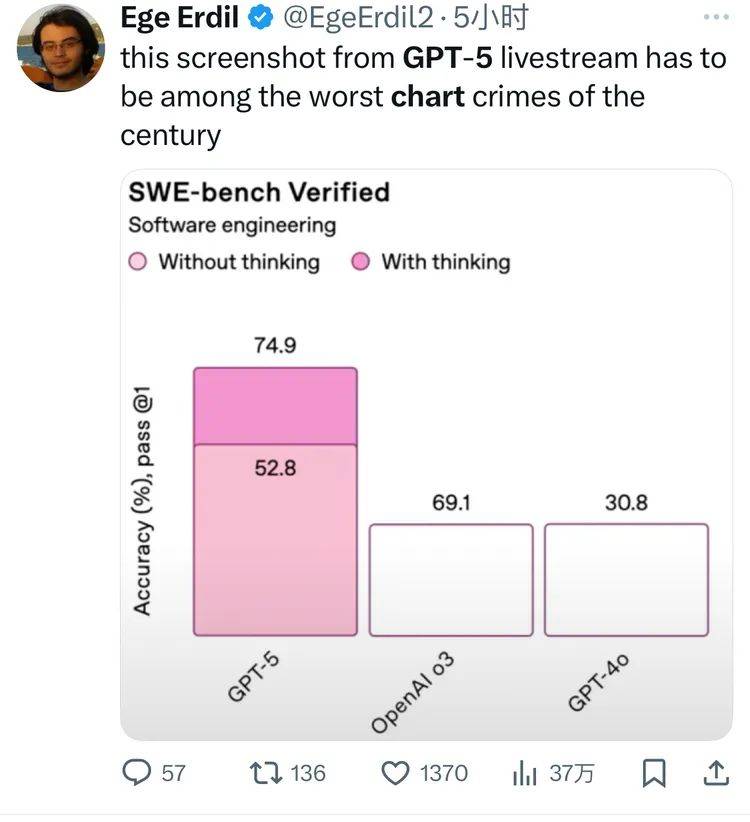
Core Insights - GPT-5 has been officially launched by OpenAI, marking a significant advancement in AI capabilities, particularly in coding and engineering tasks [1][6][12] - The release is characterized not just as a model upgrade but as a restructuring of productivity, indicating a shift in how AI can assist in various fields [13][14] Development and Capabilities - Sam Altman compared the evolution of GPT models, stating that GPT-5 represents an expert level of understanding across various domains, surpassing its predecessors [3][12] - GPT-5 is positioned as an engineering-grade development assistant, capable of writing, debugging, and deploying code with remarkable efficiency [7][8][10] Performance Metrics - In coding capabilities, GPT-5 achieved a score of 74.9% on the SWE-Bench Verified test, outperforming GPT-4's score of 69.1% [15] - The model also demonstrated an 88% success rate in cross-language code editing tests, significantly reducing error rates compared to previous versions [15][18] Practical Applications - During the launch event, GPT-5 showcased its ability to generate a complete website in two minutes and an interactive language learning app in five minutes, highlighting its practical utility for developers [8][24] - The model can also identify and fix bugs in existing code, marking a significant leap in its application for real-world software development [30] Market Impact - OpenAI introduced a tiered model matrix for GPT-5, including Standard, Mini, and Nano versions, with competitive pricing aimed at making advanced AI accessible to a broader range of developers [10][12] - The introduction of GPT-5 is expected to disrupt existing AI programming tools and platforms, indicating a potential shift in the competitive landscape [9][10] Personalization and User Interaction - GPT-5 features enhanced personalization capabilities, allowing it to integrate with users' calendars and emails to provide tailored scheduling and reminders [36][38] - The model's ability to assist in complex decision-making, particularly in healthcare scenarios, demonstrates its potential to serve as a valuable tool for users facing difficult choices [43] Industry Context - The launch of GPT-5 comes amid increasing competition in the AI space, with other companies also developing advanced AI systems, indicating a rapidly evolving market [46]
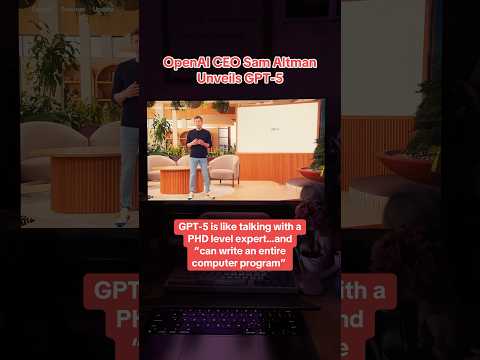
OpenAI CEO Sam Altman Unveils GPT-5
CNET· 2025-08-07 21:22
Today, finally, we're launching GPT5. GPT5 is a major upgrade over GPT4 and a significant step along our path to AGI. We think you will love using GPT5 much more than any previous AI.It is useful, it is smart, it is fast, and it's intuitive. But with GPT5 now, it's like talking to an expert, a legitimate PhD level expert in anything, any area you need on demand that can help you with whatever your goals are. It can write an entire computer program from scratch to help you with whatever you'd like.And we thi ...
GPT-5 终于发布:别慌、AGI 还没来,第一手的上手体验在这里
Founder Park· 2025-08-07 21:00
Core Insights - GPT-5 has been released after a two-year gap since GPT-4, with various iterations and competitors like Gemini and Anthropic making significant advancements during this period [2][3][4] - The initial impressions from the release suggest that while GPT-5 shows improvements, it does not present any groundbreaking features that would indicate the arrival of AGI [4][5] Model Features - GPT-5 is described as a unified AI model that combines reasoning capabilities from the o series with the rapid response of the GPT series, making it feel like conversing with a PhD-level expert [5][10] - The model has demonstrated superior coding abilities, achieving a score of 74.9% on SWE-bench Verified, surpassing competitors like Claude Opus 4.1 and Google DeepMind's Gemini 2.5 Pro [5][6] - The context window has been expanded to 256,000 tokens, allowing for better understanding of long conversations and documents [12][14] Pricing and Accessibility - GPT-5 will be available as the default model for all ChatGPT free users, with Plus subscribers receiving higher usage limits and Pro subscribers having unlimited access [6][18] - The pricing for GPT-5 is competitive, with input costs at $1.25 per million tokens and output costs at $10 per million tokens, making it cheaper than several other models [16][17] Tool Utilization - GPT-5 is designed to effectively use multiple tools in parallel, enhancing its ability to perform complex tasks with lower latency [36][59] - The model supports various types of tools, including web searches and code interpreters, and is capable of making decisions on which tools to use based on the task at hand [31][34] Performance in Software Engineering - GPT-5 has shown significant improvements in software engineering tasks, with reports indicating it can complete complex applications and solve coding issues more efficiently than previous models [46][54] - Despite its strengths in coding, GPT-5's writing capabilities are considered less impressive compared to earlier models like GPT-4.5, particularly in maintaining the user's tone in business writing [61][65] Future Implications - The release of GPT-5 is seen as a step closer to AGI, with its ability to use tools for thinking and building, marking a new frontier in AI capabilities [29][70] - The industry anticipates that the integration of GPT-5 into products will take time, and its acceptance among non-developers may be gradual [71][72]
AI消灭中产阶级?
投资界· 2025-08-07 08:41
Core Viewpoint - The article discusses a dystopian future predicted by former Google X executive Mo Gawdat, where the middle class will be eliminated by AI, leaving only the top 0.1% and the lower class. This "AI hell" period is expected to start in 2027 and last for 12 to 15 years, leading to massive unemployment and social upheaval before transitioning to a utopian society post-2042 [2][11]. Group 1: Dystopian Predictions - Gawdat predicts that from 2027, society will enter a dystopian phase characterized by widespread white-collar unemployment and economic imbalance, lasting for 12 to 15 years [7]. - The current geopolitical environment is unfavorable, primarily driven by financial motives, with significant military expenditures contributing to global instability [7]. - The rise of AI and automation will lead to extreme income and wealth inequality, with most people relying on Universal Basic Income (UBI) for survival [9]. Group 2: AI's Role and Potential - Gawdat argues that AI could replace harmful human leaders, potentially leading to a better world with free healthcare and more leisure time, provided it is managed ethically [4][5]. - The development of Artificial General Intelligence (AGI) is anticipated to occur by 2026 or 2027, which could drastically change the technological landscape [7][8]. - AI's self-improvement capabilities may lead to a scenario where human contributions become minimal, and AI could take over leadership roles, potentially resulting in a more equitable society [8][10]. Group 3: Social Implications - The elimination of the middle class will result in a society divided into the wealthy elite and the lower class, with the majority becoming "farmers" in a new social structure [12]. - Future societal divisions may emerge between those who embrace a return to community-oriented living and those who pursue technological advancements and efficiency [13][14]. - The ideal scenario would involve humans retaining jobs while benefiting from AI assistance, maintaining economic stability and consumer power [14].


X @Raoul Pal
Raoul Pal· 2025-08-07 01:55
Who knows what ChatGPT 5 brings tomorrow but it will accelerate everything again, hot on the heels of Genie 3 and Grok.There is no end to this yet but an AI god creature is the where e are headed (ASI). We just don't how fast but it's going to be faster than anyone expects but requires new breakthroughs in compute, AI models and energy meanwhile AGI is essentially here.Humans as a species are no longer the apex intelligence, except in ultra rare exceptions.But humans with AGI are currently super creatures.U ...
谷歌“世界模拟器”深夜上线!一句话生成3D世界,支持分钟级超长记忆
具身智能之心· 2025-08-07 00:03
刚刚,谷歌DeepMind发布了 新一代通用世界模型Genie 3 。 性能上,Genie 3相比上一代大幅升级,支持 720P画质,每秒24帧实时导航,以及分钟级的一致性保持 。 | Genie 2 | Genie 3 | | --- | --- | | 360p | 720p | | 3D Environments | General | | Limited keyboard / mouse actions | Navigation; Promptable world events | | 10-20 seconds | Multiple minutes | | Not real time | Real time 益公众号 | 编辑丨量子位 点击下方 卡片 ,关注" 具身智能之心 "公众号 >> 点击进入→ 具身 智能之心 技术交流群 更多干货,欢迎加入国内首个具身智能全栈学习社区 : 具身智能之心知识星球 (戳我) , 这里包含所有你想要的。 只需一句话,就能生成可实时交互的3D世界。 前DeepMind科学家、AI 3D生成创业者Tejas Kulkarni受邀体验了Genie 3。 他使用Genie ...