
AI PC

Search documents
东芯股份(688110.SH):砺算科技的GPU产品主要应用于AI PC、云游戏等应用场景
Ge Long Hui A P P· 2025-09-24 10:08
Core Viewpoint - Dongxin Co., Ltd. (688110.SH) has indicated that the GPU products developed by Lishuan Technology are primarily used in applications such as personal computers, professional design, AI PCs, cloud gaming, cloud rendering, and digital twins. Currently, these products have not generated any revenue as they are still in the stages of market marketing, customer development, and mass production supply [1]. Group 1 - Dongxin Co., Ltd. is involved in the development of GPU products through its subsidiary Lishuan Technology [1]. - The applications of the GPU products include personal computers, professional design, AI PCs, cloud gaming, cloud rendering, and digital twins [1]. - The products are still undergoing industrialization processes such as market marketing, customer development, and mass production supply [1].

9月22日沪深两市强势个股与概念板块
2 1 Shi Ji Jing Ji Bao Dao· 2025-09-22 10:42
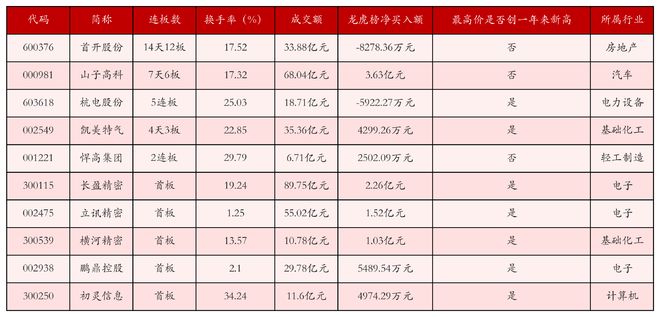
Strong Stocks - As of September 22, the Shanghai Composite Index rose by 0.22% to 3828.58 points, the Shenzhen Component Index increased by 0.67% to 13157.97 points, and the ChiNext Index went up by 0.55% to 3107.89 points [1] - A total of 73 stocks in the A-share market hit the daily limit, with the top three strong stocks being Shouke Co., Ltd. (600376), Shanzi Gaoke (000981), and Hangdian Co., Ltd. (603618) [1] - The detailed performance of the top 10 strong stocks includes metrics such as consecutive limit-up days, turnover rates, trading volumes, and net buying amounts from the top trading accounts [1] Strong Concept Sectors - The top three concept sectors with the highest gains are AI Mobile Phones (up 4.06%), Smart Speakers (up 3.43%), and National Big Fund Holdings (up 3.11%) [2] - The detailed data for the top 10 concept sectors includes percentage changes, the proportion of constituent stocks, and the ratios of rising and falling constituent stocks [2]

AI PC概念上涨2.80%,9股主力资金净流入超亿元
Zheng Quan Shi Bao Wang· 2025-09-22 10:18
Group 1 - The AI PC concept index rose by 2.80%, ranking 7th among concept sectors, with 35 stocks increasing in value, including Changying Precision which hit a 20% limit up, and Demingli and Pengding Holdings also reaching the limit up [1] - Leading stocks in the AI PC sector included Sixuan New Materials, Jiangbolong, and Lingyi Zhi Zao, with respective increases of 11.75%, 9.96%, and 9.12% [1] - The stocks with the largest declines were Kosen Technology, Zhongjing Electronics, and Bomin Electronics, which fell by 3.83%, 3.44%, and 2.33% respectively [1] Group 2 - The AI PC concept sector saw a net inflow of 1.963 billion yuan, with 22 stocks receiving net inflows, and 9 stocks exceeding 100 million yuan in net inflows [2] - Lingyi Zhi Zao led the net inflow with 1.971 billion yuan, followed by Changying Precision and Pengding Holdings with net inflows of 796 million yuan and 446 million yuan respectively [2] - The top net inflow ratios were recorded by Lingyi Zhi Zao at 18.98%, Pengding Holdings at 14.99%, and Anfu Technology at 12.73% [3] Group 3 - The AI PC concept stocks with significant trading volumes included Lingyi Zhi Zao, Changying Precision, and Pengding Holdings, with respective trading volumes of 197.12 million yuan, 79.57 million yuan, and 44.63 million yuan [3][4] - Other notable stocks in the sector included Jiangbolong with a trading volume of 22.04 million yuan and Huachuang Technology with 35.49 million yuan [4] - The overall trading activity in the AI PC sector indicates strong investor interest and participation [2][3]




半导体 - 对英特尔与英伟达合作的看法-Semiconductors North America-Thoughts on IntelNVDA partnership
2025-09-22 01:00
Summary of Key Points from the Conference Call Industry and Company Involved - **Industry**: Semiconductors, specifically focusing on North America - **Companies**: Intel Corporation (INTC) and Nvidia Corporation (NVDA) Core Insights and Arguments 1. **Collaboration Announcement**: Intel and Nvidia announced a partnership to develop custom data center and PC products, including Nvidia-custom x86 CPUs and x86 SOCs integrating Nvidia graphics chiplets with Intel CPUs [3][4] 2. **Investment Details**: Nvidia will invest $5 billion in Intel's common stock at a price of $23.28 per share [3] 3. **Market Impact**: The server CPU market is currently around 30 million units, with Intel holding approximately 65% market share. Nvidia's expected shipment of 30,000 racks this year represents a small contribution to Intel's overall market share [5][10] 4. **Strategic Importance**: The collaboration is seen as a positive development for Intel, particularly in enhancing its position in AI systems and regaining lost content from Nvidia's shift to its own Grace CPU [4][9] 5. **Long-term Product Release**: New products from this collaboration are not expected to hit the market until 2027 [13] 6. **Foundry Relationship Speculation**: There is potential for a future Nvidia-Intel foundry relationship, although no immediate plans were disclosed [14] 7. **Stock Market Reaction**: Initial enthusiasm for Intel's stock may fade if the partnership does not evolve into a foundry aspect, which is a concern for some investors [19] Additional Important Insights 1. **AMD's Position**: The collaboration is viewed as neutral for AMD, as it does not significantly impact their market share in either server or PC segments [22] 2. **ALAB's Outlook**: The partnership may affect ALAB due to potential changes in connectivity standards, but the specifics remain unclear [23] 3. **Capex Expectations**: Intel's capital expenditure is expected to increase, with estimates for 2026 capex around $13.2 billion, influenced by the partnership [24][25] 4. **Risks and Opportunities**: The semiconductor industry faces various risks, including competition from AMD and potential delays in new product launches, which could impact revenue growth [28][30] This summary encapsulates the key points discussed in the conference call regarding the Intel and Nvidia partnership, its implications for the semiconductor industry, and the potential market dynamics moving forward.
AIDC国内链-H公司专家交流
2025-09-22 01:00
Summary of Key Points from the Conference Call Industry and Company Overview - The conference call primarily discusses **Huawei** and its developments in the **data center** and **high-performance computing** sectors, particularly focusing on the **384 node system** and advancements in **liquid cooling** and **high voltage direct current (HVDC)** technologies. Core Insights and Arguments - **384 Node System**: The 384 node system is considered a transitional product with performance improvements over the 920B model, but still lacking in certain precision operations. Future products like the 950 and 960 are expected to enhance performance further [1][3][5] - **HVDC Adoption**: Huawei plans to adopt **800V or higher HVDC** systems to improve power supply efficiency and reduce energy consumption. A mixed mode of AC to DC UPS and HVDC is anticipated to be implemented by 2025-2026 [1][4][10] - **Liquid Cooling Technology**: Liquid cooling has become a standard configuration, with the 920C model reaching a maximum power of **600W**, while the upcoming 950 and 960 models are expected to reach **1,000W** and **1,200W** respectively. Liquid cooling is deemed necessary for high power density applications despite its higher cost compared to air cooling [1][11][14] - **Cost Analysis**: The cost of a liquid cooling system is approximately **20,000 yuan per square meter**, with a total cabinet cost around **120,000 yuan**. In contrast, air cooling systems cost between **15,000 to 20,000 yuan per square meter**, totaling around **80,000 yuan** for a cabinet [14][15] - **Market Projections**: Expected shipments for the 920C model in 2025 are around **300,000 units**, while the 920B is projected at **600,000 units**. The 950 model is set to launch in Q1 2026, but with lower yield rates [3][24][25] Additional Important Insights - **Partnerships**: Huawei's SVDC project collaborates with partners like **Kehua** and **Bank of China** to advance project development [7] - **UPS Systems**: The company utilizes both international brands like **Schneider**, **ABB**, and **Vertiv**, as well as domestic brands like **Kehua** in its UPS solutions, aiming for localization [8] - **Microchannel Technology**: This technology is being explored for high heat dissipation needs, particularly in the 950 series chips, although it currently has high material costs [20][22] - **Future Trends**: The data center industry is expected to gradually transition to liquid cooling systems, especially as power demands increase beyond **30 kW** per cabinet [28][29] - **Reliability Measures**: The 2N configuration in data center power systems ensures high reliability, with a design that allows for 99.9% uptime even in dual power failure scenarios [30][31] This summary encapsulates the key points discussed in the conference call, highlighting Huawei's strategic direction in the data center and cooling technology sectors.
英伟达联手英特尔,或重塑AI PC市场格局,联发科压力山大
Hua Er Jie Jian Wen· 2025-09-19 06:37
Core Insights - Nvidia has announced a $5 billion investment in Intel, aiming to collaborate on next-generation data center and client processors, which is expected to reshape the data center and PC market landscape [1][2] Group 1: Impact on TSMC - The direct impact on TSMC from the Nvidia-Intel partnership is limited, as the collaboration focuses on product design rather than manufacturing [2] - The initial products are likely to be produced by TSMC, highlighting its leadership in high-performance computing wafer foundry technology [2] - Nvidia may consider outsourcing some products to Intel in the future, but TSMC's position in advanced process technology may remain stable [2] Group 2: Challenges for MediaTek - MediaTek faces negative impacts from the partnership, as its exclusive collaboration with Nvidia in computing and automotive sectors is now compromised [3] - The strong product combination of Intel's x86 CPU and Nvidia's GPU may enhance competitiveness in AI workstations, overshadowing MediaTek's offerings [3] - Despite MediaTek's upcoming GB10 PC chip launch, its future prospects are clouded due to the loss of exclusivity with Nvidia [3] Group 3: AI PC Market Potential - The collaboration between Nvidia and Intel could serve as a catalyst for the sluggish AI PC market, which has been slow to take off [4] - Intel's previous processors lacked sufficient NPU performance, but leveraging Nvidia's graphics and AI technology may lead to more competitive product launches [4] - A successful partnership could initiate a stronger product cycle in the AI PC segment [4] Group 4: Supply Chain Implications - The impact on the Asian semiconductor supply chain is expected to be differentiated, with companies related to Intel's products benefiting more significantly [6] - Semiconductor equipment suppliers linked to Intel's foundry business may see only marginal benefits due to the lack of new wafer foundry business in the collaboration [6] - Market expectations regarding Intel's increased spending depend on gaining more customer confidence in its 14A process technology [6]


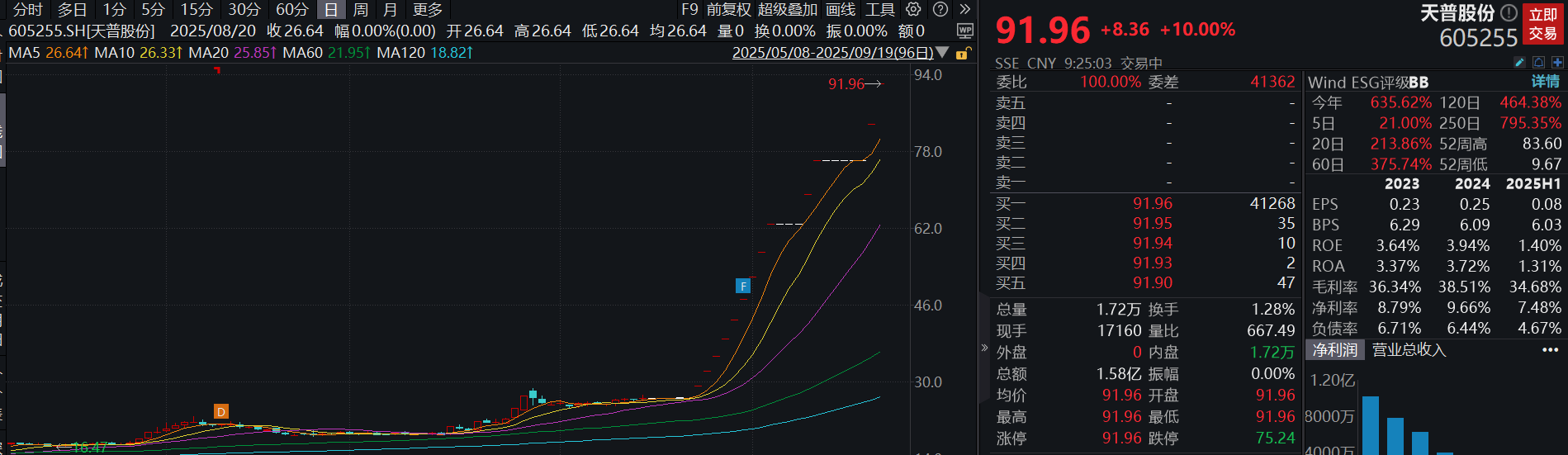
滚动更新丨A股三大指数开盘涨跌不一,天普股份走出13连板
Di Yi Cai Jing· 2025-09-19 01:34
Group 1 - Huawei HiSilicon concept stocks, AI PC, and communication equipment sectors are performing actively, while film and television box office, PEEK materials, and robotics concept stocks are weakening [1][3] - Tianpu Co., Ltd. has reached a trading limit with a 13-day consecutive rise, following a notice from the Shanghai Stock Exchange regarding abnormal trading behaviors that misled investors [1] Group 2 - The A-share market opened with mixed results: the Shanghai Composite Index fell by 0.03%, the Shenzhen Component Index decreased by 0.01%, while the ChiNext Index rose by 0.08% [3][4] - The Hong Kong stock market opened with the Hang Seng Index up by 0.14% and the Hang Seng Tech Index up by 0.44%, with notable rebounds in tech stocks like SMIC and JD Group [4][5]

郭明錤谈英伟达英特尔合作:对台积电 AI 芯片订单影响不大
Sou Hu Cai Jing· 2025-09-18 15:47
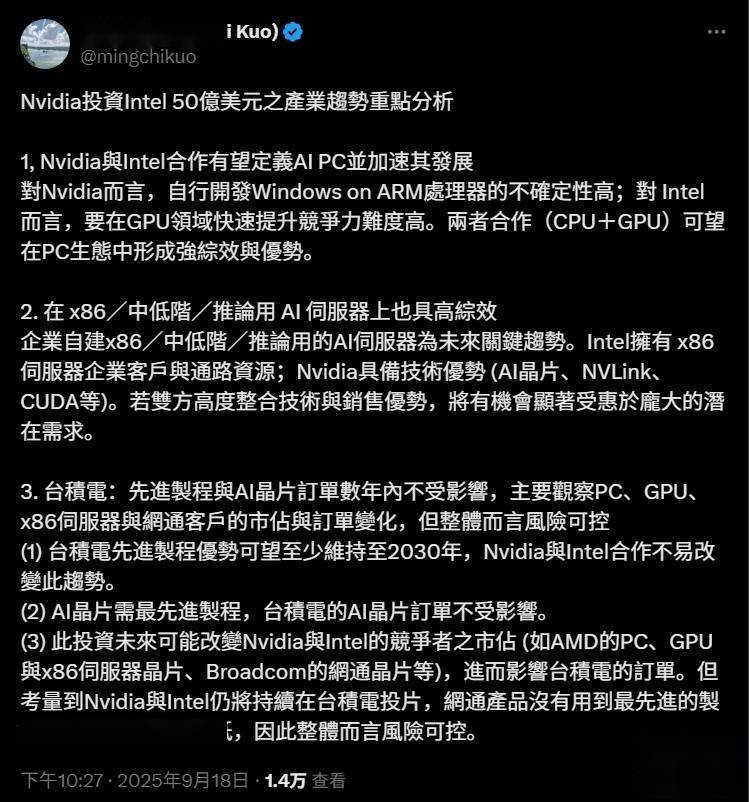
Core Viewpoint - Nvidia announced a $5 billion investment in Intel to jointly develop chips for PCs and data centers, which is expected to accelerate the development of AI PCs and create strong synergies in the PC ecosystem [1][3]. Group 1: Nvidia and Intel Collaboration - The collaboration between Nvidia and Intel is anticipated to define AI PCs and accelerate their development, as Nvidia faces high uncertainty in developing Windows on ARM processors, while Intel struggles to quickly enhance its competitiveness in the GPU sector [1][3]. - The partnership is expected to create a powerful synergy by combining CPU and GPU capabilities within the PC ecosystem [3]. Group 2: AI Server Market Trends - There is a significant trend towards enterprises building x86/mid-range/inference AI servers, with Intel having established x86 server enterprise clients and distribution channels, while Nvidia possesses technical advantages in AI chips, NVLink, and CUDA [1][4]. - A high level of integration between the technical and sales strengths of both companies could lead to substantial benefits from the large potential demand in the AI server market [4]. Group 3: Impact on TSMC - TSMC's advantage in advanced processes is expected to last at least until 2030, and the collaboration between Nvidia and Intel is unlikely to change this trend [1][4]. - AI chips require cutting-edge advanced processes, so TSMC's orders for AI chips are not expected to be affected [4]. - The investment may shift market shares among competitors of Nvidia and Intel, such as AMD in the PC, GPU, and x86 server chip sectors, potentially impacting TSMC's orders; however, overall risks remain manageable as Nvidia and Intel are expected to continue being key customers of TSMC [2][4].
X @郭明錤 (Ming-Chi Kuo)
郭明錤 (Ming-Chi Kuo)· 2025-09-18 14:27
Key Industry Takeaways from Nvidia’s $5 Billion Investment in Intel1. Partnership Could Define and Accelerate the AI PC LandscapeFor Nvidia, developing its own Windows-on-ARM processors carries high uncertainty; for Intel, establishing a competitive edge in GPUs is difficult. Teaming up (CPU + GPU) could create powerful synergies and advantages across the PC ecosystem.2. Significant Synergistic Potential in x86 / Mid & Low-Range / Inference AI ServersA key trend ahead is enterprises building x86-based / mid ...
X @郭明錤 (Ming-Chi Kuo)
郭明錤 (Ming-Chi Kuo)· 2025-09-18 14:27
Collaboration Synergies - Nvidia and Intel collaboration aims to define AI PC and accelerate its development, leveraging combined CPU and GPU strengths [1] - Potential high synergy in x86/mid-to-low end/inference AI servers, combining Intel's x86 server enterprise client and channel resources with Nvidia's AI chip technology [2] Competitive Landscape Impact - Investment may shift market share among competitors like AMD in PC, GPU, and x86 server chips, and Broadcom in networking chips [2] TSMC's Perspective - TSMC's advanced process technology leadership is expected to remain until at least 2030, unaffected by Nvidia-Intel collaboration [1] - TSMC's AI chip orders are unaffected as AI chips require the most advanced processes [2] - Overall risk to TSMC is considered controllable, considering continued Nvidia and Intel orders, and lower contribution from networking products using less advanced processes [2]