
物联网

Search documents
广日股份:公司致力于人工智能、物联网、智能电梯等关键技术的研究
Zheng Quan Ri Bao Wang· 2026-02-12 12:10
Core Viewpoint - Guangri Co., Ltd. (600894) is focusing on the integration of advanced technologies such as artificial intelligence, the Internet of Things, and smart elevators into its core business to drive industrial digital upgrades and transformations [1] Group 1: Company Strategy - The company is a key entity under the Guangzhou Industrial Control Group's advanced manufacturing sector, emphasizing research in critical technologies [1] - There is a commitment to merging research outcomes with the company's main operations to enhance industrial digitalization [1] Group 2: Collaboration and Innovation - The Industrial Control Science and Technology Group, as a technological innovation platform under Guangzhou Industrial Control Group, will explore collaborative paths with the company [1] - Planned cooperation will focus on areas such as the transformation of high-quality technological achievements, the establishment of a technological innovation system, resource linkage for manufacturing innovation centers, and the construction of smart parks [1]

湖南裕星科技有限公司成立,注册资本200万人民币
Sou Hu Cai Jing· 2026-02-12 10:46
Core Insights - Hunan Yuxing Technology Co., Ltd. has been established with a registered capital of 2 million RMB, fully owned by Yiyang City Ziyang District Zhongda Lixin Enterprise Service Co., Ltd. [1] Company Overview - The legal representative of Hunan Yuxing Technology Co., Ltd. is Hu Fenxia [1] - The company is classified under the information transmission, software, and information technology services industry, specifically in software development [1] - The registered address is located at Jinshui Sunshine, Wanyuan, Room 105, Maliang Community, Qiche Road Street, Ziyang District, Yiyang City, Hunan Province [1] - The company type is a limited liability company (wholly owned by a natural person) with an operating period until February 11, 2026, with no fixed term thereafter [1] Business Scope - The business scope includes technology intermediary services, IoT technology research and development, hardware product research and development, popular science promotion services, digital technology services, 5G communication technology services, and artificial intelligence innovation and entrepreneurship service platforms [1] - Additional services include research and development of electronic special materials, household appliances, software development, and various artificial intelligence software applications [1] - The company is also involved in the retail of computer software and hardware and auxiliary equipment, excluding projects that require approval by law [1]
广州白云智算信息服务有限公司成立,注册资本500万人民币
Sou Hu Cai Jing· 2026-02-12 08:01
Core Viewpoint - Guangzhou Baiyun Zhican Information Service Co., Ltd. has been established with a registered capital of 5 million RMB, focusing on various technology services including blockchain and artificial intelligence [1] Company Overview - The legal representative of the company is Liu Guixin [1] - The registered capital is 5 million RMB [1] - The company is a limited liability entity with no fixed term of operation, registered until February 11, 2026 [1] Shareholding Structure - Guangzhou Zhican Information Technology Co., Ltd. holds 51% of the shares [1] - Guangzhou Huiying Investment Holdings Co., Ltd. holds 49% of the shares [1] Business Scope - The company’s business includes services related to blockchain technology, IoT applications, industrial internet data services, and various IT consulting and data processing services [1] - It also offers artificial intelligence application software development, big data services, and network security software development [1]
联域股份跌0.24%,成交额1.01亿元,今日主力净流入24.16万
Xin Lang Cai Jing· 2026-02-12 07:54
Core Viewpoint - The company, Shenzhen Lianyu Optoelectronics Co., Ltd., is actively advancing its technology in smart lighting and has begun to expand its production bases internationally, benefiting from the depreciation of the RMB and the Belt and Road Initiative [2][3][4]. Group 1: Company Developments - The company is focusing on the development of new technologies in smart lighting, including self-adaptive plant control spectrum and wireless networking for intelligent control circuits [2]. - The company has established a full subsidiary, Shenzhen Haibo, to develop charging piles and energy storage businesses, which have already generated revenue [2]. - As of the 2024 annual report, overseas revenue accounted for 95.62% of total revenue, benefiting from the depreciation of the RMB [3]. Group 2: Financial Performance - For the period from January to September 2025, the company achieved a revenue of 1.155 billion yuan, representing a year-on-year growth of 1.03%, while the net profit attributable to shareholders decreased by 79.23% to 19.5341 million yuan [8]. - The company has distributed a total of 129 million yuan in dividends since its A-share listing [9]. Group 3: Market Activity - On February 12, the company's stock price decreased by 0.24%, with a trading volume of 101 million yuan and a turnover rate of 6.81%, resulting in a total market capitalization of 4.533 billion yuan [1]. - The stock has shown no significant trend in major capital inflows, with a net inflow of 241,600 yuan on the day, indicating a lack of strong buying or selling pressure [5][6].
同洲电子跌1.27%,成交额1.51亿元,后市是否有机会?
Xin Lang Cai Jing· 2026-02-12 07:32
Core Viewpoint - The company, Tongzhou Electronics, is experiencing significant growth in its revenue and profit, primarily driven by its focus on high-power power supply products and lithium-ion battery business, while also benefiting from the depreciation of the RMB [2][3][8]. Group 1: Company Overview - Tongzhou Electronics is located in Shenzhen, Guangdong Province, and was established on February 3, 1994. It was listed on June 27, 2006 [7]. - The company's main business includes the research, development, manufacturing, and sales of broadcasting intelligent devices and lithium-ion batteries. The revenue composition is as follows: high-power power supply business 90.23%, trade business 4.47%, battery business 3.73%, and others 1.03% [7]. - As of January 20, the number of shareholders is 54,700, an increase of 2.49% from the previous period, with an average of 12,604 circulating shares per person, a decrease of 2.43% [7]. Group 2: Financial Performance - For the period from January to September 2025, the company achieved a revenue of 657 million yuan, representing a year-on-year growth of 176.75%. The net profit attributable to the parent company was 232 million yuan, with a year-on-year increase of 1724.48% [8]. - The company's overseas revenue accounted for 79.72%, benefiting from the depreciation of the RMB [3]. Group 3: Business Segments - The company's main business is divided into two segments: the energy sector, which includes high-power power supply products, lithium batteries, and electric vehicle battery swap services, and the new energy lithium-ion battery business, which focuses on technology research, production, and sales [2][3]. - The company has made investments in the Internet of Things (IoT) sector, providing solutions for smart parks and communities [2].

思创智联:公司提供物联网解决方案及软硬件一体化服务
Zheng Quan Ri Bao Wang· 2026-02-12 06:48
Core Viewpoint - The company, Sichuang Zhili (300078), focuses on providing IoT solutions and integrated hardware and software services, emphasizing its commitment to transforming lives through the Internet of Things [1] Group 1: Business Focus - The company's main business is based on the development and production of EAS and RFID technologies [1] - It targets various sectors including unmanned retail, smart loss prevention, clothing supply chain, and smart cities [1] Group 2: Future Plans - The company is actively monitoring national industrial policy directions and technological development trends [1] - It plans to expand into new business scenarios by aligning its operations with market demands [1] Group 3: Information Disclosure - The company commits to timely information disclosure in accordance with legal regulations if there are any relevant updates [1]

思创智联:积极关注产业政策导向与技术发展趋势,未来将结合自身业务积极拓展新业务场景
Sou Hu Cai Jing· 2026-02-12 04:02
Group 1 - The core business of the company focuses on "Internet of Things (IoT) to change lives," with a foundation in EAS and RFID research and production [1] - The company provides IoT solutions and integrated hardware and software services, targeting areas such as unmanned retail, smart loss prevention, clothing supply chain, and smart cities [1] - The company is actively monitoring national industrial policy directions and technological development trends to expand new business scenarios in line with market demand [1]
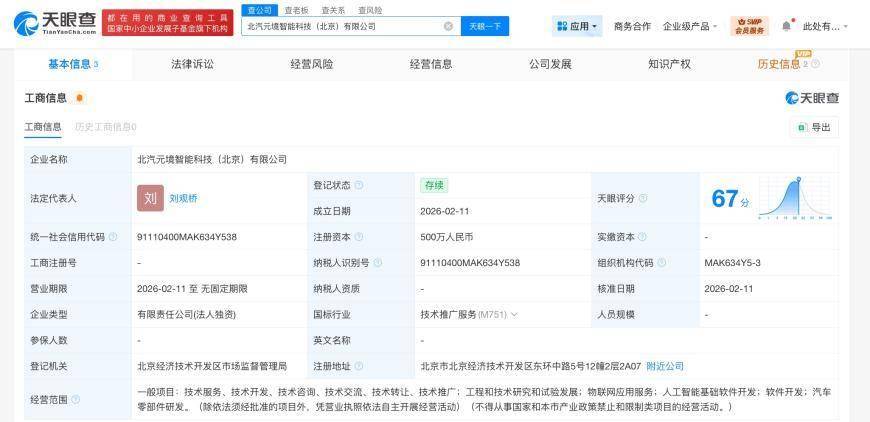
北汽新能源成立元境智能科技公司 注册资本500万
Sou Hu Cai Jing· 2026-02-12 03:04
Core Viewpoint - Beijing Automotive Yuanjing Intelligent Technology Co., Ltd. has been established with a registered capital of 5 million RMB, focusing on engineering and technology research, IoT application services, AI software development, and automotive parts R&D, fully owned by Beijing New Energy Automobile Co., Ltd. [1] Group 1 - The company was founded recently, with Liu Guanquiao as the legal representative [1] - The registered capital of the company is 5 million RMB [1] - The business scope includes engineering and technology research and experimental development, IoT application services, AI basic software development, software development, and automotive parts R&D [1] Group 2 - The company is fully owned by Beijing New Energy Automobile Co., Ltd. [1] - The registration status of the company is active, with a business term lasting until February 11, 2026, with no fixed expiration [1] - The company is registered in the Beijing Economic and Technological Development Zone [1]

2026年中国立体仓库设备行业产业链、市场规模及发展趋势研判:行业加速向高质量发展转型,以自动化升级、定制化方案推动降本增效与产值提升[图]
Chan Ye Xin Xi Wang· 2026-02-12 01:15
Industry Overview - The Chinese automated warehouse equipment industry is transitioning from rapid expansion to high-quality development, with a market size projected to reach approximately 43.52 billion yuan in 2024, reflecting a year-on-year growth of 12.52% [1][9] - The fundamental purpose of investing in automated warehouse equipment is shifting from "storing goods" to "optimizing processes," aiming for cost reduction through semi/full automation and intelligence [1][9] - The current trend involves upgrading traditional high-rise warehouses to automated storage and retrieval systems (AS/RS), integrating shuttle cars, AGVs, and WMS systems [1][9] Market Size - The area of automated warehouses in China is expected to reach about 450 million square meters in 2024, with a year-on-year growth of 4.65% [6][7] - The growth in warehouse area directly reflects strong demand in industrial production, e-commerce logistics, and cold chain transportation, leading to increased equipment renovation and system integration needs [7][9] Industry Chain - The upstream of the automated warehouse equipment industry includes raw materials and components such as steel, aluminum alloys, sensors, and PLCs [4] - The midstream involves the manufacturing and system integration of automated warehouse equipment, while the downstream applications span various sectors including e-commerce, pharmaceuticals, and renewable energy [4] Key Companies - Leading companies in the industry include Qingdao Maoyuan, Kunshan Intelligent, and Beizi Technology, which dominate large complex projects due to their strong capital and technical backgrounds [9] - Companies like Jiangsu Liuwi and Hefei Jingsong are recognized for their dynamic market presence, transitioning from equipment manufacturing to solution providers [9] Industry Development Trends 1. The future of automated warehouses will evolve beyond simple "automated storage and retrieval" functions to become "intelligent warehouse brains" with capabilities for perception, decision-making, and execution [11] 2. Market demand is shifting from general scenarios to high-growth niche industries such as new energy vehicles and biomedicine, leading to customized solutions [12] 3. The focus of market competition is shifting from equipment sales to providing comprehensive intelligent warehouse solutions, which will concentrate resources among leading system integrators [13][14]


研判2026!中国载波通信设备行业产业链图谱、市场现状、竞争格局、发展趋势分析:智能电网建设推动,载波通信设备行业规模持续增长[图]
Chan Ye Xin Xi Wang· 2026-02-12 01:15
Core Insights - The carrier communication equipment market is experiencing continuous growth, driven by the development of the new energy industry, smart grid construction, and the proliferation of IoT technology [1][7] - The market size of China's carrier communication equipment industry is projected to reach 39.666 billion yuan by 2025, representing an 8% year-on-year increase [1][7] - Government support for the construction and development of power communication networks is creating a favorable policy environment, further expanding market demand [1][7] Industry Overview - Carrier communication equipment refers to devices used in frequency division multiplexing systems for signal modulation, transmission, and reception, operating within a frequency range of 300 to 3400 Hz [3] - The equipment is categorized into analog and digital types, with digital communication becoming the mainstream due to advancements in technology [4] Industry Chain - The upstream of the carrier communication equipment industry includes raw material and component suppliers, while the midstream involves manufacturing, and the downstream encompasses various application fields such as power, transportation, and petrochemicals [5] - The filter is a crucial component in carrier communication equipment, enhancing signal stability and clarity, with the filter industry in China projected to grow from 10.7 billion yuan in 2020 to 15.9 billion yuan by 2025, at a compound annual growth rate of 8.2% [5][6] Market Dynamics - The investment in China's power engineering construction is expected to reach 1.78 trillion yuan in 2024, a 13.2% increase year-on-year, indicating a rising demand for carrier communication equipment due to accelerated grid construction [6][7] Competitive Landscape - The carrier communication equipment industry is competitive, with several companies demonstrating strong capabilities in technology development and market expansion, including Neusoft Carrier, Dingsheng Communication, and Liyuan Information Technology [9] - Neusoft Carrier has developed advanced power line carrier communication technology, achieving significant market penetration across various provinces [9][10] Future Trends - Future growth in the carrier communication equipment industry will be driven by technological innovation and product upgrades, with emerging applications in smart homes and industrial control [11] - The industry is expected to enhance its international presence and competitiveness, contributing to global development [11]

