
物联网

Search documents
行业聚焦:全球热电制冷器模块市场头部企业份额调研(附Top 10 厂商名单)
QYResearch· 2025-10-29 02:52
Core Viewpoint - The thermoelectric cooler module industry is experiencing significant growth driven by advancements in semiconductor materials and increasing applications across various sectors such as consumer electronics, communication, automotive, and medical devices. The market is expected to see a compound annual growth rate (CAGR) of approximately 10% over the next five years, with a projected global shipment of over 205 million units in 2024 [4][6]. Industry Overview - The history of thermoelectric cooler modules dates back to the discovery of the Peltier effect in the 19th century, but commercialization only began in the mid-20th century with the development of semiconductor materials. Initially, these modules were used in military and aerospace applications, but they have since expanded into consumer electronics, medical devices, and industrial sectors [3]. - Thermoelectric cooler modules operate based on the Peltier effect, where an electric current passes through a thermocouple made of p-type and n-type semiconductor materials, resulting in one end absorbing heat (cold side) and the other releasing heat (hot side). This solid-state technology is compact, noiseless, highly reliable, and allows for precise temperature control [3]. Market Size and Growth - According to QYResearch, the global thermoelectric cooler module market is projected to reach $1.55 billion by 2031, with a CAGR of 8.6% in the coming years [4]. - The market is expected to see a shipment of over 205 million units in 2024, with a continued growth trajectory driven by the proliferation of technologies such as 5G, artificial intelligence, and the Internet of Things [4]. Key Players - Major players in the thermoelectric cooler module market include Ferrotec, KELK Ltd. (Komatsu), Coherent Corp, Tark Thermal Solutions, KYOCERA, and several others. The top five manufacturers are expected to hold over 50% of the market share in 2024, with Ferrotec leading at over 20% [6]. Product Segmentation - Single-stage thermoelectric cooler modules currently dominate the market, accounting for approximately 68.3% of the total market share [8]. Application Areas - The demand for thermoelectric cooler modules is rising across various sectors, including consumer electronics, communication, medical, automotive, industrial, and defense aerospace. The consumer electronics sector remains the largest market, expected to account for about 25% of the global market in 2024. The communication and automotive sectors are anticipated to experience higher growth rates during the forecast period [10]. Regional Insights - North America, Europe, and the Asia-Pacific region are the primary markets for thermoelectric cooler modules. North America benefits from strong demand in the electronics and medical technology sectors, while Europe focuses on environmental sustainability. The Asia-Pacific region, particularly China, Japan, and South Korea, is the fastest-growing market due to rapid advancements in electronics manufacturing and the electric vehicle industry [11].


行业聚焦:全球食品X射线检测设备市场头部企业份额调研(附Top 10 厂商名单)
QYResearch· 2025-10-29 02:52
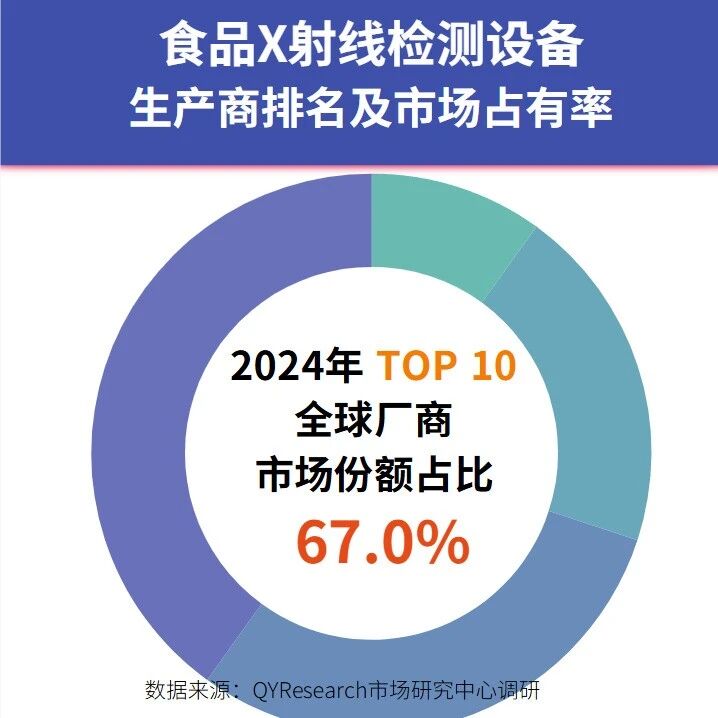
Core Viewpoint - The global food X-ray inspection equipment market is experiencing significant growth driven by increasing food safety regulations, consumer health awareness, and advancements in technology [2][3][5]. Market Overview - The global production of food X-ray inspection equipment is expected to reach 5,100 units in 2024, with an average price of $44,000 per unit [2]. - By 2031, the market size is projected to reach $400 million, with a compound annual growth rate (CAGR) of 6.9% [5]. - North America and Europe are mature markets for food X-ray inspection equipment, while the Asia-Pacific region, particularly China, India, Japan, and South Korea, is experiencing rapid growth [3][5]. Key Drivers - Increasing consumer concerns about food quality and safety are accelerating the adoption of X-ray inspection technology in the food industry [14]. - Retail giants like Walmart and Carrefour have incorporated X-ray inspection into their supplier standards, pushing upstream food companies to comply [14]. - Technological innovations have reduced equipment costs and operational complexity, facilitating market penetration [14]. - The global food processing automation rate is expected to rise from 41% in 2019 to 58% in 2024, increasing the demand for X-ray inspection machines as part of automated production lines [15]. Market Trends - The integration of dual-energy X-ray technology with artificial intelligence algorithms is enhancing detection accuracy to sub-millimeter levels [17]. - AI-driven IoT real-time monitoring systems are transforming quality management in production lines, allowing for predictive maintenance and rapid response to anomalies [17]. - Manufacturers are introducing modular and lightweight X-ray inspection solutions tailored for small and medium-sized food enterprises, promoting rapid market expansion in regions like China [17]. Major Players - Key manufacturers in the global food X-ray inspection equipment market include Anritsu Infivis, Mettler-Toledo, Ishida, and Thermo Fisher Scientific, with the top ten companies holding approximately 67% market share in 2024 [8][21].
泰凌微:物联网芯片领航者的蜕变与崛起
Xin Hua Wang· 2025-10-29 02:32
Core Viewpoint - The article highlights the significant growth and technological advancements of TaiLing Microelectronics in the low-power wireless connectivity sector, emphasizing its successful transition from technology catch-up to market leadership over the past five years. Group 1: Technological Advancements - TaiLing Microelectronics has maintained high R&D investment, achieving breakthroughs in multi-protocol integration, AI fusion, and advanced processes, which are core to its development strategy [2]. - The company launched a multi-mode low-power IoT chip with a peak current of only 1mA in 2024, significantly extending battery life for IoT devices [2]. - TaiLing Microelectronics has developed a one-stop solution for the Matter protocol, enabling smart devices to connect across multiple platforms, enhancing interoperability among major smart home ecosystems [3]. - The introduction of the TL721X series edge AI chips marks the company's entry into the AIoT era, with significant sales growth in the second quarter of 2025 [3]. Group 2: Financial Performance - In 2024, TaiLing Microelectronics achieved revenue of 844 million yuan, a year-on-year increase of 32.69%, and a net profit of 97 million yuan, up 95.71% [4]. - The first half of 2025 saw further acceleration, with revenue reaching 503 million yuan, a 37.72% increase, and net profit soaring to 101 million yuan, a 274.58% rise [4]. Group 3: Market Expansion - The company is expanding its product matrix into diverse application scenarios, including smart home, healthcare, and automotive electronics, leveraging its technological advantages [5]. - TaiLing Microelectronics has begun mass production of continuous glucose monitoring devices, positioning itself favorably in the medical IoT market [5]. - In the automotive sector, the company has developed a Bluetooth digital key solution, achieving mass production and certification from leading automotive manufacturers [5]. Group 4: Global Strategy - The company has enhanced its global presence, with increasing overseas revenue, and has successfully entered the supply chains of major international clients like Google and Sony [7]. - TaiLing Microelectronics actively participates in international standard-setting and industry ecosystem development, strengthening its brand influence [7]. Group 5: Capital Operations and Governance - The company was listed on the Shanghai Stock Exchange's Sci-Tech Innovation Board in August 2023, raising 1.499 billion yuan to support R&D and capacity expansion [8]. - TaiLing Microelectronics plans to acquire 100% of Panqi Microelectronics to enhance its low-power wireless IoT chip capabilities and strengthen its market competitiveness [10]. - The company has distributed cash dividends totaling 65.87 million yuan and repurchased shares worth 92.96 million yuan since its listing, reflecting its commitment to shareholder returns [11]. Group 6: Future Outlook - TaiLing Microelectronics aims to deepen its technological accumulation in the wireless IoT field and expand into new application scenarios, enhancing its global market competitiveness [12].


秦川物联跌2.00%,成交额718.53万元,主力资金净流出24.62万元
Xin Lang Cai Jing· 2025-10-29 02:23
Core Viewpoint - Qin Chuan IoT's stock price has experienced fluctuations, with a year-to-date increase of 39.66%, but a recent decline in trading performance, indicating potential volatility in investor sentiment [2][3]. Company Overview - Qin Chuan IoT, established on December 30, 2001, and listed on July 1, 2020, is located in Chengdu, Sichuan Province. The company specializes in the research, manufacturing, sales, and service of smart gas meters, integrating core technologies such as precise measurement, smart control, data communication, and information security [2]. - The company's revenue composition includes: IoT smart gas meters (61.56%), smart sensors and related components (17.62%), membrane gas meters (11.49%), and other products [2]. Financial Performance - For the period from January to September 2025, Qin Chuan IoT reported revenue of 219 million yuan, a year-on-year decrease of 16.24%. The net profit attributable to shareholders was -69.89 million yuan, reflecting a significant decline of 66.72% year-on-year [3]. - As of September 30, 2025, the company had 6,303 shareholders, an increase of 7.01% from the previous period, while the average circulating shares per person decreased by 6.55% [3]. Market Activity - On October 29, 2025, Qin Chuan IoT's stock price fell by 2.00%, trading at 12.22 yuan per share, with a total market capitalization of 2.053 billion yuan. The net outflow of main funds was 246,200 yuan, with no large purchases recorded [1]. - The company has appeared on the "Dragon and Tiger List" once this year, with the most recent appearance on July 9, 2025, where it recorded a net buy of -614,700 yuan [2]. Shareholder Information - Since its A-share listing, Qin Chuan IoT has distributed a total of 35.28 million yuan in dividends, with no dividends paid in the last three years [4]. - As of September 30, 2025, the sixth largest circulating shareholder is CITIC Prudential Multi-Strategy Mixed Fund (LOF) A, holding 742,000 shares as a new shareholder [4].

顺络电子涨2.05%,成交额1.96亿元,主力资金净流入107.01万元
Xin Lang Cai Jing· 2025-10-29 01:57
Core Insights - The stock price of Shunluo Electronics increased by 2.05% on October 29, reaching 42.30 CNY per share, with a total market capitalization of 34.107 billion CNY [1] - The company has seen a significant stock price increase of 36.92% year-to-date, with a 17.96% rise over the past five trading days [1] Financial Performance - For the period from January to September 2025, Shunluo Electronics reported a revenue of 5.032 billion CNY, reflecting a year-on-year growth of 19.95% [2] - The net profit attributable to shareholders for the same period was 769 million CNY, marking a year-on-year increase of 23.23% [2] Shareholder Information - As of September 30, 2025, the number of shareholders increased to 46,000, a rise of 16.79% from the previous period [2] - The average number of tradable shares per shareholder decreased by 14.38% to 16,456 shares [2] Dividend Distribution - Since its A-share listing, Shunluo Electronics has distributed a total of 2.32 billion CNY in dividends, with 869 million CNY distributed over the last three years [3] Institutional Holdings - As of September 30, 2025, Hong Kong Central Clearing Limited is the second-largest circulating shareholder, holding 45.1919 million shares, a decrease of 5.0674 million shares from the previous period [3] - The top ten circulating shareholders include various funds, with notable changes in holdings among them [3]

趋势研判!2025年中国智慧安检行业发展历程、产业链、市场规模、竞争格局及发展趋势:公共安全需求持续升级,智慧安检市场规模将超350亿元[图]
Chan Ye Xin Xi Wang· 2025-10-29 01:24
Core Insights - The article emphasizes the importance of smart security checks as a technological innovation that enhances public safety by integrating advanced technologies like AI, big data, and IoT to improve efficiency and accuracy in security processes [1][10]. Industry Overview - Smart security checks represent a comprehensive upgrade of traditional security methods, significantly improving detection efficiency and accuracy while enabling real-time monitoring and analysis of potential threats [3][10]. - The market size of China's smart security check industry is projected to grow from 8.93 billion yuan in 2014 to 27.81 billion yuan in 2024, with a compound annual growth rate (CAGR) of 12.03% [1][11]. Industry Development History - The development of smart security checks began in the 1980s with the introduction of X-ray machines in airports, evolving rapidly in the 21st century with advancements in internet and AI technologies [5][10]. - A notable milestone occurred in 2007 when Phoenix, Arizona, introduced a full-body scanning device, marking the global adoption of similar technologies in airports [5]. Industry Chain - The upstream of the smart security check industry includes manufacturers of security equipment, AI technology providers, and big data processing companies, while the downstream applications are concentrated in transportation, industrial safety, and healthcare sectors [6][10]. Market Dynamics - The smart security check industry is experiencing robust growth driven by continuous policy support and technological advancements, with expectations to exceed 35 billion yuan by 2026 [1][11]. - In 2024, China's transportation sector is expected to see 64.592 billion passenger trips, indicating a growing demand for efficient security measures [8][9]. Competitive Landscape - The global smart security check industry features a tiered competitive structure, with international giants like Arsenal and Garrett leading the high-end market, while Chinese companies like Hikvision and Dahua are prominent in the second tier [12][13]. Future Trends - Key future trends in smart security checks include the realization of "seamless passage" experiences, proactive risk identification through digital profiling, and the establishment of a data trust chain using blockchain technology [16][17][18].




研判2025!中国电磁铁行业发展历程、产业链、发展现状、竞争格局和发展趋势分析:智能化升级推动行业需求不断增加[图]
Chan Ye Xin Xi Wang· 2025-10-29 01:11
Core Insights - The Asia-Pacific region, particularly China, is experiencing significant growth in the electromagnet market, driven by technological advancements and increasing demand for automation and digitalization [1][6] - The Chinese electromagnet industry has reached a market size of 10.98 billion yuan, with a year-on-year increase of 10.2%, and is expected to continue growing rapidly due to advancements in 5G, IoT, and big data technologies [1][6] Industry Overview - Electromagnets are devices that generate magnetic fields when electric current passes through coils wrapped around a core, with applications in various industries [3] - The industry has evolved through four stages: initial stage (1950s), early development (1980s-1990s), rapid development (21st century), and is now focusing on high-end products and green technologies [4][5] Industry Chain - The electromagnet industry chain consists of upstream materials (magnetic, conductive, and insulating materials), midstream manufacturing, and downstream applications in sectors like industrial automation, power systems, transportation, home appliances, and medical devices [5][6] Current Market Status - The global electromagnet market is projected to reach $2.57 billion by 2024 and $4.10 billion by 2030, with increasing demand in automotive, electronics, and medical sectors [6] Competitive Landscape - The electromagnet industry is competitive, with major players including Hunan Zhongke Electric Co., Ltd. and Ningbo Yunsen Electronic Technology Co., Ltd., among others [8][9] - Zhongke Electric, a leading company, reported a revenue of 166 million yuan from its electromagnetic equipment in the first half of 2025, a decrease of 9.7% year-on-year [9] Development Trends - Future trends in the electromagnet industry include technological innovation for product upgrades, a shift towards high-end applications, and a focus on sustainable development practices [11][12][13]


头部“智造”集结物博会 硬核科技重塑产业与生活
Xin Lang Cai Jing· 2025-10-29 00:17
Core Insights - The 2025 World Internet of Things Expo will take place from October 31 to November 2 in Wuxi, showcasing cutting-edge IoT and AI integration products that demonstrate how "smart manufacturing" is reshaping industries and daily life [1] Group 1: Local Companies and Innovations - Wuxi-based enterprises are demonstrating their industrial strength through core technology breakthroughs, with Wuxi Vehicle Networking Industry Development Group showcasing its integrated cloud control platform that supports over ten application scenarios including smart public transport and unmanned delivery [2] - Changguangxi Intelligent Manufacturing has evolved its robots to understand and execute natural language commands, enabling 3D environment modeling in one second without manual programming, redefining the application boundaries of automotive-grade collaborative robots [2] - Yiyou Technology has achieved mass production of integrated servo joint modules for humanoid robots, capable of delivering strong thrust in a compact size with low vibration rates, marking a key development stage for domestic humanoid robot industry [2] - Local innovation enterprises have launched the Shenwei series of domestic terminals equipped with self-developed chips, providing strong computing power and security for critical fields [2] Group 2: Expo Themes and Exhibitors - The expo features four main themed pavilions: IoT Capability Pavilion, Industry Application Pavilion, Smart Connection Ecology Pavilion, and Smart Life Pavilion, with hundreds of global brands set to unveil innovative IoT products and solutions [3] - Tesla will present its Cybertruck with a stainless steel armored body, 500-mile range, and advanced driving assistance systems, along with a 1.73-meter tall humanoid robot [3] - Leading domestic companies will focus on smart energy and digital ecology, showcasing innovative applications of IoT in energy management and smart interaction, complementing local industries [3] - Numerous exhibitors will present AIoT innovations covering core technologies such as smart scheduling, unmanned equipment, and multimodal interaction, highlighting the limitless possibilities of IoT technology from industrial upgrades to lifestyle enhancements [3]
亿安智航科技(重庆)有限公司成立 注册资本10000万人民币
Sou Hu Cai Jing· 2025-10-28 21:50
Core Viewpoint - A new company, Yian Zhihang Technology (Chongqing) Co., Ltd., has been established with a registered capital of 100 million RMB, focusing on various technology and aviation-related services and products [1] Company Overview - The company is legally represented by Jiang Yutao and has a registered capital of 100 million RMB [1] - The business scope includes technology services, development, consulting, and transfer, as well as sales of aviation transport equipment and various electronic products [1] Business Activities - The company engages in a wide range of activities including: - Technical services and consulting [1] - Sales of aviation transport equipment and electronic products [1] - Manufacturing of intelligent unmanned aerial vehicles [1] - Software development and data processing services [1] - Research and development in various technological fields including AI and IoT [1]
汉朔科技2025年前三季度营业收入28.09亿元 扣非净利润3.66亿元
Zheng Quan Shi Bao Wang· 2025-10-28 16:13
Core Insights - Han Shuo Technology reported a revenue of 2.809 billion yuan and a net profit of 366 million yuan for the first three quarters of 2025, with Q3 revenue at 835 million yuan and net profit attributable to shareholders at 92.524 million yuan [1] - The company is a global leader in digital solutions for retail, focusing on electronic price tag systems and smart retail solutions, emphasizing continuous R&D and product improvement [1] - The global electronic price tag market has a penetration rate of only 15%, indicating significant growth potential, with an expected market size of 34.9 billion yuan by 2028 and a compound annual growth rate of 13.2% from 2024 to 2028 [2] Company Developments - Han Shuo Technology is increasing its strategic investments in artificial intelligence, integrating advanced technologies like machine vision into retail scenarios [3] - The company is innovating by combining machine vision and big data analytics with its electronic price tag systems, transforming traditional shelves into smart sensing nodes to enhance operational efficiency and customer experience [3] - The AI shelf camera captures real-time product display status, accurately identifies stockouts and misplacements, and triggers automatic replenishment processes [3]