
价值投资

Search documents
中小型私募短中期竟跑赢头部私募!仅4家主观私募持续领先!神农、一久两度上榜!
私募排排网· 2025-09-17 04:00
Core Viewpoint - The article discusses the performance and characteristics of private equity firms in China, highlighting the advantages of both large and small firms in generating investment returns, while emphasizing the challenges faced by larger firms when exceeding strategy capacity [1][3]. Summary by Sections Overview of Private Equity Firms - Large private equity firms (over 5 billion) are favored for their comprehensive research teams, diverse strategies, and mature risk control, which can lead to sustained investment returns [1]. - However, once a firm's scale exceeds its strategy capacity, returns may decline, making it challenging to be both "large and strong" [1]. Performance Analysis - As of August 2025, there are 6,608 private equity firms established for over five years, with those under 5 billion in scale showing weaker performance over five years compared to larger firms, but outperforming them in the past one and three years [3]. - Among firms with a scale of 5-50 billion, 892 have been identified, with a focus on those that have products meeting ranking criteria for performance evaluation [3]. Recent Performance Rankings - In the past year, the top-performing private equity firm is Jiu Private Equity Fund, achieving an average return of 50.19% [3][6]. - The top 20 firms in the past year include 14 subjective private equity firms, with a majority in the 5-10 billion scale range [4]. Detailed Rankings - The top firms in the past year include: 1. Jiu Private Equity Fund 2. Lei Xing Capital 3. Neng Jing Investment Holdings 4. Berkshire Investment 5. Jiu Ge Investment [5]. - Jiu Private Equity Fund has consistently ranked first over the past three years, with a focus on fundamental research and growth stocks [6]. Three-Year Performance - In the past three years, the average return for the top 20 private equity firms is 53.54%, with a significant number being subjective firms [8]. - Notable firms include Jiu Private Equity Fund, Fu Ying Investment, and Shen Nong Investment, with the latter focusing on value investment in high-quality A-share companies [9][11]. Five-Year Performance - Over the past five years, the average return for the top 20 firms is 78.6%, with subjective firms dominating the rankings [12]. - Heng Bang Zhao Feng leads the five-year performance rankings, emphasizing value-driven investment strategies [13]. Consistent Performers - Only four firms—Heng Bang Zhao Feng, Fu Ying Investment, Long Hang Asset, and You Bo Capital—ranked in the top 20 across one, three, and five-year periods, all employing subjective investment strategies [14].


三年回报0.24%,泉果基金首只公募产品封闭期将满
Sou Hu Cai Jing· 2025-09-17 02:04
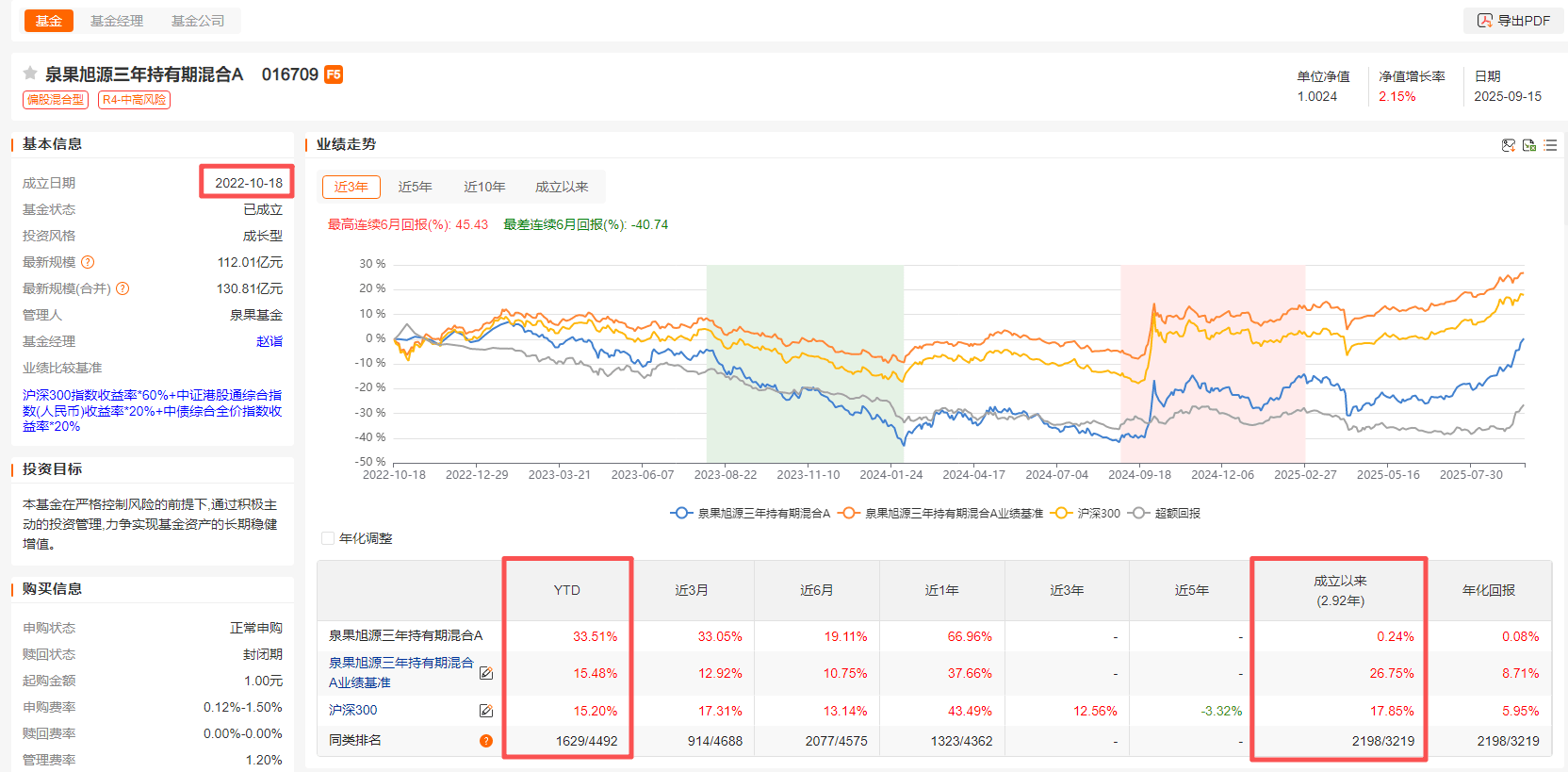
Group 1 - The first public fund of QuanGuo Fund, QuanGuo XuYuan Three-Year Holding Period Mixed Fund (016709), is approaching its first redemption period, having achieved a cumulative return of only 0.24% since its establishment in October 2022, significantly lagging behind its performance benchmark by 26.5 percentage points [1][5] - As of mid-2025, the fund's A share size reached 11.2 billion yuan, accounting for over 70% of the company's total managed assets, making it a crucial product for the company [5][7] - The fund's investment focus includes growth sectors such as new energy, high-end manufacturing, military industry, and TMT, but its long-term performance remains disappointing [5][6] Group 2 - In 2023, the fund faced a systemic decline in the new energy sector and continued pressure in the Hong Kong internet market, leading to significant net value retracement [6] - Despite a rebound in 2025 driven by themes like AI and military industry, the fund's long-term performance still reflects volatility and instability in industry selection and position management [6][9] - The opening of the redemption period presents both an opportunity for investors to realize returns and a critical moment to assess the fund manager's long-term research capabilities [6][9] Group 3 - QuanGuo Fund, established in February 2022, is a new player in the domestic public fund industry, managing a total of 16.14 billion yuan across five funds as of mid-2025, but heavily reliant on the performance of the XuYuan fund [7][8] - The company faces pressure on its profitability, with a high proportion of client maintenance fees at 44.6% of management fees, indicating a strong dependence on distribution channels [7][8] - The overall fund performance is not ideal, with a reported loss of 940 million yuan from equity investments in the first half of 2025, overshadowing positive returns from other products [7][8] Group 4 - The founding team of QuanGuo Fund, led by Chairman Wang Guobin and fund manager Zhao Yi, was initially seen as a significant advantage, but this has not translated into stable performance [8][9] - The core challenges for the company include limited scale, high fees, strong channel dependence, and unproven research capabilities [8][9] - The experience of QuanGuo Fund serves as a reminder to the industry that holding period funds do not guarantee long-term benefits, and a balance between fees, channels, and performance is essential for new fund companies [9]
D.R. Horton, Inc. (DHI): A Bull Case Theory
Yahoo Finance· 2025-09-16 18:14
Group 1: Company Overview - D.R. Horton, Inc. (DHI) is the largest homebuilder in the U.S., trading at a forward P/E of 9–10x compared to the S&P 500's ~20x, indicating significant undervaluation in growth potential [2][4] - In fiscal 2024, DHI reported earnings per share (EPS) exceeding $14 on revenues over $35 billion, with a return on equity (ROE) consistently above 20% [2] - The company's balance sheet is strong, with a net debt/EBITDA ratio below 1x, showcasing a conservative financial position for a cyclical business [2] Group 2: Market Conditions and Opportunities - Elevated mortgage rates have depressed housing affordability in 2023–24, but this is expected to improve as inflation decreases and the Federal Reserve may cut rates in 2025 [3] - A potential drop in mortgage rates from ~7.5% to the 5–6% range could unleash pent-up demand from millions of sidelined buyers [3] - The U.S. housing market is structurally undersupplied by an estimated 3–5 million homes, particularly in the entry-level segment, creating a favorable environment for DHI [3] Group 3: Valuation and Growth Potential - DHI's average selling price is approximately $385K, positioning the company to benefit from a recovery in demand as mortgage rates decline [4] - Projected double-digit earnings and sales growth are achievable, with a potential re-rating to a 12–14x multiple on projected $15 EPS, suggesting a stock value between $180–210 compared to the current ~$140 [4] - The combination of discounted valuation, structural demand tailwinds, and rate-driven catalysts presents an attractive risk/reward profile for investors [4] Group 4: Recent Performance and Sentiment - DHI's stock price has appreciated approximately 44.5% since a previous bullish thesis was published, reflecting resilient fundamentals [5] - The company is not among the 30 most popular stocks among hedge funds, with 67 hedge fund portfolios holding DHI at the end of the first quarter, up from 60 in the previous quarter [6]

Valaris Limited (VAL): A Bull Case Theory
Yahoo Finance· 2025-09-16 16:56
Core Thesis - Valaris Limited is positioned to benefit from a recovering offshore drilling market, with a modernized fleet and minimal net debt, making it an attractive investment opportunity [2][5]. Company Overview - Valaris is a leading provider of offshore drilling rigs and crews, enabling oil and gas companies to access hydrocarbons without owning the resources [2]. - The company emerged from bankruptcy with a modernized fleet, allowing it to capitalize on market conditions [2]. Market Dynamics - The supply-demand dynamic in the offshore drilling market has led to a significant increase in day rates, with seventh-generation drillships' rates doubling from approximately $250K/day to $500K/day since 2022 [3]. - Revenue efficiency has been reported at 96–99%, contributing to revenue growth from $1.2 billion in 2021 to $2.4 billion TTM [3]. Contractual Backlog - Valaris has secured long-term contracts in key regions, building a backlog exceeding $4 billion, which indicates strong demand and profitability of its fleet [4]. - Since April 2025, the company has added over $1 billion in new contract commitments, raising the total backlog to approximately $4.7 billion [4]. Financial Health and Shareholder Returns - The company has strong cash flow and a solid balance sheet, actively returning capital to shareholders through a share repurchase program, with about 10% of its market capitalization remaining under buyback authorization [5]. - Valaris presents a compelling investment case due to its efficient operations, robust backlog, and high-margin revenue streams [5]. Recent Developments - The stock has appreciated approximately 9% since a previous bullish thesis, reflecting improving offshore demand and operational efficiency [6]. - Recent contract wins and shareholder returns have been emphasized as key factors in the ongoing positive outlook for Valaris [6].

低价股不一定更安全
Bei Jing Shang Bao· 2025-09-16 16:53
Core Viewpoint - The article emphasizes that low-priced stocks are not necessarily safer investments and may carry significant risks due to underlying performance and operational issues [1][2]. Group 1: Performance Issues - Many low-priced stocks exhibit poor profitability, with weak revenue growth and potential net losses, which can lead to significant declines in stock prices [1]. - Investors may face long-term losses if they blindly purchase low-priced stocks solely based on their price, risking capital being tied up and facing potential delisting [1]. Group 2: Operational Risks - Low-priced stocks may suffer from management issues, unclear strategic direction, and a lack of foresight, which can hinder performance and growth [1]. - High levels of debt in some companies can lead to financial strain and potential debt crises, amplifying investment risks for shareholders [1]. Group 3: Market Sentiment and Speculation - Low-priced stocks are often influenced by market sentiment and speculative trading, which can lead to price manipulation and attract uninformed investors [2]. - The liquidity of low-priced stocks is typically poor, especially in unfavorable market conditions, making it difficult for investors to sell their shares [2]. Group 4: Delisting Risks - Low-priced stocks face a higher likelihood of delisting due to their price levels, and there is a risk of major shareholders depleting the company's valuable assets if they anticipate delisting [2]. - Companies with low-priced stocks may receive adverse audit opinions, further increasing the risk of delisting [2]. Group 5: Investment Strategy - To avoid the pitfalls of low-priced stocks, investors should adhere to rational value investing principles, focusing on high-quality blue-chip stocks with strong performance and growth potential [3]. - A comprehensive analysis of a company's fundamentals, including profitability, financial health, industry position, and management team, is essential for making informed investment decisions [3].
INTR or AXP: Which Is the Better Value Stock Right Now?
ZACKS· 2025-09-16 16:41
Core Insights - Investors in the Financial - Miscellaneous Services sector may consider Inter & Co. Inc. (INTR) and American Express (AXP) for potential value opportunities [1] - The Zacks Rank system emphasizes earnings estimates and revisions, which are crucial for identifying value stocks [2] Valuation Metrics - Currently, INTR has a Zacks Rank of 2 (Buy), while AXP has a Zacks Rank of 3 (Hold), indicating a stronger earnings outlook for INTR [3] - INTR's forward P/E ratio is 16.08, compared to AXP's 21.45, suggesting INTR may be undervalued [5] - INTR has a PEG ratio of 0.44, while AXP's PEG ratio is 1.73, indicating INTR's expected earnings growth is more favorable [5] - INTR's P/B ratio is 2.38, significantly lower than AXP's P/B of 7.05, further supporting INTR's valuation attractiveness [6] - Based on these metrics, INTR holds a Value grade of A, while AXP has a Value grade of C, positioning INTR as the superior value option [6]


侃股:低价股安全性不一定更高
Bei Jing Shang Bao· 2025-09-16 12:57
随着股指不断走高,部分投资者有了"恐高"情绪,转而开始关注低价股。其实低价股并不一定更安全, 其业绩或者经营反而可能存在各种问题,投资者应警惕其中的投资风险。 值得注意的是,如果投资者买入的低价股股价足够低,还存在面值退市或者市值退市的风险,而且低价 股还有可能会出现控股股东"竭泽而渔"的风险。从退市机制方面来考虑,低价股本身就比高价股存在更 大的退市可能。如果控股股东认为自己无力避免公司退市,那么可能会想尽最后的办法掏空上市公司有 价值的最后资产,这会让上市公司的业绩雪上加霜,问题严重的,还有可能被审计机构出具非标审计意 见并引发退市。 投资者想要避免陷入低价股的"陷阱",关键在于坚持理性的价值投资观念,拥抱业绩和成长性俱佳的优 质蓝筹股。在选择股票时,不能仅仅关注股价的高低,还要全面深入地分析上市公司的基本面。考察企 业的盈利能力、财务状况、行业地位、管理团队等因素,选择那些具有良好发展前景、业绩稳定增长的 上市公司进行投资。同时,投资者也要保持清醒的头脑,不被市场的短期波动和投机氛围所左右,坚持 长期价值投资的理念。 经营方面的问题同样是低价股的一大隐患。一些低价股可能存在管理混乱、战略方向不清晰等情况 ...
How Bath & Body Works Is a Perfect Example of a Value Stock
MarketBeat· 2025-09-16 12:37
Core Insights - Bath & Body Works demonstrates strong financial metrics, particularly in challenging retail sectors, highlighting the importance of understanding niche businesses and their financial health [4][6] - The company maintains a gross profit margin of 44.6%, indicating strong customer loyalty and effective pricing power [6][7] - Bath & Body Works has a return on invested capital (ROIC) of 28.3%, showcasing effective financial management and potential for compounding growth [9] Financial Performance - The company reported an operating cash flow of $145 million, a significant increase from $30 million the previous year, despite sales growth of less than 2% [11] - Bath & Body Works has engaged in stock buybacks amounting to $254 million, supporting shareholder value and market valuation [11] - The current stock price is $26.47, with a 12-month price forecast of $39.69, indicating a potential upside of 49.95% [10] Market Position - Analysts maintain a Moderate Buy rating for Bath & Body Works, with a valuation that is 63% of its 52-week high, suggesting it remains an attractive investment opportunity [12] - J.P. Morgan Chase increased its holdings in Bath & Body Works by 11.5%, reflecting confidence in the company's fundamentals [13] - Despite recent bearish price action, the company's strong fundamentals are expected to be reflected in its valuation over time [14]


Unum Group: Compounding Through Capital Allocation (NYSE:UNM)
Seeking Alpha· 2025-09-16 09:58
Core Insights - The article emphasizes a value investing approach with a focus on long-term horizons and an owner's mindset [1] Group 1 - The analyst does not engage in writing sell articles, as they are viewed as short theses, and does not recommend shorting stocks [1] - The analyst has previously worked as an advisory representative at Fidelity and is now conducting independent research and investing [1] Group 2 - The analyst has no current stock, option, or similar derivative positions in the companies mentioned but may initiate a long position in UNM within the next 72 hours [2] - The article reflects the analyst's personal opinions and is not influenced by compensation from any company mentioned [2] Group 3 - Seeking Alpha clarifies that past performance does not guarantee future results and that no specific investment advice is being provided [3] - The views expressed may not represent those of Seeking Alpha as a whole, and the analysts are third-party authors who may not be licensed or certified [3]


海外创新产品周报:锐联发行基本面选股产品-20250916
Shenwan Hongyuan Securities· 2025-09-16 08:43
- Model Name: RuiLian Market Cap Weighted Index ETF - Model Construction Idea: The index still uses market cap weighting but selects stocks based on four fundamental indicators: sales, cash flow, dividends and buybacks, and book value including intangible assets, focusing on the economic efficiency of enterprises[11] - Model Construction Process: The model involves screening stocks using the four fundamental indicators mentioned above, and then applying market cap weighting to the selected stocks[11] - Model Evaluation: The model aims to achieve better returns with relatively small tracking errors compared to broad-based indices[11] - Factor Name: Sales - Factor Construction Idea: Select stocks based on their sales performance[11] - Factor Construction Process: The factor is constructed by evaluating the sales figures of companies and selecting those with strong sales performance[11] - Factor Name: Cash Flow - Factor Construction Idea: Select stocks based on their cash flow performance[11] - Factor Construction Process: The factor is constructed by evaluating the cash flow figures of companies and selecting those with strong cash flow performance[11] - Factor Name: Dividends and Buybacks - Factor Construction Idea: Select stocks based on their dividends and buybacks performance[11] - Factor Construction Process: The factor is constructed by evaluating the dividends and buybacks figures of companies and selecting those with strong performance in these areas[11] - Factor Name: Book Value Including Intangible Assets - Factor Construction Idea: Select stocks based on their book value including intangible assets[11] - Factor Construction Process: The factor is constructed by evaluating the book value including intangible assets of companies and selecting those with strong performance in this area[11] Model Backtest Results - RuiLian Market Cap Weighted Index ETF, tracking error: relatively small[11] Factor Backtest Results - Sales factor, performance: strong[11] - Cash Flow factor, performance: strong[11] - Dividends and Buybacks factor, performance: strong[11] - Book Value Including Intangible Assets factor, performance: strong[11]