金融服务实体经济

Search documents
期货赋能暖黔乡 “信富乡村”结“安 顺”情缘——信达期货以金融“活水”精准滴灌黔中振兴路
Qi Huo Ri Bao· 2025-10-31 08:49
Core Insights - The 20th Central Committee's Fourth Plenary Session has outlined a new blueprint for rural revitalization, emphasizing the acceleration of agricultural modernization and the effective implementation of policies to benefit farmers [1] - The collaboration between government and enterprises is crucial for rural revitalization, with a focus on establishing platforms for discussion and cooperation [2] Group 1: Agricultural Development and Challenges - The agricultural development in Anshun City is highlighted, with local leaders discussing the status of agricultural industries and the challenges faced, such as poor market sales and weak branding [3] - Specific local products like "Duo Bei Tea" and "Huang Niu" are identified as key drivers for agricultural development, but issues like price volatility and market access remain significant obstacles [3] Group 2: Financial Tools and Support - Financial tools, particularly futures contracts, are emphasized as essential for managing price risks in agriculture, with examples provided for various crops [4] - The signing of cooperation agreements between financial institutions and local agricultural departments marks a significant step towards practical support for rural revitalization [4] Group 3: Community Engagement and Education - The importance of community engagement is underscored through visits to local villages, where discussions on brand development and e-commerce channels took place [5] - Educational initiatives are highlighted as vital for breaking the cycle of poverty, with a focus on supporting local children and fostering a culture of learning [6][7] Group 4: Commitment to Long-term Support - The commitment of financial institutions to long-term support for rural areas is evident through the establishment of partnerships and frameworks for ongoing assistance [5][8] - The historical context of community support and the dedication of individuals in the region are recognized as foundational elements for future success in rural revitalization efforts [8][9]
2025金融街论坛年会闭幕 取得三大显著成效
Zheng Quan Ri Bao· 2025-10-31 07:14
Core Insights - The 2025 Financial Street Forum concluded with a focus on "Resilient Cooperation in International Trade and Economy under Global Changes," gathering over 400 officials and experts from more than 30 countries and regions, marking the largest scale and impact in its history [1][2] Group 1: Financial Policy and Market Stability - The forum highlighted the role of financial policy as a "barometer," with key insights from Vice Premier He Lifeng, providing stability and confidence to the market amid profound changes in the global financial system [1] Group 2: International Cooperation Expansion - The number of overseas sub-venues increased to five, covering key regions such as Southeast Asia, the Middle East, Europe, and North America, enhancing professional and diverse international cooperation mechanisms [2] Group 3: Results and Collaboration - The forum facilitated the unveiling of several significant institutions and the signing of multiple international cooperation agreements, resulting in over 100 important outcomes and substantial investment discussions between more than 300 quality enterprises and over 100 investment institutions [2]

中国建设银行股份有限公司2025年第三季度报告
Zheng Quan Ri Bao· 2025-10-30 22:52
Core Points - The announcement confirms the authenticity and completeness of the financial report for the third quarter of 2025, with the board of directors taking legal responsibility for its accuracy [1][23][24] Financial Data - As of September 30, 2025, total assets reached 45.37 trillion yuan, an increase of 4.80 trillion yuan or 11.83% from the previous year [10] - Total loans and advances amounted to 27.68 trillion yuan, up by 1.84 trillion yuan or 7.10% [10] - Financial investments increased to 12.35 trillion yuan, reflecting a growth of 1.67 trillion yuan or 15.61% [10] - Non-performing loans stood at 365.47 billion yuan, an increase of 20.78 billion yuan, with a non-performing loan ratio of 1.32%, down by 0.02 percentage points [11] - Total liabilities were 41.71 trillion yuan, rising by 4.49 trillion yuan or 12.05% [11] - Total equity reached 3.66 trillion yuan, an increase of 312.18 billion yuan or 9.34% [11] Profitability - The net profit for the first nine months of 2025 was 258.45 billion yuan, with a year-on-year growth of 0.52% [13] - Net interest income decreased by 3.00% to 427.61 billion yuan, with a net interest margin of 1.36%, down by 16 basis points [13] - Non-interest income increased by 13.95% to 146.10 billion yuan, with fee and commission income rising by 5.31% [13] Shareholder Information - As of September 30, 2025, the total number of ordinary shareholders was 343,236, with 307,319 A-share shareholders and 35,917 H-share shareholders [3] - The top three H-share shareholders included State Grid Corporation, China Yangtze Power, and China Baowu Steel Group, holding significant shares [3][4] Dividend Distribution - The company plans to distribute a mid-term cash dividend of 1.858 yuan per 10 shares, totaling approximately 48.61 billion yuan [14] - The dividend for domestic preferred shares is set at 3.57%, amounting to 2.142 billion yuan [25][26] Other Important Information - The company issued 45 billion yuan in subordinated debt in July 2025 and plans to increase capital in its wholly-owned subsidiary [15] - The board approved the revised articles of association, eliminating the supervisory board and transferring its duties to the audit committee [15]

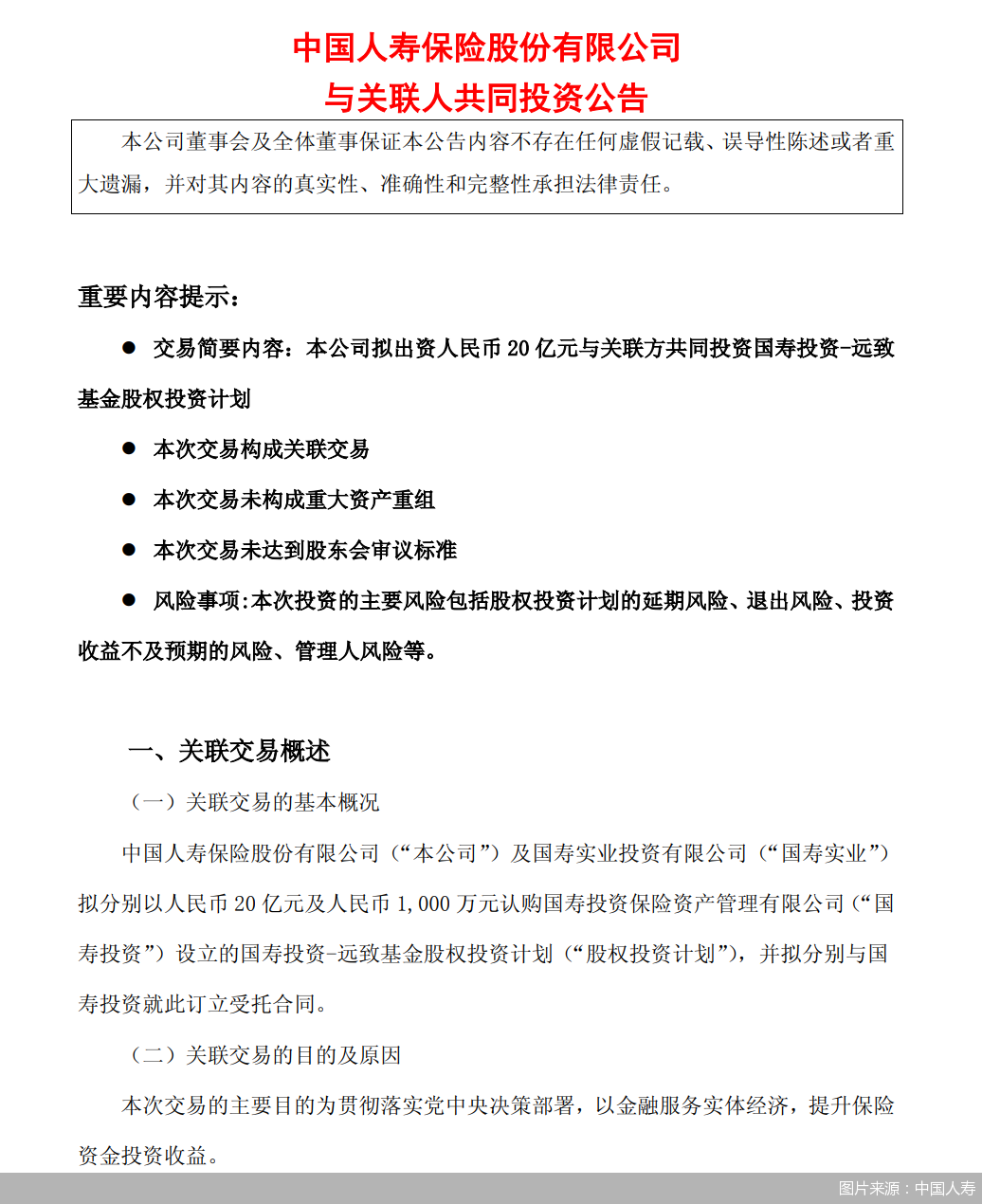
中国人寿:拟出资20亿元投资股权投资计划,主要投资半导体等领域
Bei Jing Shang Bao· 2025-10-30 15:15
Core Viewpoint - China Life Insurance Co., Ltd. announced a joint investment with related parties in a fund aimed at investing in sectors such as semiconductors, digital energy, and smart electric vehicles [1][5]. Group 1: Investment Details - The company plans to invest RMB 2 billion and its affiliate, Guoshou Industrial Investment Co., Ltd., will invest RMB 10 million in the Guoshou Investment - Yuanzhi Fund Equity Investment Plan [1][5]. - The investment will be made through a trust agreement with Guoshou Investment Insurance Asset Management Co., Ltd. [1][5]. Group 2: Purpose and Objectives - The primary purpose of this transaction is to implement the central government's decision to enhance financial services for the real economy and improve investment returns from insurance funds [5]. Group 3: Transaction Classification - This transaction constitutes a related party transaction but does not qualify as a major asset restructuring [6]. - The transaction does not meet the standards for shareholder meeting review [6].


中国银行加速构建“银行+保险”一体化服务生态圈
Jin Rong Shi Bao· 2025-10-30 07:15
Core Points - The signing of a comprehensive strategic cooperation agreement between Bank of China Zibo Branch and PICC Zibo branches marks a new phase of deep integration and collaborative development in the banking and insurance sectors [1][2] - The agreement aligns with the national strategy and focuses on five key areas: technology finance, green finance, inclusive finance, pension finance, and digital finance, aiming to enhance financial services for high-quality economic development [1][2] Group 1 - Zibo, as a birthplace of Qi culture and a demonstration zone for the transformation of old industrial bases, is accelerating the construction of a new type of industrial city, providing ample space for collaborative innovation in banking and insurance [1] - The three parties will collaborate on core business areas including national strategic business, product sales, pension-related financial services, deposit services, payroll and bank card services, and insurance payment collection [1] - The cooperation model aims to create a shared customer base, complementary advantages, and win-win development [1][2] Group 2 - Bank of China Zibo Branch has a long-standing commitment to serving local economic and social development, with new loans exceeding 5 billion yuan for two consecutive years and an annual market share increase of over 1% [2] - The focus will be on building a localized financial service ecosystem that aligns with rural revitalization strategies, addressing tasks such as food security, industrial upgrading, poverty alleviation, and rural construction [3] - The collaboration will integrate financial services and insurance protection, enhancing support in inclusive finance, technological innovation, and supply chain finance [3]


国务院关于金融工作情况的报告:下一步将着力提供高质量金融服务
Zhong Guo Jing Ji Wang· 2025-10-29 04:04
Core Insights - The report presented to the Standing Committee of the 14th National People's Congress emphasizes the financial system's commitment to maintaining stability while enhancing support for the real economy, strengthening financial regulation, and deepening financial reform and opening-up [1][2][3] Group 1: Monetary Policy - The People's Bank of China has implemented a series of substantial monetary policy measures since September 2024, including further reductions in reserve requirements and interest rates to support technology innovation, consumption, small and micro enterprises, and stabilize foreign trade [1][2] - The execution and transmission of monetary policy have been strengthened, resulting in ample liquidity and historically low social financing costs, which positively impacts financial market confidence and economic recovery [1] Group 2: Financial Services Enhancement - Financial services in key areas and weak links have improved, with the establishment of a policy framework and mechanisms to support technology innovation, including the creation of a "Technology Board" in the bond market and increasing re-lending quotas for technology innovation and agricultural support [2] - By September 2025, loans for technology, green initiatives, inclusive finance, elderly care, and digital economy sectors grew significantly, with increases of 11.8%, 22.9%, 11.2%, 58.2%, and 12.9% respectively, all surpassing the overall loan growth rate [2] Group 3: Regulatory and Structural Reforms - The report calls for the implementation of moderately loose monetary policies to create a conducive financial environment for economic recovery, alongside enhancing financial regulation and risk prevention measures [3] - Continuous efforts will be made to deepen supply-side structural reforms in finance and promote high-level bilateral financial openness while maintaining national financial security [3]
【金融街发布】中国人民银行行长潘功胜:大力整治金融机构无序非理性竞争 不断增强监管质效
Xin Hua Cai Jing· 2025-10-28 13:17
Core Viewpoint - The People's Bank of China (PBOC) has reported significant progress in financial work since November 2024, emphasizing the importance of a stable monetary policy to support the real economy and enhance financial services [1][2]. Monetary Policy Execution - The PBOC has implemented a moderately loose monetary policy since 2025, including measures such as reserve requirement ratio (RRR) cuts and interest rate reductions to support technology innovation, consumption, small and micro enterprises, and stabilize foreign trade [1][2]. - As of September 2025, loans in key sectors such as technology, green finance, and digital economy have seen substantial year-on-year growth rates, with technology loans increasing by 11.8% and green loans by 22.9% [2]. Financial Market Stability - The Chinese financial market has withstood significant external shocks, with improved expectations and confidence among market participants [1][2]. - The PBOC has explored various monetary policy tools to maintain market stability, particularly during the global financial market turbulence in April 2025 [1]. Financial Reform and Opening Up - A comprehensive cross-border payment system for the Renminbi has been established, with the currency becoming the largest for cross-border payments in China and ranking among the top three globally for trade financing [2]. - The PBOC is committed to enhancing international financial cooperation and maintaining national financial security [2]. Risk Management - The PBOC has utilized mergers, market exits, and other strategies to reform and mitigate risks in small and medium-sized financial institutions, resulting in a significant reduction in the number of financing platforms and their debt levels [2]. Future Work Considerations - The PBOC plans to continue implementing a moderately loose monetary policy and enhance financial regulation to improve the quality of financial services [3][4]. - There is a focus on providing high-quality financial services to key sectors, including technology innovation and small enterprises, while ensuring policy coordination across fiscal, monetary, and industrial domains [3][4]. Structural Reforms - The PBOC aims to deepen supply-side structural reforms in finance, improve the central bank's system, and enhance the macro-prudential management framework [4][5]. - Efforts will be made to promote the internationalization of the Renminbi and maintain financial security through systematic monitoring and risk assessment [4][5].
国务院关于金融工作情况的报告
第一财经· 2025-10-28 12:38
Core Viewpoint - The report emphasizes the importance of financial work in supporting high-quality economic development and maintaining financial stability, guided by the principles set forth by the central leadership [2][3]. Financial Work Progress and Achievements - Since November 2024, the financial system has focused on stabilizing and improving support for the real economy, enhancing financial regulation, and deepening financial reform and opening up, achieving new results [3]. - Monetary policy measures have been implemented, including a package of significant monetary policy measures introduced in May 2025, resulting in a year-on-year growth of 8.7% in social financing scale and 8.4% in broad money supply by September [3]. - By September 2025, the total assets of financial institutions exceeded 520 trillion yuan, with a capital adequacy ratio of 15.36% and a non-performing loan ratio of 1.52% for commercial banks, indicating a stable financial environment [4][5]. Financial Support for the Real Economy - From November 2024 to September 2025, A-share IPOs raised 91.8 billion yuan, with 86% from private enterprises and 92% from strategic emerging industries [6]. - Loans for technology, green, inclusive, elderly, and digital economy sectors grew significantly, with year-on-year increases of 11.8%, 22.9%, 11.2%, 58.2%, and 12.9% respectively by September 2025 [6]. Financial Reform and Opening Up - The reform of financial institutions has deepened, with state-owned banks successfully raising 520 billion yuan for capital replenishment [7]. - The cross-border payment system for the renminbi has been established, with the renminbi becoming the largest currency for cross-border payments in China and ranking third in the IMF's Special Drawing Rights basket [8]. Risk Prevention and Mitigation - Measures have been taken to resolve risks in small and medium-sized financial institutions, with a 71% decrease in the number of financing platforms and a 62% reduction in operating financial debt by September 2025 compared to March 2023 [9]. - The real estate market is being supported through macro-prudential management, with new loans of 2.2 trillion yuan facilitated through a "white list" mechanism [9]. Future Work Considerations - The focus will be on implementing a moderately loose monetary policy to support economic recovery, enhancing financial regulation, and providing high-quality financial services to key sectors [11][12]. - Continued efforts will be made to deepen financial supply-side structural reforms and promote the internationalization of the renminbi [13][14].

潘功胜:突出金融服务实体经济重点方向 着力提供高质量金融服务
Zheng Quan Shi Bao Wang· 2025-10-28 11:29
Core Viewpoint - The People's Bank of China emphasizes the importance of providing high-quality financial services to support the real economy, focusing on key areas such as technological innovation, consumption stimulation, small and micro enterprises, and stabilizing foreign trade [1] Group 1: Financial Services Focus - The next steps will highlight financial services for the real economy, aiming to enhance the quality of financial services [1] - Financial institutions are guided to improve their specialized and refined service capabilities [1] Group 2: Policy Coordination - There will be a strong emphasis on the coordination of fiscal, monetary, and industrial policies to effectively support key sectors and address weaknesses [1] - Existing structural monetary policy tools will be managed and utilized effectively to support priority areas [1] Group 3: Targeted Financial Support - Financial support will be precisely and effectively advanced to enhance the quality and upgrade of key industries [1]
未来五年怎么走?政策性银行、国有大行集体发声,擘画“十五五”工作重点
Xin Lang Cai Jing· 2025-10-28 01:21
Core Viewpoint - The financial regulatory bodies in China are focusing on risk prevention and enhancing financial services to support the real economy, as outlined in the spirit of the 20th National Congress of the Communist Party of China [1][2][4]. Financial Regulatory Focus - The central bank and financial regulatory authorities emphasize the importance of risk prevention and the establishment of a comprehensive financial risk management system [2][4]. - The next phase of work will prioritize enhancing financial services for the real economy, particularly in areas such as technology innovation, consumption stimulation, and support for small and micro enterprises [1][2][4]. Key Work Areas - The People's Bank of China (PBOC) has identified five key areas for future work: maintaining centralized leadership in financial work, developing a robust monetary policy framework, enhancing macro-prudential management, deepening supply-side structural reforms, and promoting high-level financial openness [2][3][4]. - Financial institutions are encouraged to align their strategies with national goals, focusing on the "Five Major Articles" to improve financial service quality and adaptability [4][5]. Progress in Financial Services - As of Q3 2025, the balance of inclusive small and micro loans reached 36.09 trillion yuan, with a year-on-year growth of 12.2%, outpacing overall loan growth by 5.6 percentage points [8]. - Green loans also saw significant growth, with a balance of 43.51 trillion yuan, reflecting a 17.5% increase since the beginning of the year [8][9]. Institutional Responses - Major state-owned banks and policy banks are actively implementing strategies to support national priorities, including food security, rural development, and ecological sustainability [5][6][7]. - Insurance companies are also aligning their strategies with the national agenda, focusing on enhancing support for technology innovation and green development [6][7]. Digital Transformation and Innovation - Banks are increasingly adopting digital transformation and AI applications to improve service efficiency across various functions, including credit assessment and customer service [10]. - The banking sector is also focusing on developing pension financial products to cater to the aging population, with initiatives aimed at enhancing the pension service system [10].