
Cloud Computing

Search documents
The Best Company in Big Tech?
The Motley Fool· 2025-05-05 16:35
Microsoft - Microsoft has reported strong financial results, with revenue up approximately 13% and net income increasing even more significantly, leading to a nearly 10% rise in share price post-report [5][22] - Cloud revenue grew by 20%, with Azure revenue specifically increasing by 33%, driven in part by AI-related services, although management noted that non-AI services also contributed significantly to this growth [5][7] - The company plans to maintain its capital expenditures, expecting to spend as much as $80 billion this year, indicating confidence in ongoing demand for AI and cloud services despite macroeconomic concerns [6][7] - Microsoft is experiencing double-digit growth across five segments, including Microsoft 365 and search advertising, suggesting a robust overall business performance [9][10] - The company is positioned well in the market, being insulated from economic uncertainties due to the critical nature of its software products, which are essential for business operations [22] Meta - Meta's revenue increased by 16%, with net income rising by 35%, driven by strong engagement and advertising efficiency, largely attributed to AI investments [12][14] - Daily active users across Meta's platforms reached 3.43 billion, representing 60% of the global internet population, with ad impressions up 5% and average ad prices increasing by 10% year-over-year [12][13] - The company is focusing on AI to enhance advertising effectiveness, with a significant increase in advertisers utilizing AI tools, which is expected to further boost productivity and revenue [13][19] - Mark Zuckerberg emphasized the importance of AI in transforming advertising and enhancing user experience, with plans for AI devices and applications to integrate seamlessly into Meta's ecosystem [16][20] - Despite some concerns regarding external factors like tariffs affecting advertising spend, Meta's revenue guidance remains in line with expectations, indicating resilience in its business model [15][31] Warner Brothers Discovery - David Zaslav, CEO of Warner Brothers Discovery, is viewed as a controversial figure, focusing on efficiency and profitability, which has led to mixed perceptions in Hollywood [27][29] - Zaslav aims to revitalize the media industry by competing with tech giants and emphasizes the importance of franchising, looking to replicate Disney's success with the DC Comics Universe [30][31] - Despite Zaslav's efforts to grow the company, Warner Brothers Discovery's stock has significantly underperformed since its merger, dropping from $25 to around $9 per share [31] - Zaslav's compensation structure is tied to cash flow generation rather than stock performance, which aligns with the company's need to manage its substantial debt load [31][32]




AKAM Set to Report Q1 Results: Will Top-Line Growth Boost Earnings?
ZACKS· 2025-05-05 16:25
Akamai Technologies, Inc. (AKAM) is scheduled to release first-quarter 2025 results on May 8, after the closing bell. In the last reported quarter, the company delivered an earnings surprise of 9.21%. It pulled off a trailing four-quarter earnings surprise of 3.42%, on average. The company is expected to report higher revenues year over year, backed by healthy demand in security and compute verticals across multiple end markets. Management’s focus on expanding its product portfolio to cater to advanced use ...


MongoDB: High Growth Database Software Company
Seeking Alpha· 2025-05-05 12:01
Group 1 - MongoDB, Inc. is a cloud-based database provider with a strong growth track record, averaging 37% growth over the past five years [1] - The analysis focuses on MongoDB's business model to understand its growth drivers and assess its potential for continued growth [1] Group 2 - Khaveen Investments is a global investment advisory firm that provides comprehensive services including market and security research, business valuation, and wealth management [1] - The firm employs a multifaceted investment approach that integrates global macro, fundamental, and quantitative strategies, focusing on disruptive technologies [1]


1 Overlooked Growth Stock Down 55% to Buy on the Dip, According to Wall Street
The Motley Fool· 2025-05-05 11:45
Core Viewpoint - Workiva has developed a software platform that integrates data for organizations, enabling efficient reporting for executives, investors, and regulators, and has reported strong financial results for Q1 2025, exceeding expectations on both revenue and earnings [1][8][11]. Financial Performance - Workiva generated $206 million in revenue for Q1 2025, marking a 17% increase year-over-year and surpassing management's guidance of $205 million [8]. - The company reported a GAAP loss of $0.38 per share, which was better than the forecasted loss of $0.45 per share, while achieving a non-GAAP profit of $0.14 per share, exceeding the expected $0.07 [11][12]. - Workiva's net revenue retention rate decreased to 110% from 111% year-over-year, indicating slower spending growth from existing customers [13]. Customer Growth and Market Position - Workiva had 6,385 customers at the end of Q1 2025, reflecting a modest 5% year-over-year increase, with significant growth in high-spending customer cohorts [9]. - The company’s addressable market is valued at $35 billion, suggesting substantial growth potential based on its current revenue of $206 million [19]. Analyst Sentiment and Stock Valuation - Analysts are overwhelmingly bullish on Workiva, with an average price target of $102, indicating a potential upside of 54% over the next 12 to 18 months [16]. - The stock is currently 55% below its 2021 high, with a price-to-sales (P/S) ratio of 4.9, close to its lowest level in five years and a 49% discount to its average P/S ratio of 9.6 during that period [2][17]. Strategic Outlook - Workiva's management plans to continue investing in growth, supported by a solid balance sheet with $767 million in cash and equivalents [14][15]. - Despite a forecast of steady revenue growth at 17% for Q2, there are concerns regarding worsening bottom-line results [14].


My Top AI Growth Stock to Buy in May (and It's Not Even Close)
The Motley Fool· 2025-05-05 09:10
Like most megacap growth stocks, Microsoft (MSFT 2.31%) had been down big year to date due to a widespread sell-off, tariff turmoil, and recession fears. But Microsoft and other growth stocks have recovered in recent weeks.On Thursday, Microsoft rocketed even higher in response to a monster third-quarter fiscal 2025 report and strong guidance. At the time of this writing, Microsoft has rebounded by so much that it is now positive on the year even though major indexes like the S&P 500 (SNPINDEX: ^GSPC) and N ...

Q3财报超预期,微软重回全球市值第一
2 1 Shi Ji Jing Ji Bao Dao· 2025-05-03 04:43
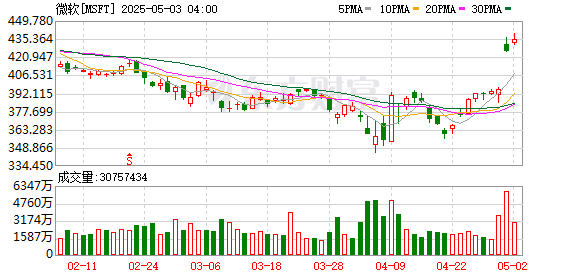
Core Insights - Microsoft reported strong Q3 results for FY2025, with revenue and profit exceeding market expectations, driven by AI and cloud computing [2][3] - The company's market capitalization surpassed $3 trillion, reclaiming its position as the world's most valuable company [2][5] Financial Performance - Total revenue reached $70.066 billion, a 13.3% year-over-year increase, surpassing analyst expectations of $68.42 billion [2] - Net profit was $25.824 billion, up 17.7% year-over-year, with adjusted earnings per share at $3.46, also exceeding forecasts [2] Cloud and AI Growth - Microsoft’s Intelligent Cloud segment generated $26.75 billion in revenue, a 21% increase year-over-year, with Azure and other cloud services growing by 33% [2][3] - AI services contributed 16 percentage points to Azure's growth, indicating strong demand for AI integration in business operations [3] Capital Expenditure and Future Plans - Capital expenditures for the quarter reached $16.75 billion, a 53% increase year-over-year, primarily for data center expansion and AI chip procurement [3] - Microsoft plans to invest a total of $80 billion in AI infrastructure for FY2025, aiming to increase AI training capacity fivefold by 2026 [3][4] Market Position and Competitive Landscape - Microsoft’s guidance for the next quarter anticipates revenue between $73.15 billion and $74.25 billion, with Azure growth projected at 34%-35% [4] - Despite concerns about AI demand slowing, Microsoft’s performance suggests continued strong demand and a robust market position compared to competitors like Amazon and Google [5][6] Industry Impact - Microsoft’s significant capital expenditure and cloud growth are seen as a positive signal for the AI supply chain, benefiting hardware manufacturers [5] - The performance of Microsoft may influence investor sentiment in other markets, including Hong Kong and A-shares, as confidence in AI investments grows [6]
赛道Hyper | 微软2025财年Q3业绩超预期
Hua Er Jie Jian Wen· 2025-05-02 04:58
Core Viewpoint - Microsoft's Q3 FY2025 earnings report shows strong growth driven by Azure cloud services and AI demand, exceeding analyst expectations in revenue and profit [1][2][16] Financial Performance - Microsoft reported revenue of $70.066 billion, a 13% year-over-year increase, surpassing the analyst consensus of $68.42 billion [1] - Net profit reached $25.824 billion, up 18% year-over-year, with adjusted earnings per share at $3.46, exceeding the expected $3.21 [1] - The company forecasts Q4 revenue between $73.15 billion and $74.25 billion, above the market expectation of $72.26 billion [2] Azure Cloud Services - Azure cloud revenue was $26.8 billion, reflecting a 33% year-over-year growth, outperforming the market expectation of 29% [1][2] - The demand for AI computing power is driving Azure's growth, with over 1 trillion AI tokens processed in the last quarter, a fivefold increase [4][17] - Microsoft's Azure growth rate is 1.7 times that of AWS's 19% and 94% of Google's cloud growth rate of 35% [5][13] Business Segmentation - Microsoft's business segments include Productivity and Business Processes (42.73% of revenue), Intelligent Cloud (38.20%), and Personal Computing (19.07%) [5] - The Intelligent Cloud segment, which includes Azure, generated $26.8 billion, accounting for 38.2% of total revenue [5] Growth Drivers - Key growth drivers for Azure include a deepened hybrid cloud strategy, compliance advantages in government cloud services, and advancements in proprietary AI chips [6][8] - Microsoft's hybrid cloud strategy, particularly Azure Arc, is attracting clients from sectors like finance and healthcare [6][7] AI Integration - The Productivity and Business Processes segment saw revenue of $29.94 billion, a 10% increase, driven by AI technology enhancements [9] - The AI application Copilot has reached a penetration rate of 35%, contributing to a 9% increase in average revenue per user [11] - Microsoft 365 commercial subscriptions grew by 12% due to AI integration [12] Market Position - Microsoft holds a 35% market share in the global hybrid cloud market, projected to reach $124 billion in 2024 [7] - The overall cloud infrastructure services market is expected to grow to $330 billion in 2024, a 22% increase from the previous year [3][16] Competitive Landscape - Microsoft Azure's growth outpaces AWS, which remains the market leader, indicating strong competitive positioning [13][17] - The company is leveraging AI-first strategies to attract enterprise clients, particularly in the context of OpenAI's GPT-4 training [14]
Buy Meta Platforms or Microsoft Stock After Beating Earnings Expectations?
ZACKS· 2025-05-01 22:30
The Nasdaq has continued to rebound and drift higher after the market received favorable quarterly results and guidance from Meta Platforms (META) and Microsoft (MSFT) .Reporting after-market hours on Thursday, both were able to exceed expectations with Meta and Microsoft’s stock spiking +4% and +7% in today's trading session, respectively. Meta's Q1 Results With Meta CEO Mark Zuckerberg stating the company is making good progress on its AI initiatives, the social media giant’s Q1 sales increased 16% year ...

Motorola Solutions(MSI) - 2025 Q1 - Earnings Call Transcript
2025-05-01 21:00
Financial Data and Key Metrics Changes - Q1 revenue grew by 6%, exceeding guidance, with all three technologies contributing to growth [12] - GAAP operating earnings were $582 million, representing 23% of sales, an increase from 21.7% in the previous year [12] - Non-GAAP operating earnings rose to $716 million, up 12% year-over-year, with a non-GAAP operating margin of 28.3%, an increase of 160 basis points [12] - GAAP earnings per share (EPS) was $2.53, up from a loss of $0.23 in the prior year [12] - Non-GAAP EPS increased by 13% to $3.18 from $2.81 last year [12] - Operating cash flow for Q1 was $510 million, up $128 million year-over-year, while free cash flow was $473 million, an increase of $137 million [13] Business Line Data and Key Metrics Changes - Software and Services revenue increased by 9%, driven by strong adoption of software applications and LMR services [9] - Products and SI sales grew by 4%, with significant operating margin expansion due to higher-tier public safety devices and lower material costs [10] - In Products and SI, operating earnings were $434 million, or 28.1% of sales, up from 24.8% in the prior year [15] - Software and Services operating earnings were $282 million, or 28.7% of sales, down from 29.8% last year, primarily due to acquisitions [16] Market Data and Key Metrics Changes - North America Q1 revenue was $1.9 billion, up 9% across all technologies [16] - International Q1 revenue was $676 million, down 3% year-over-year, affected by foreign currency headwinds and lower LMR revenue from Ukraine [16] - Ending backlog for Q1 was $14.1 billion, down 2% year-over-year, driven by strong LMR shipments and revenue recognition [18] Company Strategy and Development Direction - The company is focused on expanding its public safety ecosystem with new products and solutions, including the recent acquisitions of RapidDeploy and Theatro [10] - Investments in video and software are expected to drive meaningful revenue growth, with a strong pipeline of new opportunities [23] - The launch of SVX and Assist technologies aims to transform public safety operations by integrating voice, video, and AI capabilities [24] Management's Comments on Operating Environment and Future Outlook - Management expressed confidence in the company's positioning, noting that customers continue to prioritize investments in safety and security [11] - The company expects strong revenue, earnings, and cash flow growth for the year, despite challenges from tariffs [11] - For Q2, sales growth is expected to be approximately 4%, with full-year revenue growth projected at 5.5% [19] Other Important Information - The company reaffirmed its full-year guidance despite anticipated tariff-related costs of up to $100 million [20] - The balance sheet remains strong, with $1.6 billion in cash on hand and a renewed $2.25 billion revolving credit facility [22] Q&A Session Summary Question: Can you walk us through the video product revenue performance in the quarter? - Video revenue grew nicely, with software leading that growth, and the cloud video offer, Alta, performing well [30][31] Question: Are you seeing any change in customer behavior due to tariff uncertainty? - There has been no noticeable change in customer behavior, and the company is proactively managing tariff impacts through dual sourcing and cost controls [34][35] Question: Can you comment on demand trends and the impact of foreign exchange? - Demand remains strong, with record orders in North America, and the company is cautious about FX impacts due to market volatility [40][41] Question: What are the early demand signals for the new SVX product? - There is high interest from customers, with some planning to upgrade to the APEX NEXT family of radios after seeing the SVX demonstration [50] Question: How is the company positioned regarding federal customers and defense spending? - Demand in the federal market remains strong, with expectations for increased spending on public safety technology [63][64] Question: What are the expectations for state budgets as they enter the new fiscal year? - State and local budgets are looking good, with public safety technology continuing to be prioritized [89][90]

Atlassian (TEAM) - 2025 Q3 - Earnings Call Transcript
2025-05-01 21:00
Financial Data and Key Metrics Changes - Total revenue for Q3 2025 reached $1.4 billion, with cloud revenue growing 25% year over year and a free cash flow margin of 47% [6][10]. - Gross margins improved to 86%, exceeding prior guidance, driven by price increases and engineering investments [40][41]. Business Line Data and Key Metrics Changes - Cloud revenue growth was primarily driven by increased adoption of premium enterprise editions, which rose over 40% year on year [14]. - Data center growth was mainly attributed to pricing, offset by strong migrations to cloud and fewer multiyear agreements [24][25]. Market Data and Key Metrics Changes - The company achieved FedRAMP Moderate Authorization for U.S. Federal Government customers, expanding its cloud platform offerings [9]. - Over 300,000 customers, including major enterprises like Mercedes and SAP, utilize Atlassian's solutions [9]. Company Strategy and Development Direction - Atlassian is focusing on integrating AI capabilities into its core products, with Robo being central to this strategy [7][10]. - The company aims to scale to $10 billion in revenue and beyond, leveraging its strategic priorities in enterprise solutions and AI advancements [10]. Management's Comments on Operating Environment and Future Outlook - Management expressed confidence in achieving a 20% compound annual growth rate (CAGR) through FY 2027, despite macroeconomic uncertainties [18][19]. - The company is adapting to longer deal cycles due to the complexity of enterprise deals, which is seen as a natural evolution rather than a macroeconomic issue [28]. Other Important Information - The introduction of the Teamwork Collection is expected to simplify purchasing for customers and drive long-term revenue growth [69][70]. - The isolated cloud offering is designed to meet the needs of large and complex organizations, providing dedicated resources [76]. Q&A Session Summary Question: Impact of embedding Robo on near-term revenue growth - Management noted that embedding Robo is expected to enhance user adoption and long-term growth potential, despite potential short-term revenue trade-offs [14][15]. Question: Cloud revenue growth and deal timing - Management acknowledged that enterprise deals were back-end loaded, impacting Q3 cloud revenue growth, but expected recognition in Q4 [23]. Question: Transition to annualized data center agreements - Management indicated that the change in agreement duration would lead to better cloud revenue growth contributions in FY 2026 and FY 2027 [36]. Question: Gross margin and efficiency gains - Management highlighted that gross margins of 86% were driven by price increases and efficient cloud infrastructure management, with expectations for continued improvements [40][41]. Question: Effect of tariffs on customer businesses - Management reported no significant macro impact from tariffs, emphasizing a strong pipeline and customer demand for cloud upgrades [54][55]. Question: CRO transition and go-to-market strategy - Management confirmed that the new CRO is adapting well, and the go-to-market strategy continues to evolve to meet customer needs [86][87].
