中小盘成长

Search documents
今年收益25.32%,中小盘行情还能持续吗?
Sou Hu Cai Jing· 2025-08-12 06:02
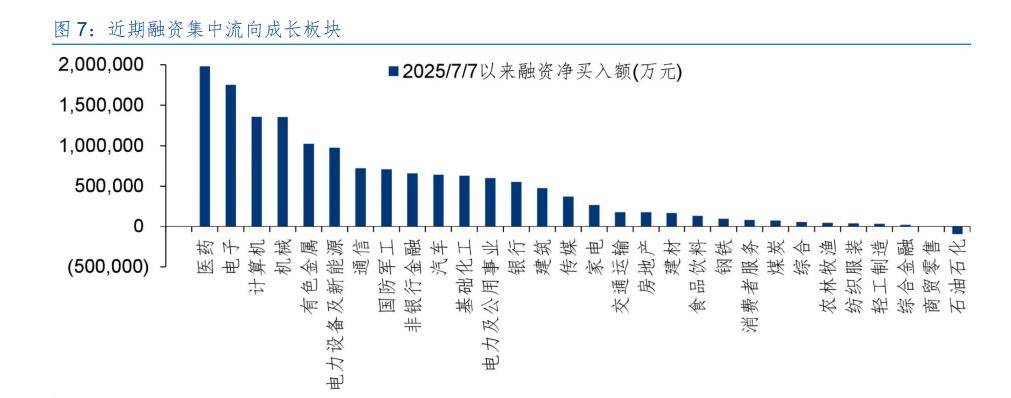
Core Viewpoint - The small and mid-cap stocks have significantly outperformed the Nasdaq and S&P 500, with the CSI 1000 index rising by 16.55% this year, indicating a strong market trend [1] Group 1: Market Performance - The 1000EFT Enhanced (159680) has achieved a year-to-date return of 25.32%, with an excess return of 8.77% [1] - The trading activity remains robust, with a turnover rate of 9.25% for the 1000EFT Enhanced, and a transaction volume exceeding 59 million yuan [1] Group 2: Economic and Policy Context - The current market conditions resemble past scenarios where technology and small-cap growth stocks surged, driven by fundamental profit recovery, liquidity easing, and policy cycles [2] - Economic indicators show a recovery trend, supported by growth policies, high investment in infrastructure and manufacturing, and a sustained high export growth rate [2] - The implementation of policies aimed at reducing internal competition may lead to a rebound in PPI growth, further boosting industrial profits and A-share earnings [2] Group 3: Financing Trends - The margin trading balance has surpassed 2 trillion yuan, returning to a 10-year high, with significant financing directed towards growth sectors such as pharmaceuticals (19.8 billion), electronics (17.5 billion), and computers (13.6 billion) [3] Group 4: Investment Tools - Enhanced ETFs are highlighted as a cost-effective tool for retail investors to participate in small-cap growth opportunities, offering flexible trading and lower entry barriers [6] - Since its inception, the 1000EFT Enhanced has consistently outperformed its benchmark, achieving a cumulative excess return of 33.10% as of June 30 [7]

中证2000增强ETF一年翻倍,二季报却提示风险:指数表现难以预测,相对超额收益更重要
Sou Hu Cai Jing· 2025-08-12 01:19
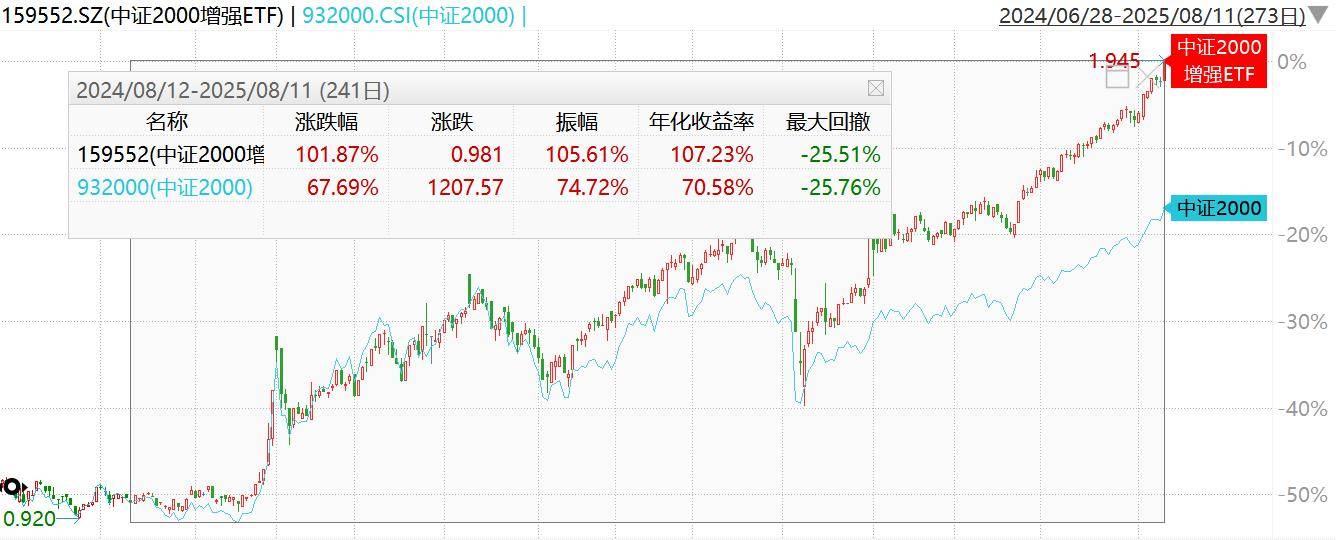
Core Viewpoint - The small-cap growth style remains strong, with the CSI 2000 Enhanced ETF (159552) achieving a cumulative increase of 101.87% over the past year, significantly outperforming the CSI 2000 Index, which rose by 67.69% [1] Historical Review: Common Features of Growth Outperformance - Historical analysis shows that small-cap growth and technology growth often start under similar conditions, including fundamental profit recovery, liquidity easing, and resonance between policy and industry cycles [3][5] - The current market may be reflecting these conditions, supported by ongoing growth policies and expectations of Federal Reserve interest rate cuts, alongside significant events like the Robot Conference and ChatGPT-5 iteration [3][6] Current Market: Strengthening Small-Cap Growth Logic - The economic and profit recovery trend is evident, with high levels of infrastructure and manufacturing investment, and continued high export growth [7] - Policies aimed at technological innovation are being emphasized, with recent initiatives like the Shanghai Intelligent Industry Development Plan and ongoing advancements in AI technology [7] - Liquidity remains loose, with significant inflows into growth sectors, particularly in pharmaceuticals, electronics, and machinery [7][9] Index Performance and Investment Trends - The CSI 2000 Index has a high valuation, with a PE ratio exceeding 145 and a PB ratio of 2.74, indicating potential risks of correction despite the ongoing strong performance [10][11] - The CSI 2000 Enhanced ETF has seen a net inflow of 780 million yuan this year, ranking first among all enhanced ETFs, highlighting strong investor interest [11] - Historical performance shows that the CSI 2000 Enhanced ETF has consistently captured excess returns across various market conditions, indicating strong market adaptability [13]
国金策略:中小盘成长“激流勇退”,资金主动流入黄金+医药— —公募基金一季度持仓分析
Sou Hu Cai Jing· 2025-05-09 00:47
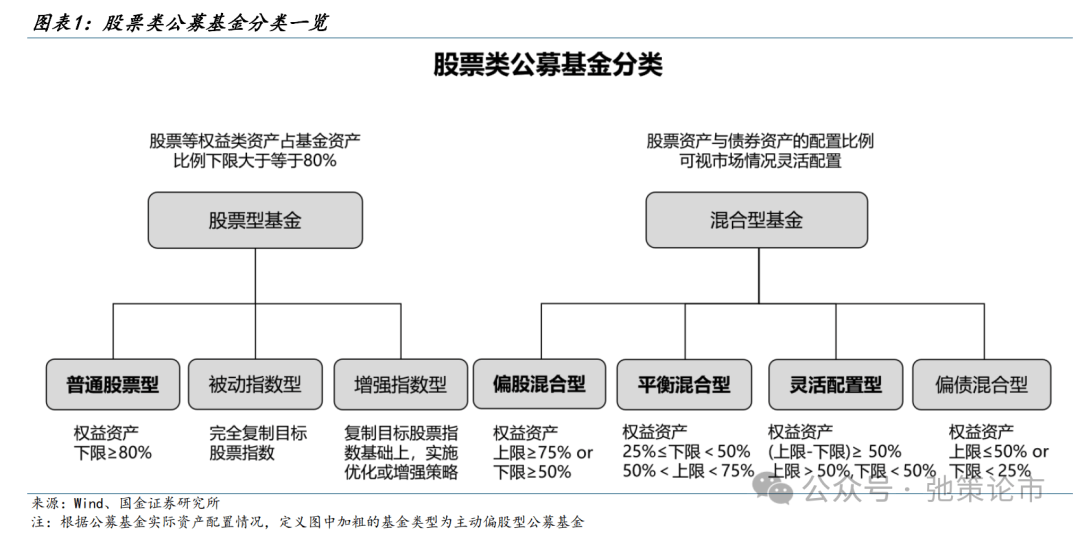
Group 1 - The core conclusion indicates that active equity funds have increased their positions, with a preference for Hong Kong stocks and the Sci-Tech Innovation Board [1][18] - In Q1 2025, the market value of active equity funds decreased slightly to 2.50 trillion yuan, with a net redemption of approximately 482 billion yuan, indicating manageable pressure on the market [10][15] - The allocation to Hong Kong stocks has risen for five consecutive quarters, while the main board and ChiNext have seen significant declines in allocation [18][21] Group 2 - Active equity funds have shown a trend of profit-taking in growth and consumer sectors, with notable reductions in positions in electronics, pharmaceuticals, and food and beverage sectors [2][38] - The only sector to see an increase in active equity fund positions in Q1 2025 was the automotive sector, while the electric power equipment sector experienced significant reductions [40][45] - The top five industries by allocation in active equity funds include electronics (18.4%), electric power equipment (11.0%), pharmaceuticals (10.6%), food and beverage (8.8%), and automotive (7.8%) [22][23] Group 3 - The pricing power of active equity funds is highest in the automotive (2.9%) and electronics (3.5%) sectors, with a notable increase in automotive pricing power [3][49] - The overall pricing power of active equity funds has slightly decreased, with the exception of the CSI 500 and CSI 1000 indices, which have shown an upward trend [47][49] - The top five industries by pricing power are home appliances (3.8%), electronics (3.5%), electric power equipment (3.0%), automotive (2.9%), and pharmaceuticals (2.7%) [49]