主动智能

Search documents
中国家电军团将强势亮相IFA2025
Zheng Quan Ri Bao Zhi Sheng· 2025-09-03 16:37
Group 1 - The IFA 2025 event in Berlin will showcase the latest AI technologies and products from Chinese home appliance brands, highlighting their technological leadership and overseas market performance [1][2] - Chinese companies are shifting from merely exhibiting products to becoming key definers and promoters of relevant technologies, integrating "proactive intelligence" and "full connectivity" into their offerings [2][3] - The three major trends observed in the overseas market for home appliance companies include AI becoming a standard feature, green intelligence enhancing export competitiveness, and scenario integration breaking industry boundaries [3] Group 2 - Chinese home appliance brands are increasingly leveraging international sports events for marketing, enhancing their global brand influence [4] - Companies are transitioning from "export trade" to "localized operations," strengthening both their soft and hard power in international markets [4][5] - The overseas performance of home appliance companies has become a highlight, with TCL reporting overseas revenue of 7.247 billion yuan, a year-on-year increase of 8.99%, and Haier's overseas revenue reaching 79.079 billion yuan, accounting for 50.53% of total revenue [6]




斑马智行:推动汽车智能座舱迈入主动智能时代
Ren Min Wang· 2025-07-28 07:10
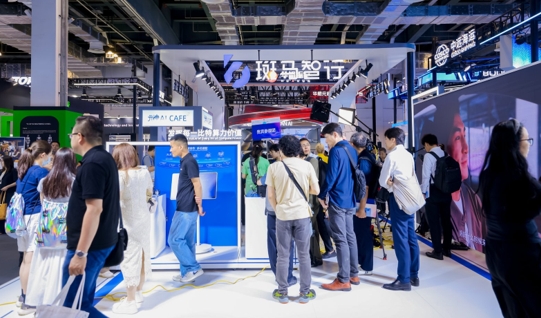
Core Viewpoint - The collaboration between Zebra Zhixing, Tongyi, and Qualcomm aims to advance automotive smart cockpit technology into an era of proactive intelligence through the release of an edge-side multimodal large model solution [1][2]. Group 1: Product Features - The edge-side multimodal large model solution, based on the Qualcomm 8397 platform, can achieve a 90% service loop of 'perception-decision-execution' purely on the vehicle side [2]. - The solution enables a generational upgrade from being a "command receiver" to a "dialogue participant" through multimodal intent perception and interaction [2]. - The local lifestyle agent, part of the "One Arrow Ten Stars" interactive intelligence released in April, reconstructs food delivery services based on travel scenarios [2]. Group 2: User Experience - Users can interact with the AI to order coffee through natural dialogue, with the AI providing a seamless experience that surpasses mobile operations [2]. - The AI can proactively adjust the vehicle's environment based on user status, recommend playlists during traffic jams, and engage in multi-user dialogue scenarios [2]. Group 3: Strategic Development - Since launching the "AI in All" strategy in 2024, Zebra Zhixing has rapidly iterated and commercialized its Yuan Shen AI across various automotive brands, including Zhiji, Roewe, and BMW [3]. - The company is moving towards a human-machine symbiosis by collaborating with customers and the ecosystem, starting from proactive intelligence [3].

为什么其他全屋智能叫有线无线,华为鸿蒙智家叫前后装?
华尔街见闻· 2025-06-23 09:15
Core Viewpoint - The article emphasizes that the whole-house smart home market is transitioning from a luxury to a necessity, driven by policy support and technological advancements, with a projected market size of $6.38 billion by 2030 [1][5]. Group 1: Market Dynamics - The whole-house smart home market is expected to grow rapidly, with a forecasted scale exceeding 100 billion yuan by 2025, transitioning from single product intelligence to proactive intelligence leveraging AI, IoT, and cloud computing [5]. - The focus of the market is shifting from new housing to the renovation of existing homes, with manufacturers introducing solutions like "functional module subscriptions" and "7-day rapid delivery" [5]. Group 2: Huawei's Strategy - Huawei has redefined service categories in the whole-house smart industry by introducing pre-installation and post-installation solutions, focusing on user needs rather than traditional wired and wireless classifications [3][9]. - The company aims to address user pain points in post-installation solutions, such as ecosystem fragmentation and installation complexity, by offering a mixed networking approach that combines wired and wireless solutions [15][20]. Group 3: User Experience and Feedback - Users have reported issues with existing post-installation solutions, including compatibility problems and complex operations, leading to a demand for more seamless and user-friendly experiences [7][18]. - Huawei's post-installation solutions have improved device connectivity and user experience, with features like automatic reconnection and voice control, addressing common user frustrations [18][20]. Group 4: Industry Implications - The article highlights the potential for Huawei's solutions to enhance the value of commercial real estate by providing flexible and cost-effective smart home upgrades, which can differentiate properties and improve their marketability [20][22]. - The hospitality and healthcare sectors are also seen as key areas for smart home integration, with Huawei's solutions offering significant improvements in user experience and operational efficiency [21][22].