全屋智能

Search documents
100%分红!超5400亿巨头,突传大动作!
券商中国· 2026-03-30 12:56
Core Viewpoint - Midea Group has announced a significant 100% dividend payout for 2025, returning nearly all of its annual profit to shareholders, which reflects a strategic shift beyond traditional home appliances into AI-driven innovations across various sectors [1][2]. Financial Performance - Midea Group reported total revenue of 458.5 billion yuan and a net profit attributable to shareholders of 43.95 billion yuan for 2025 [1]. - The total dividend for 2025 amounts to 32.4 billion yuan, with an additional 11.6 billion yuan allocated for share buybacks, bringing the total return to shareholders to approximately 44 billion yuan, nearly equivalent to the net profit [2]. Market Position - Midea is recognized as the world's leading brand in smart home appliance sales for 2025, with the highest sales in both online and offline channels in China [3]. - The company has expanded its global reach, increasing the number of countries covered by its subsidiaries from 27 to 50, and holds the top market share in 32 product categories on major platforms like Amazon in North America and Europe [3]. Cash Flow and Investment - Midea's operating cash flow for 2025 reached 53.3 billion yuan, indicating strong business performance and providing the confidence to distribute all profits as dividends [4]. - The company invested 17.8 billion yuan in R&D in 2025, a 9.6% increase year-on-year, with plans to invest over 60 billion yuan in cutting-edge research over the next three years [5]. Diversification and Growth - Midea is diversifying beyond home appliances, achieving significant market shares in various sectors, including motors for air conditioning and elevators, and has seen over 50% growth in its automotive components division [6]. - The company’s robotics division, KUKA, ranks among the top four global industrial robot manufacturers, with a 9.6% market share in domestic sales and a 47.4% share in heavy-load robots [7]. AI Integration - Midea has established a 400-member AI team focused on smart home, manufacturing, and industry empowerment, with over 13,000 AI agents deployed across various operational areas [8]. - The company’s AI capabilities are enhancing efficiency in manufacturing and logistics, exemplified by the certification of its washing machine factory as the world's first smart factory [9]. Future Outlook - Midea's AI-driven initiatives are expected to redefine its operational efficiency and market valuation, prompting discussions on whether the company should be reassessed in the context of the AI era [10].



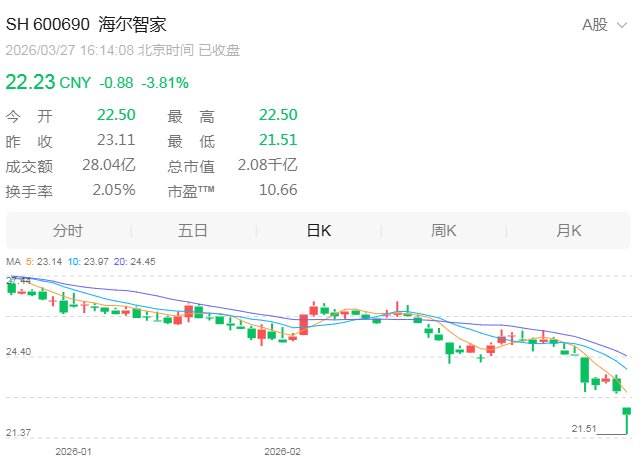
股价大跌!海尔智家2025年Q4业绩环比、同比双降
Shen Zhen Shang Bao· 2026-03-28 07:30
Core Viewpoint - Haier Smart Home's 2025 annual report shows a significant increase in global revenue and net profit, but concerns arise from disappointing Q4 performance, leading to a drop in stock price [2][3][4]. Financial Performance - The company reported a global revenue of 302.35 billion yuan in 2025, a year-on-year increase of 5.71% [2]. - The net profit attributable to shareholders reached 19.55 billion yuan, up 4.39% year-on-year [2]. - A total of over 8.2 billion yuan will be distributed as dividends, with a proposed cash dividend of 8.867 yuan per 10 shares [4]. Q4 Performance Concerns - Q4 revenue was 68.29 billion yuan, a quarter-on-quarter decrease of 11.95% [4]. - Net profit for Q4 was 2.18 billion yuan, down 59.17% from Q3 [4]. - Year-on-year, Q4 revenue decreased by 17.73% and net profit fell by 39.22% compared to 2024 [4]. Margin and Cost Analysis - The gross margin for 2025 was 26.7%, a decline of 1.1 percentage points from 2024 [4]. - The increase in management expense ratio to 4.6% was attributed to one-time costs for efficiency improvements in the European market and investments in emerging markets [4]. Industry Outlook - The home appliance industry is transitioning from incremental growth to a focus on quality upgrades, with key growth drivers being green energy, smart home integration, and health-oriented solutions [5].

家电行业深度分析:从规模到价值:智能家电行业的竞争与增长
Zhongyuan Securities· 2026-03-25 09:06
Investment Rating - The report provides an investment rating of "In line with the market" for the home appliance industry, indicating a neutral outlook compared to the Shanghai and Shenzhen 300 Index [2]. Core Insights - The global smart home appliance market is projected to reach approximately $147.5 billion by 2025, with a compound annual growth rate (CAGR) of 22% from 2016 to 2026. By 2026, the market is expected to touch $180 billion, maintaining strong double-digit growth [8][13]. - China's smart home appliance market has seen significant growth, expanding from 200 billion yuan in 2016 to 500 billion yuan in 2022, with a market penetration rate of 12.66% in 2016, rising to 65% for smart TVs and 38.5% for smart air conditioners by 2022 [19][21]. - The competitive landscape of the global smart home appliance market is characterized by a tripartite structure of "Chinese giants + Korean duopoly + Western legacy brands," with Chinese brands holding a 38% to 40% share of global shipments [31]. Summary by Sections Global Smart Home Appliance Market - The smart home appliance market is defined as appliances that incorporate microprocessors, sensors, and network communication technologies, enabling them to have autonomous sensing, decision-making, and remote control capabilities [9]. - The market is expected to grow significantly, driven by the adoption of the Matter protocol and advancements in generative AI [13]. Chinese Smart Home Appliance Market - China's retail sales of smart home appliances are projected to reach approximately 450 billion yuan (around $642.86 billion) by 2025, accounting for 43.58% of the global market [19]. - There is substantial room for growth in market penetration for products like robotic vacuums and smart kitchen appliances, which remain lower in China compared to the U.S. [21][22]. High-Growth Niche Markets - The robotic vacuum market is expected to see a rise in shipments from 11 million units in 2019 to 24.12 million units by 2025, with a sales value of $11.5 billion [26]. - The high-end kitchen appliance market is projected to grow from $38 billion in 2020 to $50.2 billion in 2024, with China being a significant contributor to this growth [27]. Supply Chain Dynamics - The supply side of the smart home appliance market is dominated by Chinese brands, which have a significant advantage in terms of supply chain efficiency and cost [31]. - Major players in the smart appliance market include Haier, Midea, Samsung, and LG, with Haier leading in global market share for large home appliances [31][36]. Profitability Analysis - Companies are categorized into three tiers based on gross margin: - **Technology Leaders** (high gross margin of 45-55%): Companies like Roborock and Boss Electric benefit from technological barriers and high-end market positioning [56]. - **Scale Leaders** (mid-high gross margin of 25-30%): Companies like Gree and Haier leverage scale and supply chain advantages [62]. - **Mid-Pressure** (low gross margin of 14-22%): Companies like Samsung and LG face pressure from intense competition and cost structures [64]. Investment Recommendations - The report suggests a three-pronged investment strategy focusing on dividend-friendly stocks, high-growth opportunities in robotic vacuums and high-end kitchen appliances, and international expansion strategies [68]. - Recommended stocks include Haier Smart Home, Midea Group, and Gree Electric for their low valuations and high dividend yields [74].



AWE2026落幕:从「参数崇拜」到「感知觉醒」,家电行业正在换道出发
雷峰网· 2026-03-17 07:40
Core Viewpoint - The future of home appliances is being redefined not by larger parameters but by technology that understands and anticipates user needs [2][26]. Group 1: Evolution of Home Appliances - The home appliance industry is shifting from a focus on performance parameters to a competition centered around "perception" and "proactivity" [4][26]. - Appliances are evolving from mere tools executing commands to intelligent entities that can sense and respond to user needs before they are articulated [4][26]. Group 2: Sensory Awakening - Major brands are equipping appliances with "sensory systems" to enhance user interaction, such as air conditioners that adjust airflow based on human presence [5][7]. - Haier's Seeker air conditioner can detect and respond to the presence and needs of individuals in the room, showcasing a significant leap in user-centric design [5][7]. - Gree's self-developed EAi chip has been shipped over 8 million units, enabling appliances to think independently and manage home environments [7][8]. Group 3: Addressing Real-Life Pain Points - Brands are focusing on practical solutions to everyday challenges, such as Haier's washing machine that can identify fabric types and prevent color bleeding [12][14]. - TCL's AI washing and drying machine aims to redefine laundry experiences with advanced features that enhance fabric care [14][15]. - The introduction of AI technologies in refrigerators allows for better food management and preservation, addressing common kitchen frustrations [14][15]. Group 4: Ecosystem Transformation - The smart home ecosystem is moving towards interoperability, with brands recognizing the need for devices to work together seamlessly [18][20]. - Midea is advocating for unified standards in smart home connectivity, emphasizing the importance of collaboration among manufacturers [20][22]. - The industry is witnessing a shift from isolated systems to a more integrated approach, with companies like TCL exploring new interfaces for smart home interactions [22][23]. Group 5: Conclusion - The insights from AWE2026 suggest that the era of measuring everything by parameters is ending, paving the way for a narrative focused on "perception" and "thoughtfulness" in home appliances [26][28].
全球大公司要闻 | 马斯克蝉联首富,英伟达发力智能体
Wind万得· 2026-03-12 01:38
Group 1 - Forbes released the global billionaire list, with Elon Musk becoming the world's richest person for the second consecutive year, with a net worth of approximately $839 billion, making him the first person in history to surpass $800 billion. Chinese billionaire Zhang Yiming ranks 26th with a net worth of $69.3 billion, followed by Zhong Shanshan at $68.1 billion in 27th place, and Ma Huateng at $53.8 billion in 33rd place [2] - Amazon issued euro-denominated bonds for the first time, raising €14.5 billion, setting a record for the euro bond market. The funds will primarily be used for AI infrastructure investments. Additionally, Amazon announced a $750 million investment to build an automated robotics logistics hub in Brisbane, Australia, to enhance delivery efficiency in the Oceania region [2] - Nvidia launched the open-source large model Nemotron 3 Super with 120 billion parameters, achieving a fivefold increase in throughput compared to its predecessor. The company plans to invest $26 billion over the next five years to build a top-tier open-source model system and made a strategic investment of $2 billion in AI cloud service provider Nebius [2] Group 2 - Tencent announced a change in the billing strategy for its cloud AI models starting March 13, 2026, ending free trials for models like GLM 5 and MiniMax 2.5. The input price for the HY2.0 Instruct model will increase from ¥0.0008 to ¥0.004505 per thousand tokens, while the output price will rise from ¥0.002 to ¥0.01113 [5] - Midea unveiled its "Three Ones" strategy for 2026, which includes building a home appliance network, a smart brain, and an open platform. The company introduced the self-evolving AI agent MevoX, which aims to transition home intelligence from "human-driven devices" to "intention-driven spaces" [5] - Laopuhuangjin expects its sales performance for 2025 to reach approximately RMB 31 billion to RMB 32 billion, representing a growth of about 216% to 227% compared to 2024. The projected revenue is around RMB 27 billion to RMB 28 billion, with a net profit forecast of RMB 4.8 billion to RMB 4.9 billion, reflecting a growth of 226% to 233% [6] Group 3 - Microsoft revealed details about its next-generation Xbox console "Project Helix," which will feature a custom AMD chip and support multi-frame generation technology, with an early version expected to be available to developers in 2027 [8] - Tesla delivered 58,600 electric vehicles from its Shanghai Gigafactory in February, marking a 91% year-on-year increase, with the Model Y leading the domestic SUV sales [8] - Meta announced a roadmap for four self-developed AI chips, with MTIA 300 already deployed for recommendation model training, while MTIA 400, 450, and 500 are set to be released by the end of 2027 to support generative AI inference tasks [8] Group 4 - Toyota recalled 550,007 Highlander vehicles in the U.S. due to a defect that may prevent the seatback from locking. The company will replace the seatback reclining device's reset spring free of charge [12] - SK Hynix signed a long-term R&D cooperation agreement with Applied Materials and Micron to jointly develop next-generation memory chips suitable for AI and HPC scenarios [12] - LG Electronics is expected to benefit from increased air conditioning demand in India due to a heatwave warning issued by the local meteorological bureau [13]

【财闻联播】国家互联网应急中心发布OpenClaw安全应用风险提示!国产机床爆单!
券商中国· 2026-03-10 12:35
Macro Dynamics - Jiangsu Province encourages financial institutions to develop specialized financial products for the brain-computer interface industry, aiming to support seed and startup companies through strategic funds and comprehensive technology financial services [2] Company Dynamics - Dongfang Securities received approval from the China Securities Regulatory Commission to publicly issue bonds totaling up to 400 billion yuan and subordinate bonds up to 150 billion yuan [7] - Volkswagen announced a nearly 50% drop in profits for the 2025 fiscal year, with net profit decreasing by approximately 44% from 12.4 billion euros to 6.9 billion euros, facing challenges such as electric vehicle strategy adjustments and high restructuring costs [11] - NIO achieved its first quarterly profit with an operating profit of 1.25 billion yuan in Q4 2025, and provided a delivery guidance of 80,000 to 83,000 vehicles for Q1 2026, representing a year-on-year growth of 90.1% to 97.2% [12] - Midea Group launched its "Three Ones" strategy for whole-home smart solutions, integrating various hardware and AI algorithms to create a self-evolving smart home environment [13] - Gemdale Group reported a 77.5% year-on-year decline in signed sales amount for February 2026, with a total signed area of 46,000 square meters, reflecting a significant downturn in performance [15] Market Data - The A-share market saw the ChiNext Index rise by 3.04%, led by the computing hardware sector, with several stocks reaching their daily limit [8][9] - The Hang Seng Index increased by 2.17%, with the semiconductor sector showing strong performance, while oil and gas stocks experienced a collective pullback [10]

海尔智家股价震荡调整,行业转型与估值承压
Jing Ji Guan Cha Wang· 2026-02-21 08:45
Company Performance - Haier Smart Home reported a revenue of 234.05 billion yuan for the first three quarters of 2025, representing a year-on-year growth of 9.98% [2] - The net profit attributable to shareholders reached 17.37 billion yuan, with a year-on-year increase of 14.68% [2] - Despite a net inflow of 2.10 million yuan on February 13, there were instances of net outflow, such as 8.06 million yuan on February 10, indicating mixed market sentiment [2] Industry Policy and Environment - The home appliance industry is undergoing a structural transformation, with a forecasted shift to a "weak recovery + structural growth" phase by 2026, driven by emerging fields like smart home technology and AI displays [3] - Haier Smart Home faces challenges related to "narrative premium loss," as its business remains heavily focused on traditional appliances like refrigerators and washing machines, with a TTM P/E ratio of approximately 10.4 times [3] - Competitors like Midea Group have achieved higher valuations by transitioning towards technology narratives [3] Company Strategy - To address market volatility, Haier Smart Home is implementing share buybacks and increasing its cash dividend payout ratio to 50% for the 2025-2026 fiscal years [4] - The company is strategically focusing on the smart home ecosystem and advancing the listing processes for its subsidiaries, Kaos and Haier New Energy, to explore new growth opportunities [4]
从BB机到全屋智能,春晚见证中国科技飞跃
Xin Lang Cai Jing· 2026-02-16 11:55
Core Viewpoint - The evolution of technology showcased during the Spring Festival Gala reflects significant advancements in China's tech landscape, transitioning from basic gadgets to comprehensive smart home ecosystems [1] Group 1: Historical Technological Milestones - In 1990, the BB machine and mobile phones symbolized status and identity [1] - By 2000, SMS interactions and computer gifting became popular trends [1] - In 2010, social media platforms like Weibo and WeChat introduced features like shaking to participate in activities such as red envelope grabbing [1] Group 2: Recent Innovations - Recent years have seen the introduction of dancing robots and AI virtual characters, enhancing the entertainment experience [1] - This year's gala prominently featured a "whole-house smart ecosystem," indicating a shift from individual tech items to integrated smart living solutions [1] - The narrative has evolved from ownership of gadgets to enjoying intelligent living experiences, highlighting a cultural shift in technology usage [1]
八大科技展区亮相CES Asia 2026,勾勒未来消费电子蓝图
Sou Hu Cai Jing· 2026-02-05 07:38
Core Insights - CES Asia 2026 will focus on "Technology Integration and Innovative Symbiosis," showcasing advancements in embodied intelligence, artificial intelligence, and low-altitude economy across an immersive 50,000 square meters exhibition space [2] - The event is scheduled to take place from June 10 to June 12, 2026, in Beijing, providing a platform for technology display, business matchmaking, and ecosystem building [2] Group 1: Embodied Intelligence - The Embodied Intelligence exhibition area will highlight breakthroughs in "flexible technology + multimodal interaction," featuring humanoid robots and flexible operational devices [3] - Key technologies such as hand-eye servo coordination, emotional computing, and spatial intelligent navigation will be showcased, addressing diverse scenarios like home services and emergency rescue [3] - The integration of flexible robots and drones will be a highlight, enabling innovative applications in complex environments [3] Group 2: Artificial Intelligence - The Artificial Intelligence exhibition area will emphasize "AI-native and full-scenario empowerment," showcasing core technologies like edge large models and cross-device collaboration [4] - AI-native smartphones will be a focal point, enhancing multi-modal interaction and task automation even in offline environments [4] - Emerging terminals like smart glasses and immersive AI desktop partners will also be presented, aiming to transform smartphones into intelligent assistants [4] Group 3: Low-altitude Economy - The Low-altitude Economy exhibition area will focus on the integration of "flying carriers + intelligent applications," featuring aerial work robots and eVTOLs [5] - Aerial work robots equipped with flexible robotic arms will demonstrate practical capabilities in high-altitude cleaning and precise delivery [5] - The intelligent mobility segment will showcase L4 autonomous driving and smart cockpit innovations, aligning with national low-altitude economic development strategies [5] Group 4: Smart Living - The Smart Living exhibition area will center on "seamless intelligence and health co-existence," showcasing the transition from single product intelligence to whole-home connectivity [6] - Home automation systems will utilize Matter protocol and 3D spatial scanning technology for seamless device integration and energy management [6] - The healthcare segment will focus on AI health monitoring devices, emphasizing non-invasive blood glucose monitoring and ECG analysis [7] Group 5: Intelligent Cockpit - The Intelligent Cockpit exhibition area will highlight the deep integration of automotive electronics and consumer electronics, showcasing innovations in "multi-modal perception + edge large models" [8] - New-generation smart cockpits will move beyond traditional app interactions, providing proactive service based on driver and passenger needs [8] - Solutions for seamless connectivity between travel and home will be presented, promoting cars as mobile smart living spaces [8] Group 6: Green Energy Storage - The Green Energy Storage exhibition area will align with the "dual carbon" strategy, showcasing portable storage and home energy systems [9] - Home energy systems will demonstrate solutions for solar integration and emergency power supply, catering to energy autonomy needs [9] - Portable storage products will leverage high energy density batteries and fast charging technology for outdoor and emergency applications [9] Group 7: Electronic Components - The Electronic Components exhibition area will focus on "hardcore foundation and innovation empowerment," presenting core technologies in the consumer electronics supply chain [10] - High-performance AI chips and flexible PCBs will be highlighted, addressing supply chain bottlenecks and enhancing product competitiveness [10] - The exhibition will facilitate connections between upstream and downstream enterprises, showcasing the entire industry chain [10] Group 8: Digital Art Technology - The Digital Art Technology exhibition area will emphasize "technology empowerment and creative expression," featuring AR/VR content and interactive art installations [11] - AR educational materials will utilize 3D visualization to enhance immersive learning experiences [11] - The exhibition will provide a platform for cross-industry innovation, connecting technology with culture, education, and entertainment [11] Additional Insights - The eight exhibition areas are interconnected through the theme of "technology integration," creating a comprehensive innovation ecosystem [11] - The event will also host forums and matchmaking events to discuss industry trends and foster collaboration among leading enterprises and research institutions [11] - Registration for exhibitors is ongoing, providing opportunities for businesses to engage with cutting-edge technologies and expand commercial partnerships [11]

海尔智家App获2025智能生活人群首选App
Jing Ji Guan Cha Wang· 2026-02-03 10:05
Core Viewpoint - The increasing penetration of smart home appliances is a significant trend, with the International Energy Agency predicting that by 2025, the global penetration rate of smart appliances will exceed 40% [1] Group 1: Market Recognition - Haier Smart Home App has been recognized as the preferred app for smart living by QuestMobile's "2025 China Internet Value List," reflecting its user scale advantage and industry leadership in the smart home sector [1][2] Group 2: Technological Innovation - The Haier Smart Home App stands out due to its industry-leading capabilities in smart experience, open ecosystem, and service system, transforming user interaction from passive control to proactive service [2][3] - The app features an "AI Life" section for comprehensive management of various home appliances, including proactive reminders for food expiration and maintenance suggestions for devices [2][3] Group 3: Ecosystem and Connectivity - The app connects over 6,600 ecosystem partners, 55+ brands, and 167+ types of devices, with a total of over 52 million connected smart devices and over 13 million monthly active users [2][3] - Collaborations with automotive companies like Changan and Chery have led to the development of seamless "home-car" solutions, extending smart living experiences beyond the home [2][3] Group 4: Service Efficiency - The Haier Smart Home App provides a full lifecycle service for smart homes, allowing users to track logistics orders in real-time and utilize AI for self-diagnosis of device issues [3] - The app includes an AI voice assistant, "Xiao You," enabling users to complete inquiries, report issues, and schedule appointments through conversational interactions, enhancing service efficiency [3] Group 5: Market Trends - The smart home market is rapidly transitioning from single-device intelligence to whole-home intelligence, with the Haier Smart Home App serving as a crucial digital platform for connecting smart devices and enhancing user experiences [3]