低波红利策略

Search documents
新高又新高,银行ETF续升再刷上市新高!低波红利策略有效性料延续
Xin Lang Ji Jin· 2025-05-14 03:21
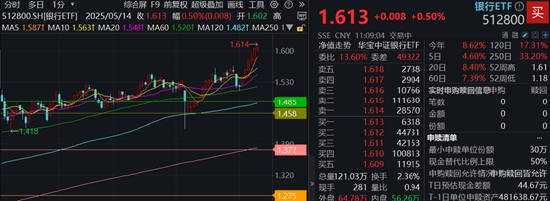
Group 1 - The banking sector continues to show strength, with the China Securities Banking Index rising by 0.45%, led by Xiamen Bank up 1.84%, Ningbo Bank up 1.37%, and Industrial Bank up 1.06% [1] - The Bank ETF (512800) saw an increase of 0.5%, reaching a new high since its listing, with real-time transaction volume nearing 200 million yuan [1] Group 2 - Following the People's Bank of China's implementation of a reserve requirement ratio and interest rate cut on May 7, several small and medium-sized banks quickly followed suit by lowering deposit rates, with some long-term fixed deposit rates dropping below 2%, indicating a shift to the "1 era" for most small and medium banks [3] - Oriental Securities noted that the unexpected implementation of loose monetary policy is likely to continue the effectiveness of low-volatility dividend strategies, as the risk-free interest rate is expected to decline further [4] - The report suggests that the correlation between A-share ROE and 10-year government bond yields indicates that in a declining interest rate environment, the importance of certain dividend income increases, making dividend strategies more effective [4] Group 3 - A significant reform in public funds emphasizes the importance of performance benchmarks, which is expected to help banks achieve excess returns [5] - The reform includes establishing a floating management fee mechanism and strengthening the constraints of performance benchmarks, with 46% of actively managed equity funds using the CSI 300 Index as their primary benchmark [5] - Current underweighting of banks in active public funds suggests potential inflows into the banking sector, enhancing the marginal pricing power of banks and driving excess returns [5]

机构:低波红利策略有效性料延续,红利低波100ETF(159307)冲击6连涨
Sou Hu Cai Jing· 2025-05-13 04:07
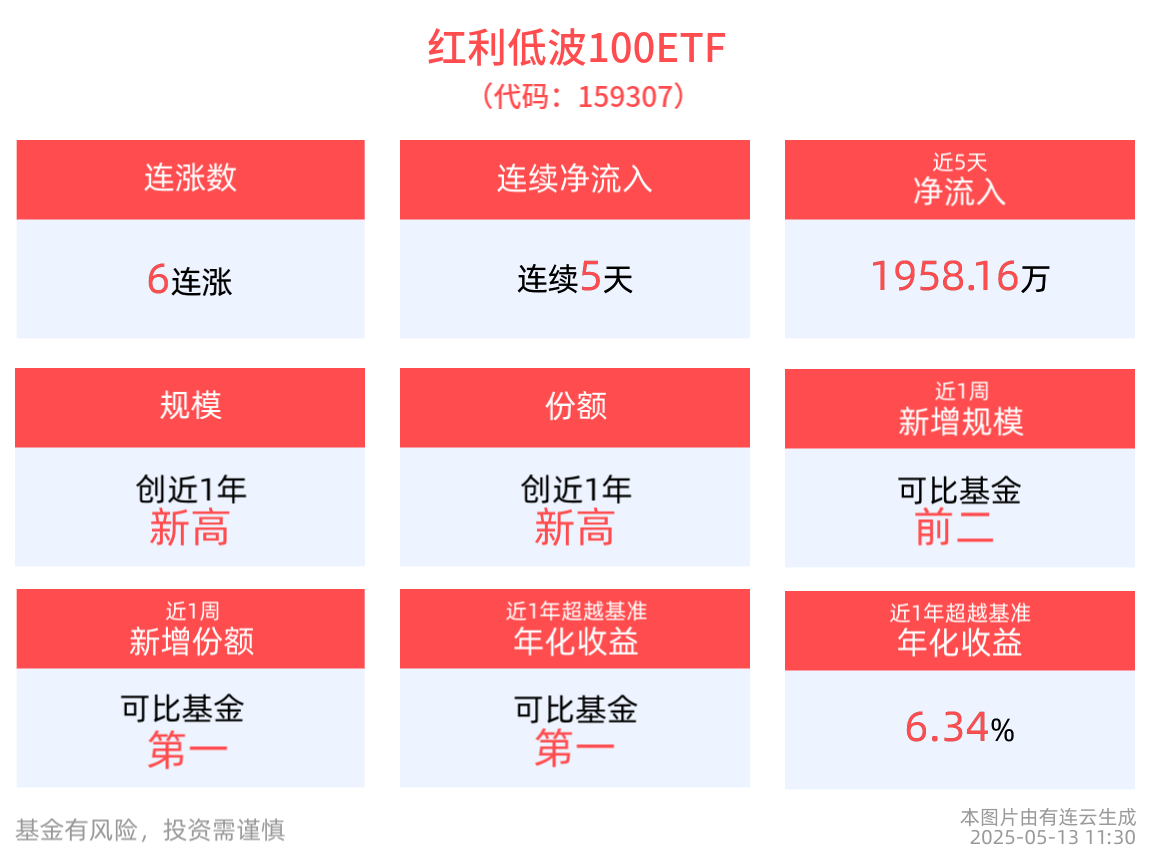
Core Viewpoint - The low volatility dividend strategy is expected to continue its effectiveness due to the anticipated decline in risk-free interest rates and the overall downward trend in expected returns across society [2][3]. Market Performance - As of May 13, 2025, the CSI Low Volatility Dividend 100 Index (930955) increased by 0.56%, with notable gains from constituent stocks such as Pudong Construction (600284) up 9.19% and Weifu High Technology (000581) up 5.42% [2]. - The Low Volatility Dividend 100 ETF (159307) rose by 0.67%, marking its sixth consecutive increase, with a trading volume of 9.337 million yuan and a turnover rate of 1% [2]. Policy Environment - The recent financial policies, including reserve requirement ratio cuts and interest rate reductions announced on May 7, are expected to create a favorable environment for further declines in risk-free interest rates [2][3]. - The central bank's actions are seen as opening up space for lower risk-free rates, which is beneficial for dividend strategies [2]. Fund Performance - The Low Volatility Dividend 100 ETF has achieved a net value increase of 6.97% over the past year, ranking first among comparable funds [4]. - The ETF's maximum drawdown this year is 6.18%, which is the smallest among comparable funds [4]. - The fund's management fee is 0.15%, and the custody fee is 0.05%, making it the lowest in its category [4]. Fund Composition - The top ten weighted stocks in the CSI Low Volatility Dividend 100 Index account for 19.66% of the index, with companies like Jizhong Energy (000937) and Daqin Railway (601006) among the leaders [5][7]. - The ETF closely tracks the index, which selects 100 stocks based on liquidity, continuous dividends, high dividend yield, and low volatility [3].
资金维度看银行股投资:宽货币落地+公募改革+保险预定利率或进一步下调,银行有望跑出超额收益
Orient Securities· 2025-05-12 10:46
Group 1 - The report highlights that the implementation of a loose monetary policy, coupled with fiscal reforms and potential further reductions in insurance premium rates, is expected to lead to excess returns for banks [1][2][9] - The current phase of intensive policy implementation for stable growth is anticipated to have a profound impact on the banking sector's fundamentals in 2025, with increased fiscal policy support expected to boost social financing and credit, benefiting cyclical stocks [2][9] - The report identifies two main investment themes: the effectiveness of low-volatility dividend strategies in a declining interest rate environment and the potential for public funds to increase their allocation to banks due to recent reforms [2][9][23] Group 2 - The report notes that the recent reforms in public funds emphasize the importance of performance benchmarks, which may drive increased allocation to previously underweighted stocks, particularly in the banking sector [23][26] - It is indicated that insurance premium rates may be further reduced in the third quarter of 2025, which could enhance the tolerance for dividend yields among insurance funds, thereby supporting absolute returns for banks [9][10] - The report suggests that banks are currently underrepresented in public fund portfolios, with significant potential for increased capital inflow, particularly for major banks like Industrial and Commercial Bank of China and China Merchants Bank [10][26]