
储备管理购买(RMP)

Search documents
美联储重启QE?RMP来了!市场想重温“2019年的美好回忆”
Hua Er Jie Jian Wen· 2025-12-11 01:39
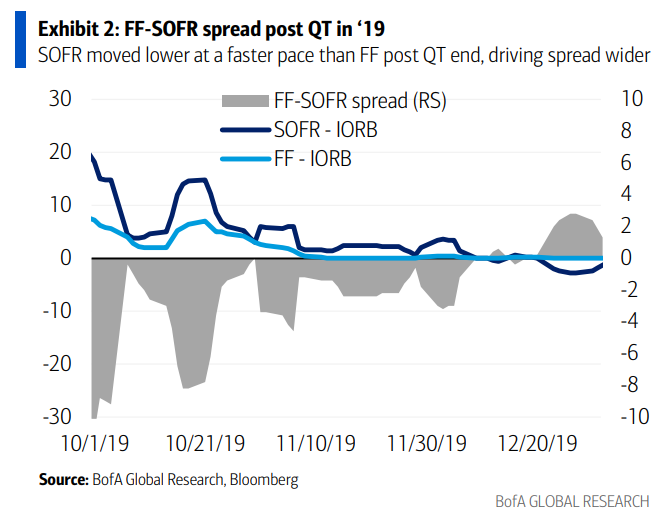
Core Viewpoint - The Federal Reserve has initiated the Reserve Management Purchase (RMP) program to inject liquidity into the market, following recent volatility in the $12 trillion repurchase market, despite emphasizing that this is not quantitative easing (QE) [1][4][5]. Group 1: RMP Program Details - The New York Fed announced a plan to purchase $40 billion in short-term Treasury securities over the next 30 days to maintain adequate reserve levels, marking a significant shift in the Fed's balance sheet management strategy [2][3]. - The RMP will adjust its purchasing scale based on expected trends in Fed liabilities and seasonal fluctuations, with the first plan to be published on December 11 [2][4]. - The Fed's statement indicates that reserve balances have fallen to adequate levels, prompting the need for short-term Treasury purchases [2][3]. Group 2: Market Reactions and Implications - Despite the Fed's insistence that RMP is not QE, the market has reacted as if it is, with increases in U.S. Treasuries, equities, Bitcoin, gold, and oil, while the dollar weakened [1][4]. - The liquidity injection is expected to quickly lower the Secured Overnight Financing Rate (SOFR), while the Federal Funds Rate (FF) will respond more slowly, creating significant arbitrage opportunities for investors [5][6]. - Historical context from 2019 suggests that similar liquidity injections led to rapid changes in SOFR, indicating that the current market may experience similar dynamics [6][9]. Group 3: Comparison with Historical Context - The RMP's scale is expected to be lower than in 2019, with anticipated monthly purchases around 0.15% of GDP, compared to 0.2-0.3% during the previous episode [9][10]. - The current liquidity situation is not as severe as in 2019, suggesting that the Fed's response may be less aggressive this time [9][10]. - The mechanism of cash injection leading to rapid SOFR changes while FF lags has been validated in previous instances, indicating a consistent pattern despite the differing contexts [10].

或许就在下周,“RMP”这个词会刷屏全市场,并被认为是“新一代QE”
Hua Er Jie Jian Wen· 2025-12-04 08:53
Core Viewpoint - The era of "Quantitative Tightening" (QT) by the Federal Reserve has ended, and a new phase aimed at expanding the balance sheet may soon begin, with the market anticipating a new term—"Reserve Management Purchases" (RMP) [1][2] Group 1: Transition from QT to RMP - The Federal Reserve has officially stopped reducing its balance sheet, shifting focus to RMP to ensure sufficient liquidity in the financial system [1][2] - Analysts predict that the Fed may announce the initiation of RMP as early as the upcoming meeting, with expectations of purchasing $35 billion in short-term Treasury bills starting in January [1][8] - The transition from QT, which reduced the balance sheet by approximately $2.4 trillion since its peak of nearly $9 trillion in 2022, indicates ongoing signs of funding stress in the market [3] Group 2: Market Reactions and Predictions - The announcement timing, scale, and specific operations of RMP will be critical for investors to assess future market liquidity and interest rate trends [2] - Wall Street analysts have provided varying predictions regarding the timing and scale of RMP, with some suggesting a potential one-time purchase of $100 billion to $150 billion in short-term Treasury bills in the first quarter [8] - Different banks have differing views on the scale of monthly purchases, with estimates ranging from $80 billion to over $400 billion, impacting market spreads accordingly [8]