联邦基金利率(FF)

Search documents
dbg盾博:美联储重启RMP,400亿美元月购计划能否复制2019年?
Sou Hu Cai Jing· 2025-12-11 08:10
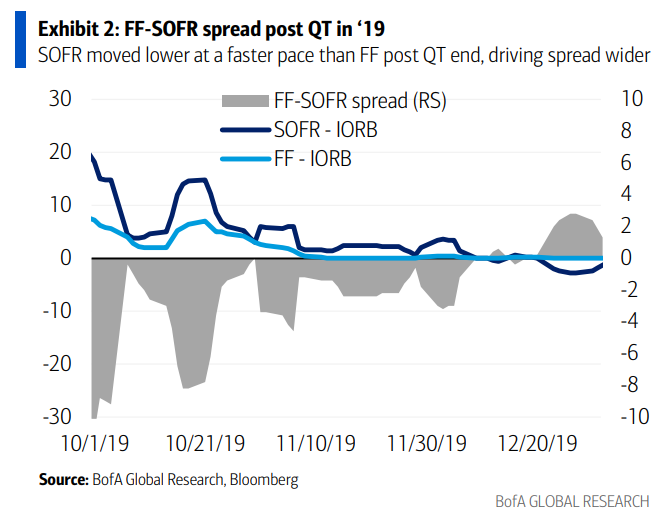
Core Viewpoint - The New York Fed is set to release its first "Reserve Management Purchase" (RMP) detail on December 11, with bond purchases commencing the following day, signaling a liquidity influx despite assurances from Powell that this is not quantitative easing [3]. Group 1: RMP Overview - The current RMP is characterized as "preventive maintenance" rather than an emergency response, aimed at preparing for a seasonal surge in non-reserve liabilities expected in April, which could impact the $12 trillion repo market [3]. - The Fed plans to initially purchase $40 billion in short-term Treasury bills over the next month, with the possibility of extending the duration to three years and adjusting monthly purchase amounts based on liability fluctuations [3]. Group 2: Market Reactions - Following the announcement, markets have reacted positively, with U.S. Treasuries, equities, Bitcoin, gold, and oil all rising, while the dollar has weakened, indicating a liquidity feast [3]. - Bank of America estimates that the current "fill" gap from RMP will last approximately six months, with monthly purchases equating to 0.15% of GDP, lower than the 0.3% seen in 2019, but still expected to influence overnight financing rates [3]. Group 3: Historical Context and Comparisons - Historical data shows that after the RMP was implemented in October 2019, the SOFR/FF spread increased from -21 basis points to -3 basis points within 20 trading days, suggesting a rapid market adjustment [4]. - Current market conditions resemble those of 2019, with leveraged funds positioning themselves in short-term Treasury futures and money market funds lowering repo quotes to secure bonds [4]. Group 4: Future Implications - The total reserves in banks remain ample, with ONRRP balances providing a $350 billion buffer, indicating that the current liquidity levels will not overwhelm the short end of the market immediately [5]. - Traders are betting that if monthly purchases rise to $60 billion, SOFR could drop below 4%, creating a significant gap with the 5.25% FF target, potentially leading to a liquidity surge [5].

美联储重启QE?RMP来了 市场想重温“2019年的美好回忆”
Hua Er Jie Jian Wen· 2025-12-11 05:11
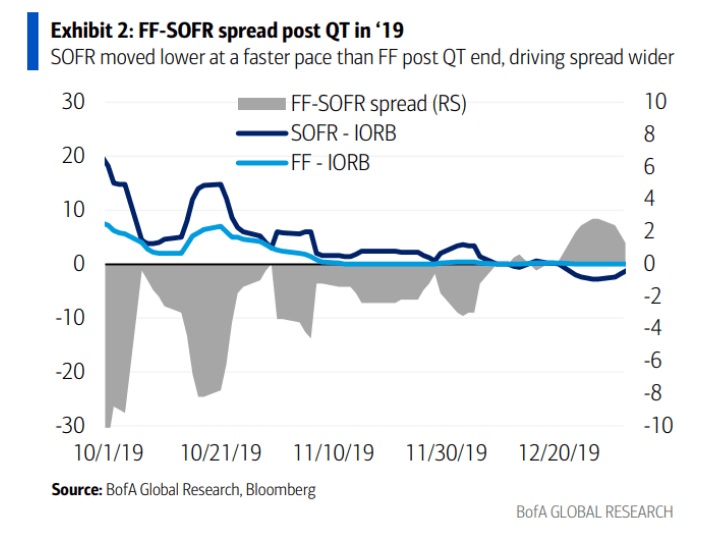
Core Viewpoint - The Federal Reserve has announced the initiation of the Reserve Management Purchase (RMP) program, which aims to inject liquidity into the market by purchasing short-term Treasury securities, amidst concerns over volatility in the repo market and the need to maintain adequate reserves [1][2]. Group 1: RMP Program Details - The New York Fed plans to purchase $40 billion in short-term Treasury securities over the next 30 days, following the cessation of balance sheet reduction [1][2]. - The RMP will adjust its purchasing scale based on expected trends in the Fed's liabilities and seasonal fluctuations, with the first purchase scheduled for December 12 [2]. - The Fed's statement indicates that reserve balances have fallen to a level that requires intervention to maintain adequate liquidity [2][3]. Group 2: Market Reactions - Despite the Fed's insistence that RMP is not quantitative easing (QE), the market has reacted as if it is, with increases in Treasury yields, equities, Bitcoin, gold, and oil, while the dollar weakened [1][4]. - The Bank of America believes that the cash injected through RMP will quickly lower the Secured Overnight Financing Rate (SOFR), while the Federal Funds Rate (FF) will respond more slowly, creating arbitrage opportunities [5]. Group 3: Historical Context - The RMP's current implementation is compared to the 2019 repo crisis, where similar liquidity injections led to a rapid narrowing of the SOFR/FF spread [6][8]. - The expected monthly RMP scale is approximately 0.15% of GDP, lower than the 0.2-0.3% seen in 2019, indicating a less severe liquidity situation [8].

美联储重启QE?RMP来了!市场想重温“2019年的美好回忆”
Hua Er Jie Jian Wen· 2025-12-11 01:39
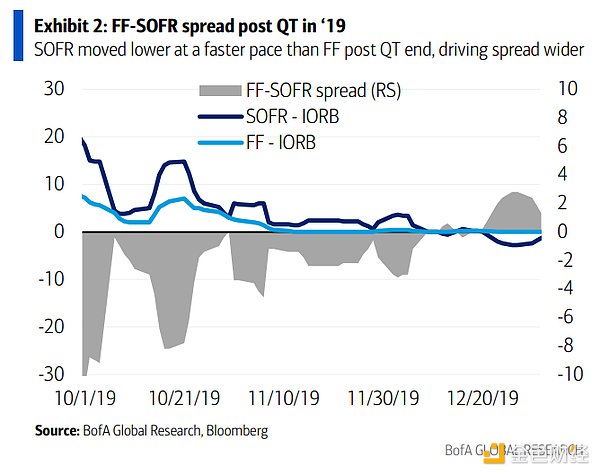
Core Viewpoint - The Federal Reserve has initiated the Reserve Management Purchase (RMP) program to inject liquidity into the market, following recent volatility in the $12 trillion repurchase market, despite emphasizing that this is not quantitative easing (QE) [1][4][5]. Group 1: RMP Program Details - The New York Fed announced a plan to purchase $40 billion in short-term Treasury securities over the next 30 days to maintain adequate reserve levels, marking a significant shift in the Fed's balance sheet management strategy [2][3]. - The RMP will adjust its purchasing scale based on expected trends in Fed liabilities and seasonal fluctuations, with the first plan to be published on December 11 [2][4]. - The Fed's statement indicates that reserve balances have fallen to adequate levels, prompting the need for short-term Treasury purchases [2][3]. Group 2: Market Reactions and Implications - Despite the Fed's insistence that RMP is not QE, the market has reacted as if it is, with increases in U.S. Treasuries, equities, Bitcoin, gold, and oil, while the dollar weakened [1][4]. - The liquidity injection is expected to quickly lower the Secured Overnight Financing Rate (SOFR), while the Federal Funds Rate (FF) will respond more slowly, creating significant arbitrage opportunities for investors [5][6]. - Historical context from 2019 suggests that similar liquidity injections led to rapid changes in SOFR, indicating that the current market may experience similar dynamics [6][9]. Group 3: Comparison with Historical Context - The RMP's scale is expected to be lower than in 2019, with anticipated monthly purchases around 0.15% of GDP, compared to 0.2-0.3% during the previous episode [9][10]. - The current liquidity situation is not as severe as in 2019, suggesting that the Fed's response may be less aggressive this time [9][10]. - The mechanism of cash injection leading to rapid SOFR changes while FF lags has been validated in previous instances, indicating a consistent pattern despite the differing contexts [10].