
担保隔夜融资利率(SOFR)

Search documents
美国金融系统年末流动性紧缩分析
Di Yi Cai Jing· 2026-01-04 13:22
Core Insights - The U.S. financial system is experiencing significant liquidity tightening, with the Federal Reserve's Standing Repo Facility (SRF) usage reaching a record $74.6 billion by the end of 2025, indicating a strong demand for short-term funding [1][3][13] - The liquidity tightening is attributed to a combination of factors including the end of Quantitative Tightening (QT), Treasury General Account (TGA) rebuilding, and seasonal pressures [6][13] Group 1: Current Liquidity Conditions - As of December 31, 2025, SRF usage hit $74.6 billion, with Treasury securities and mortgage-backed securities (MBS) as collateral, reflecting increased year-end pressure [3][4] - The SOFR (Secured Overnight Financing Rate) was reported at 3.71% on December 30, 2025, nearing the Fed's upper limit of 3.75%, indicating liquidity stress [3][4] - Bank reserves decreased to approximately $3 trillion by the end of 2025, down from a peak of $4.3 trillion in 2021, primarily due to QT and TGA management [4][6] Group 2: Causes of Liquidity Tightening - QT has been a major driver of liquidity tightening, with the Fed reducing its balance sheet and removing excess liquidity from the system [6][7] - The TGA rebuilding has exacerbated liquidity withdrawal, with significant increases in TGA balances following the debt ceiling crisis [6][7] - Seasonal factors, particularly year-end window dressing, have led banks to reduce leverage and hoard cash, further tightening liquidity [7][8] Group 3: Market Impact - The S&P 500 index experienced a slight decline of approximately 0.25% at year-end, reflecting investor caution amid rising financing costs [8] - Gold and silver prices benefited from increased safe-haven demand, with gold prices rising above $2000 per ounce [8] - The bond market saw an overall increase in yield curves, with short-term Treasury bill yields approaching SOFR levels, indicating heightened funding costs [8] Group 4: Federal Reserve's Response - The Federal Reserve initiated the Reserve Management Purchase (RMP) program in December 2025, planning to purchase about $40 billion in short-term Treasury bills monthly to maintain adequate reserves [10][11] - The SRF has effectively acted as a ceiling tool, preventing a freeze in the repo market despite high usage levels [10][11] - The Fed's interventions are seen as timely and targeted, with the RMP expected to stabilize SOFR within the target range [10][11] Group 5: Future Outlook - The liquidity environment in 2026 will depend on various factors, including potential seasonal effects and global geopolitical dynamics [12][13] - If liquidity tightening persists, it may lead to increased financing costs for small and medium-sized enterprises, potentially impacting consumption and investment [9][12] - Overall, the liquidity situation is expected to stabilize, but monitoring of reserve thresholds will be crucial to ensure system resilience [12][13]
据美国纽约联储数据,上个交易日(12月11日,美联储宣布降息和债券购买计划的第二天)担保隔夜融资利率(SOFR)报3.66%,之
Sou Hu Cai Jing· 2025-12-12 14:24
Core Insights - The New York Federal Reserve reported a decrease in the secured overnight financing rate (SOFR) to 3.66% on December 11, down from 3.90% the previous day [1] - The effective federal funds rate also declined to 3.64% on the same day, compared to 3.89% the day before [1] Group 1 - The SOFR decreased by 0.24 percentage points from the previous day [1] - The effective federal funds rate saw a reduction of 0.25 percentage points [1]
dbg盾博:美联储重启RMP,400亿美元月购计划能否复制2019年?
Sou Hu Cai Jing· 2025-12-11 08:10
Core Viewpoint - The New York Fed is set to release its first "Reserve Management Purchase" (RMP) detail on December 11, with bond purchases commencing the following day, signaling a liquidity influx despite assurances from Powell that this is not quantitative easing [3]. Group 1: RMP Overview - The current RMP is characterized as "preventive maintenance" rather than an emergency response, aimed at preparing for a seasonal surge in non-reserve liabilities expected in April, which could impact the $12 trillion repo market [3]. - The Fed plans to initially purchase $40 billion in short-term Treasury bills over the next month, with the possibility of extending the duration to three years and adjusting monthly purchase amounts based on liability fluctuations [3]. Group 2: Market Reactions - Following the announcement, markets have reacted positively, with U.S. Treasuries, equities, Bitcoin, gold, and oil all rising, while the dollar has weakened, indicating a liquidity feast [3]. - Bank of America estimates that the current "fill" gap from RMP will last approximately six months, with monthly purchases equating to 0.15% of GDP, lower than the 0.3% seen in 2019, but still expected to influence overnight financing rates [3]. Group 3: Historical Context and Comparisons - Historical data shows that after the RMP was implemented in October 2019, the SOFR/FF spread increased from -21 basis points to -3 basis points within 20 trading days, suggesting a rapid market adjustment [4]. - Current market conditions resemble those of 2019, with leveraged funds positioning themselves in short-term Treasury futures and money market funds lowering repo quotes to secure bonds [4]. Group 4: Future Implications - The total reserves in banks remain ample, with ONRRP balances providing a $350 billion buffer, indicating that the current liquidity levels will not overwhelm the short end of the market immediately [5]. - Traders are betting that if monthly purchases rise to $60 billion, SOFR could drop below 4%, creating a significant gap with the 5.25% FF target, potentially leading to a liquidity surge [5].

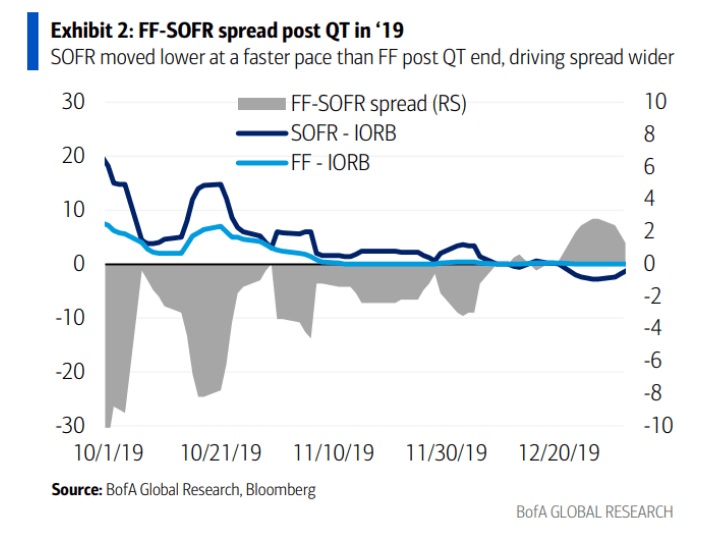
美联储重启QE?RMP来了 市场想重温“2019年的美好回忆”
Hua Er Jie Jian Wen· 2025-12-11 05:11
Core Viewpoint - The Federal Reserve has announced the initiation of the Reserve Management Purchase (RMP) program, which aims to inject liquidity into the market by purchasing short-term Treasury securities, amidst concerns over volatility in the repo market and the need to maintain adequate reserves [1][2]. Group 1: RMP Program Details - The New York Fed plans to purchase $40 billion in short-term Treasury securities over the next 30 days, following the cessation of balance sheet reduction [1][2]. - The RMP will adjust its purchasing scale based on expected trends in the Fed's liabilities and seasonal fluctuations, with the first purchase scheduled for December 12 [2]. - The Fed's statement indicates that reserve balances have fallen to a level that requires intervention to maintain adequate liquidity [2][3]. Group 2: Market Reactions - Despite the Fed's insistence that RMP is not quantitative easing (QE), the market has reacted as if it is, with increases in Treasury yields, equities, Bitcoin, gold, and oil, while the dollar weakened [1][4]. - The Bank of America believes that the cash injected through RMP will quickly lower the Secured Overnight Financing Rate (SOFR), while the Federal Funds Rate (FF) will respond more slowly, creating arbitrage opportunities [5]. Group 3: Historical Context - The RMP's current implementation is compared to the 2019 repo crisis, where similar liquidity injections led to a rapid narrowing of the SOFR/FF spread [6][8]. - The expected monthly RMP scale is approximately 0.15% of GDP, lower than the 0.2-0.3% seen in 2019, indicating a less severe liquidity situation [8].

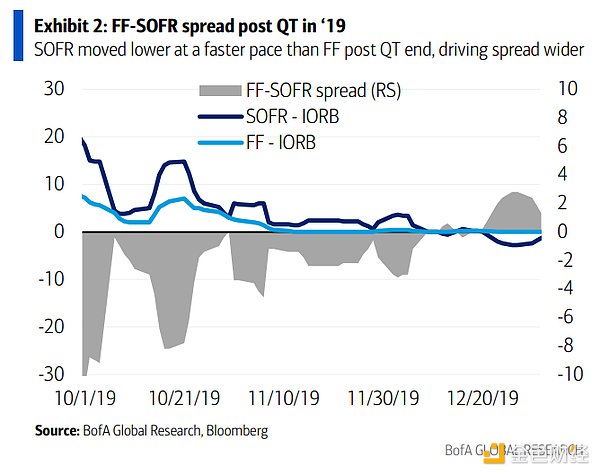
美联储重启QE?RMP来了!市场想重温“2019年的美好回忆”
Hua Er Jie Jian Wen· 2025-12-11 01:39
Core Viewpoint - The Federal Reserve has initiated the Reserve Management Purchase (RMP) program to inject liquidity into the market, following recent volatility in the $12 trillion repurchase market, despite emphasizing that this is not quantitative easing (QE) [1][4][5]. Group 1: RMP Program Details - The New York Fed announced a plan to purchase $40 billion in short-term Treasury securities over the next 30 days to maintain adequate reserve levels, marking a significant shift in the Fed's balance sheet management strategy [2][3]. - The RMP will adjust its purchasing scale based on expected trends in Fed liabilities and seasonal fluctuations, with the first plan to be published on December 11 [2][4]. - The Fed's statement indicates that reserve balances have fallen to adequate levels, prompting the need for short-term Treasury purchases [2][3]. Group 2: Market Reactions and Implications - Despite the Fed's insistence that RMP is not QE, the market has reacted as if it is, with increases in U.S. Treasuries, equities, Bitcoin, gold, and oil, while the dollar weakened [1][4]. - The liquidity injection is expected to quickly lower the Secured Overnight Financing Rate (SOFR), while the Federal Funds Rate (FF) will respond more slowly, creating significant arbitrage opportunities for investors [5][6]. - Historical context from 2019 suggests that similar liquidity injections led to rapid changes in SOFR, indicating that the current market may experience similar dynamics [6][9]. Group 3: Comparison with Historical Context - The RMP's scale is expected to be lower than in 2019, with anticipated monthly purchases around 0.15% of GDP, compared to 0.2-0.3% during the previous episode [9][10]. - The current liquidity situation is not as severe as in 2019, suggesting that the Fed's response may be less aggressive this time [9][10]. - The mechanism of cash injection leading to rapid SOFR changes while FF lags has been validated in previous instances, indicating a consistent pattern despite the differing contexts [10].
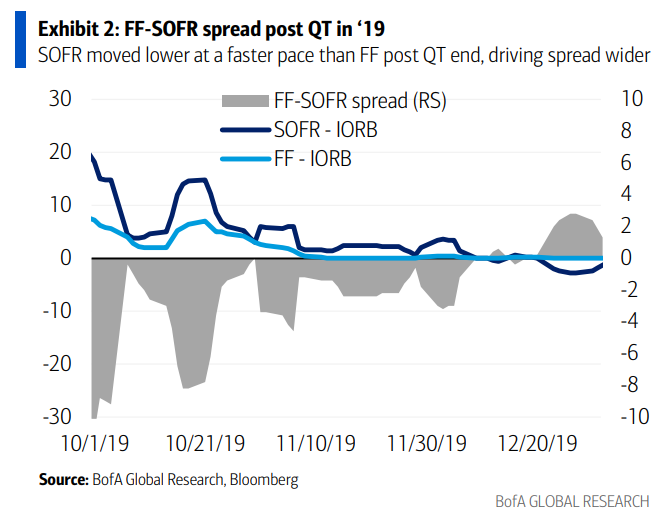
据美国纽约联储数据,上个交易日(11月7日)担保隔夜融资利率(SOFR)报3.93%
Mei Ri Jing Ji Xin Wen· 2025-11-10 14:17
Group 1 - The secured overnight financing rate (SOFR) on November 7 was reported at 3.93%, an increase from the previous day's rate of 3.92% [1] - The effective federal funds rate on the same day remained unchanged at 3.87%, consistent with the previous day's rate [1]
据美国纽约联储数据,上个交易日(10月29日,美联储降息日)担保隔夜融资利率(SOFR)报4.27%,之前一天报4.31%。上
Sou Hu Cai Jing· 2025-10-30 14:07
Core Insights - The New York Federal Reserve reported a decrease in the Secured Overnight Financing Rate (SOFR) to 4.27% on October 29, down from 4.31% the previous day [1] - The effective federal funds rate remained unchanged at 4.12% on the same day [1] Group 1 - SOFR decreased by 0.04 percentage points from the previous day [1] - The effective federal funds rate has not changed, remaining stable at 4.12% [1]
美国纽约联储:10月28日SOFR及联邦基金利率情况
Sou Hu Cai Jing· 2025-10-29 14:27
Core Points - The secured overnight financing rate (SOFR) reported at 4.31% on October 28, an increase from 4.27% the previous day [1] - The effective federal funds rate remained unchanged at 4.12% on October 28, consistent with the previous day's rate [1]
FOMC开幕前一天,与美联储政策利率相关的关键利率最近一个月第四次上涨
Sou Hu Cai Jing· 2025-10-28 14:16
Core Insights - The secured overnight financing rate (SOFR) increased to 4.27% on October 27, up from 4.24% the previous day [1] - The effective federal funds rate rose to 4.21% on the same day, compared to 4.11% the day before [1] Summary by Category - **Interest Rates** - SOFR reported at 4.27%, an increase of 0.03 percentage points from the previous day [1] - Effective federal funds rate at 4.21%, up by 0.10 percentage points from the prior day [1]
融资压力持续:美国SOFR上涨10个基点,创9月17日以来新高
Xin Lang Cai Jing· 2025-10-16 14:52
Core Insights - The overnight secured financing rate (SOFR) reached 4.29% on October 15, marking the largest single-day fluctuation since September 30, which had a volatility of 11 basis points [1] - The previous day's SOFR was reported at 4.19%, indicating a notable increase [1] - The effective federal funds rate remained unchanged at 4.10% on the same day [1]