储备管理购买(RMP)

Search documents
下周美联储决议前瞻:“暂停”是确定,不确定的是“鹰派还是鸽派暂停”
Sou Hu Cai Jing· 2026-01-25 09:09
Group 1 - The core viewpoint is that Morgan Stanley anticipates the Federal Reserve will maintain interest rates during the upcoming January FOMC meeting, with a focus on the tone of the statement indicating a dovish pause to soothe the market [1][2] - The Federal Reserve is expected to keep the federal funds rate target range unchanged at 3.50%-3.75%, which is seen as a tactical adjustment rather than a return to a tightening cycle [1][2] - The key for investors lies in the forward guidance, with expectations that the Fed will retain language suggesting consideration for further adjustments, indicating a continued dovish stance [2][9] Group 2 - Jerome Powell is expected to justify the pause by referencing recent strong growth data, stable hiring, and a decrease in the unemployment rate to 4.375% [3] - Despite the Fed's pause on rate cuts, the short-term financing market remains loose, with repo rates normalizing below the interest on reserve balances (IORB), indicating an excess of cash in the system [4] - Morgan Stanley has revised its outlook on the foreign exchange market, now projecting a stronger U.S. economy with an upward adjustment of GDP growth to 2.4% for 2026, while delaying the anticipated rate cuts [5] Group 3 - In the mortgage-backed securities (MBS) sector, the announcement of a $200 billion purchase plan by government-sponsored enterprises (GSEs) has led to a significant narrowing of MBS spreads, prompting a neutral stance from Morgan Stanley [8] - The FOMC statement is expected to upgrade the assessment of economic growth from "moderate" to "robust" and remove references to increased risks in the labor market, reflecting a more positive outlook [9] - The Federal Reserve is projected to maintain a monthly purchase of $40 billion in Treasury bills to manage reserve levels, with expectations that the SOMA account will exceed $600 billion by the end of 2026 [9]

吴说本周宏观指标与分析:美国 11 月非农及 CPI、日欧英利率决议
Sou Hu Cai Jing· 2025-12-14 16:23
Core Viewpoint - The Federal Reserve has lowered interest rates by 25 basis points to 3.75%, with some dissent among members regarding the decision, while also announcing the restart of reserve management purchases [2] Group 1: Federal Reserve Actions - The Federal Reserve's new interest rate is set at 3.75%, down from the previous 4.00% [2] - There were three dissenting votes during the meeting, with two members opposing the rate cut and one advocating for a larger cut of 50 basis points [2] - The latest Summary of Economic Projections (SEP) indicates that 6 out of 19 officials do not support the rate cut, and the median path for 2026 remains unchanged [2] Group 2: Economic Indicators - Initial jobless claims in the U.S. for the week ending December 6 were reported at 236,000, higher than the expected 220,000 [2] - The U.S. trade deficit for September was revised to $59.3 billion, which is narrower than the expected $63.3 billion, marking the smallest deficit since June 2020 [2] - China's CPI for November increased by 0.7% year-on-year, the highest since March 2024, while the M2 money supply growth was reported at 8%, below the market expectation of 8.2% [2] Group 3: Upcoming Events - Key upcoming events include the Bank of England's interest rate decision on December 18, the European Central Bank's deposit rate announcement, and the U.S. November CPI and non-farm payroll data release on December 18 [3]
如何理解美联储重启扩表?
一瑜中的· 2025-12-13 14:55
Core Viewpoint - The Federal Reserve announced the initiation of the Reserve Management Purchases (RMP) tool starting December 12, with a plan to purchase $40 billion of short-term Treasury securities in the first month, maintaining a high level of purchases in subsequent months. This RMP is expected to inject approximately $150 billion in reserves into the market, lasting until Q2 2026, primarily focusing on ultra-short-term Treasury securities [2][5][25]. Group 1: Actions by the Federal Reserve - The RMP is a significant highlight of the December FOMC meeting, aimed at maintaining adequate reserve levels and addressing seasonal fluctuations in the Treasury General Account (TGA) [5][6]. - The RMP will primarily purchase short-term Treasury securities, with 75% of purchases targeting securities with maturities of 1-4 months [25][26]. - The RMP is expected to last at least until Q2 2026, with a target reserve balance of around $3 trillion, requiring an injection of approximately $150 billion in reserves [6][28]. Group 2: Economic Implications of RMP - The RMP is expected to improve short-term liquidity, benefiting the stock market by facilitating "loose trading" conditions. However, it is not equivalent to quantitative easing (QE) and may have limited effects on long-term interest rates and financing costs for the real economy [7][35]. - The RMP's operational scale is designed to counteract seasonal liquidity pressures, particularly during tax payment periods, which can tighten market liquidity [6][29]. Group 3: Current Liquidity Conditions - The current reserve levels are slightly below the reasonable range, with the reserve balance to nominal GDP ratio at 9.5% and the reserve balance to total bank assets ratio at 11.8% [8][45]. - Maintaining adequate reserve levels is crucial for the effective implementation of the Federal Reserve's "floor system" monetary policy framework, which relies on sufficient reserves to control market interest rates [9][51]. - The liquidity conditions are tighter than desired, but the situation is better than during the previous QT phase, reducing the risk of a liquidity crisis [41][60].

如何理解美联储重启扩表?
Huachuang Securities· 2025-12-12 04:28
Group 1: Federal Reserve Actions - The Federal Reserve announced the restart of the Reserve Management Purchases (RMP) tool, starting December 12, with an initial plan to purchase $40 billion in short-term Treasury securities in the first month[2] - The RMP is expected to inject approximately $150 billion in reserves into the market, continuing until Q2 2026[4] - The purchase structure will focus on ultra-short-term Treasury securities, with 75% of purchases planned for maturities of 1-4 months[4] Group 2: Economic Implications - The RMP aims to improve short-term liquidity, benefiting the U.S. stock market's "loose trading" environment[5] - However, RMP is not equivalent to quantitative easing (QE) and is expected to have limited effects on long-term interest rates and the cost of financing for the real economy[5] - The RMP's operational scale may need to be adjusted based on seasonal fluctuations in the Treasury General Account (TGA) and overall liquidity demands[4] Group 3: Current Liquidity Conditions - The current reserve levels are slightly below the reasonable range, with reserves to nominal GDP ratio at 9.5% and reserves to total bank assets at 11.8%[7] - The reasonable reserve balance is estimated to be around $3 trillion, indicating a need for the RMP to maintain adequate liquidity levels[22] - Compared to the end of QT-1, the current reserve levels are more ample, as they were 6.4% and 7.9% respectively at that time[7] Group 4: Market Indicators - The effective federal funds rate (EFFR) and the secured overnight financing rate (SOFR) have shown signs of liquidity tightening, with SOFR recently exceeding the interest on excess reserves (IOER) for consecutive weeks[8] - The EFFR-IOER spread has been narrowing, indicating a potential liquidity shortage in the banking system, although the situation is better than in 2019[9]
美联储12月议息会议点评:再度降息、重启RMP
Huachuang Securities· 2025-12-11 14:28
Report Industry Investment Rating The provided content does not mention the report industry investment rating. Core Views of the Report - The Fed ended 2025 with continued interest rate cuts, totaling 75 basis points for the year. The policy focus shifted from concerns about inflation rebound to addressing employment downward pressure. The threshold for restarting rate cuts in 2026 is expected to increase, depending more on the pace of employment slowdown and the effectiveness of alleviating commodity inflation related to tariffs. [5][30] - The Fed's restart of RMP is expected to ease the previous liquidity tightening situation. However, internal disagreements among officials have intensified, and with key events such as the Fed chairmanship change and mid - term elections in 2026, the stability of monetary policy has decreased. It is expected that the Fed will maintain a "wait - and - see" attitude in the first half of 2026, and changes in the second half may depend on the new chairman's policy orientation and the economic outlook due to fiscal expansion. [5][30] Summary by Relevant Catalogs 1. Interest Rate Decision and Market Reaction - On the early morning of December 11, 2025, the Fed cut interest rates for the third consecutive time, lowering the federal funds rate target range by 25 basis points to 3.5% - 3.75%, and the reserve balance rate and discount rate to 3.65% and 3.75% respectively. In 2025, the Fed cut interest rates three times, a cumulative 75 basis points, reducing the federal funds target rate from 4.5% to 3.75%. [4][7] - After the interest rate decision was announced, the 10 - year U.S. Treasury yield fluctuated upward, reaching a high of 4.18%. The three major U.S. stock indexes rose, and the U.S. dollar index briefly rose above 99 points. During the press conference, the 10 - year U.S. Treasury yield turned downward, the U.S. stock rally continued to expand, the U.S. dollar index returned to around 98.5, COMEX gold first fell then rose, and crude oil prices declined. [8] 2. Interest Rate Statement - Focused on labor market pressure, policy outlook, and Reserve Management Purchases (RMP). The description of the unemployment rate was changed to "the unemployment rate has risen as of September". The statement added the expression "the extent and timing" for future interest rate adjustments, last seen in December 2024, which may imply a higher threshold for future rate cuts. It also added that the committee believes the reserve balance has fallen to an adequate level and will buy short - term U.S. Treasuries as needed to maintain a continuous and adequate supply of reserves. [4][12][16] 3. Economic Forecast - GDP growth forecasts for the next four years were raised, while the unemployment rate forecast for the following year and inflation forecasts for this and next year were slightly lowered. The December dot - plot predicts one rate cut each in 2026 and 2027, with the median remaining the same as in September. However, there is a high degree of dispersion among the 19 Fed officials providing forecasts, indicating significant disagreements on the subsequent rate - cut magnitude and increasing policy uncertainty. [18][19] 4. Reserve Management Purchases (RMP) - Core Purpose: To increase the bank system's reserve scale by purchasing short - term Treasuries and other assets, addressing the recent surge in funding prices. Since 2023, the scale of the overnight reverse repurchase tool ONRRP has dropped significantly to near zero, and the bank reserve scale has returned to the 2020 level. The Fed's long - term balance sheet reduction and the U.S. government shutdown have also drained short - term liquidity, with the SOFR remaining persistently higher than the EFFR since September 2025, with the spread reaching a maximum of 36 basis points. [2][20][22] - Bond - buying Operation: Starting from December 12, it plans to purchase $40 billion in Treasury bills over the next 30 days. The subsequent purchase amount will be adjusted according to the reserve supply outlook and seasonal fluctuations. According to Powell, the neutral monthly purchase level may be between $20 billion and $25 billion. [2][22] - Historical Operation: The last time the Fed carried out RMP was in 2019. In mid - September 2019, the SOFR was nearly 300 basis points higher than the EFFR. The Fed announced the launch of RMP on October 11, 2019, buying Treasury bills at a rate of $60 billion per month to maintain the reserve level at or above that of early September 2019. [2][22] - Comparison with QE: Unlike QE, which lowers long - term interest rates by buying long - term Treasuries and then reduces borrowing costs, RMP aims to replenish the bank system's reserves by buying short - term Treasuries, ensuring an adequate reserve scale without indicating a change in the monetary policy stance. [3][23] 5. Labor Market - Both labor supply and demand are slowing down, and employment data may overestimate the actual situation. From June to September 2025, the unemployment rate rose by 0.3 percentage points to 4.4%. Since April, the average monthly non - farm employment increase was about 40,000, but after adjustment, it may actually have decreased by about 20,000 per month. The continuous and gradual cooling of the labor market might be the main reason for the continued rate cuts. [5][24] 6. Inflation - Non - tariff factors have made positive progress, and inflation caused by tariff factors may peak in the first quarter of 2026. It is maintained that the impact of tariffs on inflation is one - time rather than continuous. In September, the U.S. core CPI year - on - year decreased from 3.1% in August to 3.0%, and the month - on - month growth rate dropped from 0.3% to 0.2%. Among sub - items, prices of tariff - sensitive goods such as clothing, furniture, and entertainment products increased month - on - month to varying degrees, while the housing rent in core services decreased, indicating a continued decline in service inflation, but the spill - over effect of commodity inflation caused by tariffs still exists. [5][27]
有克制的“价”“量”双宽——12月FOMC会议点评
一瑜中的· 2025-12-11 12:19
Core Viewpoint - The December FOMC meeting resulted in a 25 basis point rate cut to a target range of 3.5%-3.75%, aligning with market expectations, while the Fed's tone remained neutral to slightly hawkish [2][20] Group 1: Interest Rate Decisions - The Fed's decision to cut rates by 25 basis points was anticipated, with 3 out of 12 FOMC members opposing the cut, indicating internal dissent [20] - The dot plot indicates only one rate cut is expected next year, which is below market pricing of two cuts [3][12] - The Fed's economic outlook is described as "Goldilocks," with upward revisions to GDP growth forecasts for 2025-2028 and downward revisions to inflation forecasts for the same period [6][21] Group 2: Economic Projections - GDP growth forecasts for Q4 of 2025, 2026, 2027, and 2028 are now projected at 1.7%, 2.3%, 2.0%, and 1.9% respectively, compared to previous estimates of 1.6%, 1.8%, 1.9%, and 1.8% [21] - Core PCE inflation forecasts for the same periods are adjusted to 3.0%, 2.5%, 2.1%, and 2.0%, down from 3.1%, 2.6%, 2.1%, and 2.0% [21] Group 3: Balance Sheet Management - The Fed is restarting "Reserve Management Purchases" (RMP) to maintain adequate reserve levels, with a purchase scale of $40 billion per month starting this December [14][35] - RMP is distinct from quantitative easing (QE), as it involves purchasing short-term Treasury securities to manage liquidity rather than a broad monetary policy shift [15][16] Group 4: Market Reactions - Following the FOMC meeting, the stock market saw gains, with the Dow Jones Industrial Average rising by 1.05%, and the S&P 500 increasing by 0.67% [38] - The dollar index fell by 0.6% to 97.24, while yields on 10-year and 2-year Treasury bonds decreased [38]

有克制的价量双宽:12月FOMC会议点评
Huachuang Securities· 2025-12-11 12:08
Group 1: Interest Rate Changes - The FOMC lowered the interest rate by 25 basis points to a target range of 3.5%-3.75%, aligning with market expectations[1] - The dot plot indicates a forecast of one rate cut in both next year and the year after, but there is significant disagreement among members[3] - There were 2 dissenting votes against the rate cut, with 6 out of 19 participants supporting no rate cut[3] Group 2: Economic Projections - The Fed raised its GDP growth forecasts for Q4 2025-2028 to 1.7%, 2.3%, 2.0%, and 1.9% respectively, compared to previous estimates of 1.6%, 1.8%, 1.9%, and 1.8%[1] - Core PCE inflation forecasts for the same period were adjusted to 3.0%, 2.5%, 2.1%, and 2.0%, down from 3.1%, 2.6%, 2.1%, and 2.0%[1] - The Fed's assessment of downside risks to growth has decreased, while the outlook for unemployment risks has also improved[21] Group 3: Quantitative Easing Measures - The Fed announced the restart of "Reserve Management Purchases" (RMP) to maintain adequate reserve levels, starting at a pace of $40 billion per month[5] - This RMP is a technical operation aimed at increasing liquidity in the money market, distinct from traditional quantitative easing (QE)[13] - The current asset purchase scale is smaller than previous QE measures, with the Fed's balance sheet at approximately $6.6 trillion compared to $3.8 trillion in 2019[7] Group 4: Market Reactions - Following the FOMC meeting, U.S. stock markets rose, the dollar index fell, and U.S. Treasury yields declined[35] - The futures market adjusted expectations for rate cuts next year from 2 to approximately 2.24 times, with the year-end policy rate forecast decreasing from 3.159% to 3.082%[35]
dbg盾博:美联储重启RMP,400亿美元月购计划能否复制2019年?
Sou Hu Cai Jing· 2025-12-11 08:10
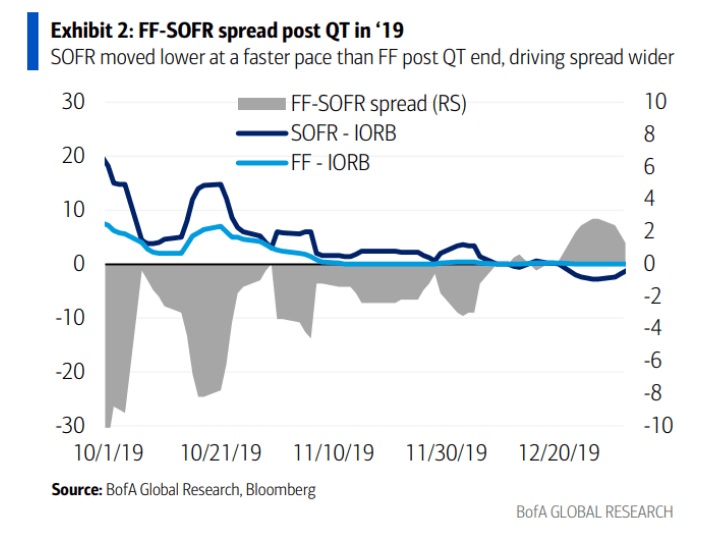
Core Viewpoint - The New York Fed is set to release its first "Reserve Management Purchase" (RMP) detail on December 11, with bond purchases commencing the following day, signaling a liquidity influx despite assurances from Powell that this is not quantitative easing [3]. Group 1: RMP Overview - The current RMP is characterized as "preventive maintenance" rather than an emergency response, aimed at preparing for a seasonal surge in non-reserve liabilities expected in April, which could impact the $12 trillion repo market [3]. - The Fed plans to initially purchase $40 billion in short-term Treasury bills over the next month, with the possibility of extending the duration to three years and adjusting monthly purchase amounts based on liability fluctuations [3]. Group 2: Market Reactions - Following the announcement, markets have reacted positively, with U.S. Treasuries, equities, Bitcoin, gold, and oil all rising, while the dollar has weakened, indicating a liquidity feast [3]. - Bank of America estimates that the current "fill" gap from RMP will last approximately six months, with monthly purchases equating to 0.15% of GDP, lower than the 0.3% seen in 2019, but still expected to influence overnight financing rates [3]. Group 3: Historical Context and Comparisons - Historical data shows that after the RMP was implemented in October 2019, the SOFR/FF spread increased from -21 basis points to -3 basis points within 20 trading days, suggesting a rapid market adjustment [4]. - Current market conditions resemble those of 2019, with leveraged funds positioning themselves in short-term Treasury futures and money market funds lowering repo quotes to secure bonds [4]. Group 4: Future Implications - The total reserves in banks remain ample, with ONRRP balances providing a $350 billion buffer, indicating that the current liquidity levels will not overwhelm the short end of the market immediately [5]. - Traders are betting that if monthly purchases rise to $60 billion, SOFR could drop below 4%, creating a significant gap with the 5.25% FF target, potentially leading to a liquidity surge [5].
“大空头”伯里警告:美联储重启购债凸显美国银行体系脆弱
Xin Lang Cai Jing· 2025-12-11 06:51
Core Viewpoint - Michael Burry warns that the Federal Reserve's resumption of short-term Treasury bond purchases indicates increasing reliance of the financial system on Fed support rather than stability [1][3] Group 1: Federal Reserve Actions - The Federal Reserve has decided to stop shrinking its balance sheet and plans to purchase approximately $35 billion to $45 billion in U.S. Treasuries monthly, starting in January [1][3] - Burry questions the timing of the Fed's actions, noting that the U.S. Treasury has been issuing more short-term bonds to avoid raising 10-year yields [4] Group 2: Financial System Vulnerability - Burry states that without the Fed's over $3 trillion in reserves, the U.S. banking system would not be able to function, highlighting a sign of weakness rather than strength [1][3] - Before the banking turmoil in 2023, the financial system required about $2.2 trillion, compared to only $45 billion in 2007, indicating a rapid decline in the banking sector's strength [1][4] Group 3: Market Implications - Burry suggests that the Fed's tendency to expand its balance sheet after each crisis helps explain the strength of the stock market [5] - He also notes that the actual limitation of this approach could lead to the complete nationalization of the U.S. bond market, with the Fed owning all $40 trillion of U.S. debt [5]
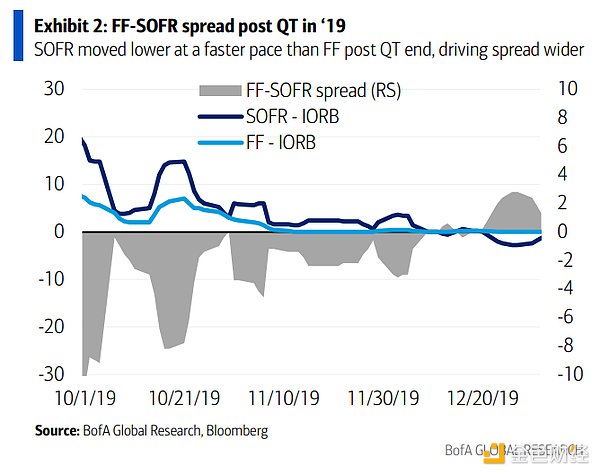
美联储重启QE?RMP来了 市场想重温“2019年的美好回忆”
Hua Er Jie Jian Wen· 2025-12-11 05:11
Core Viewpoint - The Federal Reserve has announced the initiation of the Reserve Management Purchase (RMP) program, which aims to inject liquidity into the market by purchasing short-term Treasury securities, amidst concerns over volatility in the repo market and the need to maintain adequate reserves [1][2]. Group 1: RMP Program Details - The New York Fed plans to purchase $40 billion in short-term Treasury securities over the next 30 days, following the cessation of balance sheet reduction [1][2]. - The RMP will adjust its purchasing scale based on expected trends in the Fed's liabilities and seasonal fluctuations, with the first purchase scheduled for December 12 [2]. - The Fed's statement indicates that reserve balances have fallen to a level that requires intervention to maintain adequate liquidity [2][3]. Group 2: Market Reactions - Despite the Fed's insistence that RMP is not quantitative easing (QE), the market has reacted as if it is, with increases in Treasury yields, equities, Bitcoin, gold, and oil, while the dollar weakened [1][4]. - The Bank of America believes that the cash injected through RMP will quickly lower the Secured Overnight Financing Rate (SOFR), while the Federal Funds Rate (FF) will respond more slowly, creating arbitrage opportunities [5]. Group 3: Historical Context - The RMP's current implementation is compared to the 2019 repo crisis, where similar liquidity injections led to a rapid narrowing of the SOFR/FF spread [6][8]. - The expected monthly RMP scale is approximately 0.15% of GDP, lower than the 0.2-0.3% seen in 2019, indicating a less severe liquidity situation [8].