全球牛市

Search documents
华尔街:全球牛市有望延续,美联储降息将给亚洲市场注入动能
Sou Hu Cai Jing· 2025-08-25 09:41
Core Viewpoint - The global market appears resilient to economic data and policy uncertainties, driven by liquidity, with expectations of continued bullish trends in Asia due to potential interest rate cuts by the Federal Reserve [1] Group 1: Market Dynamics - A major Wall Street bank's chief economist noted a "water buffalo" sign indicating liquidity-driven market behavior [1] - In the U.S., there is a frenzy around AI themes, while the Eurozone benefits from low interest rates and increased defense spending, attracting funds into defense and cyclical stocks [1] Group 2: China Market Insights - In China, a stable economic foundation and policy expectations have led to a flow of household savings into the stock market, with insurance funds investing nearly 1 trillion yuan [1] - The recent trading volume in A-shares has reached over 30 trillion yuan for the second time in history, indicating strong market activity [1] Group 3: Federal Reserve and Interest Rates - Federal Reserve Chairman Jerome Powell indicated potential adjustments to policy stance based on changes in baseline outlook and risk balance [1] - Goldman Sachs predicts a high probability of a 25 basis point rate cut in the September meeting, which is expected to inject momentum into Asian markets [1]


全球牛市?因何而起,因何而止
Xin Lang Cai Jing· 2025-08-20 12:17
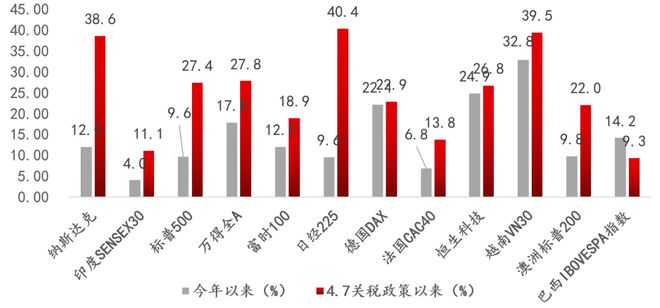
Core Viewpoint - The global equity markets have shown significant recovery and growth since the implementation of the 4.7 tariff policy, with an average increase of 24% post-policy compared to a 14% increase year-to-date, indicating a potential upward trend overcoming tariff-induced volatility [1]. Historical Bull Markets 1. 1991-2000: "New Economy" Driven Internet Bull Market - From early 1991 to March 2000, major global stock markets experienced continuous growth, with the Nasdaq index rising over 500% and significant gains in European and Japanese markets [2]. - The information technology revolution and the rise of "new economy" companies like Microsoft and Intel drove this growth, with the S&P 500's net profit growing at an average of 15% annually from 1995 to 2000 [2][5]. - The bull market ended in 2000 due to the bursting of the internet bubble and subsequent economic recession [5]. 2. 2003-2007: Globalization Dividend and Credit Expansion Bull Market - The global stock market rebounded from March 2003 to October 2007, with the S&P 500 rising approximately 90% and emerging markets seeing gains over 200% [6]. - Economic recovery in the U.S. and China's entry into the WTO fueled demand for commodities, leading to significant growth in resource-rich countries [6]. - The bull market concluded with the 2008 financial crisis, triggered by the subprime mortgage crisis and subsequent liquidity panic [6]. 3. 2009-2019: Long Bull Market Driven by Quantitative Easing (QE) - The bull market began in 2009, with a gradual recovery from the 2008 financial crisis, characterized by strong performance in technology, consumer, and healthcare sectors [9]. - Central banks' QE policies and low interest rates facilitated capital inflow into the stock market, with technology companies driving high profit growth [9]. - The bull market ended unexpectedly due to the global disruption caused by the COVID-19 pandemic in 2020 [9]. 4. 2022-Present: Economic Recovery and AI - The current market rally has been attributed to post-pandemic economic recovery and the emergence of AI technologies, with nearly 70% of S&P 500 companies exceeding earnings expectations in recent reports [11]. - The global liquidity environment has improved, with the Federal Reserve pausing interest rate hikes and the European Central Bank expected to lower rates in mid-2024 [13]. - The ongoing bull market is characterized by new industry drivers, a supportive monetary policy environment, and improving earnings and economic growth [13].