
公序良俗

Search documents
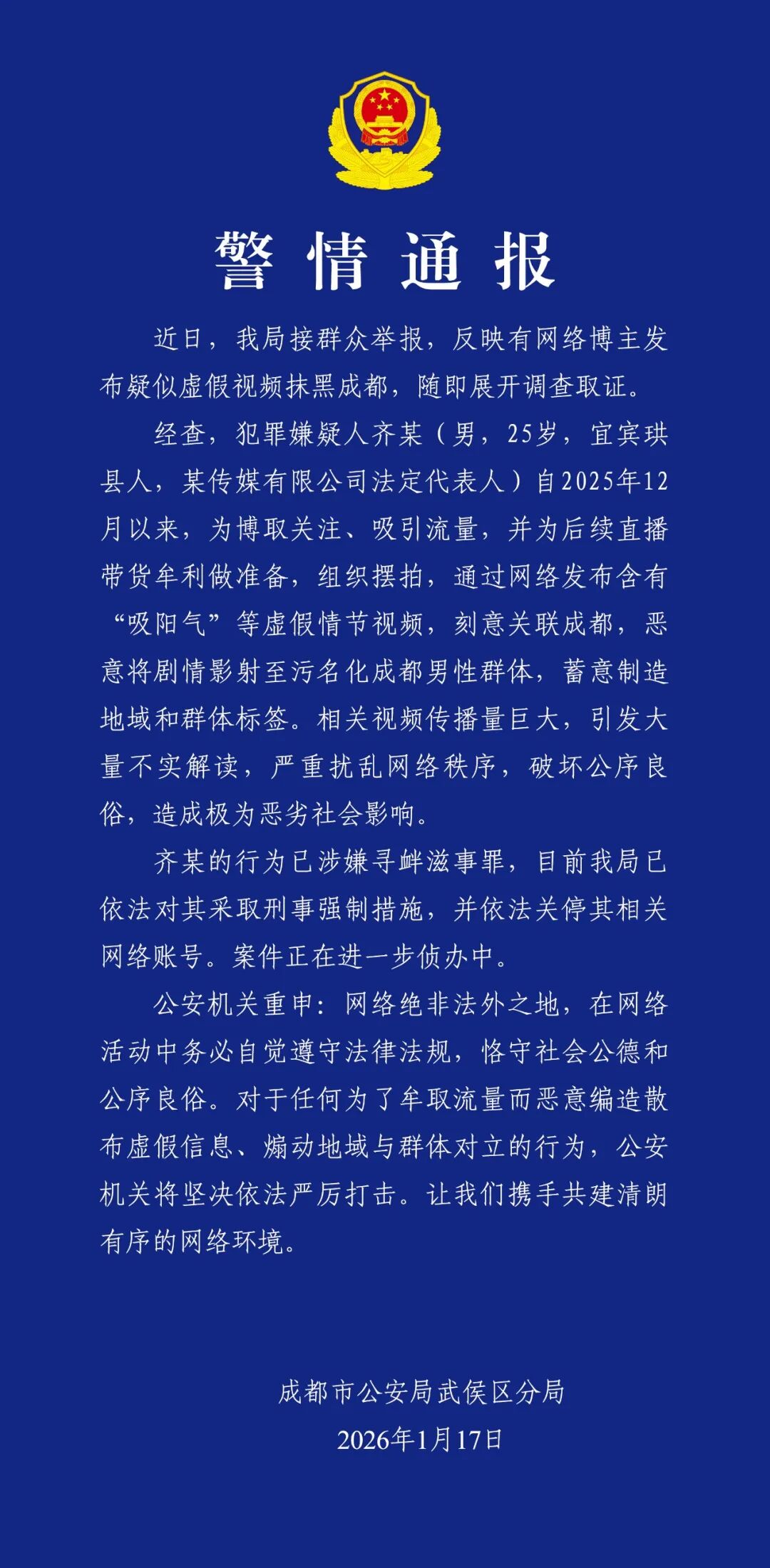
成都警方:男子摆拍“吸阳气”等虚假视频蓄意制造地域和群体标签被采取刑事强制措施
Xin Lang Cai Jing· 2026-01-17 12:35
Core Viewpoint - The Chengdu Public Security Bureau has taken action against an individual for spreading false information online that maligns the city and its male population, which has led to significant social disruption and legal consequences [1][3]. Group 1 - The suspect, identified as Qi, a 25-year-old male and legal representative of a media company, has been accused of creating and disseminating videos with false narratives to gain attention and prepare for future profit through live streaming sales [1]. - The videos included misleading content such as "absorbing yang energy," which was intentionally linked to Chengdu, aiming to stigmatize the local male demographic and create regional and group labels [1]. - The dissemination of these videos has resulted in a massive spread of misinformation, causing severe disruption to online order and damaging public morals [1]. Group 2 - The Chengdu Public Security Bureau has stated that any malicious fabrication and dissemination of false information aimed at inciting regional and group conflicts will be met with strict legal action [3]. - The authorities emphasize the importance of adhering to laws and social ethics to maintain a clear and orderly online environment [3].

成都警方:一男子为博流量摆拍视频污名化成都,被刑拘
Xin Lang Cai Jing· 2026-01-17 12:35
Group 1 - The core issue involves individuals creating and disseminating false videos to defame Chengdu, leading to significant social unrest and legal consequences [1][3] - The first suspect, Qi, aged 25, is accused of organizing staged videos with misleading content related to Chengdu, which resulted in a large volume of views and negative interpretations [1] - The second suspect, Sun, aged 23, used a fabricated "homosexual identity" to attract attention and mislead the public, which also caused severe disruption to online order and public morals [3] Group 2 - Both suspects' actions have been classified as "picking quarrels and provoking trouble," leading to criminal charges and administrative penalties [1][3] - The police have emphasized the importance of adhering to laws and social ethics in online activities, indicating a crackdown on malicious dissemination of false information [1]
单次1.99元,“地铁代坐协议”受法律保护吗?
Xin Lang Cai Jing· 2026-01-16 00:32
转自:法治日报 "单次1.99元,包月50元"? 近日,一项名为"地铁代坐"的服务,引发关注。有上海网友发帖称,早高峰期间,可代占上海地铁9号 线某特定路段座位的服务,自己上车提前占座,再私下"让座"给买家,交易座位的"使用权",单次售价 1.99元,包月50元。此外,社交平台上还衍生出了差异化定价体系,比如高峰时段加价、冷门线路打折 等。 "地铁代坐"靠谱吗?买卖双方私下达成的"代坐协议"受法律保护吗?《法治日报》律师专家库成员、北 京市康达(西安)律师事务所高级合伙人慕丽律师,对此作出专业解读。 慕丽:地铁座位属于典型的公共资源,遵循"先到先得"的无偿分配原则。"代坐"服务实质上是一种"有 偿占座"行为,是将本应平等、免费向所有乘客开放的座位资源,通过提前占有的方式,异化为个人牟 利的"商品"。此类行为涉嫌扰乱公共交通工具上的秩序,违反我国治安管理处罚法规定,存在被公安机 关依法查处,并面临警告、罚款等行政处罚的法律风险。 更关键的是,通过付费"插队"获取座位的行为,侵害了其他乘客的平等使用权,与社会普遍认同的公平 观念和公共道德相悖。因此,"地铁代坐"这类交易的法律效力存在重大瑕疵,在司法实践当中,以此 ...
1900万元送给婚外第三者,男子死后妻子起诉!上海法院判了
Xin Lang Cai Jing· 2026-01-10 20:33
上海市第一中级人民法院认为,金某在与沈某婚姻关系存续期间赠与陶某大量财产,显然不是因日常生 活需要而处理夫妻共同财产的行为,且金某与陶某存在婚外情人关系,该赠与行为既侵犯了沈某的财产 权益,又违背公序良俗,应认定为无效,相应的款项应由陶某全额返还。据此,法院判决驳回上诉,维 持原判。 来源:"上海一中法院"微信公众号、"南方都市报"微信公众号 编辑:符亚丽 日前,上海市第一中级人民法院公布多起婚姻家庭纠纷中妇女权益司法保护典型案例,其中已婚男子金 某擅自将婚内共同财产1900万余元赠与婚外第三者陶某,沈某妻子提起诉讼要求赠与无效,要求对方返 还财产,法院判定该赠与行为无效,相应的款项应由陶某全额返还。 相关案例显示,沈某(女)与金某(男)于1999年7月登记结婚,婚后生育一子一女。金某与陶某在 2015年左右发展成婚外情人关系,金某并向陶某赠与大额财产。金某于2022年5月死亡。沈某及子女提 起诉讼,要求确认金某对陶某的赠与行为无效,陶某返还受赠款1900万余元。 一审法院认为,金某擅自将共同财产赠与他人的赠与行为应为无效,陶某应全额返还夫妻共同财产。一 审法院扣除陶某向金某转回的540万余元后,判决金某向陶 ...
【8点见】两部门督促雀巢(中国)有限公司做好乳粉召回工作
Yang Shi Wang· 2026-01-09 00:09
央视网消息:每天8点,央视网为您梳理24小时内发生在咱们身边的大小事儿。 ·外交部:日本右翼日益膨胀的核野心对世界和平稳定构成严重威胁。 ·公安部:重大跨境赌诈犯罪集团头目陈志被从柬埔寨押解回国。 ·商务部回应两用物项对日出口管制:制止"再军事化",涉民事用途不受影响。 ·教育部:2026年将启动新一轮"双一流"高校建设。 ·强强联手!中国石化中国航油官宣重组。 ·《"高效办成一件事"重点事项"集成办"工作指南》《政务服务大厅集约化建设指南》两项推荐性国家标准近日发布实施。 ·我国公开发布2025年度《中国空间站科学研究与应用进展报告》。 ·2025年全国铁路旅客发送量超45亿人次。 ·严厉打击盗采盗挖行为,国务院安委办公布5起典型案例。 ·找矿新发现!我国铬铁矿与非常规油气勘查双获突破。 ·新疆生产建设兵团党委常委、副司令员李旭接受中央纪委国家监委审查调查。 ·美方强行带离委总统行动致100人死亡,马杜罗夫妇受伤。 ·《政治报·欧洲版》:美国或试图在数月内取得格陵兰岛控制权。 ·俄罗斯外交部:西方国家在乌克兰部署的军事单位、军事设施等都将被视为俄罗斯武装部队的合法作战目标。 ·美国盐湖城枪击事件致2死6伤。 ...


法院判决首次认定销售烟卡“违反公序良俗”,电商平台何为?
Nan Fang Du Shi Bao· 2025-12-29 12:31
Core Viewpoint - The Beijing Internet Court ruled against the sale of "smoking cards" to minors, emphasizing the need for e-commerce platforms to take responsibility in protecting minors from tobacco-related products [1][7][9]. Group 1: Court Ruling and Analysis - The court determined that selling smoking cards as toys violates public order and morals, as it poses a risk to minors' health and promotes tobacco-related imagery [9][11]. - The ruling highlighted that the sale of smoking cards undermines the legal framework designed to protect minors from tobacco exposure, despite existing laws not explicitly banning such products [8][9]. - The court's decision reflects a broader societal goal of safeguarding minors' physical and mental well-being, aligning with the principles established in the Minor Protection Law [8][9]. Group 2: E-commerce Platform Responsibilities - The defendant e-commerce platform argued that it merely serves as a marketplace and does not control the products sold by third-party vendors, claiming no legal basis for banning smoking cards [5][12]. - Despite the platform's implementation of a "Green Network Plan" to filter out smoking card listings, the effectiveness of these measures has been questioned, as many listings remain accessible [11][12]. - The court indicated that the platform must enhance its oversight and regulatory measures to better protect minors, suggesting that current efforts are insufficient [12][15]. Group 3: Public and Regulatory Response - The case has drawn attention to the rising popularity of smoking cards among schoolchildren, prompting concerns from health experts about their potential to normalize smoking behavior [2][14]. - Regulatory bodies, including the State Tobacco Monopoly Administration, have initiated actions to address the sale of smoking cards, urging e-commerce platforms to self-regulate and remove such products [14][15]. - Despite these efforts, the ongoing availability of smoking cards on various platforms indicates that previous regulatory actions have not achieved lasting results [15].
相亲后索财不断,“给钱才领证”?法院:全额返还!
Xin Lang Cai Jing· 2025-12-27 23:52
Core Viewpoint - The case revolves around a dispute between two individuals regarding the return of money given under the pretext of marriage, highlighting issues of financial exploitation and the legal implications of such actions [1][3]. Group 1: Background of the Case - The individual named Tu met Jiang through a dating group and expressed a desire for a relationship, which led to Jiang requesting a "bride price" of 18,000 yuan, with an initial payment of 2,000 yuan [1]. - Over time, Tu transferred over 50,000 yuan to Jiang, who subsequently became unresponsive and avoided discussions about marriage [1][2]. Group 2: Legal Proceedings - Tu filed a lawsuit against Jiang in the local court, seeking the return of the money given during their relationship [2]. - The court determined that Jiang's actions constituted financial solicitation under the guise of marriage, violating legal and ethical standards [3]. Group 3: Court's Decision - The court ruled that Tu's financial contributions were invalid as they were made under the premise of marriage, which Jiang exploited for personal gain [4]. - Jiang is required to return the full amount of over 50,000 yuan to Tu as per the court's ruling [4].
企业生产销售“儿童色情特征”情趣娃娃,当地通报:已要求其停产
Guan Cha Zhe Wang· 2025-12-03 11:47
Core Viewpoint - The Huizhou market supervision authority has initiated an investigation into a local company suspected of producing and selling "sex dolls" with child-like features, leading to an immediate suspension of production and a broader crackdown on similar enterprises in the region [1][2]. Group 1: Investigation and Regulatory Actions - The Huizhou market supervision bureau, in collaboration with police and health departments, formed a joint investigation team to address the issue of the company allegedly producing and selling dolls with child pornography characteristics [2]. - The investigation has resulted in the immediate suspension of the company's production activities while the inquiry is ongoing [2]. - A special inspection will be conducted across the Huizhou area to enhance regulation of such enterprises [2]. Group 2: Product Characteristics and Market Presence - Investigations revealed that various e-commerce platforms listed products labeled as "child-like dolls," which are actually silicone or TPE products designed for adult use, with heights ranging from 70 cm to 140 cm [3]. - These products, marketed under terms like "BJD figures" and "anime dolls," are equipped with sexual functions and are priced from several hundred to over a thousand yuan [3]. - Local factories in Dongguan and Huizhou were found to produce dolls with "child pornography characteristics," offering customization options and various adult-oriented features [3]. Group 3: Social Implications - The emergence of these products has raised concerns among child protection advocates, who argue that it undermines societal norms and the consensus on protecting children from sexual exploitation [3]. - Multiple e-commerce platforms have begun to take action by removing listings of "child-like sex dolls" in response to the growing scrutiny [4].
女主播拒绝与粉丝“恋爱”,遭公司起诉
Xin Lang Cai Jing· 2025-12-03 03:41
Core Viewpoint - The case highlights a contract dispute between a live-streaming host and a talent agency, focusing on the agency's unethical demands and the legal implications of such actions [1][2][5]. Group 1: Contract Details - In June 2023, Ms. Chu signed a one-year talent agency contract requiring her to complete 25 days of effective live streaming each month, with a minimum of 6 hours per day, and produce 21 qualified short videos, earning a guaranteed monthly income of 9,000 yuan plus gift sharing [1][3]. - The contract stipulated that if Ms. Chu terminated the agreement unilaterally, she would incur a significant penalty [1][3]. Group 2: Agency's Actions - In October 2023, the agency began instructing Ms. Chu to create a false "romantic relationship" with fans to solicit gifts, and even accessed her WeChat account to impersonate her in conversations with fans [1][4]. - Despite Ms. Chu's compliance with the contract, the agency deemed her live streams "invalid," severely impacting her income [4][5]. Group 3: Legal Proceedings - The agency filed a lawsuit claiming Ms. Chu breached the contract by stopping her live streams and sought 300,000 yuan in damages and 10,000 yuan in legal fees [1][4]. - Ms. Chu countered that the agency's actions constituted a breach of contract and abuse of rights, as they demanded unethical conduct and invalidated her streams without justification [2][4]. Group 4: Court's Ruling - The court ruled that the agency's demands violated public morals and constituted a fundamental breach of contract, thus Ms. Chu's cessation of streaming was not a breach [2][5]. - The contract had naturally expired before the lawsuit, so the court did not need to rule on its termination, ultimately dismissing all claims from the agency [5].
求打赏,经纪公司要求主播与粉丝“假恋爱”?法院判了
Xin Jing Bao· 2025-12-02 07:40
Core Viewpoint - The case highlights unethical practices in the live streaming industry, where talent agencies may pressure streamers to engage in deceptive behaviors to increase revenue through fan donations [1][2]. Group 1: Contractual Obligations - The contract between the streamer and the agency required the streamer to perform 25 days of effective live streaming each month, with a minimum of 6 hours per day, and produce 21 qualifying short videos, in exchange for a guaranteed monthly income of 9,000 yuan and gift sharing [1]. - The agency imposed high penalties for early termination of the contract, which created a significant financial burden on the streamer [1]. Group 2: Agency Misconduct - The agency requested the streamer to feign a romantic relationship with fans to solicit gifts, and even accessed the streamer's personal account to impersonate her in conversations with fans [2]. - The agency deemed the streamer's live broadcasts as "invalid" despite her compliance with the contract, which severely impacted her income [2]. Group 3: Legal Proceedings - The streamer ceased her activities due to the agency's unethical demands and subsequently faced a lawsuit from the agency for contract termination, seeking 300,000 yuan in damages and 10,000 yuan in legal fees [2]. - The court ruled in favor of the streamer, stating that the agency's actions constituted a fundamental breach of contract and violated public morals, thus rejecting all claims made by the agency [2].