国有资产管理

Search documents
细读国资国企最新账本:国有企业营业总收入5年来年均增6.0%
Xin Jing Bao· 2025-10-28 07:22
Core Insights - The report highlights the current status of state-owned assets in China, revealing a total asset value of 401.7 trillion yuan for state-owned enterprises (excluding financial enterprises) as of the end of 2024 [2][5] - Over the past five years, the average annual growth rate of operating revenue for state-owned enterprises has been 6.0% [6] State-Owned Enterprises Overview - As of the end of 2024, total assets of state-owned enterprises (excluding financial enterprises) amount to 401.7 trillion yuan, with state capital equity at 109.4 trillion yuan [2][5] - The total assets of state-owned financial enterprises are 487.9 trillion yuan, with state financial capital equity at 33.9 trillion yuan [2] - The total administrative and public service state-owned assets are valued at 68.2 trillion yuan, with net assets of 55.4 trillion yuan [2] Financial Asset Management - In 2024, the government plans to allocate 547 million yuan for agricultural insurance premium subsidies and 107.3 million yuan for inclusive finance development [3] Administrative Asset Management - The report emphasizes the importance of optimizing the management of administrative state-owned assets and improving public infrastructure management [4] - A national platform for the sharing and adjustment of administrative state-owned assets is being established to enhance inter-departmental and inter-regional cooperation [4] Financial Health of State-Owned Enterprises - The asset-liability ratio of state-owned enterprises remains below 65%, with total liabilities at 260.5 trillion yuan [5] - Over the past five years, total assets, liabilities, and state capital equity have grown at average annual rates of 11.4%, 11.7%, and 11.0%, respectively [5] Performance and Responsibilities - State-owned enterprises have shown improved operational efficiency, with an average annual growth in labor productivity of 7.7% over the past five years [6] - The report indicates that state-owned enterprises have actively participated in major regional strategies and contributed to national strategic initiatives [6] Future Directions - The report outlines plans for further deepening reforms in state-owned enterprises, enhancing core functions, and accelerating the development of new productive forces [4][6] - There is a focus on strengthening the management of state financial capital and improving the service capabilities of state-owned financial institutions [4]
推进社会经济发展,国资责无旁贷
第一财经· 2025-10-27 15:58
Core Viewpoint - The reports emphasize the importance of managing and utilizing state-owned assets effectively, highlighting the need for improved governance and the active role of state-owned enterprises in social responsibilities and economic development [2][3][7]. Group 1: Overview of State-Owned Assets - State-owned assets consist of operational, administrative, and resource-based assets, with total assets, liabilities, and equity growing at annual rates of 11.4%, 11.7%, and 11.0% respectively over the past five years [2]. - The total value of administrative and public service state-owned assets reached 68.2 trillion yuan, with net assets at 55.4 trillion yuan as of 2024 [2][5]. Group 2: Responsibilities of State-Owned Enterprises - State-owned enterprises are urged to take the lead in industrial development and fulfill social responsibilities, particularly in areas like elderly care and healthcare [4]. - There is a call for state-owned enterprises to focus on developing new productive forces and strategic emerging industries while reducing participation in mature market sectors [4]. Group 3: Activation of Administrative Assets - A significant portion of administrative state-owned assets is underutilized, necessitating enhanced management and activation strategies [5]. - The Ministry of Finance issued guidelines in 2022 to improve the utilization of administrative state-owned assets, addressing issues of underutilization and inefficiency [5]. Group 4: Resource Security - The reports stress the need to establish a robust natural resource asset management system to safeguard resource security and maintain national safety [6]. - There is an emphasis on protecting resource asset rights and improving the management system through reforms [6]. Group 5: Importance of State-Owned Assets - State-owned assets are viewed as a collective wealth of the people, and their effective management is crucial for economic and social development [7]. - The concept of "three assets" (state-owned assets, resources, and funds) and "three transformations" (assetization, securitization, and leveraging) is highlighted as a means to enhance the functionality of state-owned assets [7].


十四届全国人大常委会第十八次会议举行第三次全体会议 赵乐际出席
Yang Guang Wang· 2025-10-27 11:35
Group 1 - The 18th meeting of the 14th National People's Congress Standing Committee was held, focusing on the implementation of the Food Safety Law and the Forest Law [1][2] - The Food Safety Law report highlighted significant achievements and existing issues, recommending a comprehensive revision of the law and enhanced regulation of food safety across the entire supply chain [1] - The Forest Law report emphasized the effective implementation of the law in supporting ecological restoration and forest resource protection, while also identifying challenges and suggesting improvements in resource quality and legal frameworks [1] Group 2 - The meeting included reports on financial work from the People's Bank of China, discussing the management of state-owned assets for 2024 [2] - The Ministry of Justice presented a report on the execution of criminal penalties, while the Supreme People's Court and the Supreme People's Procuratorate provided updates on maritime trial work and supervision of criminal penalty execution, respectively [3]
人大常委会丨守好“家底” 深化改革——国有资产管理晒出“成绩单”
Xin Hua Wang· 2025-10-27 01:13
Group 1 - The core report presented the management status of state-owned assets in China as of the end of 2024, highlighting total assets of state-owned enterprises (excluding financial enterprises) at 401.7 trillion yuan and state-owned capital equity at 109.4 trillion yuan [1][4] - State-owned financial enterprises reported total assets of 487.9 trillion yuan and state-owned financial capital equity of 33.9 trillion yuan [1][4] - Administrative and public service state-owned assets totaled 68.2 trillion yuan, with net assets amounting to 55.4 trillion yuan [1][4] - The total area of state-owned land reached 52,413 million hectares, and the total water resources for 2024 were reported at 31,123 billion cubic meters [1][4] Group 2 - The report indicated a positive trend in asset management and reform, emphasizing the establishment of a supervisory system for state-owned assets and enterprises, and the enhancement of the modern enterprise system with Chinese characteristics [2] - Future plans include deepening the reform of state-owned enterprises, optimizing the structure of state-owned economy, and enhancing the management of natural resource assets [2] - The report stressed the importance of managing state-owned assets effectively as they are considered a common wealth for all people, aiming to improve asset management efficiency and governance [2]

十四届全国人大常委会第十八次会议审议多部报告
Ren Min Ri Bao· 2025-10-26 22:19
Financial Sector Overview - The report indicates that financial institutions' operational and regulatory indicators remain within a reasonable range, with total assets of financial institutions exceeding 520 trillion yuan as of September 2025 [2] - The capital adequacy ratio of commercial banks stands at 15.36%, and the non-performing loan ratio is 1.52%, both significantly above regulatory standards [2] - The average weighted interest rate for new corporate loans is 3.14% as of September [2] Monetary Policy and Economic Support - The implementation of a moderately loose monetary policy since 2025 has been highlighted, with measures including further reductions in reserve requirements and interest rates to support technology innovation, consumption, small and micro enterprises, and stabilize foreign trade [1] - As of September, the social financing scale and broad money supply increased by 8.7% and 8.4% year-on-year, respectively [1] - Loans to technology, green, inclusive, elderly care, and digital economy sectors have seen significant year-on-year growth rates of 11.8%, 22.9%, 11.2%, 58.2%, and 12.9%, respectively [2] Risk Management and Financial Stability - The report emphasizes the establishment of a comprehensive financial support framework to mitigate risks, with the number of financing platforms and the scale of operating financial debt decreasing by 71% and 62% respectively since March 2023 [3] - Policies to lower down payment ratios and mortgage rates in the real estate sector have been implemented to enhance financial stability [3] State-Owned Assets Management - As of the end of 2024, the total equity of state-owned enterprises (excluding financial enterprises) is reported at 109.4 trillion yuan, with total assets of state-owned enterprises reaching 401.7 trillion yuan [4][7] - The average annual growth rates for total assets, liabilities, and state-owned capital equity over the past five years are 11.4%, 11.7%, and 11.0%, respectively [7] - The report highlights the importance of enhancing the management and supervision of state-owned assets to ensure their value preservation and appreciation [8] Future Directions - The report outlines plans to further deepen the reform of state-owned enterprises, enhance core functions, and improve competitiveness, with a focus on developing world-class enterprises [8][9] - There is a commitment to advancing the internationalization of the renminbi and promoting the construction of international financial centers in Shanghai and Hong Kong [3]
守好“家底” 深化改革——国有资产管理晒出“成绩单”
Xin Hua She· 2025-10-26 13:57
Core Insights - The report presented by the State Council highlights the management status of state-owned assets in China as of the end of 2024, showcasing significant figures in various categories of state-owned enterprises and assets [1][2] Group 1: State-Owned Assets Overview - Total assets of state-owned enterprises (excluding financial enterprises) amount to 401.7 trillion yuan, with state capital equity at 109.4 trillion yuan [1] - Total assets of state-owned financial enterprises reach 487.9 trillion yuan, with state financial capital equity at 33.9 trillion yuan [1] - Administrative and public service state-owned assets total 68.2 trillion yuan, with net assets at 55.4 trillion yuan [1] - The total area of state-owned land is 52,413 million hectares, and the total water resources for 2024 are projected at 31,123 billion cubic meters [1] Group 2: Growth Metrics - Over the past five years, the total assets of state-owned enterprises, total liabilities, and total state capital equity have grown at annual rates of 11.4%, 11.7%, and 11.0% respectively, while the asset-liability ratio remains below 65% [1] Group 3: Management and Reform Initiatives - The report outlines new directions in asset management and reform, including the establishment of a robust management and supervision system for state-owned assets and enterprises, and the enhancement of the modern enterprise system with Chinese characteristics [2] - Future initiatives will focus on deepening the reform of state-owned enterprises, optimizing the layout and structure of the state economy, and advancing technological innovation through a new type of national system [2] - The report emphasizes the importance of managing state-owned assets effectively as they are considered a common wealth for all people, aiming to improve asset management efficiency and governance [2]
人大常委会|守好“家底” 深化改革——国有资产管理晒出“成绩单”
Xin Hua She· 2025-10-26 13:48
Core Insights - The report highlights the latest achievements in the management of state-owned assets in China, emphasizing the importance of safeguarding and effectively utilizing these assets for the benefit of the public [1][3]. Group 1: State-Owned Asset Management Overview - As of the end of 2024, the total assets of state-owned enterprises (excluding financial enterprises) amount to 401.7 trillion yuan, with state capital equity at 109.4 trillion yuan [1]. - The total assets of state-owned financial enterprises reach 487.9 trillion yuan, with state financial capital equity at 33.9 trillion yuan [1]. - Administrative and public service state-owned assets total 68.2 trillion yuan, with net assets of 55.4 trillion yuan [1]. - The total area of state-owned land is 52,413 million hectares, and the total water resources for 2024 are projected at 31,123 billion cubic meters [1]. Group 2: Growth Metrics - Over the past five years, the total assets of state-owned enterprises, total liabilities, and total state capital equity have grown at average annual rates of 11.4%, 11.7%, and 11.0%, respectively, while maintaining a debt-to-asset ratio below 65% [2]. Group 3: Management and Reform Initiatives - The report outlines new trends in asset management and reform, including the establishment of a robust supervision system for state-owned assets and enterprises, and the enhancement of the modern enterprise system with Chinese characteristics [3]. - There is a focus on strengthening the management of state financial capital and improving financial services for the real economy [3]. - Future initiatives include deepening reforms of state-owned enterprises, optimizing the structure of state-owned economy, and enhancing the management of natural resource assets [3].
国资亮“家底”,惠及民生底气更足
Nan Fang Du Shi Bao· 2025-10-26 13:43
Group 1 - The core viewpoint of the report emphasizes the importance of transparency and accountability in the management of state-owned assets, reinforcing the concept of public ownership and the government's fiduciary responsibility [2][3] - As of the end of 2024, the total assets of state-owned enterprises (excluding financial enterprises) are projected to reach 401.7 trillion yuan, with state capital equity at 109.4 trillion yuan, while state-owned financial enterprises are expected to have total assets of 487.9 trillion yuan and capital equity of 33.9 trillion yuan [2] - The report aims to enhance governance efficiency and promote high-quality development by ensuring that the management of state-owned assets is systematic and standardized, thereby preventing waste and corruption [3] Group 2 - The reform of transferring part of state-owned capital to supplement the social security fund illustrates the deep social significance of releasing state capital dividends, directly linking the achievements of state-owned enterprises to public welfare [4] - The initiative to use state-owned capital to fill historical gaps in the social security fund helps maintain intergenerational equity and avoids increasing taxes or contribution rates, thereby enhancing the public's perception of the value of state-owned assets [4] - There is a call for further improvement in the state-owned capital operating budget system and increasing the proportion of state capital returns allocated to public finance, particularly in key areas such as education, healthcare, and housing [4]

国有资产最新“家底”公布
证券时报· 2025-10-26 11:05
10月26日,国务院关于2024年度国有资产管理情况的综合报告提请十四届全国人大常委会第十八次 会议审议,国有资产最新"家底"公布。 新华社权威快报 国务院关于2024年度国有资产管理情况的综合报告 26日提请十四届全国人大常委会第十八次会议审议 国有资产最新 "家底" 公布 截至2024年末 全国国有企业资产总额401.7万亿元 国有金融企业资产总额487.9万亿元 C 行政事业性国有资产总额68.2万亿元 0 国有土地总面积52413万公顷 0 2024年水资源总量31123亿立方米 新华社国内部出品 截至2024年末,全国国有企业(不含金融企业)资产总额401.7万亿元、国有资本权益109.4万亿元。国 有金融企业资产总额487.9万亿元、国有金融资本权益33.9万亿元。报告还公布了行政事业性国有资产和 国有自然资源资产的情况。 证 券 时 报 新 媒 体 矩 阵 海 15 王崇 数据5 ULL l 35 数据宝 人民财讯 券商中国 e公司 全景财经 北证 新財富 CHDC Rustway 杂志 期货回报 资讯 创业资本汇 北证资讯 信托百佬汇 新财富 期货日报 识别二维码关注 点击下载app 证券时报 ...
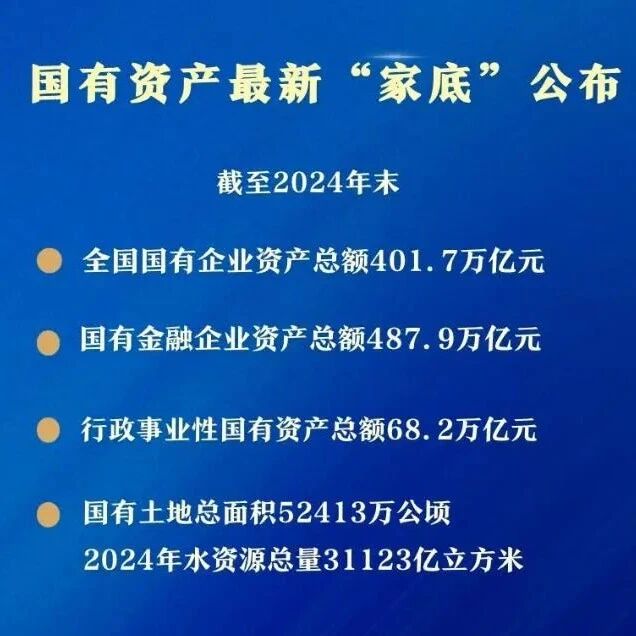
国有资产最新“家底”公布
21世纪经济报道· 2025-10-26 08:04
Group 1 - The total assets of state-owned enterprises (excluding financial enterprises) are projected to reach 401.7 trillion yuan, with state capital equity at 109.4 trillion yuan by the end of 2024 [3] - The total assets of state-owned financial enterprises are expected to be 487.9 trillion yuan, with state financial capital equity at 33.9 trillion yuan [3] - The report highlights the continuous improvement in the management of state-owned assets across various regions and departments, emphasizing the importance of effectively managing and utilizing the collective wealth of the people [3]