增材制造

Search documents
华曙高科:全球3D打印龙头,下游需求临近爆发节点-20260124
SINOLINK SECURITIES· 2026-01-24 10:45
Investment Rating - The report assigns a "Buy" rating to the company with a target price of 116.06 RMB based on a 40x PS valuation for 2026 [3]. Core Insights - The company is positioned as a global leader in 3D printing, with a comprehensive ecosystem that includes equipment, materials, proprietary software, and after-sales services [8][10]. - The company is expected to experience significant revenue growth, with projected revenues of 6.91 billion RMB in 2025, 12.02 billion RMB in 2026, and 16.23 billion RMB in 2027, reflecting year-on-year growth rates of +40.6%, +73.8%, and +35.0% respectively [3][7]. - The aerospace sector is anticipated to contribute nearly 50% of the company's revenue by 2024, driven by increasing demand for 3D printing in aerospace and consumer electronics [8][21]. Financial Projections - The company forecasts revenues of 606 million RMB in 2023, 492 million RMB in 2024, and a rebound to 691 million RMB in 2025, with a net profit of 131 million RMB in 2023, dropping to 67 million RMB in 2024, and recovering to 72 million RMB in 2025 [7][3]. - The diluted earnings per share are projected to be 0.317 RMB in 2023, 0.162 RMB in 2024, and increasing to 0.174 RMB in 2025 [7]. Business Overview - The company has established a full industry chain covering industrial-grade 3D printing equipment, materials, software, and technical services, achieving 100% domestic control [17][18]. - The company has developed over 40 specialized materials and has a strong focus on R&D, with a research and development expense ratio reaching 22.23% in the first three quarters of 2025 [8][19]. Market Dynamics - The global 3D printing market is projected to reach 219 billion USD in 2024, with China expected to account for approximately 27% of this market [40][45]. - The company is strategically expanding into consumer electronics and automotive sectors, leveraging its technology to meet the growing demand for lightweight and customized components [8][10][21].

3D 打印行业系列报告(一):工业级与消费级应用双轮驱动,行业迈入快速发展期
Southwest Securities· 2026-01-23 10:30
Investment Rating - The report maintains an "Outperform" rating for the 3D printing industry as of January 22, 2026 [1] Core Insights - The 3D printing industry is entering a rapid development phase driven by both industrial and consumer applications, with significant market potential projected to reach hundreds of billions [8] - The global additive manufacturing market is expected to grow to $21.9 billion by 2024, with a CAGR of 18% projected until 2034 [8] - Domestic policies in China are increasingly supportive, indicating a maturing industry with substantial growth potential [8] Summary by Sections 1. 3D Printing Technology and Development - Seven core processes facilitate the development of 3D printing across multiple fields, including powder bed fusion and directed energy deposition [16][22] - The technology has evolved from rapid prototyping in the 1980s to widespread commercial applications in various sectors, including aerospace and healthcare [18][20] 2. Industry Growth and Applications - The 3D printing industry is experiencing rapid growth, with applications expanding across various sectors such as aerospace (17.7%), medical (17.6%), and automotive (10.3%) [8][71] - The global market for aerospace 3D printing is projected to reach $2.88 billion by 2025, with a CAGR of 20% until 2035 [8] 3. Market Dynamics and Competitive Landscape - Domestic manufacturers are leading in desktop applications, while industrial-grade 3D printing is seeing increased competition from local firms [8] - Key players in the industrial-grade market include EOS, which holds over 40% market share, followed by other significant companies [8] 4. Investment Opportunities - The report suggests focusing on companies that are well-positioned to benefit from technological advancements and expanding applications, including equipment manufacturers like Huazhu High-Tech and service providers like Jingyan Technology [8]

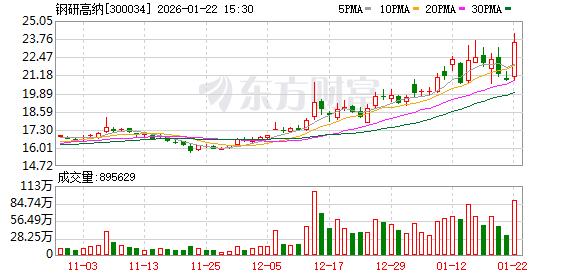
钢研高纳:参股公司常州钢研极光涵盖增材制造、3D打印等业务
Zheng Quan Ri Bao· 2026-01-22 14:07
Group 1 - The core viewpoint of the article is that Steel Research High-Tech (钢研高纳) has a stake in Changzhou Steel Research Aurora, which is involved in additive manufacturing and 3D printing, applicable in the aerospace sector [2] Group 2 - The company emphasizes its involvement in advanced technologies such as additive manufacturing and 3D printing [2] - The applications of these technologies are particularly relevant to the aerospace industry, indicating potential growth opportunities [2]


金属3D打印切入商业航天核心制造环节 易加增材凭硬核实力抢先卡位
Zheng Quan Ri Bao Wang· 2026-01-22 12:13
Core Insights - The commercial aerospace industry is increasingly focusing on high-end manufacturing equipment for core components like rocket engines, with capital markets showing significant interest in this sector [1][2] - The rise of industrial-grade metal 3D printing technology is crucial for meeting the demands of commercial rockets, which require high frequency, low cost, and reusability [1][2] Group 1: Industry Developments - The demand for large-scale, complex, and highly reliable manufacturing equipment in commercial aerospace has made large powder bed metal 3D printing devices essential for the mass production of liquid rocket engines [2] - The proportion of components made using metal 3D printing in commercial liquid engines has reached nearly 90% in some advanced models, highlighting the technology's growing importance [2][3] - Traditional manufacturing methods are unable to meet the rapid iteration and high-frequency launch needs of commercial aerospace, making industrial-grade metal 3D printing a preferred process [2] Group 2: Company Advancements - Hangzhou E-jet 3D Technology Co., Ltd. (E-jet) has made significant breakthroughs in large powder bed metal 3D printing equipment, launching devices with three-axis forming sizes exceeding one meter and plans for devices over two meters in 2024 [3] - E-jet is positioned as a leader in the field, particularly in the production of components like nozzles and combustion chambers using copper alloys, with expectations for further advancements by 2026 [3] - The company is developing the world's largest SLM metal 3D printing equipment, with capabilities to support various materials, including stainless steel and high-temperature alloys [3][4] Group 3: Market Position and Policy Support - E-jet's equipment has been integrated into the engine development systems of several leading commercial aerospace companies, covering critical components such as combustion chambers and valves [4] - The Chinese government is actively supporting the commercial aerospace sector, with policies aimed at promoting high-quality development and providing institutional support for companies like E-jet to access the STAR Market [5] - E-jet has submitted an IPO application to raise 1.205 billion yuan for expanding metal 3D printing production and establishing a research center, indicating strong market confidence in its growth potential [5] Group 4: Future Outlook - The commercial aerospace sector is seen as a key area for fostering new productive forces, with domestic high-end metal 3D printing equipment expected to see increased adoption and volume [6] - Companies that successfully navigate both technological and capital advancements are likely to be the first to benefit from the growing market [6]
钢研高纳:公司深耕镍基高温合金领域
Zheng Quan Ri Bao Wang· 2026-01-21 12:44
证券日报网讯1月21日,钢研高纳(300034)在互动平台回答投资者提问时表示,公司目前是国内高端 和新型高温合金制品生产规模领先且产品体系最完整的企业之一,公司深耕镍基高温合金领域,拓展 铝、镁、钛铸锻件领域,布局精密铸造、离心铸造、模锻环轧、粉末冶金、精细制造、增材制造产业布 局。 ...
深圳市泛海统联智能装备有限公司成立,注册资本2000万人民币
Sou Hu Cai Jing· 2026-01-20 00:25
Core Viewpoint - Shenzhen Panhai Tonglian Intelligent Equipment Co., Ltd. has been established with a registered capital of 20 million RMB, fully owned by Shenzhen Panhai Tonglian Precision Manufacturing Co., Ltd. [1] Company Overview - The legal representative of the new company is Yang Hu [1] - The registered capital is 20 million RMB [1] - The company is located at 282 Huan Guan Zhong Road, Building D, Fan Hai Technology Park, Longhua District, Shenzhen [1] - The business scope includes additive manufacturing, manufacturing and sales of additive manufacturing equipment, 3D printing services, and various technical services [1] Shareholding Structure - Shenzhen Panhai Tonglian Precision Manufacturing Co., Ltd. holds 100% of the shares in Shenzhen Panhai Tonglian Intelligent Equipment Co., Ltd. [1] Industry Classification - The company falls under the manufacturing industry, specifically in the specialized equipment manufacturing sector, focusing on electronic and electrical machinery [1]

航天增材制造专题-减重降本利器-产业必由之路
2026-01-19 02:29
Summary of Key Points from the Conference Call Industry Overview - The focus is on the aerospace industry, specifically the application of additive manufacturing (3D printing) in rocket production and its impact on efficiency and cost reduction [1][2][4][8]. Core Insights and Arguments - **Weight Reduction and Cost Efficiency**: Rocket propellant weight significantly affects payload efficiency. SpaceX has improved its Raptor engine design to reduce structural weight, thereby enhancing payload capacity. Reducing dead weight is crucial for increasing effective payload [1][2]. - **Production Cycle Improvement**: Traditional rocket engine manufacturing takes about 6 months, while additive manufacturing can reduce this to approximately 1 month. NASA has indicated that traditional methods for producing injectors can exceed a year, whereas additive manufacturing drastically shortens this time [1][2][4]. - **Cost Reduction through Additive Manufacturing**: Reports indicate that 3D printing can lower engine production costs to one-tenth of traditional methods while also reducing weight by half. This not only cuts material costs but also saves on labor and time associated with lengthy traditional processes [1][2][4][11]. - **Complex Design Capabilities**: Additive manufacturing allows for the construction of components with higher precision and complexity, overcoming limitations of traditional subtractive manufacturing methods. This results in reduced material waste and shorter production cycles [1][5][6]. Additional Important Content - **Applications in Various Industries**: 3D printing is widely used across aerospace, medical devices, automotive, and renewable energy sectors, with aerospace being the largest application area. Components such as aircraft structures, engine turbines, and precision nozzles are commonly produced using additive manufacturing [1][8]. - **Specific Applications in Commercial Space**: In commercial space, rocket engines are a primary focus for additive manufacturing due to their complex structures. Key applications include components related to propellant flow, high-temperature and high-pressure parts, and valve pipelines [9]. - **Significant Weight Reduction Examples**: The Long March 5 heavy rocket in China utilized laser powder feeding technology to reduce the weight of its interstellar bundling structure by 30% while maintaining performance [10]. - **Industry Players**: Notable companies in the additive manufacturing space include Relativity Space, which aims to produce over 85% of its rocket components via 3D printing, and domestic players like BoLiTe and HuaShu GaoKe, which focus on various aspects of aerospace manufacturing [14][15][16]. Conclusion - Additive manufacturing presents a transformative opportunity for the aerospace industry, particularly in enhancing production efficiency, reducing costs, and enabling complex designs. The ongoing developments and applications in this field are likely to shape the future of commercial space travel and aerospace manufacturing [1][2][4][8][14].
商业航天:为什么3D打印可成为商业航天最终加工解决方案?(附55页PPT)
材料汇· 2026-01-18 15:29
Core Viewpoint - The article discusses the evolution and commercialization of 3D printing technology, particularly its applications in the aerospace industry, highlighting its advantages in design flexibility, cost reduction, weight savings, and material innovation [3][4][39]. Group 1: Technological Advancements in 3D Printing - 3D printing has transitioned from a conceptual stage to mass production, supported by seven major technological routes that cater to various industry needs [3][4]. - The technology has evolved from plastic to metal applications, with over 20 different metal additive manufacturing techniques now available, significantly enhancing production quality and speed [5][8]. - The cost advantages of 3D printing are realized through technological innovations rather than mere scale, allowing for competitive pricing even at larger production volumes [9][12]. Group 2: 3D Printing in Aerospace - 3D printing is positioned as a final processing solution for commercial aerospace, enabling designs that significantly reduce the number of components [39][43]. - The technology allows for shorter supply chains and lower trial-and-error costs, which are critical in aerospace manufacturing [47][50]. - Weight reduction is a key benefit, with 3D printing enabling complex structures that contribute to significant fuel savings in aircraft [52][53]. Group 3: Investment Opportunities - Companies like Huazhu Business, Yinbang Co., and Feiwo Technology are highlighted for their strategic positions in the 3D printing market, particularly in aerospace applications [5][5][5]. - The article suggests that investment in firms with comprehensive 3D printing capabilities, especially in metal and polymer sectors, could yield substantial returns as the technology matures [5][5][5]. Group 4: Material Innovations - The development of high-temperature alloys for 3D printing is advancing, with significant potential for new materials that meet the demanding requirements of aerospace applications [63][64]. - The article emphasizes the importance of material properties, such as strength and heat resistance, in the performance of aerospace components [63][64]. Group 5: 3D Printing Techniques - The article categorizes 3D printing into seven main techniques, including Material Extrusion, Photopolymerization, and Powder Bed Fusion, each with distinct advantages and limitations [18][19]. - The integration of cooling structures and complex geometries is made easier through 3D printing, enhancing the performance of aerospace components [57][60]. Group 6: Case Studies and Applications - NASA's use of 3D printing in developing rocket engines demonstrates the technology's ability to reduce part counts and costs significantly [43][49]. - The article provides examples of successful 3D printed components in rocket engines, showcasing the technology's potential to streamline manufacturing processes [83][84].

铂力特融资净买入3276.67万元,正被调查受损投资者索赔麻烦待解
Sou Hu Cai Jing· 2026-01-14 12:21
Group 1 - Company received financing buy-in of 369 million yuan and repayment of 336 million yuan on January 13, resulting in a net financing buy-in of 32.77 million yuan [2] - Company announced on December 31, 2025, that it received a notice of investigation from the China Securities Regulatory Commission, allowing affected investors to claim compensation if they held shares as of that date [3] - Company held a half-year performance briefing on September 2, 2025, addressing investor questions and showcasing its management team [3] Group 2 - Company is focused on exploring the application of metal 3D printing in thermal management, providing innovative solutions for industries such as new energy vehicles, consumer electronics, and aerospace [4] - The company has optimized the internal structure of its liquid cooling plates to enhance overall performance, addressing the high-efficiency cooling needs of the radiator industry [4] - The company has seen a significant increase in production and R&D personnel in its 2025 semi-annual report compared to the previous year [4] Group 3 - Company, established in 2011, is located in Xi'an, Shaanxi Province [5]

商业航天燃起,激光巨头如何撬动万亿赛道?
Xin Lang Cai Jing· 2026-01-12 12:28
Core Viewpoint - Ruike Laser has disclosed that it has delivered 120 units of aerospace 3D printing laser orders by the end of 2024, as per the contract with a state-owned enterprise, aimed at the production of precision core components [1][8]. Group 1: Product Development and Strategy - Ruike Laser's product strategy has shifted towards specialized laser models to meet diverse application scenarios, moving away from traditional general-purpose lasers that cannot effectively serve the precision processing market [3][10]. - The company has launched a dual-mode output laser for additive manufacturing, addressing issues such as low single-mode efficiency and poor multi-mode quality, achieving output power of up to 1kW in Gaussian mode and 3kW in flat-top mode [4][11]. - The company has completed the development of next-generation laser products tailored to the needs of leading customers and is collaborating closely with top domestic 3D printing equipment manufacturers [3][10]. Group 2: Industry Trends and Market Demand - The Ministry of Industry and Information Technology has identified additive manufacturing as a core area of national technology strategy, indicating a rising focus on this sector [3][10]. - The year 2026 is anticipated to be a pivotal year for China's commercial space industry, with multiple companies accelerating the development of reusable rockets, creating a surge in demand for upstream manufacturing capabilities [6][13]. - The high costs associated with rocket launches have historically constrained industry growth, but advancements in reusable rocket technology are expected to significantly reduce these costs, thereby stimulating market demand [6][13]. Group 3: Applications in Aerospace - Ruike Laser's products are utilized in large aircraft manufacturing, including the use of welding instead of riveting, and in the additive manufacturing of aerospace engines [7][14]. - The company's lasers are essential for 3D printing key structural components of launch vehicles, precision welding, and surface cleaning of parts, ensuring high performance and reliability in aerospace equipment [7][14]. - Ruike Laser has developed specialized lasers for the additive manufacturing of complex components, including those made from titanium alloys and high-temperature alloys, to meet the rigorous demands of aerospace applications [15].