对外直接投资

Search documents
1—11月我国全行业对外直接投资11314.5亿元人民币 同比增长7.5%
Sou Hu Cai Jing· 2025-12-24 10:59
Core Insights - China's total foreign direct investment (FDI) reached 1131.45 billion RMB from January to November 2025, marking a year-on-year increase of 7.5% (equivalent to 158.21 billion USD, a growth of 6.9%) [1] Investment Overview - Domestic investors from China made non-financial direct investments in 10,165 overseas enterprises across 153 countries and regions, totaling 944.64 billion RMB, which represents a growth of 3.2% (approximately 132.09 billion USD, an increase of 2.7%) [1]
商务部:1-11月我国全行业对外直接投资11314.5亿元人民币,同比增长7.5%
Sou Hu Cai Jing· 2025-12-24 10:53
Core Insights - China's total foreign direct investment (FDI) reached 1,131.45 billion RMB from January to November 2025, marking a year-on-year increase of 7.5% in RMB terms and 6.9% in USD terms, amounting to 158.21 billion USD [1] Group 1 - Domestic investors from China made non-financial direct investments in 10,165 overseas enterprises across 153 countries and regions, totaling 944.64 billion RMB, which represents a growth of 3.2% in RMB and 2.7% in USD, equating to 132.09 billion USD [1]
如何应对东道国气候风险,筑牢海外投资安全网?
Zhong Guo Huan Jing Bao· 2025-12-14 23:33
Core Viewpoint - China's outbound direct investment (ODI) is expanding significantly, with 52,000 overseas enterprises established in 190 countries by the end of 2024, including 19,000 in Belt and Road Initiative countries. However, climate risks in host countries are increasingly impacting the safety of these investments, as global temperatures have risen approximately 1.55°C above pre-industrial levels, surpassing the 1.5°C target set by the Paris Agreement, highlighting the urgent need for climate risk management [1]. Group 1: Climate Risks Faced by Chinese Outbound Investment - Chinese outbound investment enterprises face three main climate risk impacts: physical risks that increase operational costs and weaken investment willingness, regulatory challenges from stricter environmental regulations, and limitations imposed by the rising demand for green products and stricter ESG standards [2][3][4]. - Physical risks from climate change lead to higher operational costs due to increased disaster preparedness investments and disruptions in supply chains, which can reduce production efficiency and product delivery [2]. - Stricter environmental regulations in developed economies impose higher compliance costs and technological upgrade pressures on Chinese enterprises, while many developing economies lack the capacity to adapt to climate change, increasing potential investment risks [2][3]. Group 2: Recommendations for Enhancing Investment Quality and Resilience - To effectively address climate risks in host countries and enhance the quality and resilience of China's outbound direct investment, it is recommended to strengthen corporate climate risk management capabilities and stabilize investment willingness [4][5]. - Companies should integrate climate risk assessments into their investment decision-making processes and develop emergency response plans for extreme weather events to mitigate risks from the outset [5]. - Promoting supply chain resilience through diversified and alternative supply networks, as well as leveraging digital supply chain management technologies, is essential to ensure operational continuity [5]. - Enhancing employee health and efficiency management by implementing protective measures against high temperatures and providing climate adaptation skills training can help mitigate the impact of climate disasters on labor productivity [5]. Group 3: Policy Coordination and Financial Support - Strengthening international policy coordination and cooperation mechanisms is crucial for optimizing the cross-border investment environment, including establishing regular dialogues on ecological and environmental policies with developed economies [6][7]. - Developing targeted fiscal and tax support policies for investments in disaster protection, energy-saving equipment, and low-carbon technology can guide enterprises towards a green transition [8]. - Enhancing ESG management capabilities among enterprises and aligning with international ESG disclosure standards will improve transparency and build trust with international investors [8].
香港金管局下调基本利率至4%
Nan Fang Du Shi Bao· 2025-12-11 23:18
Group 1: Interest Rate Adjustments - The Hong Kong Monetary Authority (HKMA) adjusted the base interest rate to 4.00% effective immediately on December 11, following a 25 basis point reduction in the U.S. federal funds rate [3][4] - The adjustment aligns with the "linked exchange rate system" and aims to maintain financial system stability in Hong Kong [3][4] - HKMA's president noted that the reduction in interest rates could lower borrowing costs for the public, positively impacting the economy and the property market [4][5] Group 2: Economic Performance and Outlook - Hong Kong's economy showed positive performance over the past three quarters, with strong exports and consumption [4][6] - The service industry in Hong Kong is expected to continue expanding, supported by moderate global economic growth and improved local consumption [6] - The tourism and IT service sectors reported significant revenue increases, with IT services up by 99.1% year-on-year [6] Group 3: Foreign Direct Investment - Hong Kong recorded a total foreign direct investment inflow of HKD 982.4 billion, reaffirming its status as a major international financial and business center [8][9] - Mainland China remains the primary source and destination for direct investment in Hong Kong, highlighting the region's role as a "super connector" [9][10] - The statistics reflect global investors' confidence in Hong Kong's economic prospects and its diverse economic activities [9][10] Group 4: Market Strategies and Diversification - Companies are encouraged to adopt diversified market strategies to mitigate macroeconomic uncertainties [11] - Hong Kong is exploring economic cooperation with ASEAN, the Middle East, and Central Asia to diversify and hedge against potential risks [11] - Recent agreements with Cambodia and Malaysia to promote intellectual property cooperation exemplify Hong Kong's efforts to enhance international ties [11]


香港外来直接投资总存量大幅上升
Xin Hua She· 2025-12-10 00:52
Core Insights - The total stock of foreign direct investment (FDI) in Hong Kong is projected to increase by 9.1% year-on-year to HKD 20,049.6 billion by the end of 2024, which is equivalent to 631% of the local GDP for that year [1] - Hong Kong's outward direct investment stock is expected to rise by 6.7% year-on-year to HKD 18,890 billion, representing 595% of the local GDP for 2024 [1] - The total FDI inflow for 2024 is estimated at HKD 982.4 billion, while the total outflow is projected at HKD 629.2 billion, resulting in a net FDI inflow of HKD 353.2 billion [1] Investment Landscape - The statistics affirm Hong Kong's status as a major international financial and commercial center, as well as a preferred location for multinational corporations, reflecting global investors' confidence in Hong Kong's economic outlook [1] - The FDI from and to mainland China is highlighted as a significant aspect of Hong Kong's investment activities, underscoring its role as a "super connector" and "super value creator" [1] Government Initiatives - The Hong Kong government aims to leverage its unique advantages to enhance its role in connecting domestic and international markets, while actively implementing measures to attract more mainland enterprises to use Hong Kong as a platform for expansion [1] - There will be a focus on strengthening policy support to attract more strategic enterprises to establish operations in Hong Kong, promoting high-quality development [1]
香港2024年底外来直接投资总存量同比上升9.1%
智通财经网· 2025-12-09 09:03
Core Insights - Hong Kong's total foreign direct investment (FDI) stock is projected to increase by 9.1% to HKD 200,496 billion by the end of 2024, equivalent to 631% of the local GDP, primarily due to positive inflows of direct investment [1] - The total outward direct investment stock from Hong Kong is expected to rise by 6.7% to HKD 188,900 billion, representing 595% of the local GDP, driven by positive outflows to overseas enterprises [1] Group 1: Inflows and Outflows - Total direct investment inflows for 2024 are estimated at HKD 9,824 billion, an increase from HKD 9,549 billion in 2023 [2] - Total direct investment outflows for 2024 are projected to be HKD 6,292 billion, a decrease from HKD 7,529 billion in 2023, resulting in a net direct investment inflow of HKD 3,532 billion [2] - Mainland China is the primary source of direct investment inflows, amounting to HKD 4,660 billion, followed by the British Virgin Islands at HKD 2,370 billion [2] Group 2: Economic Activities - The largest economic activities for Hong Kong enterprises receiving foreign direct investment are investment and holding, real estate, and professional and commercial services, accounting for 68.2% of the total by the end of 2024 [1] - For outward direct investment, the same sectors (investment and holding, real estate, and professional and commercial services) represent 78.8% of the total by the end of 2024 [2] Group 3: Role of Hong Kong - Hong Kong continues to be a major destination and source for global foreign direct investment, with significant inflows and outflows reinforcing its status as an international financial and business hub [3] - The government aims to leverage Hong Kong's unique advantages to enhance international connections and attract more mainland enterprises to use Hong Kong as a platform for expansion [4]
广东今年利用外资增长7.5%
Shen Zhen Shang Bao· 2025-12-01 07:28
Group 1 - Guangdong Province has established 27,000 new foreign investment projects from January to October this year, representing a growth of 32.2%, with actual foreign investment reaching 84.62 billion yuan, an increase of 7.5%, leading the nation [1] - The actual foreign investment in Guangdong is expected to remain above 100 billion yuan annually during the first four years of the 14th Five-Year Plan, with a total of 237 projects exceeding 10 million USD [1] - The proportion of foreign investment in the manufacturing sector has rebounded from 16.8% to 30%, significantly supporting the construction of a modern industrial system [1] Group 2 - Guangdong's foreign direct investment has an average annual growth rate of 7.4%, maintaining the top position in the country, with foreign direct investment reaching 25.904 billion USD from January to October, a growth of 55.4% [1] - The trade structure in Guangdong has continuously optimized during the first four years of the 14th Five-Year Plan, with general trade growing at an average annual rate of 9.9%, increasing its share from 51.2% to 58.2% [2] - The role of private enterprises has become increasingly prominent, with their share of imports and exports rising from 55.1% to 63.6% [2] - New business models and new driving forces are growing robustly, with cross-border e-commerce imports and exports increasing at an average annual rate of 44.1%, reaching a total of 746.2 billion yuan last year, accounting for nearly 40% of the national total [2] - Exports of "new three items" such as lithium batteries, electric vehicles, and photovoltaic products have grown at an average annual rate of 33.1% [2]
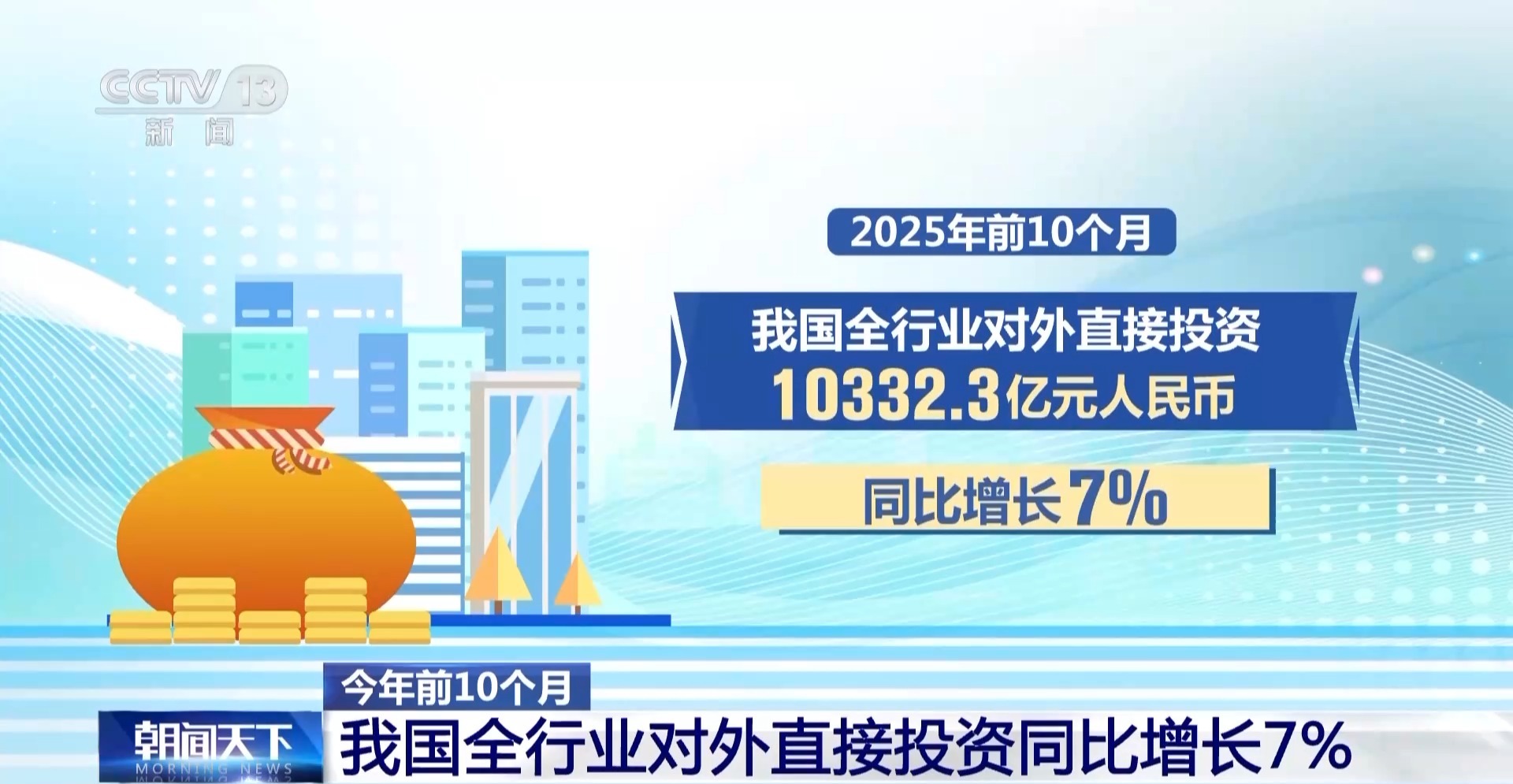
视频丨今年前10个月 我国全行业对外直接投资同比增长7%
Yang Shi Xin Wen Ke Hu Duan· 2025-11-27 02:38
Group 1 - Domestic investors in China made non-financial direct investments in 9,553 overseas enterprises across 152 countries and regions, totaling 872.6 billion RMB, representing a growth of 6% [2] - In the first ten months of this year, Chinese enterprises invested 234.15 billion RMB in countries participating in the Belt and Road Initiative, marking a year-on-year increase of 22.3% [2] Group 2 - Chinese enterprises signed new engineering contracts in Belt and Road countries amounting to 1,333.81 billion RMB, which is a year-on-year growth of 24.4% [4] - The completed revenue from these engineering contracts reached 804.24 billion RMB, reflecting a growth of 9.4% [4]
新华财经晚报:《信用修复管理办法》公布 自2026年4月1日起施行
Xin Hua Cai Jing· 2025-11-26 13:54
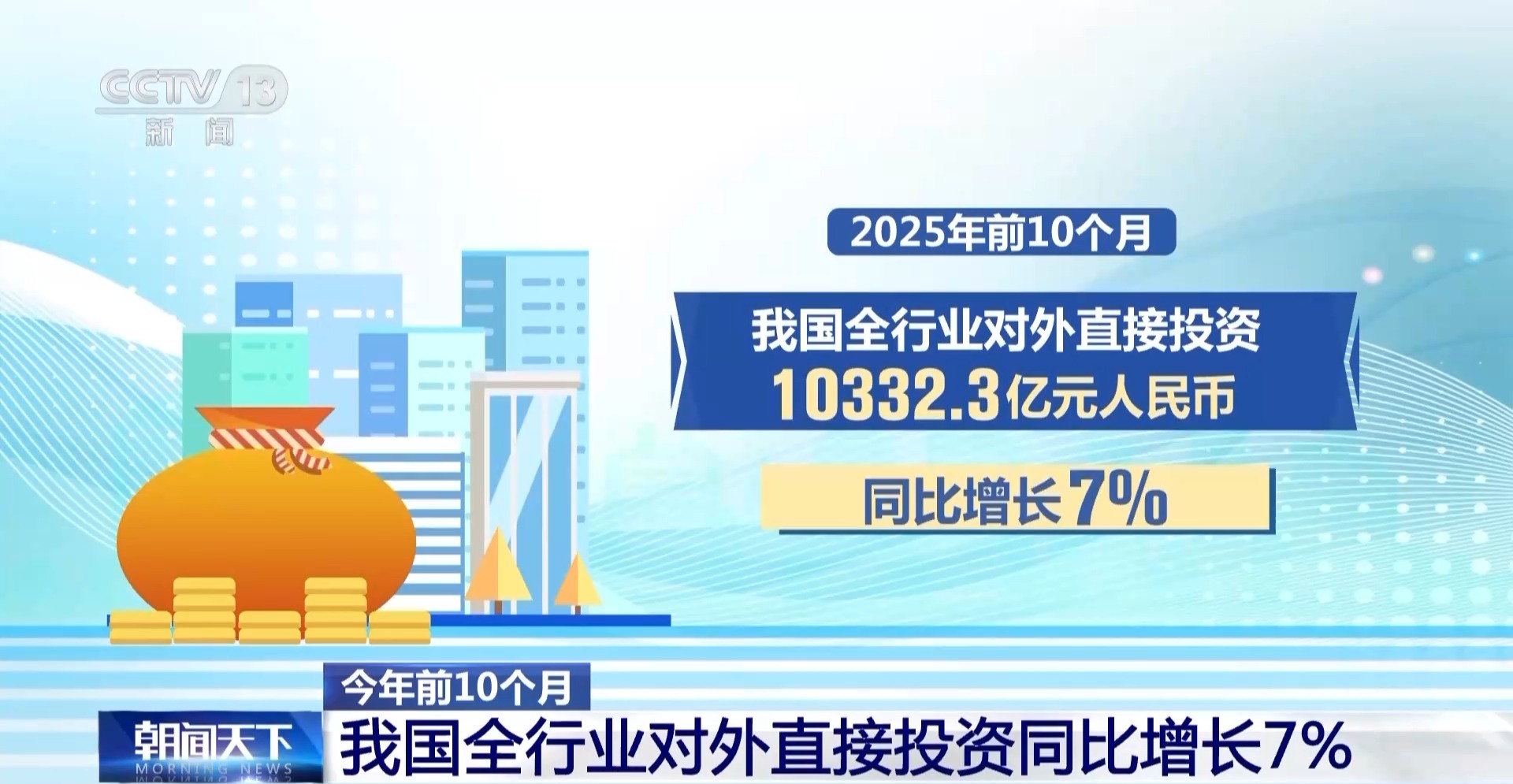
Domestic News - The Ministry of Industry and Information Technology and other departments issued a plan to enhance the adaptability of supply and demand for consumer goods, aiming for a significant optimization of the supply structure by 2027, with the goal of forming three trillion-level consumption fields and ten hundred-billion-level consumption hotspots [1][2] - The "Credit Repair Management Measures" will be implemented starting April 1, 2026, categorizing dishonest information based on severity and setting different public disclosure periods [1] - From January to October 2025, China's total foreign direct investment reached 1,033.23 billion yuan, a year-on-year increase of 7%, with non-financial direct investments in 9553 overseas enterprises totaling 872.6 billion yuan, up 6% [2] - In the first ten months of 2025, the telecommunications business revenue reached 1,467 billion yuan, a year-on-year increase of 0.9%, with a 9% increase in total telecommunications volume at constant prices [2] - Liaoning Province aims to establish a multi-level, sector-specific private equity investment fund system by the end of 2027, targeting a subscription scale of over 180 billion yuan [2] International News - The European Union's trade surplus with the United States decreased, with a surplus of 40.8 billion euros in the third quarter, down 13.3% from the second quarter and 49.7% from the first quarter [4] - The European Commission noted that Germany's defense spending has led to an excessive deficit but has not initiated procedures to address it [4] - Australia's consumer price index rose by 3.8% year-on-year in October, exceeding market expectations and marking the fourth consecutive month of increase [4]
今年前10个月 我国全行业对外直接投资同比增长7%
Yang Shi Xin Wen· 2025-11-26 01:13
Group 1 - The core viewpoint is that China's foreign direct investment (FDI) has shown a positive growth trend in the first ten months of the year, with a total investment of 1,033.23 billion RMB, representing a year-on-year increase of 7% [1] - Domestic investors have made non-financial direct investments in 9,553 overseas enterprises across 152 countries and regions, with a cumulative investment of 872.6 billion RMB, marking a growth of 6% [3] - Investment in countries participating in the Belt and Road Initiative (BRI) has significantly increased, with a non-financial direct investment of 234.15 billion RMB, reflecting a year-on-year growth of 22.3% [3] Group 2 - In terms of foreign contracting projects, Chinese enterprises have signed new contracts in BRI countries amounting to 1,333.81 billion RMB, which is a year-on-year increase of 24.4% [5] - The completed business revenue from these projects reached 804.24 billion RMB, showing a growth of 9.4% [5]