
开源策略

Search documents
如果不是这个消息传出,很多人还被蒙在鼓里,原来外媒说的真的
Xin Lang Cai Jing· 2025-07-25 18:48
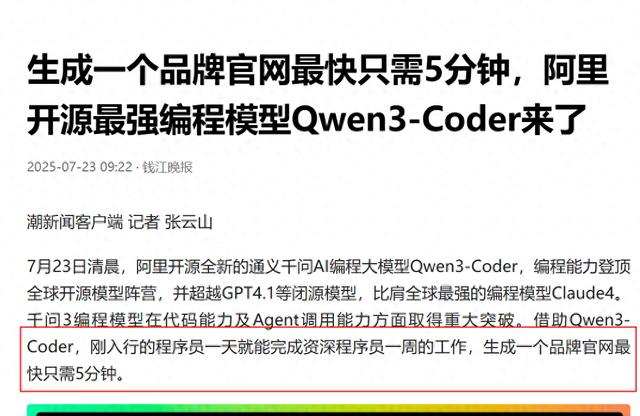
Core Insights - Alibaba's recent advancements in AI, particularly with the open-source programming model Qwen3-Coder, are challenging established players like GPT-4.1 and Claude4, showcasing significant efficiency improvements in programming tasks [1][4] - The company's open-source strategy, supported by Alibaba Cloud's robust infrastructure and the extensive ecosystem of Tongyi Qianwen, positions it as a leader in the AI field, emphasizing global collaboration and rapid model iteration [3][4] - The emergence of Qwen3-Coder signifies a potential transformation in productivity within the software development sector, reducing development cycles and lowering technical barriers for businesses [4][5] Group 1 - Alibaba's Qwen3-Coder has been recognized as a "programming accelerator," enabling junior programmers to achieve the output of experienced developers in a fraction of the time [1] - The company has released multiple advanced models this year, creating a comprehensive matrix of AI solutions that spans various applications [3] - The open-source approach allows for greater transparency and collaboration, enhancing the model's performance through real-world feedback [3] Group 2 - Alibaba Cloud is a leading player in the global cloud computing market, supporting a significant portion of China's tech companies [4] - The capabilities of Alibaba in AI extend beyond large models to include foundational technologies like machine translation and image recognition, which are integral to its business operations [4] - The rise of AI tools like Qwen3-Coder is expected to democratize access to technology for small and medium enterprises, facilitating their digital transformation [5][7] Group 3 - The recognition of Alibaba's technological prowess reflects a broader trend of Chinese tech companies transitioning from "technology followers" to "innovation leaders" [7] - The ongoing development of open-source models and the integration of cloud and AI technologies are anticipated to drive further surprises and efficiency upgrades across industries [7]


下一站“算力主权”!马克龙警告欧洲AI基础设施落后中美
Hua Er Jie Jian Wen· 2025-07-11 04:14
Group 1: AI Sovereignty and Infrastructure - European countries, particularly France and the UK, face a significant shortfall in AI computing power, with Europe accounting for 20% of global AI demand but only 3%-5% of supply capacity, leading to heavy reliance on US and Chinese technology [1][3][4] - The French President emphasized the need for Europe to establish its own computing and chip manufacturing capabilities to reduce external dependencies and achieve "computing sovereignty" [3][4] - France and the UK announced plans to significantly expand their computing infrastructure, with the UK aiming for a 20-fold increase in public computing capacity by 2030 [1][4] Group 2: Talent Retention and Ecosystem Development - There is a pressing issue of talent retention in Europe, with many AI professionals being attracted to other regions; creating an environment conducive to research and innovation is crucial [1][8][9] - France is implementing measures to retain AI talent, including allowing researchers to engage in entrepreneurial activities while remaining in academia and modifying intellectual property laws to facilitate technology transfer [9][34] - The importance of a supportive ecosystem that includes collaboration between public and private sectors, as well as startups, is highlighted as essential for fostering innovation [9][34] Group 3: Technological Leadership and Open Source Strategy - DeepMind's CEO warned that to have a voice in global AI governance, countries must maintain technological leadership, emphasizing that those who can train models and deploy systems hold the real power [5][6][7] - Mistral AI's open-source strategy aims to democratize access to AI models, allowing more researchers to participate in innovation and reducing the dominance of a few large companies [10][11] - The open-source approach is seen as a way for Europe to establish its influence in the global AI ecosystem and create a counterbalance to the US and China [11] Group 4: Global Collaboration and Future Outlook - The discussion emphasized the need for a global approach to AI innovation, with collaboration across borders being essential to address challenges in various sectors, including energy and life sciences [42][43] - The importance of maintaining a competitive edge in computing power and reducing reliance on external sources, particularly in chip manufacturing, is underscored [44][45] - The upcoming AI summits are viewed as critical opportunities for fostering international dialogue and collaboration in the AI space [48][54]

1亿美元年薪、72小时火速签字,没人能阻止扎克伯格了
凤凰网财经· 2025-07-08 13:16
Core Insights - The article discusses the intense competition for AI talent among major tech companies, particularly focusing on Meta's aggressive recruitment strategy and the implications for Apple and OpenAI [3][6][12]. Group 1: Meta's Recruitment Strategy - Meta has offered a compensation package of tens of millions of dollars annually to attract top AI talent, including Ruoming Pang from Apple [6][8]. - In recent weeks, several prominent researchers have joined Meta, indicating a trend of talent migration within the tech industry [6][12]. - Meta's CEO, Mark Zuckerberg, is personally involved in recruiting efforts, which has led to a "hit list" of targeted talent circulating in Silicon Valley [6][8]. Group 2: Challenges Faced by Apple and OpenAI - Apple has faced internal divisions regarding its AI strategy, leading to talent loss, including the departure of key figures like Ruoming Pang [7][19]. - OpenAI's recruitment head has expressed frustration over Meta's aggressive offers, which leave little time for employees to consider their options [8][10]. - OpenAI's financial situation is precarious, with a significant increase in stock-based compensation, raising concerns about sustainability [11][12]. Group 3: The Role of Chinese Talent - Chinese scientists are becoming pivotal in the AI talent landscape, with many having backgrounds from top Chinese universities and experience in leading tech firms [12][14]. - A significant number of the new hires at Meta come from prestigious institutions and have previously contributed to major AI projects [12][14]. - The article highlights the importance of these talents in determining the future of AI technology and competition among firms [12][15]. Group 4: Meta's Financial Commitments and Internal Dynamics - Meta plans to increase its capital expenditures significantly, with projections of $64-72 billion for 2025, primarily for AI infrastructure [21][22]. - The disparity in compensation between new hires and existing employees at Meta raises concerns about team integration and morale [21][22]. - Internal competition at Meta has reportedly reached a peak, leading to dissatisfaction among existing employees [22].



从开源看“智能向善”(评论员观察)
Ren Min Ri Bao· 2025-06-17 22:10
Core Viewpoint - The article emphasizes that digital dividends should not lead to digital hegemony, and the intelligent revolution should not create an intelligence gap. The principle of "intelligence for good" is essential for artificial intelligence (AI) to truly benefit humanity [1][2][3][4] Group 1: AI Development and Global Disparities - There is a significant concern regarding whether AI will narrow or widen the development gap, particularly between developed and developing countries. Many developing nations are considered "followers" in the AI field, lacking competitive tech companies, sufficient talent, and infrastructure [1][2] - The International Monetary Fund's "AI Readiness Index" indicates that as of April 2024, developed countries have an index of 0.68, while emerging and low-income countries have indices of 0.46 and 0.32, respectively [1] Group 2: Open Source Strategy - The open-source strategy transcends the traditional practices of exclusivity and inequality, lowering the barriers for research and application, thus allowing more individuals to participate in AI research [2][3] - The emergence of numerous open-source large models enables broader sharing of AI benefits, highlighting the need for both technological advancement and an inclusive approach to AI development [2][3] Group 3: International Cooperation and Governance - The article advocates for strengthening international governance and cooperation in AI to ensure it serves humanity and avoids becoming a game for the wealthy [2][3][4] - China's initiatives, such as the establishment of the International Cooperation Group for AI Capability Building, reflect a commitment to inclusive AI development, having hosted seminars with representatives from over 40 countries [3][4] Group 4: Cultural and Ethical Considerations - The principle of "intelligence for good" reflects China's cultural values of openness and cooperation, promoting a collaborative ecosystem for AI innovation [3][4] - The article draws parallels between the transformative impact of electricity and the current potential of AI, emphasizing that continuous technological breakthroughs and ethical considerations are crucial for AI to become universally accessible [4]