循环投资

Search documents
“看,皇帝没穿衣服”!对冲基金经理:万亿美元的AI投入,赚得回来吗?
Hua Er Jie Jian Wen· 2025-10-15 11:29
Core Viewpoint - The discussion highlights significant concerns regarding the sustainability and profitability of AI data centers, suggesting that the required investment and revenue projections are unrealistic and may lead to substantial financial losses in the future [1][2][3]. Investment Requirements - AI data center construction is projected to require investments in the range of trillions of dollars over the next 3-5 years, with estimates suggesting that achieving a 10% capital return would necessitate revenues of $1-2 trillion, and for better returns, revenues of $3-4 trillion would be needed [1][4][8]. - Current annual spending on data center construction is around $400 billion, which is significantly lower than the projected needs for profitability [6][9]. Market Dynamics - The AI business model is criticized for its lack of customer loyalty and high substitutability among products like ChatGPT, Gemini, and Claude, leading to intense price competition that could reduce profit margins to just above energy costs [1][2][4][16]. - The potential for a price war is highlighted, where companies may continuously undercut each other, resulting in minimal profit margins [1][4][16]. Historical Comparisons - The current AI investment landscape is likened to the telecom bubble of 2000, where companies created artificial revenue through financing schemes, leading to eventual market collapse [2][22]. - The analogy of railroad construction is used to illustrate the cyclical nature of capital investment in AI, suggesting that many investors may face repeated failures despite ongoing funding [18][19]. Revenue Generation Challenges - The AI industry is currently generating revenues estimated between $15 billion to $20 billion, which is insufficient to cover the projected costs of data center operations, indicating a need for a 30-fold increase in revenue to break even [9][11][13]. - Concerns are raised about the viability of AI applications in generating sustainable income, especially in sectors like healthcare and finance, where free alternatives may dominate the market [11][13][14]. Investor Sentiment - Conversations with industry insiders reveal a consensus that many AI-related assets are overvalued, with significant skepticism about their future profitability [32][33]. - The sentiment among investors is one of caution, with many expressing disbelief in the projected growth and profitability of AI technologies [33][34].


巨头深度绑定 AI闭环隐现
Bei Jing Shang Bao· 2025-10-09 14:11
Core Insights - Major AI companies in Silicon Valley are increasingly collaborating while competing, exemplified by xAI's unprecedented $20 billion funding round, including $2 billion from Nvidia, reflecting the intense investment in AI infrastructure [1][3] - The funding round for xAI exceeded initial plans, comprising approximately $7.5 billion in equity and up to $12.5 billion in debt, indicating a significant capital influx to support AI model development [3] - xAI faces high operational costs, reportedly burning through $1 billion monthly, necessitating substantial funding to sustain its operations [3] Nvidia's Strategic Moves - Nvidia's investment in xAI is part of a broader strategy, having recently acquired over 4% of Intel for $5 billion and planning to invest up to $100 billion in OpenAI to support AI data center development [4][5] - Nvidia's CEO expressed enthusiasm for investing in promising startups, highlighting the shift from CPU to GPU-driven AI computing as just beginning [4] AMD's Collaboration with OpenAI - AMD and OpenAI announced a strategic partnership to deploy a total of 6GW of AMD GPU computing power, with the collaboration expected to generate hundreds of billions in revenue for AMD [5][6] - The deployment will significantly enhance OpenAI's computational capabilities, supporting the development of large-scale AI models [5] Market Reactions and Concerns - The announcement of large-scale deals has led to significant stock market fluctuations, raising concerns among analysts about the sustainability of such investment cycles and the potential for an AI bubble [7] - Analysts have expressed skepticism regarding the financial implications of AMD's stock warrants for OpenAI, suggesting that OpenAI may sell its AMD shares to cover costs, effectively raising AMD's stock price at the expense of investors [7] Infrastructure Development Perspective - CoreWeave's CEO noted that the tech industry is undergoing fundamental infrastructure development, with major companies like Meta, Microsoft, Amazon, and Google investing heavily to meet real customer demands [8]



Coreweave CEO反驳“AI闭环”:大公司都在砸基建,哪来的循环,这都是需求
美股IPO· 2025-10-09 04:48
Core Viewpoint - The technology industry is undergoing a fundamental infrastructure build driven by real demand from major companies like Meta, Microsoft, Amazon, and Google [1][2][8] Infrastructure Demand - Major tech companies are significantly purchasing infrastructure services to meet customer needs, indicating a robust demand for foundational services [1][2][8] - CoreWeave has signed substantial contracts exceeding $43 billion with companies like OpenAI, Meta, and Nvidia, solidifying its position in the AI infrastructure market [3][6] Market Dynamics - The current partnership model in infrastructure development is not uncommon in large-scale projects across various markets [2][8] - Concerns regarding "circular investment" among tech giants are viewed as flawed by CoreWeave's CEO, who emphasizes that these investments are driven by genuine demand rather than mere financial maneuvering [4][8][9] Recent Contracts - CoreWeave's recent agreements include a $6.5 billion expansion with OpenAI, bringing the total contract value with the company to $22.4 billion, and a $14.2 billion deal with Meta [6] - Additionally, CoreWeave disclosed a minimum $6.3 billion order with Nvidia, which is committed to purchasing remaining unsold capacity until April 2032 [6] Market Sentiment - Analysts on Wall Street express concerns about potential over-circulation of investments among tech companies due to these large contracts [7] - However, CoreWeave's CEO argues that the fundamental market drivers are substantial and will outlast current skepticism regarding circular investments [9]
OpenAI投大单,AMD两天狂涨27%!“循环投资”引担忧
Sou Hu Cai Jing· 2025-10-08 08:52
Core Viewpoint - AMD has entered a significant partnership with OpenAI, which is expected to generate hundreds of billions in additional revenue for AMD and accelerate OpenAI's AI infrastructure development [3][5]. Group 1: Partnership Details - AMD and OpenAI signed a multi-generational agreement for a 6-gigawatt AMD Instinct GPU supply, marking one of the largest known single AI chip procurement collaborations globally [3]. - The initial deployment will utilize 1 gigawatt of computing power from the AMD Instinct MI450 series GPUs, set to begin in the second half of 2026 [3]. - AMD has granted OpenAI warrants to purchase up to 160 million shares of AMD common stock, equivalent to about 10% of AMD's current total shares, contingent on achieving specific milestones [5]. Group 2: Market Impact - Following the announcement, AMD's stock surged nearly 23.71% and continued to rise by 3.83% the next day, totaling a 27.5% increase over two days, pushing its market capitalization above $340 billion [4]. - The partnership is anticipated to significantly enhance AMD's non-GAAP earnings per share, according to AMD's CFO [5]. Group 3: Broader Industry Context - OpenAI's collaboration with AMD is part of a broader trend of significant partnerships in the tech sector, including a $300 billion cloud computing contract with Oracle and a strategic collaboration with Nvidia [6]. - The tech sector is experiencing volatility, with concerns about "circular investments" among major players potentially inflating stock prices and increasing risks of market corrections [10][13].

华尔街的科技神话:“循环投资”和“循环控股”成就第一美股
Sou Hu Cai Jing· 2025-09-30 00:07
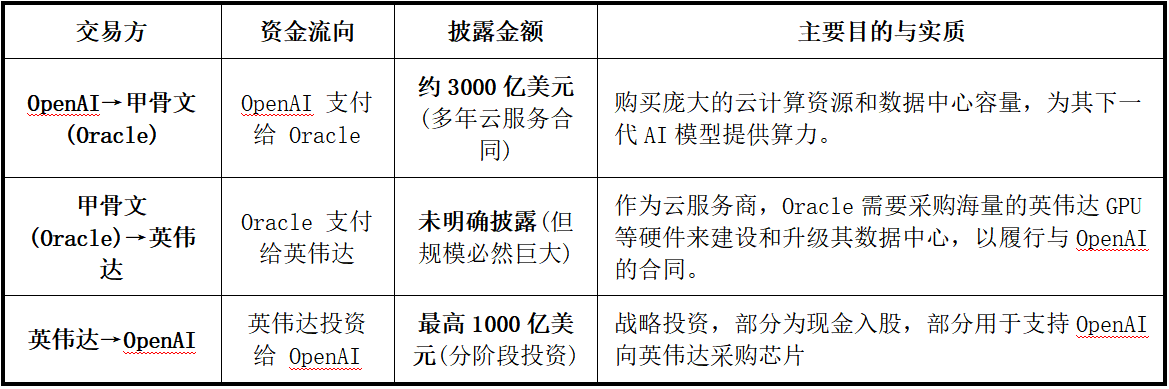
Core Insights - The article discusses the intricate financial relationships and investments among OpenAI, Oracle, and Nvidia, highlighting a cycle of investments that raises questions about the sustainability and authenticity of these transactions [1][3][15]. Investment Dynamics - OpenAI is reported to have paid approximately $300 billion to Oracle for cloud services over several years, which is aimed at acquiring substantial cloud computing resources to support its AI models [2]. - Oracle, in turn, is expected to make significant purchases of Nvidia hardware to enhance its data centers, although the exact amount has not been disclosed [2]. - Nvidia's investment in OpenAI is officially noted as up to $100 billion, which includes both cash equity and support for hardware procurement [2]. Market Implications - The article suggests that the core driver of this investment cycle is OpenAI's massive demand for computational power, which necessitates significant infrastructure investments from Oracle and hardware purchases from Nvidia [3][15]. - This interconnected investment strategy creates a "demand-infrastructure-supply" cycle, potentially leading to inflated valuations and revenue figures for the involved companies [3][5]. Financial Concerns - Analysts have raised concerns about the potential for these transactions to resemble "round-tripping," where companies engage in transactions that inflate their financial metrics without creating real economic value [4][5]. - The excessive investment in AI infrastructure is viewed as a high-risk gamble, with the possibility of resource wastage if AI application demand does not meet expectations [5]. Broader Financial Context - The article draws parallels between the current investment strategies and historical financial practices, suggesting that the relationships among these tech giants could lead to a situation where valuations become detached from actual business performance [18][24]. - It emphasizes the importance of understanding the distinction between legitimate investment aimed at value creation and manipulative practices that may lead to financial deception [18][25].

科技巨头“循环投资”转起来!科技股是否在“吹泡沫”?
Sou Hu Cai Jing· 2025-09-25 08:13
Core Viewpoint - The U.S. tech stock market experienced a significant surge from April to July, with companies like Nvidia, Microsoft, Google, and Broadcom reaching new market capitalization highs, but has recently shown signs of fatigue, leading to investor concerns about a potential pause in market momentum [2] Group 1: Market Performance - Nvidia's market capitalization reached $4.3 trillion, surpassing Japan's projected GDP for 2024 [2] - Following the surge, many tech stocks have been consolidating at high levels, prompting worries among investors [2] - Wall Street strategists suggest that the market is in a "pause period," seeking new catalysts for growth [2] Group 2: Corporate Collaborations - Intel is reportedly in discussions with Apple for potential investment and collaboration, although negotiations are still in early stages [3][4] - Nvidia and OpenAI announced a strategic partnership to deploy at least 10GW of Nvidia systems for AI model training, with Nvidia committing up to $100 billion for this initiative [5] - Nvidia also announced a $5 billion investment in Intel, focusing on joint development in AI infrastructure and personal computing products [6] Group 3: Financial Results and Projections - Oracle reported a significant increase in unfulfilled performance obligations, reaching $455 billion, a 229.71% increase from the previous quarter [7] - Oracle's cloud infrastructure revenue is projected to grow to $18 billion in fiscal 2026, a nearly 77% year-over-year increase [7] - Oracle's founder noted a remarkable 1529% growth in multi-cloud database revenue from major partners like Amazon, Google, and Microsoft [8] Group 4: Market Sentiment and Valuation - The current U.S. stock market is in a delicate phase, with differing opinions among institutions regarding valuation levels [11] - Fed Chair Powell indicated that stock prices appear overvalued based on various metrics, but he does not see immediate financial stability risks [11] - Bank of America strategists highlighted that 19 out of 20 indicators suggest the S&P 500 is trading at expensive levels, with a forward P/E ratio of 22.9 [11] Group 5: Economic Outlook - Deutsche Bank emphasized that tech spending, particularly in AI, is crucial for understanding the resilience of the U.S. economy [12] - Nomura warned of significant downside risks in the market despite the solid foundation of the AI-driven bull market, citing excessive bullish sentiment among investors [12] - The potential for rapid market corrections exists if catalysts trigger deleveraging, making it risky to abandon hedging strategies [12] Conclusion - The substantial collaborations among tech giants are stabilizing the U.S. stock market, but the risk of short-term declines remains after a period of rapid growth, with the ability of AI investments to translate into tangible performance being critical [13]