投资组合对冲

Search documents
高盛解读“金价突破”:西方投资者大幅加仓,金价涨幅或超预期
凤凰网财经· 2025-10-02 12:34
Core Viewpoint - Goldman Sachs maintains a long-term bullish outlook on gold, suggesting that the recent surge in gold prices, driven by unexpected inflows from Western individual investors, may continue [1]. Group 1: ETF Inflows and Investor Behavior - The recent surge in gold prices is significantly driven by strong demand for gold ETFs from Western investors, with September inflows reaching 109 tons, far exceeding the model's prediction of 17 tons [2]. - Goldman Sachs categorizes gold buyers into three groups: Western ETF investors, central banks, and speculators, noting that the current price increase reflects a strong purchasing power from committed individual buyers rather than speculative short-term funds [2][3]. - The increase in gold prices since August 26 has seen a contribution of 3 percentage points from the growth in Western ETF holdings, indicating a solid foundation for the current price rally [4]. Group 2: Price Outlook and Market Dynamics - Goldman Sachs highlights that the baseline forecast for gold prices faces increasing upward risks, primarily due to the low speculative component in the current rally, suggesting a more robust foundation for price increases [5]. - The relatively small size of the gold market, with Western gold ETFs valued at only about 1.5% of privately held U.S. Treasury securities, implies that even minor shifts in asset allocation from fixed income could lead to significant price increases for gold [5]. - Gold is seen as an attractive investment option, providing a hedge against adverse scenarios such as economic slowdowns and increasing concerns over macroeconomic policies in developed economies, which negatively impact traditional stock and bond portfolios [5].



黄金还将继续闪耀?
Hu Xiu· 2025-10-02 10:41
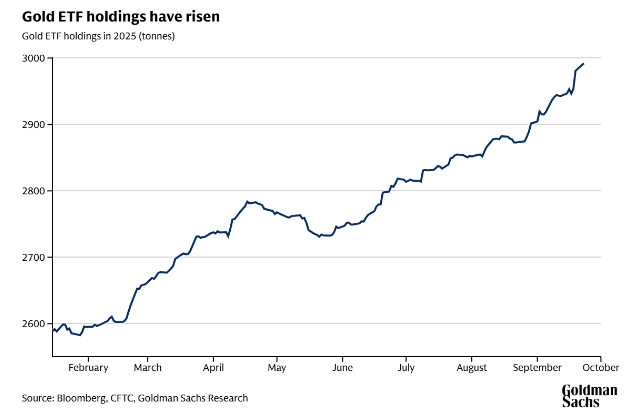
Core Viewpoint - Goldman Sachs indicates that the recent surge in gold prices is driven by strong interest from private investors, suggesting further upside potential that may exceed previous forecasts [2][10]. Group 1: Gold Price Movement - Gold prices are currently trading around $3,865 per ounce, continuing a five-day upward trend and approaching the $4,000 milestone [1]. - Year-to-date, gold has surged nearly 50%, surpassing the highest inflation-adjusted record set in 1980 [7]. - Since August 29, gold prices have increased by over 10%, breaking through previous trading ranges of $3,200 to $3,450 per ounce [7]. Group 2: Investor Behavior - Private investors are significantly increasing their investments in gold, with September inflows into gold ETFs reaching 109 tons, far exceeding the model's predicted 17 tons [9]. - The report highlights two types of gold buyers: steadfast buyers who consistently purchase regardless of price, and opportunistic buyers who enter the market only when prices are favorable [9]. - Steadfast buyers, including central banks and ETFs, have a notable impact on price movements, with a net purchase of 100 tons of gold correlating to a 1.7% increase in gold prices [8]. Group 3: Central Bank Demand - Central banks are expected to continue increasing their gold purchases, with a structural shift in reserve management observed since the onset of the Russia-Ukraine conflict [8]. - A recent survey indicated that 95% of central banks anticipate increasing their gold holdings over the next 12 months, with 43% planning to buy more gold, the highest level since 2018 [8]. - Goldman Sachs predicts that the trend of central banks increasing gold allocations will persist for at least three years, particularly among emerging market central banks [8].
高盛解读“金价突破”:西方投资者大幅加仓,金价涨幅或超预期
Hua Er Jie Jian Wen· 2025-10-02 06:34
Core Viewpoint - Goldman Sachs maintains a long-term bullish outlook on gold, indicating that the recent surge in gold prices is likely to continue, driven by unexpected strong inflows from Western individual investors into gold ETFs [1][2]. Group 1: ETF Inflows and Investor Behavior - The recent increase in gold prices is significantly attributed to strong demand from Western investors for gold ETFs, with September inflows reaching 109 tons, far exceeding Goldman Sachs' model prediction of 17 tons [2]. - The report highlights that speculative positions have contributed minimally to the recent price increase, suggesting that the current rally is driven by committed buyers rather than short-term speculators [2][3]. - Goldman Sachs notes that the increase in Western ETF holdings contributed approximately 3 percentage points to the 14% rise in gold prices since August 26 [2]. Group 2: Price Predictions and Market Dynamics - Goldman Sachs predicts that gold prices could reach $4,000 per ounce by mid-2026 and $4,300 per ounce by the end of 2026 [4]. - The firm emphasizes that the relatively small size of the gold market means that even a minor shift in asset allocation from fixed income to gold could lead to significant price increases [3]. - The report outlines that gold serves as an attractive hedge in scenarios of economic slowdown and increasing macroeconomic policy concerns, enhancing its appeal for portfolio diversification [3].
Why Lockheed Martin Rallied on a Bad Day for the Markets on Friday
The Motley Fool· 2025-06-13 21:02
Group 1 - Lockheed Martin's shares increased by 3.5% despite a 1.1% decline in the S&P 500, driven by geopolitical tensions following Israel's strike on Iran, which raised the possibility of increased defense spending [1] - The U.S. Defense Department may reduce its orders for Lockheed's F-35s from 48 to 24 planes in fiscal 2026, potentially impacting about 5% of Lockheed's revenue [2] - The escalation of conflict could lead to a reversal or reduction of the anticipated F-35 order cuts, as Israel is a significant buyer of Lockheed's defense equipment [3][4] Group 2 - Defense stocks, including Lockheed Martin, have faced pressure this year due to skepticism around defense spending and government efficiency efforts, but they can provide stability during geopolitical tensions [6][7] - In times of rising geopolitical tensions, defense, oil, and gold stocks can act as a hedge, offering a form of insurance for diversified portfolios, while Lockheed also provides dividends [8]