
推理AI

Search documents
英伟达暴跌!一夜蒸发2万亿!
国芯网· 2025-02-28 04:32
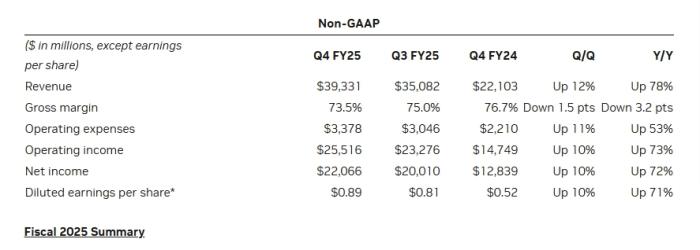
Core Viewpoint - The article discusses the recent significant drop in stock prices of major US tech companies, particularly Nvidia, despite its strong financial performance, highlighting concerns about future growth prospects in the AI chip market [1]. Group 1: Nvidia's Financial Performance - Nvidia reported a revenue of $39.331 billion for Q4 of fiscal year 2025, representing a year-on-year growth of 78% [1]. - The net profit for the same period was $22.066 billion, showing a year-on-year increase of 72% [1]. Group 2: Market Concerns - Despite Nvidia's strong financial results, the market remains skeptical about its future growth, particularly due to concerns over the company's quarterly gross margin guidance not meeting market expectations [1]. - The emergence of new AI technologies, such as DeepSeek, has raised worries about potential oversupply in the AI sector [1]. Group 3: CEO's Insights - Nvidia's CEO, Jensen Huang, emphasized the remarkable demand for the Blackwell chip and the rapid development of AI inference as new growth drivers for the industry [1]. - Huang also mentioned that the release of the DeepSeek-R1 model is a positive indication of ongoing innovation and progress within the AI market, countering market misconceptions [2].



DeepSeek冲击之下,英伟达还能“扛住”吗?
Zhong Guo Jing Ji Wang· 2025-02-27 11:42
一季度赚百亿 黄仁勋称英伟达芯片需求"惊人" 数据显示,英伟达四季度多项业绩超出市场预期。 中新网北京2月27日电(宫宏宇)在经历了DeepSeek带来的股价巨震和博通等对手ASIC芯片冲击后,备受 关注的AI巨擘英伟达于当地时间26日发布2025财年第四季度业绩报告。 营收393.3亿美元、净利润220.66亿美元、毛利率73%......凭借多个超预期表现,英伟达在风波之下再次 给投资者吃下一颗定心丸。英伟达CEO黄仁勋在财报电话会上表示,DeepSeek-R1点燃了全球的热情, 公司对AI推理带来的潜在需求感到兴奋。 不过,也有彭博社等外媒指出,英伟达此次表现优秀但称不上卓越,DeepSeek带来的算力质疑仍可能 冲击未来业绩。 截图自英伟达官网发布的2025财年第四季度业绩报告。 营收方面,同比大幅增长78%至393.31亿美元,高于市场预期的380.5亿美元,也超过英伟达上季度对自 己的业绩指引(375亿美元);每股收益方面,非GAAP口径下调整后同比增长71%至0.89美元,高于分析 师预期的0.84美元;净利润220.66亿美元,高于彭博综合预期(209亿美元)。 其中,数据中心部门销售额355 ...
戴尔第四季度预览:推理 AI 助阵 ,现在是买入好时机吗?
美股研究社· 2025-02-27 10:41
Core Viewpoint - Dell's stock has underperformed since November due to market concerns about a slowdown in AI data center construction, but the company is positioned to benefit from the shift towards inference computing, suggesting potential upside for its stock price [1][10]. Group 1: Market Concerns and Opportunities - The market is worried about the efficiency of AI chips leading to a slowdown in GPU demand, which could impact sales growth expectations for companies like Dell [1]. - Despite concerns, key factors are shifting favorably for Dell, particularly in the inference computing space, which is expected to perform well [1][10]. - The transition from pre-training to inference computing is anticipated to happen faster than expected, with more cost-effective data centers supporting AI inference [3][10]. Group 2: Strategic Partnerships - Dell has partnered with AMD to integrate Ryzen AI PRO processors into new Dell Pro devices, marking a significant milestone in their strategic collaboration [4]. - AMD's CEO highlighted that the total cost of ownership (TCO) for AMD's inference computing solutions is significantly lower than Nvidia's, which could benefit Dell in both PC and server markets [4][9]. Group 3: Financial Performance Expectations - Dell is expected to report solid earnings and revenue growth in its upcoming Q4 financial results, with analysts predicting a 14.46% year-over-year increase in earnings per share (EPS) to $2.52 [5]. - Revenue forecasts for Q4 are set at $24.57 billion, indicating a 10.09% year-over-year growth, with a consensus among analysts on the earnings estimates [5][6]. Group 4: Valuation Metrics - Dell's non-GAAP expected price-to-earnings (P/E) ratio is 14.50, significantly lower than the industry median of 23.87, indicating a 39.26% discount [9]. - The expected price-to-sales (P/S) ratio for Dell is 0.83, which is 73.43% lower than the industry median of 3.11, suggesting strong valuation metrics [9]. Group 5: Future Growth Catalysts - Dell is projected to benefit from a $5 billion deal with Elon Musk's xAI and an anticipated $4 billion increase in AI server shipments from FY 2024 to FY 2025 [8][9]. - The shift towards inference computing is expected to catalyze Dell's next growth phase, supported by recent strategic agreements [11].


天风海外英伟达FY25Q4业绩会全文纪要
2025-02-27 01:29
Company and Industry Summary Company Overview - The company reported record revenue of $39.3 billion in Q4, a 12% quarter-over-quarter increase and a 78% year-over-year increase, exceeding expectations of $37.5 billion. For FY2025, revenue is projected to be $130.5 billion, a 114% increase from the previous year [2][14]. Key Points Data Center Performance - Data center revenue for FY2025 is expected to reach $115.2 billion, more than doubling from the previous year. In Q4, data center revenue hit a record $35.6 billion, with a 16% quarter-over-quarter increase and a 93% year-over-year increase [2][3]. - The introduction of the Blackwell architecture has significantly driven growth, with $11 billion in revenue from Blackwell in Q4, marking the fastest product ramp in the company's history [3][4]. AI and Infrastructure Demand - There is a massive demand for AI infrastructure, with companies racing to expand their capabilities for training and inference. The next generation of AI models requires substantial computational resources, with inference needs potentially exceeding pre-training requirements by 100 times [4][34]. - Blackwell is designed to enhance inference AI models, offering up to 25 times higher token throughput compared to previous architectures, making it revolutionary for AI applications [4][34]. Market Dynamics - The company noted that large cloud service providers (CSPs) accounted for about half of its data center business, with sales nearly doubling year-over-year. Major CSPs like Azure, GCP, AWS, and OCI are rapidly adopting Blackwell systems to meet surging customer demand [5][6]. - The consumer internet revenue tripled year-over-year, driven by expanding generative AI and deep learning use cases [6]. Healthcare and Robotics - NVIDIA's technology is being utilized in healthcare for drug discovery and genomic research, with significant partnerships including IQVIA and Mayo Clinic. The company anticipates growth in the healthcare sector to reach approximately $5 billion this fiscal year [7]. - The automotive sector is also a key growth area, with major manufacturers like Toyota adopting NVIDIA technology for next-generation vehicles [12]. Financial Metrics - The company returned $8.1 billion to shareholders through stock buybacks in Q4. For Q1, total revenue is expected to be $43 billion, with GAAP and non-GAAP gross margins projected at 70.6% and 71%, respectively [14][13]. - Operating expenses are expected to rise, reflecting higher engineering and infrastructure costs associated with new product launches [13]. Future Outlook - The company is optimistic about the demand for Blackwell continuing to grow significantly in Q1, with expectations for both data center and gaming segments to see quarter-over-quarter growth [14]. - The introduction of Blackwell Ultra is planned for the second half of the year, with expectations for improved performance and capabilities [20][21]. Geographical Insights - The company noted that while sales in China remain competitive, they are still below levels prior to export controls. The overall demand for AI infrastructure is expected to grow globally, with significant investments in AI ecosystems in regions like France and the EU [8][25]. Conclusion - The company is positioned at the forefront of the AI revolution, with its Blackwell architecture set to meet the increasing demands for AI computation across various sectors. The anticipated growth in data center revenue, coupled with strong performance in healthcare and automotive applications, underscores the company's strategic focus on AI and machine learning technologies [34].
英伟达公司(NVDA.US)2026财年第一季度业绩电话会
2024-10-31 00:57
Summary of NVIDIA's Q1 Fiscal 2026 Conference Call Company Overview - **Company**: NVIDIA - **Date of Call**: May 28, 2025 - **Fiscal Quarter**: Q1 of Fiscal 2026 Key Industry Insights - **Data Center Revenue**: Reached $39 billion, a 73% year-on-year growth driven by strong AI workload transitions to inference and AI factory build-outs [2][3] - **AI Market in China**: The new export controls on the H20 GPU have significantly impacted NVIDIA's ability to operate in the Chinese market, which is projected to grow to nearly $50 billion [2][13] - **Inference Demand**: There is a sharp increase in demand for inference, particularly in reasoning AI, with major companies like Microsoft processing over 100 trillion tokens in Q1, a five-fold increase year-on-year [4][19] Financial Performance - **H20 Revenue Impact**: NVIDIA recognized $4.6 billion in H20 revenue before the new export controls but had to write down $4.5 billion due to unsold inventory and purchase obligations [2][11] - **Gross Margins**: GAAP gross margins were reported at 60.5%, with non-GAAP gross margins at 61%. Excluding the inventory charge, non-GAAP gross margins would have been 71.3% [11][12] - **Shareholder Returns**: NVIDIA returned a record $14.3 billion to shareholders through share repurchases and dividends [11] Product Developments - **Blackwell Architecture**: Contributed nearly 70% of data center compute revenue, with significant improvements in manufacturing yields and ramping production of GB200 NBL racks [3][4] - **New Products**: Introduction of the GB300 systems, which will leverage the same architecture as GB200, allowing for seamless transitions for customers [3] - **AI Factories**: Nearly 100 NVIDIA-powered AI factories are currently in operation, doubling year-on-year, with significant growth in GPU deployment [5] Strategic Partnerships and Initiatives - **Collaborations**: Partnerships with major companies like Microsoft, OpenAI, and Yum Brands to enhance AI capabilities across various sectors [6][10] - **Sovereign AI**: NVIDIA is positioning itself as a leader in the sovereign AI market, with nations investing in AI infrastructure akin to past investments in electricity and the internet [13][30] Market Challenges - **Export Controls**: The new restrictions on H20 have effectively closed the Chinese market to NVIDIA, leading to significant write-offs and potential long-term impacts on revenue [2][13] - **Competition**: The inability to compete in China may benefit foreign competitors and hinder NVIDIA's market position globally [2][13] Future Outlook - **Revenue Guidance**: For Q2, NVIDIA expects total revenue to be around $45 billion, with a significant decline in China data center revenue due to the H20 export ban [11][12] - **Growth Drivers**: Anticipated growth in enterprise AI, industrial AI, and reasoning AI, with a focus on building out AI infrastructure globally [19][30] Additional Insights - **Networking Growth**: Networking revenue grew 64% quarter-over-quarter, with significant adoption of Spectrum X solutions among major cloud service providers [7][28] - **Gaming Revenue**: Achieved a record $3.8 billion in gaming revenue, driven by strong demand for Blackwell GPUs [8][9] This summary encapsulates the key points from NVIDIA's Q1 Fiscal 2026 conference call, highlighting the company's performance, strategic initiatives, and market challenges.