
DeepSeek-R1模型

Search documents
2025年宏观经济回顾与2026年展望:于变局中开新局,寻求新均衡的2026
Zhong Cheng Xin Guo Ji· 2026-01-23 08:12
1. Report's Industry Investment Rating - No relevant information provided 2. Core View of the Report - In 2025, China's economy achieved a growth target of around 5% despite challenges, but it also faced structural pressures. In 2026, the economy is expected to grow at 4.8%, likely showing a "low - then - high" trend. To achieve the economic growth target in 2026, comprehensive macro - policies are needed, including fiscal, monetary, and various industry - specific policies [3][7][48] 3. Summary by Relevant Catalogs 3.1 2025 Review: A Year of "Reconstruction" Amid Interwoven Multiple Variables - **Growth Trend**: In 2025, China's economy showed a "high - then - low" pattern. The real GDP grew 5.0% year - on - year, with nominal growth at 4.0%. Final consumption contributed over half (52%) to GDP growth, but there is room for improvement. Investment weakened, with capital formation contribution declining [9] - **Economic Structure**: The economy maintained a "strong supply, weak demand" pattern. Industrial production grew at about 6%. "Two - new" policies supported the economy in the first half, but domestic demand lacked momentum in the second half. Investment, especially fixed - asset investment, declined, with real estate and infrastructure investment hitting new lows [10] - **Structural Reconstruction**: - **Macroeconomic Narrative**: DeepSeek's technological breakthrough led to a re - evaluation of Chinese assets, especially technology assets, and changed the economic growth narrative [17] - **Export Resilience**: Exports were affected by US tariffs but remained resilient. The export support shifted from Europe and the US to emerging markets, with high - value - added capital and intermediate goods being the main export items [20] - **New and Old Kinetic Energy Conversion**: The real estate industry continued to adjust, gradually returning to its livelihood nature. New kinetic energy, such as high - tech industries, played an increasing role in economic growth. "Anti - involution" governance promoted the transformation of emerging industries [25][26] 3.2 Four Constraints on the Economy's Path to a "New Equilibrium" - **Global Political and Economic Landscape**: The global political and economic landscape is evolving rapidly. Sino - US competition intensifies in non - trade areas, and geopolitical frictions with non - US countries are increasing [32] - **Micro - entity Behavior**: The behavior of micro - entities has not emerged from the "post - pandemic" paradigm. Residents' preventive savings are likely to be normalized, and enterprises' investment willingness is still low. Local governments face fiscal and debt constraints [32][35][36] - **New and Old Kinetic Energy Conversion**: The transformation from old to new kinetic energy brings downward pressure, fiscal, and employment gaps. New industries are not yet able to fully replace old ones [40] - **High - quality Supply**: The supply of high - quality products and services is insufficient, leading to a mismatch between supply and demand and restricting the release of domestic demand [44] 3.3 2026 Outlook: Expected Economic Growth of 4.8%, with Potential Marginal Improvement in Macro - micro Temperature Difference - **Overall Economic Growth**: In 2026, the economy is expected to show a "low - then - high" trend. Under the neutral scenario, the GDP growth rate is expected to be around 4.8%, with quarterly rates of 4.6%, 4.8%, 4.9%, and 4.9% respectively [7][48] - **Sector - specific Outlook**: - **Production**: Industrial production is expected to remain resilient, with an expected 5.5% increase in industrial added value. The service industry is also expected to grow, with the service production index rising 5.6% [52] - **Exports**: Although there is a base effect, exports are supported by multiple factors. With potential "tactical" easing of Sino - US trade frictions and demand from emerging markets, the export growth rate is expected to be 4.5% [53] - **Investment**: Investment is likely to stop falling and stabilize. Infrastructure and emerging industries will be the main drivers, with overall investment growth expected to reach 2% and narrow - sense infrastructure investment growing by 8% [57] - **Real Estate**: In the short term, the real estate market is still in the inventory - clearing stage, but investment decline is expected to narrow to 10% [58] - **Consumption**: Consumption is expected to have a weak recovery, with total social retail sales growing by 4%. Service consumption has greater growth potential, while commodity consumption is restricted by policy and base effects [60] - **Prices**: The effects of "anti - involution" governance will continue to show, and PPI and CPI are expected to have a mild recovery, potentially improving the macro - micro temperature difference [62] 3.4 Policy Recommendations for Achieving the 2026 Economic Growth Target - **Fiscal and Monetary Policy**: In 2026, the deficit rate should be kept above 4%, and the general fiscal expenditure may reach about 15 trillion yuan. There may be one interest rate cut and 1 - 2 reserve requirement ratio cuts [7][67][69] - **Expanding Domestic Demand**: For consumption, expand subsidies to service consumption, promote full implementation of holidays, and improve the service consumption environment. For investment, play the role of government investment and use the national venture capital guidance fund to attract private capital [70][71] - **Increasing High - quality Supply**: Encourage innovation in products and services, and relax market access to increase high - quality supply [74] - **Cultivating New Kinetic Energy**: Focus on key "choke - point" technologies, strengthen the role of enterprises in innovation, and promote the cluster - based development of strategic emerging industries [74] - **Stabilizing the Real Estate Market**: Improve the "commercial housing + affordable housing" dual - track system, and promote the coordinated development of supply and demand in the real estate market [76] - **Debt Management**: Optimize the debt structure and efficiency, and build a long - term debt management mechanism [77] - **External Response**: Implement a more diversified and in - depth opening - up strategy, expand the foreign trade "circle of friends", and support enterprises to go global [79] - **Reform and System - building**: Promote economic, fiscal, and tax system reforms, and release institutional dividends [81]
DeepSeek新模型曝光?“MODEL1”现身开源社区
Shang Hai Zheng Quan Bao· 2026-01-21 21:31
Core Insights - DeepSeek has updated its FlashMLA code on GitHub, revealing the previously undisclosed "MODEL1" identifier, which may indicate a new model distinct from the existing "V32" [3][4] - The company plans to launch an "open source week" in February 2025, gradually releasing five codebases, with Flash MLA being the first project [4] - Flash MLA optimizes memory access and computation processes on Hopper GPUs, significantly enhancing the efficiency of variable-length sequence processing, particularly for large language model inference tasks [4] Company Developments - DeepSeek's upcoming AI model, DeepSeek V4, is expected to be released around the Lunar New Year in February 2025, although the timeline may vary [4] - The V4 model is an iteration of the V3 model released in December 2024, boasting advanced programming capabilities that surpass current leading models like Anthropic's Claude and OpenAI's GPT series [5] - Since January 2026, DeepSeek has published two technical papers introducing a new training method called "optimized residual connections (mHC)" and a biologically inspired "AI memory module (Engram)" [5] Industry Context - The introduction of the Engram module aims to improve knowledge retrieval and general reasoning, addressing inefficiencies in the Transformer architecture [5] - The support from Liang Wenfeng's private equity firm, which has achieved a 56.55% average return in 2025, has bolstered DeepSeek's research and development efforts [5]


2025年终复盘,在混乱分裂的市场抓住确定性
Sou Hu Cai Jing· 2026-01-01 03:13
Group 1: Global Economic Landscape - 2025 marks a pivotal year for global economic restructuring post-pandemic, characterized by a shift from synchronized monetary tightening to differentiated policy approaches among central banks [3][5] - The Federal Reserve initiated a liquidity easing cycle with three rate cuts, contrasting with the European Central Bank's stability and Japan's rate hikes, influencing global capital flows [3][4][5] - AI technology is on the brink of large-scale implementation, with Nvidia achieving a market cap of $5 trillion, highlighting the value of computational power dominance [1][9] Group 2: Market Dynamics and Investment Opportunities - Emerging markets, particularly Chinese assets, demonstrated resilience, with A-shares leading the tech sector and Hong Kong IPOs regaining global prominence [2][33] - Gold and other precious metals emerged as top-performing asset classes due to their dual role as safe havens and inflation hedges, with gold prices soaring [2][38] - The investment landscape is shaped by a closed loop of policy transmission, capital flow, industrial linkage, and risk spillover, setting the stage for market trends in 2026 [2] Group 3: Central Bank Policies - The Federal Reserve's rate cuts were driven by slowing economic growth and declining inflation, with GDP growth expected to drop from 2.4% to 1.8% in 2025 [4][6] - Other major central banks maintained stable rates, with the ECB emphasizing core inflation persistence and Japan's shift to rate hikes reflecting domestic economic recovery [5][6] Group 4: Technology Sector Developments - Nvidia's market cap surge is attributed to its monopoly in high-end computing chips, with significant revenue growth from its data center business [9][10] - The launch of China's DeepSeek AI model, surpassing OpenAI's GPT-5, signifies a breakthrough in the global AI landscape, prompting a reevaluation of Chinese hard tech investments [13][15] Group 5: Trade and Debt Challenges - Trump's "reciprocal tariffs" policy disrupted global trade, leading to a slowdown in trade growth and increased inflationary pressures [21][22] - Global public debt reached a historic high of 95% of GDP, driven by multiple factors including increased defense spending and rising social security costs [24][25] Group 6: Chinese and Hong Kong Markets - The A-share market experienced a tech-driven bull run, with significant liquidity activation and a record number of new tech listings [30][31] - Hong Kong's IPO market rebounded strongly, supported by southbound capital flows and foreign investment, reclaiming its status as a global capital hub [33][34]

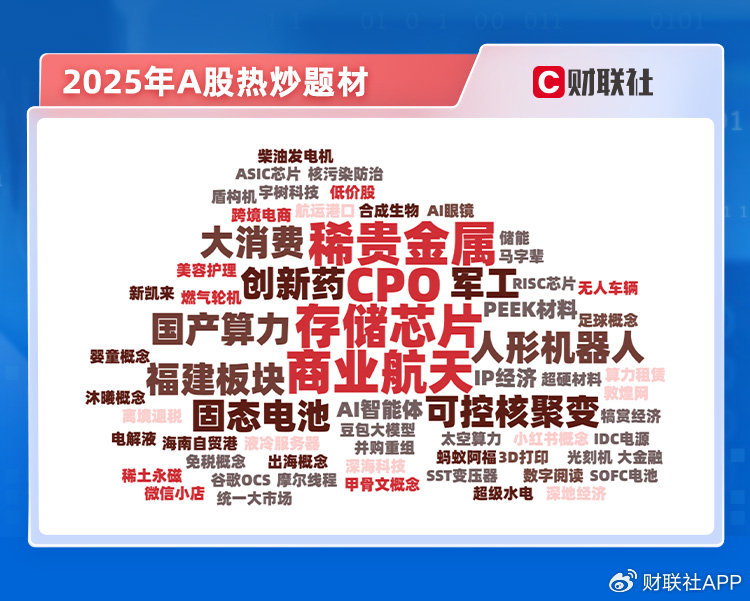
年终盘点|DeepSeek点燃AI热......一文看懂2025年A股热炒题材
Xin Lang Cai Jing· 2025-12-29 13:45
Core Viewpoint - The A-share market in 2025 experienced a significant upward trend after a rapid decline in early April, culminating in a clear focus on "new productive forces" driven by policy, events, and industry developments, leading to a fast-paced and concentrated trading environment [1][23]. AI Hardware and Chip Sector - The launch of the DeepSeek-R1 model in January 2025, with a training cost of approximately $294,000, disrupted the belief that top models required tens of millions of dollars, leading to a surge in domestic AI hardware stocks [3][25]. - The performance of computing chip stocks was notable, with Tianpu Co. achieving a maximum annual increase of over 1300%, while Dongxin Co. and Xinyuan Co. both exceeded 300% [3][27]. Storage Chip Sector - The demand for storage chips surged, with prices for DRAM and NAND Flash increasing by over 300% since September 2025, driven by major companies focusing on HBM and DDR5 [8][29]. - The top performers in the storage chip sector included Xiangnan Chip, which saw an annual increase of over 600%, and several others exceeding 200% [8][31]. Precious Metals and Commodities - The precious metals market experienced a historic bull run, with gold prices rising over 70% and silver over 170% due to global liquidity and demand from emerging industries [10][31]. - The industrial metal sector also thrived, with copper prices increasing over 40%, and several companies in the sector achieving annual increases exceeding 200% [10][31]. Commercial Aerospace Sector - The commercial aerospace sector saw significant growth in Q4 2025, with multiple successful rocket launches and a notable IPO plan from SpaceX, valued at approximately $1.5 trillion [12][34]. - Key stocks in this sector, such as Shunhao Co. and Feiwo Technology, recorded annual increases exceeding 450% [12][34]. Energy Storage and Lithium Battery Sector - The global energy storage demand is projected to grow significantly, with a target of 180 million kilowatts of new storage capacity by the end of 2027, leading to a resurgence in the lithium battery industry [15][36]. - Major players in the lithium battery sector, such as Ningde Times, saw their market value exceed 1.8 trillion yuan, with several companies achieving annual increases over 560% [15][36]. Regional Policy Impact - The Fujian and Hainan regions experienced significant market activity due to new policies, with Fujian's stock performance showing increases over 500% for some companies [19][40]. - Hainan's free trade port officially launched, leading to strong growth in related stocks, with some companies achieving annual increases over 180% [19][42].
年终盘点|DeepSeek点燃AI热,贵金属引领周期逆袭,商业航天奏响年末最强音......一文看懂2025年A股热炒题材
Xin Lang Cai Jing· 2025-12-29 09:39
Core Viewpoint - The A-share market in 2025 experienced a significant upward trend after a rapid decline in early April, characterized by a concentrated focus on "new productive forces" and driven by policy, events, and industry developments [1] Group 1: AI Hardware and Chip Market - The launch of the DeepSeek-R1 model in January 2025, with a training cost of approximately $294,000, disrupted the belief that top models required tens of millions of dollars, leading to a surge in domestic AI hardware stocks [3] - The performance of computing power chip stocks was remarkable, with Tianpu Co. achieving a maximum increase of over 1300% in 2025, while Dongxin Co. and Chipone Co. both exceeded 300% [5] - The collaboration between Nvidia and OpenAI, valued at $100 billion, highlighted the competitive landscape in AI chips, with significant demand for H100 GPUs for training next-generation models [4] Group 2: Storage Chip Market - The demand for storage chips surged, with prices for DRAM and NAND Flash increasing by over 300% since September 2025, driven by the focus on HBM and DDR5 technologies [9] - Companies like Shannon Semiconductor saw a maximum increase of over 600% in 2025, while others like Demingli and Jiangbolong exceeded 200% [9] Group 3: Commodities and Precious Metals - The decline in the US dollar and the Fed's interest rate cuts led to a significant rise in commodity prices, with gold increasing by over 70% and silver by over 170% in 2025 [11] - The demand for industrial metals surged due to new industries, with copper prices rising over 40%, and several companies in the precious metals sector saw increases exceeding 200% [11] Group 4: Commercial Aerospace - The commercial aerospace sector experienced a boom in Q4 2025, driven by government support and successful rocket launches, with companies like Shunhao Co. and Feiwo Technology seeing maximum increases of over 450% [13] Group 5: Energy Storage and Lithium Battery Industry - The global energy storage demand is expected to grow significantly, with projections of over 60% growth in 2026, leading to price increases in lithium and related materials [15] - Companies in the energy storage sector, such as Yidong Electronics and Zhenhua Co., saw maximum increases of over 270%, while lithium battery companies like Haike New Energy exceeded 560% [15] Group 6: Regional Policy Impacts - The Fujian and Hainan regions experienced significant market activity due to new policies, with Fujian stocks like Haixia Innovation seeing increases over 500% and Hainan stocks like Zhongtung High-tech exceeding 180% [18][22]
2025大厂领衔,AI应用创新开打“巅峰赛”
Tai Mei Ti A P P· 2025-12-19 11:29
Core Insights - The rapid adoption of AI applications in 2025 is transforming everyday life, driven by a competitive landscape among market participants [1] - The emergence of DeepSeek's R1 model has disrupted industry cost perceptions, demonstrating that top-tier AI can be developed at a fraction of the previously assumed costs [2] - Major players like Alibaba and Baidu are advancing their AI models, with Alibaba's Qwen3-Max and Baidu's Wenxin model achieving significant milestones in performance and ecosystem development [3][4] - The AI application market is witnessing intense competition, with a shift from model parameters to practical application capabilities, as evidenced by the rise of platforms like Doubao and Tencent Yuanbao [5][6] - The introduction of AI smartphones, particularly by ByteDance and ZTE, is reshaping the competitive landscape, raising concerns about user privacy and regulatory frameworks [7][8][9] Group 1: AI Model Development - DeepSeek's R1 model was launched in January 2025, with training costs around $294,000, challenging the notion that top models require tens of millions of dollars [2] - Alibaba's Qwen3-Max model has surpassed 1 trillion parameters and ranks among the top three globally in evaluations, showcasing its technical prowess [3] - Baidu's Wenxin model has evolved to version 5.0 with 2.4 trillion parameters, achieving competitive language and multimodal understanding capabilities [3] Group 2: Market Dynamics - The AI application market is rapidly evolving, with significant shifts in user engagement and application performance, as seen with Doubao's integration into over 50 internal business scenarios [5] - Tencent Yuanbao has quickly become a leading AI-native application, achieving daily active user numbers comparable to its monthly totals earlier in the year [5] - The "Qianwen" app, backed by Alibaba, gained 30 million monthly active users within 23 days of its public beta, indicating strong market demand [6] Group 3: AI Smartphone Impact - The launch of the "Doubao phone" by ByteDance and ZTE has introduced a new dimension to AI application competition, allowing for complex task automation across apps [7] - Concerns have arisen regarding user privacy and security as AI agents challenge traditional app ecosystems, potentially disrupting established business models [7][8] - The industry faces a need for new consensus on the legality and safety of AI smartphone operations to mitigate risks associated with user data and privacy [9]
年薪千万,天才少女求放过
Sou Hu Cai Jing· 2025-12-09 01:11
Core Insights - The article highlights the journey of Luo Fuli, a prominent figure in the AI field, who recently joined Xiaomi, ending speculation about her potential move after being offered a significant salary by Lei Jun [2][13]. Group 1: Background and Early Life - Luo Fuli, born in 1995 in Yibin, Sichuan, comes from a modest family background, with her father being an electrician and her mother a teacher [16]. - Despite her initial academic struggles, she gradually improved her performance through goal-setting and encouragement from her parents, eventually ranking among the top students in her class [16][17]. Group 2: Academic Journey - Luo Fuli transferred to the Computer Science department at Beijing Normal University, where she initially faced challenges due to her lack of programming experience [21][24]. - She dedicated herself to learning programming and excelled academically, ultimately securing a spot for graduate studies at Peking University [27][29]. Group 3: Professional Development - After graduating, Luo Fuli joined Alibaba's Damo Academy, where she contributed to significant projects, including the development of AI models that generated substantial value for the company [41]. - She later became a core developer of the DeepSeek-V2 model, which disrupted the AI market by significantly reducing the cost of using large models [10][41]. Group 4: Recognition and Impact - Luo Fuli gained widespread recognition in 2019 after publishing eight papers at the ACL conference, a prestigious event in the natural language processing field [29][32]. - Her work has been influential in promoting the importance of women in technology, emphasizing the fair evaluation based on merit in the field of computer science [44]. Group 5: Current Developments - Following her recent move to Xiaomi, Luo Fuli aims to contribute to the company's AI model team, reflecting her desire to work in a quieter environment focused on meaningful projects [13][44].

DeepSeek新模型降价:优化推理效率,API价格降超50%
YOUNG财经 漾财经· 2025-09-30 06:25
Core Insights - DeepSeek has launched the new DeepSeek-V3.2-Exp model, which significantly reduces API costs by over 50% [2][3][4] Group 1: Model Release and Features - The DeepSeek-V3.2-Exp model is an experimental version that builds on the previous V3.1-Terminus, introducing the DeepSeek Sparse Attention mechanism to enhance training and inference efficiency for long texts [3][4] - The new model maintains performance levels comparable to V3.1-Terminus across various public evaluation datasets, despite the introduction of the sparse attention mechanism [4] Group 2: Cost Reduction and Pricing - The introduction of the new model has led to a substantial decrease in service costs, with API pricing dropping by more than 50%. Specific price changes include input cache hits reduced from 0.5 yuan to 0.2 yuan per million tokens, cache misses from 4 yuan to 2 yuan per million tokens, and output costs from 12 yuan to 3 yuan per million tokens [4] Group 3: Research and Development - The development of the DeepSeek-V3.2-Exp model involved designing new GPU operators and utilizing the TileLang programming language for rapid prototyping, which supports deeper exploration of model capabilities [4] - DeepSeek's research on the DeepSeek-R1 model, which focuses on incentivizing reasoning capabilities in large language models through reinforcement learning, was featured on the cover of the prestigious journal Nature [7]

国际产业新闻早知道:中美TikTok协议进展受关注, H-1B签证费暴涨引担忧
Chan Ye Xin Xi Wang· 2025-09-23 05:22
Group 1 - The U.S. and China are in communication regarding the TikTok agreement, with President Trump aiming to finalize it during the upcoming APEC summit [1][2] - Trump's new visa policy has raised concerns among tech companies, increasing the H-1B visa application fee to $100,000, effective September 21 [3] - The U.S. and the UK signed the "Technology Prosperity Agreement," focusing on collaboration in AI, quantum computing, and civil nuclear energy, with U.S. tech firms committing £31 billion to enhance the UK's AI infrastructure [4] Group 2 - The EU is advancing the "Financial Data Access" (FiDA) regulation, which requires banks to share customer data with third parties upon authorization, with Germany proposing to exclude major U.S. tech companies from this system [6][7] - DeepSeek's R1 model training cost is reported to be only $294,000, significantly lower than competitors, raising discussions about China's position in the global AI field [8][10] - DeepSeek has upgraded its online model to DeepSeek-V3.1-Terminus, improving language consistency and agent capabilities [11][12] Group 3 - Nvidia and OpenAI have announced a partnership involving an investment of up to $100 billion to co-build large-scale data centers, with Nvidia expected to deliver chips by the end of 2026 [17][18] - Oracle is negotiating a $20 billion cloud computing deal with Meta Platforms, indicating Oracle's growing role as a key infrastructure provider [22] - OpenAI plans to spend $100 billion on backup servers over the next five years, with total server leasing expenses projected to reach $350 billion from 2025 to 2030 [23][24] Group 4 - BYD has significantly expanded its dealer network in Spain, increasing from 25 to nearly 100, and is projected to capture over 10% of the Spanish electric vehicle market by 2025 [46][48] - Tesla has received permission to test autonomous vehicles in Arizona, marking a key step in expanding its Robotaxi business [52] - BMW has initiated prototype testing for its third-generation hydrogen fuel cell system, set to enter mass production in 2028 [53] Group 5 - The Chinese Ministry of Industry and Information Technology aims to develop over 10 million satellite communication users by 2030, promoting high-quality growth in the satellite communication industry [59] - SpaceX is collaborating with chip manufacturers to develop technology for direct mobile connections to its Starlink satellite internet service [63][64] - Rainbow Rare Earths has made significant progress in its South Africa project, enhancing product quality and reducing costs through improved processing steps [78]


华富中证人工智能产业ETF投资价值分析:聚焦AI产业核心赛道,掘金人工智能优质个股
CMS· 2025-08-17 08:19
Quantitative Models and Construction Methods Model: DeepSeek-R1 - **Model Construction Idea**: The DeepSeek-R1 model aims to innovate in AI technology by reducing dependency on high-end imported GPUs and enhancing cost-effectiveness and performance in global markets[5][12][30] - **Model Construction Process**: - The model is based on the DeepSeek-V3 architecture and applies reinforcement learning techniques during the post-training phase to significantly improve inference capabilities with minimal labeled data[33] - The model's performance in tasks such as mathematics, coding, and natural language inference is on par with OpenAI's o1 official version[33] - The team also introduced six distilled small models using knowledge distillation techniques, with the 32B and 70B versions surpassing OpenAI o1-mini in several capabilities[34] - The model's training cost was $5.576 million, only 1/10th of GPT-4o's training cost, and its API call cost is 1/30th of OpenAI's similar services[38] - **Formula**: $$ \text{SUE} = \frac{\text{Single Quarter Net Profit} - \text{Expected Net Profit}}{\text{Standard Deviation of Net Profit YoY Change over the Past 8 Quarters}} $$ where Expected Net Profit = Last Year's Same Quarter Actual Net Profit + Average YoY Change in Net Profit over the Past 8 Quarters[55] - **Model Evaluation**: The model is highly cost-effective and adaptable to different application environments, breaking the traditional AI industry's reliance on "stacking computing power and capital"[38][43] Model Backtesting Results - **DeepSeek-R1 Model**: - **AIME pass@1**: 9.3 - **AIME cons@64**: 13.4 - **MATH-500 pass@1**: 74.6 - **GPQA Diamond pass@1**: 49.9 - **LiveCodeBench pass@1**: 32.9 - **CodeForces rating**: 759.0[36] Quantitative Factors and Construction Methods Factor: Standardized Unexpected Earnings (SUE) - **Factor Construction Idea**: SUE is used to measure the growth potential and latest marginal changes in the prosperity of the industry and individual stocks[57] - **Factor Construction Process**: - SUE is calculated as: $$ \text{SUE} = \frac{\text{Single Quarter Net Profit} - \text{Expected Net Profit}}{\text{Standard Deviation of Net Profit YoY Change over the Past 8 Quarters}} $$ where Expected Net Profit = Last Year's Same Quarter Actual Net Profit + Average YoY Change in Net Profit over the Past 8 Quarters[55] - **Factor Evaluation**: SUE effectively measures future earnings growth and the latest marginal changes in prosperity, representing the future trend changes in the industry[57] Factor Backtesting Results - **SUE Factor**: - **2022**: -29.8% - **2023**: 15.9% - **2024**: 20.1% - **2025 YTD**: 11.0%[65]