
文化消费升级

Search documents
从金星中式精酿的现象级爆火,解读传统啤酒行业的破局之道
Sou Hu Cai Jing· 2025-07-15 16:54
Core Insights - The rise of Jin Xing Beer’s "Chinese Craft Beer" reflects a significant transformation in the Chinese beer industry, which is currently facing challenges in growth and competition [2][4][22] - Jin Xing Beer has successfully repositioned itself from a local brewery to a cultural creator through its innovative product line, which has significantly improved its overall gross margin [2][8] Industry Overview - The Chinese beer industry is experiencing a decline, with a 0.6% decrease in production in 2024 compared to the previous year, and a 5.7% drop in revenue, making it the only category in the food and beverage sector to show negative growth [4][22] - Despite the downturn, industry experts believe that the beer sector is not at a dead end but is undergoing necessary transformation and upgrading, with a clear trend towards consumer demand for personalization and quality [4][22] Company Strategy - Jin Xing Beer identified the key to breaking through the market by focusing on "Chinese Craft Beer," which aligns with two core consumer trends: cultural identity and experiential consumption [5][22] - The brand has effectively integrated familiar cultural elements into its products, such as using local tea and traditional flavors, which has resonated with younger consumers and reduced the cost of consumer education [5][13] Product Innovation - The product line has expanded to 12 SKUs, with total production and sales exceeding 100,000 tons by June 2025 [2] - Jin Xing Beer employs a dual-channel strategy of "online ignition + offline cultivation," successfully reaching young consumers through platforms like Douyin, where it has amassed over 1.58 million followers [5][7] Brand Repositioning - The brand's transformation is characterized by a deep integration of Chinese cultural elements, which has allowed it to lower consumer recognition costs and enhance brand loyalty [8][13] - The unique naming conventions and packaging designs of products like "Xinyang Maojian Chinese Craft Beer" reflect a strategic approach to brand identity that resonates with consumers [8][9] Technological Innovation - Jin Xing Beer has developed proprietary brewing techniques, such as the 1258 core brewing process, which combines traditional tea culture with modern brewing methods, creating distinctive flavors that set it apart from competitors [14][19] - The introduction of advanced extraction techniques has allowed the brand to maintain the natural aromas and nutritional components of its ingredients, enhancing product quality [16][19] Market Trends - The success of Jin Xing's Chinese Craft Beer signifies a broader trend in the consumer market, where buyers are increasingly willing to pay for products with cultural significance and emotional value [22] - As the "Guochao" (national trend) consumption continues to rise, there is potential for Chinese Craft Beer to transition from niche to mainstream, indicating a promising future for Jin Xing Beer [22]


真金白银放补贴 黄金档期全覆盖 宁夏惠民观影活动激活电影市场消费活力
Sou Hu Cai Jing· 2025-06-23 07:03
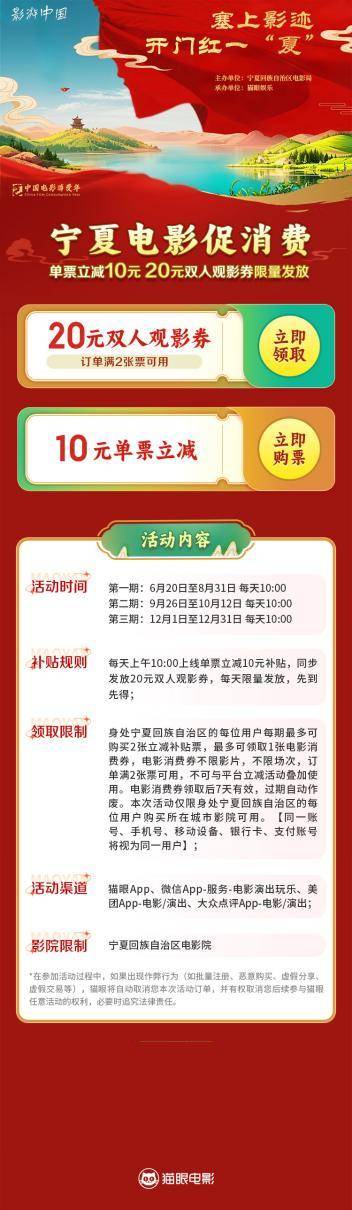
Core Points - The "Saishang Yingji: Opening Red Summer" movie promotion event aims to stimulate cultural consumption in Ningxia, running from June 20, 2025, to December 31, 2025, covering key viewing periods such as summer and National Day [1][4] - The event offers cash subsidies for movie tickets, with daily discounts available for viewers, enhancing the movie-going experience in the region [1][4] Summary by Sections Event Overview - The event is organized by the Ningxia Hui Autonomous Region Committee's Propaganda Department and Cat's Eye Entertainment, lasting for 8 months and targeting major viewing periods [1] - The first phase runs from June 20 to August 31, the second from September 26 to October 12, and the third from December 1 to December 31 [2][4] Subsidy Details - Daily subsidies include a 10 yuan discount per ticket and a limited 20 yuan double ticket coupon, available on a first-come, first-served basis [2][4] - Each user in Ningxia can purchase up to 2 discounted tickets and claim 1 movie consumption coupon per phase, valid for 7 days after issuance [2][4] Distribution Channels - Users can access the subsidies through various platforms, including Cat's Eye App, WeChat App, Meituan App, and Dazhongdianping App [2][4] Movie Highlights - The event coincides with the release of several films, including "How to Train Your Dragon," "Sauce Garden Alley," and "Lychee in Chang'an," promising diverse viewing experiences for audiences [4][6][8][10] - The promotion aims to integrate culture and consumption, revitalizing the local film and tourism economy in Ningxia [10]
老萬年亮相江苏老字号博览会,助推文化消费升级
Zhong Guo Jing Ji Wang· 2025-06-09 03:00
Core Viewpoint - The article highlights the participation of the time-honored brand Laomannian at the Jiangsu Old Brand Expo, showcasing its rich heritage and innovative products, while promoting the integration of traditional craftsmanship with modern consumer demands [1][5]. Group 1: Company Heritage and Achievements - Laomannian, founded in 1710, has a history of over 300 years and has received numerous accolades, including recognition as a "Century-Old Meritorious Enterprise" and "Advanced Unit for Inheritance and Innovation" [2]. - The brand is known for its non-material cultural heritage in gold and silver craftsmanship, having participated in significant national events such as the G20 and the centenary of the Communist Party [2]. Group 2: Product Showcase and Consumer Engagement - At the expo, Laomannian's booth featured exquisite products, including the "Blooming Flower Silk Treasure Box," which combines traditional craftsmanship with modern design, attracting a diverse audience [3][4]. - The booth's atmosphere was lively, with staff engaging visitors by sharing the brand's history and craftsmanship, enhancing consumer appreciation for traditional arts [2][3]. Group 3: Cultural Preservation and Innovation - Laomannian emphasizes the preservation of cultural heritage while innovating its product offerings, recently opening the Jiangnan Garden-style Gold Museum to enhance cultural experiences [4]. - The museum features a non-material heritage workshop where artisans demonstrate traditional goldsmithing techniques, further promoting the brand's commitment to cultural transmission [4]. Group 4: Market Positioning and Consumer Trends - The brand aims to meet the evolving consumer demands for personalized and culturally rich products, positioning itself as a leader in the new consumption landscape [5][6]. - By participating in the expo, Laomannian seeks to enhance its market presence and contribute to the promotion of traditional culture while driving economic circulation [6].
对博物馆的爱正在“升级”
Ren Min Ri Bao· 2025-05-23 21:56
Core Insights - The latest data from the National Cultural Heritage Administration indicates a thriving museum sector in China, with significant growth in both the number of museums and visitor engagement [1][2] Group 1: Museum Development - By the end of 2024, there will be 7,046 registered museums in China, equating to one museum for every 200,000 people [1] - County-level museums have an impressive coverage rate of 80%, highlighting the accessibility of cultural resources [1] - The Shandong Qingzhou Museum has welcomed over 4 million visitors in two years, demonstrating the appeal of smaller, well-curated museums [1] Group 2: Visitor Engagement - Museums received 1.49 billion visitors in 2024, with an average of one visit per person per year [1] - Among the visitors, 359 million are teenagers, and nearly 50% of visitors to the National Museum of China are aged 18-30, indicating a growing interest among younger demographics [2] - Museums are increasingly utilizing technology and cross-disciplinary approaches to enhance visitor experiences and attract younger audiences [2] Group 3: Cultural Significance - The construction and development of museums reflect the broader cultural development of the nation, showcasing the rich history and profound cultural heritage of China [2] - Museums are becoming vital cultural spaces that connect audiences with both historical narratives and contemporary societal issues [2]