日本政治右倾化

Search documents
高市早苗为何豪赌“闪电战”
Xin Lang Cai Jing· 2026-01-28 00:11
日本首相、自民党总裁高市早苗26日在党首辩论上称,若执政党阵营在众议院选举中未获得过半数议 席,她将即刻辞职,俨然对"政治豪赌"志在必得。几天前,她在内阁会议上宣布解散众议院,且从解散 到投票、开票,仅预留16天时间,创下战后最短纪录。高市早苗执意发动"闪电战",究竟有哪些盘算? 直观来看,这是高市早苗采取的一次极端自保与扩权行动。2025年总裁选举后,自民党通过与更加保守 的维新会合作,勉强保住其执政地位。但这种合作也建立在高市早苗诸多让步的基础上,在自民党内存 在争议,联盟根基亦不稳固。眼下,高市早苗欲挟"蜜月期"的高支持率,将民众对其政权的支持迅 速"套现":若自民党赢得此次众议院大选,则高市早苗在党内政治地位将显著提升,受党内政治势力掣 肘的情况将得到缓解,还会提高其与维新会讨价还价的空间。 其次,此举可以"合理"规避在野党质询,打乱在野党的整合进程。按日本政治惯例,1月开幕的通常国 会,本应是行政首长就年度施政方针接受全盘质询的场所。一段时间以来,围绕涉台错误言论、政治献 金等,高市早苗正受在野党集中围攻。此番,高市早苗利用首相特权,直接掐断了法定的质询程序,在 野党的追责攻势只能戛然而止。加之,目 ...


日本大选开启,高市可能下台吗?
Xin Lang Cai Jing· 2026-01-23 04:39
Group 1 - The core viewpoint of the article is that Prime Minister Sanna Takashi's decision to dissolve the House of Representatives is a risky political gamble, facing significant internal party pressure and potential consequences if the election results are unfavorable [1][4][13] - The election schedule indicates a rapid transition from dissolution to voting, with only 16 days in between, reflecting the government's intention for a swift resolution [4][16] - The establishment of the new party "Center Reform Alliance" by the largest opposition party, the Constitutional Democratic Party, and the former coalition partner Komeito is seen as a formal opposition alliance against Takashi [4][10][16] Group 2 - Takashi's political gamble aims to achieve three objectives: securing a majority for the Liberal Democratic Party (LDP), consolidating her power within the party, and avoiding accountability from opposition parties [7][20] - The LDP currently holds 199 seats in the House of Representatives and needs to gain at least 34 more to achieve a majority, with factors such as high public support and the rightward shift in societal thought being advantageous, while the exit of Komeito poses a significant challenge [8][20] - The upcoming election is expected to reshape the political landscape in Japan, with potential internal power shifts within the LDP and the emergence of the new opposition party posing a significant variable in the election outcome [11][24]

视频丨日本学者对政坛日益右倾化深表忧虑
Yang Shi Xin Wen Ke Hu Duan· 2026-01-20 13:32
0:00 当地时间19日,日本首相高市早苗表示,将于23日解散众议院。日本学者表示,高市早苗上台以来,不仅公然发表错误言论,同时通过渲染战争危机,大幅 增加防卫费,推进修改"和平宪法",右倾化日趋严重,令人担忧。 新潟国际情报大学国际学部教授 佐佐木宽:她认为只要强硬表态"绝不撤回",国民就会支持她,无能的政客靠战争来维持权力,有能力的政治家创造和 平,遗憾的是虽然高市是日本首相,但她是通过战争以及煽动战争来维持权力,所以我认为她是无能的。 佐佐木宽还指出,在物价持续上涨、民众生活压力不断加重的背景下,高市政权却决定解散众议院,将重心放在政治博弈和权力运作上,这种罔顾民生、只 考虑自身政治盘算的做法,使日本政治的未来走向令人深感忧虑。 新潟国际情报大学国际学部教授 佐佐木宽:内阁成立三个多月 ,实际上她还什么都没有做。如果今后以经济政策为中心,却看不到什么成果,那么她的支 持率很可能会迅速下降。现在党内基础薄弱,又是参众两院的少数执政党,在这种情况下,她只能拼命吸收社会舆论的右翼及不安情绪,勉强维持权力。为 了维持她自己的权力,可能在自民党内部也没有充分沟通,几乎是她个人决定解散众议院,连自民党的国会议员们都 ...

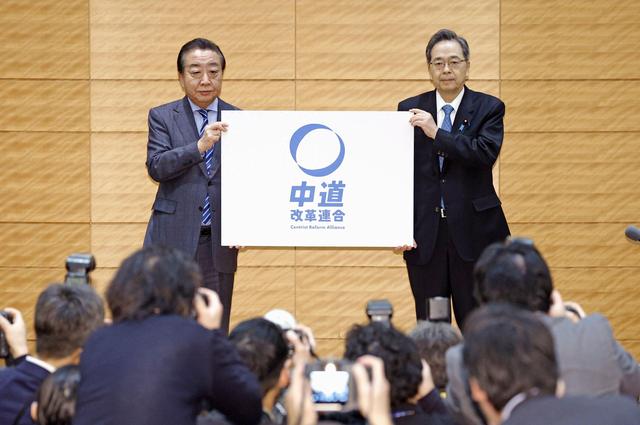
日本在野两党联手会否把高市政权“逼入困境”?
Xin Lang Cai Jing· 2026-01-16 11:54
Group 1 - The core viewpoint of the article is the formation of a new political party called "Center Reform Union" by Japan's largest opposition party, the Constitutional Democratic Party, and the Komeito party, in response to Prime Minister Sanna Takashi's sudden intention to dissolve the House of Representatives and call for early elections [1][3][6] - The new party aims to consolidate "centrist" forces in the face of Japan's political rightward shift, with both parties believing it is crucial to unite under a centrist banner [3][7] - The Constitutional Democratic Party and Komeito currently hold 148 and 24 seats respectively in the 465-seat House of Representatives, while the ruling parties, the Liberal Democratic Party and the Japan Innovation Party, hold 199 and 34 seats [3][4] Group 2 - Komeito candidates will not participate in single-member districts but will run as proportional representation candidates, indicating a full support for candidates from the Constitutional Democratic Party in key districts [4][6] - The formation of the new party appears rushed, as reports suggest that only members of the House of Representatives will join the new party, while senators and local assembly members will remain with their original parties [6][7] - There are existing policy differences between the two parties on key issues such as security laws and nuclear power, which may complicate the integration of their policies within the new party [7][9]
列国鉴·年终观察|高市早苗上台 日本加速右倾
Xin Hua She· 2025-12-29 12:54
作为日本右翼保守势力的代表人物,高市上台执政本身就是日本政治右倾化的结果,其上台伊始在外交、安保、人事任命等方面的举措,也让 日本社会右倾化加速。专家认为,高市的执政路线是一场高风险赌博,对日本、地区乃至世界的危害极大。 10月21日,在日本东京,自民党总裁高市早苗(中)在临时国会众议院首相指名选举中胜出后起身致谢。新华社记者贾浩成摄 右倾活动更趋公开 记者观察发现,高市上台以来,日本社会右倾趋势更加明显,相关活动愈发公开化,比如民众对不同观点的容忍度下降、偏激游行明显增多, 民众历史认知的断裂也更加暴露。 新华社东京12月29日电(记者李子越)高市早苗10月出任自民党总裁和日本首相以来,无论在网络空间还是现实生活中,记者都感受到日本社 会加速"向右转"。 最直观的变化在网络空间。日本法务省统计,日本社交媒体上近期针对外国人的仇恨与排外言论呈扩散趋势,向法务省求助的外国人明显增 多。记者在社交媒体平台检索时发现,以激烈保守言论讨论移民、历史议题的右翼内容显著增多。 12月8日,早稻田大学名誉教授池田清彦仅因在社交媒体质疑高市的支持率,即遭到大量恶意留言攻击。日本知名主持人谷原章介在电视节目 中谈及高市涉台错误 ...

2025,日本加速右倾的一年
Xin Lang Cai Jing· 2025-12-23 04:37
Core Viewpoint - Japan is experiencing a significant political shift towards the right, driven by social and economic anxieties, as evidenced by the recent elections and the rise of far-right political forces [2][3][4]. Political Landscape - The July 2025 Senate elections marked a turning point, with the ruling Liberal Democratic Party (LDP) and its ally Komeito suffering losses, while the far-right party made significant gains, winning 14 seats [2]. - The election results reflect a broader societal shift towards right-wing politics, influenced by global trends [2]. - The election of Sanae Takaichi as Prime Minister represents a strategic move by the LDP to regain conservative voters amid crises [3]. Military and Defense Budget - Japan's defense budget is set to reach approximately 11 trillion yen for the 2025 fiscal year, marking a historical peak and achieving the goal of defense spending constituting 2% of GDP two years ahead of schedule [6][7]. - The focus of the defense budget includes enhancing "counterattack capabilities" and establishing new military bases in strategic locations [7]. - Legal frameworks are being adjusted to facilitate military expansion, including plans to significantly relax weapon export restrictions [7][8]. Societal Concerns - Rising social anxieties, including stagnant wages and high inflation, are contributing to a growing sense of disillusionment among the Japanese populace [4][9]. - The political climate has led to an increase in nationalist sentiments and anti-immigrant rhetoric, which far-right parties are capitalizing on [4][9]. Economic Policies - The government has proposed a comprehensive economic strategy with a spending plan of 21.3 trillion yen aimed at boosting the economy and defense spending [11]. - However, there are concerns regarding the sustainability of these policies, especially given Japan's high national debt, which stands at 250% of GDP [11]. - The potential deterioration of Japan-China relations could further complicate economic recovery efforts, as trade between the two countries exceeds 300 billion USD annually [11].
【环时深度】2025,日本加速右倾的一年
Huan Qiu Shi Bao· 2025-12-22 22:41
Core Viewpoint - Japan is experiencing a significant political shift towards the right, driven by social and economic anxieties, as evidenced by the recent elections and the rise of extreme right parties [3][4][5]. Political Developments - The 2025 summer elections marked a turning point, with the ruling Liberal Democratic Party (LDP) and its ally Komeito suffering losses, while the extreme right party gained 14 seats, indicating a broader societal shift to the right [3][4]. - The election results reflect Japan's susceptibility to global political trends, with analysts suggesting that mainstream parties may adopt more exclusionary policies to compete for votes [3][4]. - The appointment of Sanae Takaichi as Prime Minister represents a strategic move by the LDP to regain conservative voters, aligning with a more hardline nationalist agenda [4][5]. Economic Context - Japan's defense budget is set to reach a historical peak of approximately 11 trillion yen for the 2025 fiscal year, marking a continuous increase for 14 years [6][7]. - The government is focusing on enhancing offensive military capabilities, including the establishment of a joint operations command and the reorganization of military units [7]. - Economic policies under Takaichi aim to balance public welfare and defense spending, but face criticism for being outdated and potentially harmful in the context of rising inflation and national debt [11]. Social Dynamics - Rising social discontent, characterized by stagnant wages and high inflation, has fueled a populist sentiment that extreme right parties are capitalizing on [5][9]. - The political climate is marked by increasing polarization, which may hinder Japan's ability to address structural challenges such as an aging population [9][10]. International Relations - Japan's military expansion and rightward shift have raised concerns among neighboring countries, with potential implications for regional security dynamics [6][8]. - The government's discussions around nuclear policy and military capabilities have sparked domestic and international debates, reflecting a departure from Japan's post-war pacifism [8][10].
中外对话丨中外专家警告:日本主动调整军事战略,或走向穷兵黩武
Zhong Guo Xin Wen Wang· 2025-12-15 13:28
Core Viewpoint - Japanese Prime Minister Kishi Nobuo's recent remarks regarding Taiwan have raised concerns among international experts, warning that Japan's military strategy may be shifting towards militarism, which could have severe implications for regional stability and Japan's own economy [1][3][4]. Group 1: Political Implications - Kishi's comments are seen as part of a broader trend of Japan's political rightward shift, driven by conservative forces advocating for constitutional amendments and military expansion [3][4]. - The core motivation behind Kishi's statements is to escape the constraints of the post-war system and to seek military flexibility for Japan, potentially transforming it into a nation with offensive military capabilities [3][4]. - Kishi's actions are also viewed as a strategy to solidify her political position by distancing herself from moderate factions within her party and appealing to conservative voters and military-industrial interests [3][4]. Group 2: Economic Consequences - The backlash against Kishi's remarks has led to significant negative impacts on various sectors in Japan, particularly tourism, retail, and dining, as Chinese tourists, a vital source of revenue, are now less inclined to visit Japan [4][5]. - Japan's reliance on trade with China means that Kishi's comments have increased uncertainty in Japan-China economic relations, which could lead to declines in corporate performance and hinder Japan's overall economic recovery [4][5]. Group 3: Military Concerns - Kishi's actions since taking office indicate a clear signal that Japan is accelerating its departure from the post-war peace development path, aiming to establish itself as a military power capable of proactive military engagement [6]. - There are growing concerns about the resurgence of militaristic ideologies in Japan, which could pose serious threats to peace and stability in the Asia-Pacific region if left unchecked [6][7].
【中外对话】专家:高市涉台谬论并非偶然,背后暗藏三大动机
Zhong Guo Xin Wen Wang· 2025-12-14 12:23
日本首相高市早苗近日发表涉台错误言论,引发广泛批评。在做客中新网"中外对话"节目时,中国国际 问题研究院亚太研究所特聘研究员项昊宇表示,高市发出涉台错误言论并非偶然,背后暗藏深层次政治 动机和战略考量,更是日本政治右倾化长期演进的必然结果。项昊宇进一步强调,高市上台之后,在强 军扩武领域采取的一系列动作冲击东亚地区安全格局,严重影响地区和平稳定。国际社会应对日本公然 破坏战后国际秩序、企图复活军国主义的危险动向,保持高度警惕。(管娜) ...
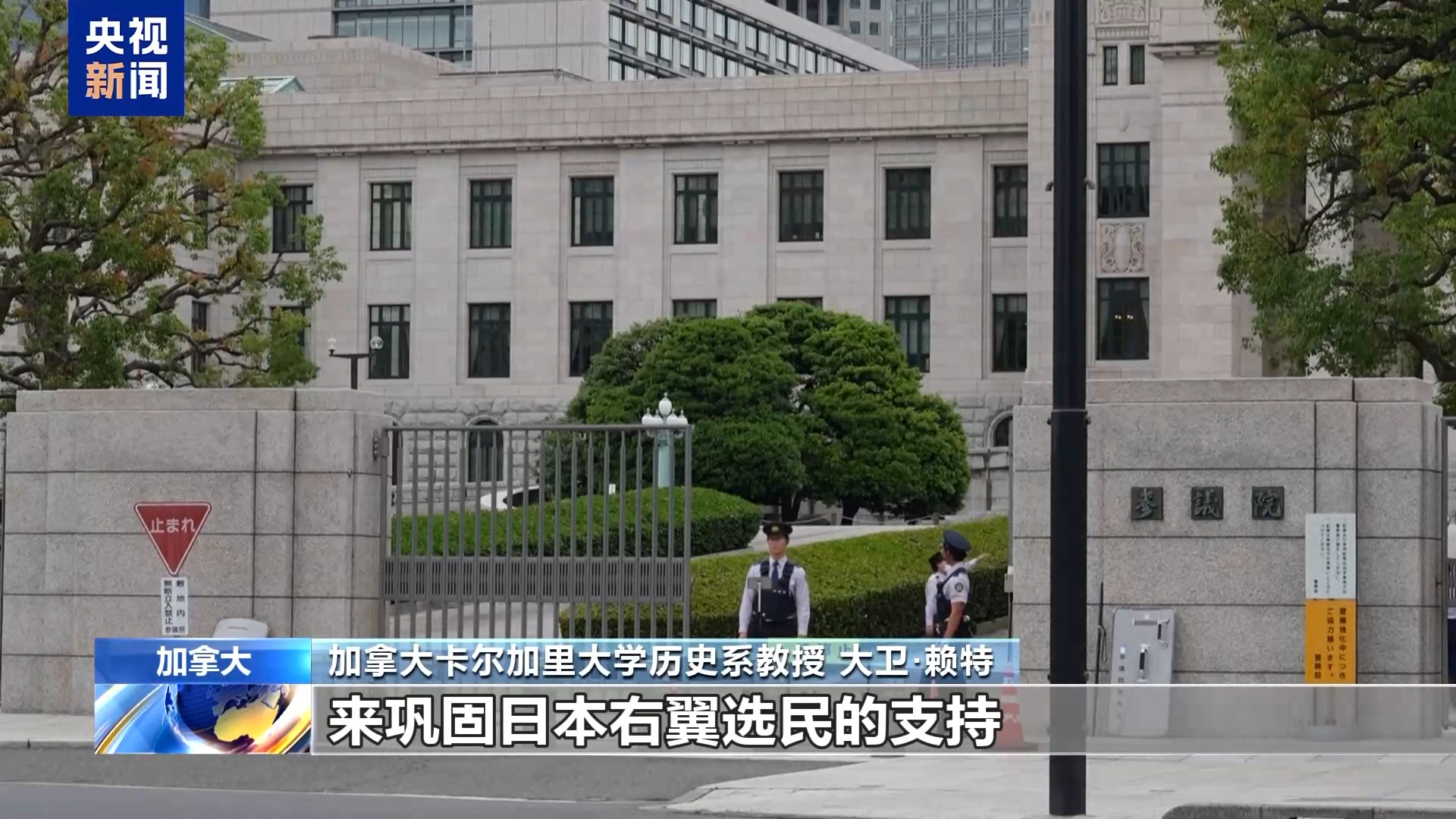
视频丨加拿大学者:高市言论损害中日关系与和平前景
Yang Shi Xin Wen Ke Hu Duan· 2025-12-06 14:25
加拿大卡尔加里大学历史系教授 大卫·赖特:千万不要以为她只是在开玩笑或随口说说,她不是一个口无遮拦的人,她说的每一句话都经过深思熟虑,她必 须通过比以往任何一届政府都更加强硬、更咄咄逼人的立场,来巩固日本右翼选民的支持。 日本对战争罪责从未真诚反省 赖特表示,日本政治右倾化以及日本国内右翼势力猖獗的一个根源是日本对于侵略战争罪责从未真诚反省,一些人甚至毫无悔意。 日本首相高市早苗近期发表的涉台错误言论引发多方批评。加拿大学者大卫·赖特表示,一个中国原则是国际社会的普遍共识,日本首相高市早苗近期的错 误言论危害中日关系,损害和平前景。 0:00 加拿大卡尔加里大学历史系教授 大卫·赖特:这种言论会危害并恶化中日外交关系,这毫无疑问。但在我看来,比损害外交关系更重要的是损害和平前景。 高市言行出于政治目的 意在拉拢右翼 赖特认为,高市早苗的一系列言行并非鲁莽行事,而是出于政治目的有意为之,通过制造挑衅,拉拢日本右翼,从而在联合政府内巩固自身脆弱的执政地 位。 加拿大卡尔加里大学历史系教授 大卫·赖特:他们不愿承认日本犯下的暴行,他们试图逃避正视历史,试图粉饰和重新诠释历史,这一切都源于他们对战争 缺乏真诚的忏悔, ...