
智慧城市

Search documents
资金流入,新两翼“比翼齐飞”
Xin Jing Bao· 2026-02-26 02:25
Core Insights - The Beijing Urban Sub-center and Xiong'an New Area are being developed as key components of the Beijing-Tianjin-Hebei coordinated development strategy, with significant investments driving their growth [9][10] - The Beijing Urban Sub-center has maintained an annual fixed asset investment exceeding 100 billion yuan, while Xiong'an New Area has sustained an investment scale of 200 billion yuan each year [2][10] Investment and Development - The Beijing Urban Sub-center has accumulated over 960 billion yuan in fixed asset investment since its construction began in 2016, with a continuous annual investment exceeding 100 billion yuan for five consecutive years [2] - In 2024, the investment composition in the Beijing Urban Sub-center is projected to be 26% from government and 74% from social capital, indicating a shift towards increased private investment [2] - Xiong'an New Area has achieved a cumulative investment exceeding 1 trillion yuan, with an average annual GDP growth rate of 17.1% since the "14th Five-Year Plan" [10] Infrastructure and Urban Development - Major infrastructure projects in the Beijing Urban Sub-center include the completion of the Beijing Tongzhou Station, which is part of a comprehensive transportation hub expected to enhance connectivity [2][3] - The development of cultural and tourism projects, such as the Universal Resort and various cultural landmarks, has significantly contributed to the urban landscape and local economy [3][4] Policy and Regulatory Framework - The introduction of the "Beijing Urban Sub-center Regulations" marks a significant milestone, providing a legal framework to clarify the development goals and support policies for the area [5] - The regulations aim to attract quality enterprises and talent to the urban sub-center, promoting high-level construction and development [5] Collaborative Development - The collaboration between Tongzhou District and the North Three Counties has led to the establishment of a national forest park and numerous joint projects, enhancing ecological and economic integration [6][7] - The "Tongbei Demonstration Zone" has made significant progress in transportation, healthcare, and education, improving resource sharing and quality of life for residents [7][8] High-Tech Industry Growth - High-tech enterprises are increasingly attracted to Xiong'an New Area, benefiting from favorable policies and a growing ecosystem for innovation [12][13] - Companies are shifting their focus from individual growth to collaborative development within the industrial ecosystem, fostering a community of shared success [13]
中贝通信股价涨6.3%,南方基金旗下1只基金位居十大流通股东,持有317.37万股浮盈赚取498.28万元
Xin Lang Ji Jin· 2026-02-26 01:52
Group 1 - Zhongbei Communication's stock increased by 6.3%, reaching 26.51 CNY per share, with a trading volume of 255 million CNY and a turnover rate of 2.27%, resulting in a total market capitalization of 14.219 billion CNY [1] - Zhongbei Communication Group Co., Ltd. is located in Wuhan, Hubei Province, and was established on December 29, 1999. The company was listed on November 15, 2018, and specializes in communication network technology services, focusing on communication network construction, system integration, optimization, maintenance, and planning [1] - The revenue composition of Zhongbei Communication includes 46.76% from 5G new infrastructure, 33.58% from smart city and other services, 18.76% from intelligent computing business, and 0.90% from other sources [1] Group 2 - Among the top ten circulating shareholders of Zhongbei Communication, a fund under Southern Fund holds shares. The Southern CSI 1000 ETF (512100) reduced its holdings by 20,100 shares in the third quarter, now holding 3.1737 million shares, which is 0.73% of the circulating shares [2] - The Southern CSI 1000 ETF (512100) was established on September 29, 2016, with a latest scale of 78.996 billion CNY. Year-to-date returns are 10.92%, ranking 1308 out of 5572 in its category; the one-year return is 32.69%, ranking 1845 out of 4311; and since inception, the return is 26.85% [2] Group 3 - The fund manager of Southern CSI 1000 ETF (512100) is Cui Lei, who has been in the position for 7 years and 113 days. The total asset scale of the fund is 137.02 billion CNY, with the best return during the tenure being 250.66% and the worst return being -15.93% [3]

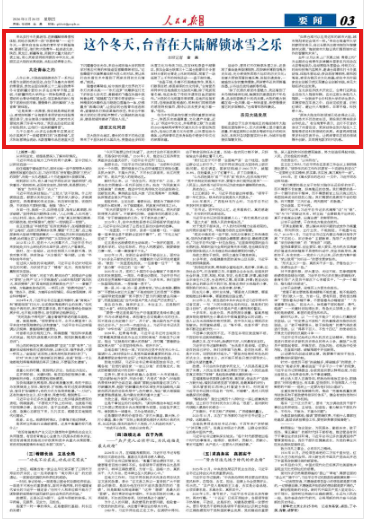
这个冬天,台青在大陆解锁冰雪之乐
Ren Min Ri Bao Hai Wai Ban· 2026-02-25 23:09
Group 1 - The article highlights the winter activities organized for Taiwanese youth in mainland China, focusing on cultural exchange and the experience of winter sports [1][2][4] - Participants engaged in skiing in Xinjiang and enjoyed ice sculptures in Harbin, showcasing the beauty of winter and the shared cultural heritage between Taiwan and mainland China [2][3] - The events included traditional activities such as the Chagan Lake winter fishing, emphasizing the deep cultural roots and traditions present in different regions of mainland China [3][4] Group 2 - The article discusses the "Taiwan Youth Winter Camp" series, which aims to foster connections between Taiwanese and mainland youth through shared experiences in ice and snow activities [2][4] - In addition to winter sports, participants visited historical sites in Shaanxi, such as the Terracotta Army and the Daming Palace, to appreciate the rich cultural history of the region [4] - The article also mentions the technological advancements in urban management observed by Taiwanese students in Beijing, highlighting the potential for collaboration in smart city development [5][6]

智慧城市算网攻坚战打响:1毫秒时延照进现实
Zheng Quan Ri Bao Zhi Sheng· 2026-02-25 16:08
Core Insights - The construction of a 1-millisecond (ms) urban computing network is becoming a national strategy in China, aimed at supporting the development of artificial intelligence and smart cities [5][9][10] - Companies are leveraging low-latency networks to enhance production efficiency and quality control, with significant improvements in manufacturing processes [2][3][4] Group 1: Industry Developments - Budweiser Snow Beer and Lantu Automotive are examples of companies utilizing advanced manufacturing technologies supported by 5G and AI, achieving high production capacities and efficiency [1][2] - The Sichuan Lingke Automotive manufacturing facility has a production capacity of 300,000 vehicles per year and employs AI for quality management and real-time data processing [2][3] - Sichuan Changhong's smart manufacturing plant has reduced order delivery times from 49 days to 11 days, showcasing the impact of AI and low-latency networks on operational efficiency [4] Group 2: Technological Advancements - The 1-ms urban computing network is designed to provide low-latency, broad scheduling, and inclusive computing services, facilitating high-end industrial development [5][6] - Over 100 cities in China are actively promoting the construction of 1-ms urban computing networks, which are expected to enhance various sectors including finance, governance, and manufacturing [5][9] Group 3: Investment and Economic Impact - The investment in 1-ms urban computing networks is projected to reach between 800 billion to 1 trillion yuan from 2025 to 2027, indicating strong market demand for high-speed, low-latency network equipment [9] - The development of the 1-ms urban computing network is seen as a strategic infrastructure that will reshape regional economic competitiveness and attract long-term capital investment [9][10]


平安智慧城市取得容器构建方法专利提升Docker容器安全性
Sou Hu Cai Jing· 2026-02-25 05:14
Group 1 - The core point of the article is that Ping An International Smart City Technology Co., Ltd. has obtained a patent for a "container construction method, device, equipment, and storage medium," with the authorization announcement number CN114968481B, and the application date being May 2022 [1] - Ping An International Smart City Technology Co., Ltd. was established in 2018 and is located in Shenzhen, primarily engaged in internet and related services [1] - The company has a registered capital of 1 billion RMB and has made investments in 2 enterprises, participated in 697 bidding projects, and holds 44 trademark information and 1,372 patent information [1] - Additionally, the company possesses 15 administrative licenses [1]
“十五五”开局之年:数字经济大有可为
Zhong Guo Fa Zhan Wang· 2026-02-24 08:00
数字经济其核心支撑是数据要素。海量数据价值的充分释放,将对劳动力、资本、技术等传统要素产生 显著的价值放大、叠加与倍增作用,直接激发数字经济创新活力与高质量发展动能。正是在数据要素加 持下,阿里巴巴、京东、抖音等平台依托海量用户行为数据,驱动个性化推荐、智能定价和供应链优 化,实现了产业规模的跨越式增长。以阿里巴巴为例,"十四五"期间,通过大数据引擎持续优化用户体 验和平台生态,线上商品交易总额保持强劲增长势头,订单量稳步增长,买家数量屡创新高,历年"双 十一"等大促表现强劲。究其原因,无外乎在数字经济的加持下,通过优化智能仓储与配送路径反哺物 流,通过需求预测驱动的柔性生产赋能制造,通过大数据风控降低坏账率助力金融支撑,最终实现效率 全面跃升和生态闭环,也使得这些平台几乎重塑了零售业态。 产业重构加速 当今时代,数字技术作为世界科技革命和产业变革的先导力量,日益融入经济社会发展各领域全过程, 深刻改变着生产方式、生活方式和社会治理方式。《中共中央关于制定国民经济和社会发展第十五个五 年规划的建议》强调,要"促进实体经济和数字经济深度融合",将数字经济提升到国家战略的核心位 置。 在新一轮科技革命和产业变革加 ...


协同推进城乡建设
Xin Lang Cai Jing· 2026-02-23 20:40
Group 1 - The city of Xining aims to build an innovative, livable, beautiful, resilient, civilized, and smart city by 2025, with a focus on high-quality urban development [1] - The urban sewage treatment rate is projected to increase from 95% in 2024 to 96% in 2025, while the proportion of green buildings in new constructions is expected to rise from 98% in 2024 to 100% [1] - The city has secured a central government subsidy of 1.2 billion yuan for urban renewal and aims to complete 34 underground pipeline renovation projects with a total of 1.257 billion yuan in national bond funding [1] Group 2 - Xining is integrating housing condition improvements with geological disaster relocation projects, completing 40 model villages and improving living conditions for 7,000 rural households [2] - In the heating sector, 40 annual tasks have been completed, including the renovation of 220.4 kilometers of heating pipelines and 145 heat exchange stations [2] - A digital platform for four heating enterprises has been established, enhancing the visibility and control of heating operations, thereby strengthening supply reliability for the upcoming winter [2]
研判2026!中国智能环卫机器人行业产业链全景、行业现状、企业布局及未来发展趋势分析:招标市场活跃度攀升,替代空间广阔可期[图]
Chan Ye Xin Xi Wang· 2026-02-23 01:32
Core Viewpoint - The smart sanitation robot industry is crucial for the development of smart cities and green low-carbon initiatives, leveraging advanced technologies such as AI and IoT to enhance operational efficiency and meet the growing demands of urban sanitation services [1][3]. Industry Overview - Smart sanitation robots integrate AI, IoT, machine vision, and autonomous navigation, enabling automated tasks such as road cleaning, waste collection, and environmental monitoring [2]. - The industry is characterized by a low penetration rate, with the smart cleaning service market expected to reach only 0.4% of the overall sanitation service market by 2024, indicating significant growth potential [9]. Policy Support - The Chinese government has introduced multiple policies to support the development of the smart sanitation robot industry, including guidelines for urban environmental infrastructure and high-quality development plans for environmental equipment manufacturing [3][4]. Market Demand - The urbanization process in China is driving a steady increase in the demand for sanitation services, with the urbanization rate projected to reach 67.89% by 2025, leading to an expanded market for sanitation services [5]. - The market for sanitation services is expected to grow to 3,612 billion yuan by 2025, with a year-on-year growth rate of 11% [9]. Industry Chain - The industry chain includes upstream components like sensors and batteries, with a focus on increasing domestic production rates, while the midstream focuses on equipment manufacturing and system integration [8]. - The downstream market covers diverse needs across municipal sanitation, industrial parks, and commercial scenarios, with a shift towards "pay-for-performance" and RaaS (Robotics as a Service) models [8]. Competitive Landscape - The competitive landscape features a mix of traditional equipment leaders, sanitation service companies, and emerging tech firms, with key players like Yingfeng Environment and Fulongma leading the market [11]. - The industry is witnessing a trend towards product diversification and technological integration, with leading companies leveraging their advantages in order volume, capacity, and technology to maintain market leadership [11]. Future Trends - The smart sanitation robot industry is expected to evolve towards deeper technological integration, product modularization, and market expansion, with a focus on service-oriented business models [13][14][15]. - Future developments will include enhanced system intelligence through the integration of vehicle-road-cloud technologies and a shift towards multi-functional, modular products that can adapt to various operational needs [13][14].


研判2026!中国共享停车行业政策环境、产业链、市场规模、竞争格局和未来趋势分析:政策与需求双驱动,共享停车行业规模持续扩容[图]
Chan Ye Xin Xi Wang· 2026-02-16 01:01
Core Insights - The article highlights the increasing challenge of parking difficulties in urban areas due to rapid urbanization and rising vehicle ownership, leading to a growing demand for innovative solutions like shared parking [1][7]. Shared Parking Industry Overview - Shared parking is a car space sharing model aimed at alleviating urban parking shortages by utilizing technology to open up idle parking spaces from public units, commercial areas, and private owners [3][5]. - The industry is categorized into two operational forms: government-enterprise cooperation and market-driven models [3]. Industry Policies - Recent policies have been introduced to promote the development of shared parking, including increasing urban parking supply and enhancing smart parking infrastructure [4]. Industry Chain - The shared parking industry chain consists of upstream resources (parking space providers), midstream operations (resource integration and management), and downstream users (private car owners) [5][6]. Market Size and Growth - The market size of China's shared parking industry is projected to reach 12.7 billion yuan by 2025, with a year-on-year growth of 8.3% [1][7]. - The number of parking spaces in China is expected to grow from 74 million in 2016 to 273 million by 2025, reflecting a compound annual growth rate of 16% [6]. Competitive Landscape - The shared parking market is becoming increasingly competitive, with companies focusing on technological and model innovations to enhance service quality and user retention [8]. - Key players in the industry include Shenzhen Jieshun Technology, Guangzhou Youting Network Technology, and others, with Jieshun Technology reporting a 39.46% year-on-year increase in revenue from smart parking operations in the first half of 2025 [8][9]. Development Trends - The shared parking industry is expected to integrate deeply into smart city frameworks, utilizing data to optimize parking space allocation and improve user experience [10]. - There is a growing trend towards personalized services, with platforms offering tailored solutions based on user data [11]. - Cross-industry collaborations are anticipated to create new growth opportunities, such as integrating shared parking with electric vehicle charging and commercial real estate [12].


海峡创新业绩预增超16倍,股价涨停引市场关注
Jing Ji Guan Cha Wang· 2026-02-14 07:17
Performance Overview - The company has released a profit forecast for 2025, expecting a net profit attributable to shareholders to increase by 1660.56% to between 1 billion and 1.5 billion yuan, primarily due to non-recurring gains from the reduction of shares in Fengzhushou (301382) from June to December 2025 [1] - Complete performance data will be available in the upcoming 2025 annual report [1] Stock Performance - On February 5, 2026, the company's stock price hit the daily limit increase of 20%, closing at 14.52 yuan, with a total market capitalization of 9.683 billion yuan [2] - The trading volume on that day was significant, with a turnover rate of 31.49%, indicating intense market speculation driven by the profit forecast and themes related to smart cities and smart healthcare [2] Company Strategy - The company plans to continue focusing on its core businesses in smart cities and smart healthcare while optimizing its asset structure [3] - Despite the optimistic outlook, the company reported a net profit loss excluding non-recurring items for the first three quarters of 2025, highlighting the need to monitor improvements in core business profitability [3]
