石油价格波动

Search documents
Oil Falls Amid Prospect That U.S. Strike on Iran Might Be Limited
WSJ· 2026-02-22 23:38
Core Viewpoint - Oil prices experienced a decline during early Asian trading hours, influenced by geopolitical tensions surrounding Iran and potential military actions by the U.S. [1] Group 1: Oil Market Impact - The drop in oil prices is linked to President Trump's consideration of a limited military strike on Iran, which could affect supply dynamics in the oil market [1] - The situation indicates heightened volatility in oil prices due to geopolitical uncertainties, particularly regarding Iran's nuclear deal negotiations [1]


石油股逆势走强,中国石油股份涨超4%
Ge Long Hui· 2026-02-20 03:39
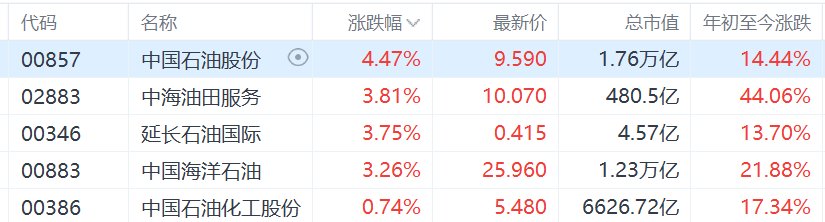
Core Viewpoint - Hong Kong oil stocks have shown strong performance against the market trend, driven by rising international oil prices and escalating tensions between the US and Iran in the Middle East [1] Group 1: Stock Performance - China Petroleum & Chemical Corporation (00857) increased by 4.47%, reaching a latest price of 9.590 with a total market capitalization of 1.76 trillion, marking a year-to-date increase of 14.44% [2] - CNOOC Services (02883) rose by 3.81%, with a latest price of 10.070 and a market cap of 48.05 billion, reflecting a year-to-date increase of 44.06% [2] - Yanchang Petroleum International (00346) saw a 3.75% increase, with a latest price of 0.415 and a market cap of 0.457 billion, showing a year-to-date increase of 13.70% [2] - China National Offshore Oil Corporation (00883) increased by 3.26%, with a latest price of 25.960 and a market cap of 1.23 trillion, resulting in a year-to-date increase of 21.88% [2] - China Petroleum & Chemical Corporation (00386) had a modest increase of 0.74%, with a latest price of 5.480 and a market cap of 662.67 billion, reflecting a year-to-date increase of 17.34% [2]




石油ETF鹏华(159697)涨超1.1%,原油价格不断上涨
Xin Lang Cai Jing· 2026-02-06 06:12
Group 1 - The core viewpoint of the articles highlights the rising oil prices due to regional risks and geopolitical uncertainties, with WTI and Brent crude oil futures increasing by 1% to $63.92 and $68.239 per barrel respectively [1] - Guosen Securities anticipates that the Brent crude oil price will stabilize between $55 and $65 per barrel, while WTI crude oil is expected to range from $52 to $62 per barrel by 2026, considering the high fiscal balance oil price costs of OPEC+ and the elevated new well costs of U.S. shale oil [1] - As of February 6, 2026, the Guozheng Oil and Gas Index (399439) rose by 0.97%, with significant increases in component stocks such as Intercontinental Oil and Gas (up 8.60%) and Potential Energy (up 7.90%) [1] Group 2 - As of January 30, 2026, the top ten weighted stocks in the Guozheng Oil and Gas Index (399439) include major companies like China National Petroleum, China National Offshore Oil, and Sinopec, collectively accounting for 66.76% of the index [2] - The Oil ETF Penghua (159697) closely tracks the Guozheng Oil and Gas Index, reflecting the price changes of listed companies in the oil and gas industry on the Shanghai and Shenzhen stock exchanges [1][3]
美股异动 | 石油股普涨 西方石油(OXY.US)涨逾4%
智通财经网· 2026-01-29 15:16
Core Viewpoint - Oil stocks experienced a significant rally, driven by rising tensions between the U.S. and Iran, which have led to a surge in Brent crude oil prices above $70 per barrel [1] Group 1: Oil Stocks Performance - Occidental Petroleum (OXY.US) rose over 4% - ConocoPhillips (COP.US) increased by more than 3% - ExxonMobil (XOM.US) and Chevron (CVX.US) both saw gains exceeding 2% [1] Group 2: Market Dynamics - Brent crude oil futures surged more than 4% in a single day, breaking the $70 mark - The market is concerned that escalating tensions between the U.S. and Iran are a primary driver of rising oil prices [1] Group 3: Geopolitical Factors - President Trump is intensifying pressure on Iran to halt its nuclear program, threatening military action and deploying naval forces to the region - Reports indicate that Trump is considering options for precise strikes against Iranian security forces and leaders to incite protests and potentially overthrow the current regime [1] Group 4: Potential Risks - Analysts warn that if Iran retaliates, such as by closing the Strait of Hormuz, it could have catastrophic effects on the transportation of over 20 million barrels of oil per day [1]


Oil Prices Leap as U.S. Pursues Third Tanker Near Venezuela
Barrons· 2025-12-22 11:22
Core Viewpoint - The U.S. is intensifying its blockade of Venezuelan crude exports, which is expected to have significant implications for the global oil market and Venezuela's economy [1] Group 1: U.S. Actions - The U.S. government is implementing stricter measures to restrict Venezuelan oil exports, aiming to further isolate the country economically [1] - These actions are part of a broader strategy to pressure the Venezuelan government and impact its revenue from oil sales [1] Group 2: Impact on Venezuela - The blockade is likely to exacerbate Venezuela's already struggling economy, which heavily relies on oil exports for revenue [1] - Analysts predict that the intensified blockade could lead to a further decline in Venezuela's oil production and exports, which have already been significantly reduced in recent years [1] Group 3: Global Oil Market Implications - The U.S. blockade may lead to increased volatility in the global oil market as supply from Venezuela diminishes [1] - Other oil-producing countries may need to adjust their production levels to compensate for the loss of Venezuelan crude in the market [1]

Oil rebounds from lowest levels since 2021 after Trump orders Venezuela oil tanker blockade
CNBC· 2025-12-17 13:14
Core Viewpoint - U.S. crude oil prices increased over 1% following President Trump's announcement to block all sanctioned oil tankers from Venezuela, indicating a potential shift in market dynamics and supply concerns [1]. Group 1: Price Movements - U.S. crude oil rose by $1.03, or 1.86%, reaching $56.30 per barrel [1]. - Global benchmark Brent crude increased by $1.04, or 1.77%, trading at $59.96 [1]. - The U.S. benchmark had previously fallen to its lowest levels since early 2021, driven by expectations of a peace agreement in Ukraine that could allow Russian crude back into the market [2]. Group 2: Market Context - The rise in crude oil prices comes after a period of near four-year lows, suggesting a volatile market influenced by geopolitical events [1][2]. - The potential return of Russian crude to a well-supplied market could further impact pricing and supply dynamics in the near future [2].

Oil prices firm after Ukrainian strikes on Russian oil infrastructure, stalled peace talks
Reuters· 2025-12-04 01:27
Core Viewpoint - Oil prices experienced a slight increase due to Ukrainian attacks on Russia's oil infrastructure, indicating potential supply constraints, while stalled peace talks reduced expectations for a restoration of Russian oil flows to global markets, although weak fundamentals limited the gains [1] Group 1 - Ukrainian attacks on Russian oil infrastructure have raised concerns about potential supply constraints in the oil market [1] - Stalled peace negotiations have tempered expectations for a deal that would restore Russian oil flows to global markets [1] - Despite the slight increase in oil prices, weak market fundamentals have kept the gains limited [1]
Oil falls after loadings resume at key Russian export hub
Reuters· 2025-11-17 01:37
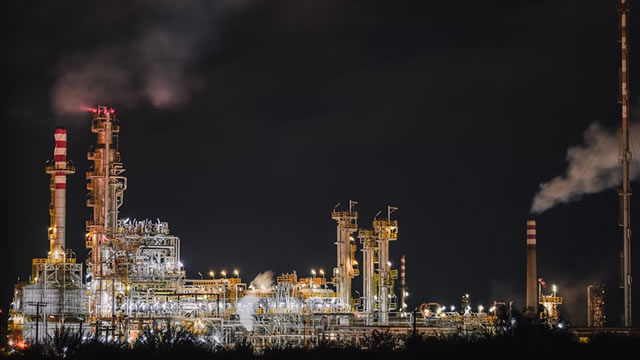
Core Viewpoint - Oil prices declined in early Asian trade, reversing last week's gains due to the resumption of loadings at the Russian export hub of Novorossiysk after a two-day suspension caused by a Ukrainian attack [1] Group 1 - Oil prices fell as loadings resumed at Novorossiysk, a key Russian export hub [1] - The decline in oil prices occurred after a two-day suspension of operations at the Black Sea port [1] - The market reaction indicates sensitivity to geopolitical events affecting oil supply [1]

伊以大战不停,全球石油主航道又成了“风暴眼”
Sou Hu Cai Jing· 2025-06-15 07:53
Group 1 - The core viewpoint of the articles highlights the significant rise in international oil prices due to escalating tensions in the Middle East, particularly the conflict between Israel and Iran, which has led to fears of supply disruptions [1][3][6] - On June 13, oil prices surged over 10% in a single day, with New York crude oil reaching a peak of $77.62 per barrel and Brent crude hitting $78.5, marking the largest intraday increase since the onset of the Russia-Ukraine conflict in February 2022 [1][3] - Analysts from Goldman Sachs and Wells Fargo suggest that the current spike in oil prices is driven more by panic rather than actual supply-demand changes, predicting that prices will likely fall back below $60 per barrel later this year and potentially drop to $56 or lower early next year [3][4] Group 2 - Concerns are particularly focused on the Strait of Hormuz, which is crucial for global oil supply, accounting for approximately 20% to 25% of oil and one-third of liquefied natural gas production [4][6] - The potential for Iran to block the Strait of Hormuz has raised alarms, as the narrow waterway is easily controlled by Iran, and any disruption could lead to a significant change in global oil supply dynamics [6][8] - Shipping companies are already reacting to the heightened risks, with the largest publicly listed tanker company refusing to sign new contracts for vessels passing through the Strait, indicating a shift towards more cautious maritime operations in the region [6][8]

Buy the Dip? 3 Oil Stocks Poised for a Big Comeback
MarketBeat· 2025-05-22 13:42
Group 1: Market Overview - The U.S. oil services companies are facing bearish sentiment due to tariff uncertainty, geopolitical issues, and market volatility [1] - Crude oil prices in the low $60 range discourage drilling activities, negatively impacting oil service companies [2] - OPEC+ nations' decision to increase output is contributing to the downward pressure on crude prices [2] Group 2: Investment Opportunities - Contrarian investors may see potential for crude oil prices to rise as the U.S. shifts towards onshore manufacturing [2] - Oil prices could rise even without demand growth; a drop to around $55 could lead major oil companies to cut production, eventually increasing prices [3] - Three oil services companies are highlighted as potential investment opportunities if oil prices increase [3] Group 3: Company-Specific Insights - Baker Hughes (NASDAQ: BKR) has a 12-month stock price forecast of $49.11, indicating a 36.26% upside, despite being down 8.7% in 2025 [4] - Baker Hughes reported record adjusted EBITDA and maintained full-year guidance, expecting to improve margins through operational efficiency [5] - Halliburton (NYSE: HAL) has a 12-month stock price forecast of $33.53, suggesting a 68.38% upside, with 51% of its revenue coming from international operations [7][8] - Halliburton's current and forward P/E ratios are below sector averages, making it an attractive investment option [9] - Schlumberger (NYSE: SLB) has a market cap over $46 billion and a 12-month stock price forecast of $52.44, indicating a 57.50% upside [10] - SLB's P/E ratio is fairly valued compared to the sector average but at a discount to historical averages [11]