
科技创新投资

Search documents
首次发债!河南创新投资集团拟发行5亿元科技创新债券
Sou Hu Cai Jing· 2025-11-10 07:32
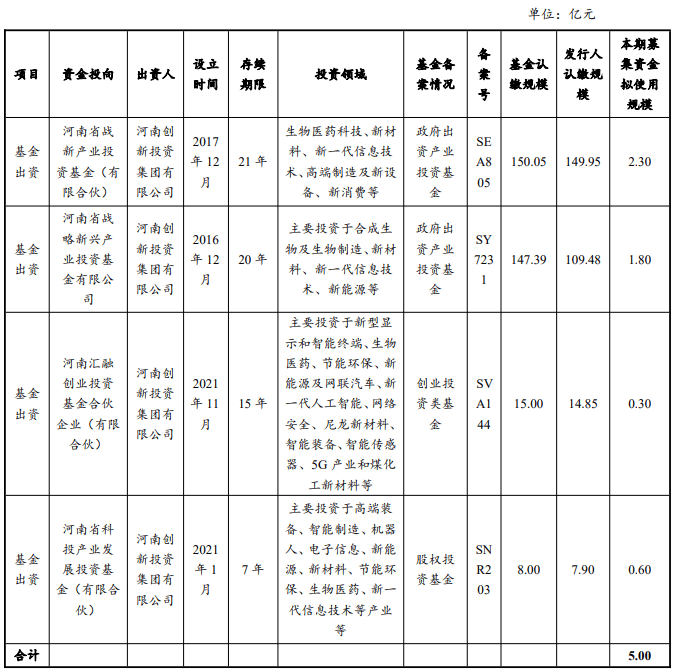
Core Points - Henan Innovation Investment Group Co., Ltd. plans to issue its first phase of technology innovation bonds for 2025, with a total amount of 500 million yuan and a term of 5 years [1] - The bond issuance period is from November 13 to November 14, 2023, with an interest start date of November 17, 2025, and a maturity date of November 17, 2030 [1] - The main underwriter for the bonds is Shanghai Pudong Development Bank, with China Industrial and Commercial Bank as the co-underwriter [1] - The issuer has received a comprehensive credit rating of AAA from China Chengxin International, with a stable outlook [1] - The funds raised will be used entirely to replace the issuer's own capital invested in technology innovation-related funds within the past year [1] Fund Allocation - The funds will be allocated to various investment projects, including biomedicine, new materials, advanced manufacturing, and new consumption [1] - Specific funds mentioned include the Henan Provincial Strategic Emerging Industry Investment Fund and the Henan Huirong Venture Capital Fund, among others [1] - The total amount raised from this bond issuance is 500 million yuan, which will be distributed across several investment areas [1] Company Background - Henan Innovation Investment Group was established in September 2022, with a registered capital of 20 billion yuan, and is a key state-owned technology investment institution in Henan Province [1] - The company is responsible for the investment operation of emerging industry investments and venture capital guiding funds in Henan Province [1] - This bond issuance marks the company's first foray into bond issuance [1]

中经评论:消费投资协同发力扩内需
Jing Ji Ri Bao· 2025-10-31 00:09
Group 1 - The core viewpoint emphasizes the importance of expanding domestic demand and constructing a new development pattern, with a focus on enhancing the domestic circulation of the economy [1][3] - In the first three quarters, final consumption expenditure contributed 53.5% to economic growth, while capital formation contributed 17.5%, highlighting the significance of domestic demand in economic development [1] - The relationship between consumption and investment is not adversarial; rather, they are interdependent and mutually reinforcing, with consumption being the ultimate demand and investment being crucial for expanding reproduction and enhancing supply capacity [2][4] Group 2 - The article stresses the need to clarify misconceptions regarding consumption and investment, such as viewing them as opposing forces or neglecting the long-term benefits of consumption [1][2] - It advocates for a systematic approach to promote a dynamic balance between consumption and investment, with a focus on enhancing residents' income and improving social security systems to stabilize consumption expectations [3][4] - Investment in key areas, particularly in new fields and weak links, is essential for high-quality development, with an emphasis on major projects that enhance foundational capabilities and long-term benefits [4]
【数说经济】消费投资协同发力扩内需
Sou Hu Cai Jing· 2025-10-30 22:42
Core Viewpoint - The expansion of domestic demand is not merely about the simple addition of consumption and investment, but rather about allowing the continuously upgrading consumption demand to guide investment direction and drive transformation, while efficient and precise investment enhances supply quality and creates new consumption demand, thus injecting lasting momentum into China's high-quality economic development [2][6] Group 1: Economic Contributions - In the first three quarters, final consumption expenditure contributed 53.5% to economic growth, while capital formation contributed 17.5%, indicating that domestic demand remains a solid foundation for China's economic development and response to challenges [2] - As a super-large economy, China possesses advantages in leading with domestic demand and internal circulation, making it crucial to correctly understand the dialectical relationship between consumption and investment to promote an economic development model driven by domestic demand and consumption [2] Group 2: Misconceptions in Practice - There are misconceptions that view consumption and investment as opposing forces, believing that increasing consumption necessarily crowds out investment or that expanding investment suppresses consumption [3] - Another misconception is the separation of short-term and long-term benefits, either overemphasizing the immediate growth from investment while neglecting the foundational role of consumption or assuming that a slowdown in investment growth indicates a contraction in investment space [3] - The tendency to focus on scale over efficiency leads to traditional expansion approaches that overlook the structure, quality, and efficiency of investment [3] Group 3: Dynamic Development Perspective - The aspiration for a better life among the populace drives continuous upgrades in consumption structure, guiding various factors towards fields that meet future development needs [4] - Forward-looking investments, especially breakthroughs in technological innovation, can create new products and services, stimulating new consumption demand, as evidenced by the rise of industries like smartphones and new energy vehicles [4] Group 4: Policy Recommendations - Accelerating the filling of consumption shortfalls requires economic policies to focus more on improving livelihoods and promoting consumption, including enhancing the income distribution system to increase residents' consumption capacity [5] - Investment in key areas and weak links remains significant, with a focus on major projects that strengthen the foundation, enhance long-term benefits, and align with national strategies for high-quality development [5] - Continuous optimization of the business environment and removal of barriers to private investment are essential to enhance the confidence and capability of private enterprises [5]

消费投资协同发力扩内需
Jing Ji Ri Bao· 2025-10-30 22:16
Core Viewpoint - The expansion of domestic demand is not merely about the simple addition of consumption and investment, but rather about allowing the continuously upgrading consumption demand to guide investment direction and drive transformation, while efficient and precise investment enhances supply quality and creates new consumption demand, thus injecting lasting momentum into China's high-quality economic development [1][4] Group 1: Economic Contributions - In the first three quarters, final consumption expenditure contributed 53.5% to economic growth, while capital formation contributed 17.5%, indicating that domestic demand remains a solid foundation for China's economic development and response to challenges [1] - As a super-large economy, China possesses advantages in leading with domestic demand and internal circulation, making it crucial to correctly understand the dialectical relationship between consumption and investment to promote an economic development model driven by domestic demand and consumption [1][2] Group 2: Misconceptions in Practice - There are misconceptions that view consumption and investment as opposing forces, believing that increasing consumption necessarily crowds out investment or that expanding investment suppresses consumption [2] - Another misconception is the separation of short-term and long-term benefits, either overemphasizing the immediate growth from investment while neglecting the foundational role of consumption or assuming that a slowdown in investment growth indicates a contraction in investment space [2] - A tendency to focus on scale over efficiency leads to traditional expansion approaches that overlook the structure, quality, and efficiency of investment [2] Group 3: Dynamic Development and Investment - The aspiration for a better life among the populace drives continuous upgrades in consumption structure, guiding various factors towards fields that meet future development needs [3] - Forward-looking investments, especially breakthroughs in technological innovation, can create new products and services, stimulating new consumption demand, as evidenced by the rise of industries like smartphones and new energy vehicles [3] Group 4: Policy Directions and Investment Focus - The 20th Central Committee of the Communist Party of China emphasizes the importance of combining investments in goods and people, using new demand to lead new supply and creating new demand through new supply, promoting a virtuous interaction between consumption and investment [3][4] - There is significant space for investment in short-board areas, weak links, and new fields, focusing on major national strategies and high-quality development requirements [4] - Continuous investment in the livelihood sector is necessary to address shortcomings, achieving an organic combination of investments in goods and people [4]
杭州“六小龙”背后险资名单曝光→
Sou Hu Cai Jing· 2025-10-25 10:40
Core Insights - The article highlights the increasing involvement of insurance capital in the investment landscape of emerging technology companies, particularly in the "Six Little Dragons" of Hangzhou, which challenges the perception that insurance funds only invest in mature enterprises [1][2][4]. Group 1: Investment Landscape - A total of 38 insurance institutions have been identified as investors in the "Six Little Dragons," with significant participation in companies like Yushut Technology and Cloud Deep Technology [3]. - Among these, 27 insurance institutions have indirectly invested in Yushut Technology, while 25 have done so in Cloud Deep Technology, indicating a robust interest from the insurance sector [3]. - The types of insurance institutions involved range from state-owned enterprises to private and foreign insurance companies, showcasing a diverse investment base [3]. Group 2: Investment Strategies - Insurance capital is primarily investing through private equity funds as limited partners (LPs), often via government-led funds, which reflects a strategic alignment with policy needs [5][7]. - Notable examples include investments from the National SME Development Fund and various sub-funds that have backed the "Six Little Dragons" [5]. - The trend indicates a shift towards more active participation in early-stage technology investments, which were previously considered outside the typical risk appetite of insurance funds [4][7]. Group 3: Challenges and Opportunities - Despite the growing involvement, insurance capital faces challenges in terms of investment capabilities and mechanisms, particularly in high-tech sectors where traditional financial models may not apply [8][9]. - The unique characteristics of insurance capital, such as long-term investment horizons and stable returns, align well with the high-risk, high-reward nature of technology innovation [8]. - Industry experts suggest that insurance funds should enhance their research capabilities and adopt more flexible internal mechanisms to better navigate the rapidly evolving investment landscape [9].
杭州“六小龙”,隐现38家险资!
券商中国· 2025-10-24 05:49
Core Viewpoint - The article highlights the increasing involvement of insurance capital in the investment of early-stage technology companies, particularly in the context of the "Six Little Dragons" in Hangzhou, which contrasts with the common perception that insurance funds primarily invest in mature enterprises [1][5]. Group 1: Investment Landscape - A total of 38 insurance institutions have been identified as investors behind the "Six Little Dragons," with significant participation in companies like Yushutech and Yundeshuchu Technology [3][4]. - Notable insurance companies involved include China Life, Ping An, and AIA, among others, showcasing a diverse mix of state-owned, private, and foreign insurance entities [4][5]. Group 2: Investment Mechanism - Insurance capital is primarily investing in the "Six Little Dragons" through private equity funds as limited partners (LPs), often in collaboration with government-led funds [7][8]. - The National SME Development Fund and other similar funds have been instrumental in channeling insurance capital into these technology firms [7]. Group 3: Challenges and Opportunities - Despite the growing trend, insurance capital faces challenges in terms of investment capabilities and mechanisms, particularly in identifying and evaluating early-stage technology projects [11][12]. - The unique characteristics of insurance capital, such as long-term investment horizons and stable returns, align well with the needs of high-investment, long-cycle technology innovation [10]. Group 4: Future Directions - Experts suggest that insurance asset management should enhance their research capabilities and adopt a more open approach to collaborate with top-tier investment teams in the market [12][13]. - The adoption of a PSD strategy (primary, secondary, direct) is recommended to better match the characteristics of technology investments, allowing for diversified risk and improved returns [13].

杭州“六小龙”背后隐现险资身影 38家机构“借道”国资基金布局
Zheng Quan Shi Bao Wang· 2025-10-22 23:12
Core Insights - The article highlights the increasing involvement of insurance capital in the investment landscape of early-stage technology companies, particularly in the context of the "Six Little Dragons" in Hangzhou [1][3]. Group 1: Insurance Capital Involvement - A total of 38 insurance institutions have been identified as indirect investors in the "Six Little Dragons," with significant participation in companies like Yushutech and Cloud Deep Technology [2][3]. - Notably, 27 insurance firms have invested in Yushutech, and 25 in Cloud Deep Technology, indicating a strong interest in these emerging tech companies [2]. Group 2: Investment Strategies - Insurance capital is primarily entering the market as limited partners (LPs) through private equity funds, predominantly those led by state-owned enterprises [3]. - The National SME Development Fund has invested in Yushutech and Cloud Deep Technology, with several insurance companies among its contributors [3]. Group 3: Challenges and Opportunities - Insurance capital is seen as "patient capital," but it faces challenges in terms of investment philosophy, capabilities, and mechanisms when supporting technology innovation [5][6]. - There is a call for insurance asset management to enhance its research and investment capabilities, particularly in understanding technology trends and industry dynamics [6].
杭州“六小龙”背后隐现数十家险资机构身影
Zheng Quan Shi Bao Wang· 2025-10-22 23:07
Core Insights - The article highlights the increasing involvement of insurance capital in the technology innovation sector, particularly through investments in the "Six Little Dragons" of Hangzhou, which are emerging tech companies [1] Group 1: Insurance Capital Involvement - Multiple insurance institutions have been identified as indirect investors in the "Six Little Dragons," with at least 38 insurance companies backing firms like Yushu Technology and Yundong Technology [1] - Specifically, 27 insurance companies have indirectly invested in Yushu Technology, while 25 have done so for Yundong Technology, indicating a significant presence of insurance capital in these startups [1] Group 2: Notable Investors - The article lists several prominent insurance companies involved, including CITIC Prudential Life, MetLife, and Ping An Property & Casualty, among others, showcasing a diverse range of investors [2] - For Yushu Technology, notable investors include China Life Insurance, Taikang Life, and New China Life, while Yundong Technology has similar backing from major players like China Life and Sunshine Insurance [2]
杭州“六小龙”背后隐现38家险资机构身影
Zheng Quan Shi Bao Wang· 2025-10-22 23:02
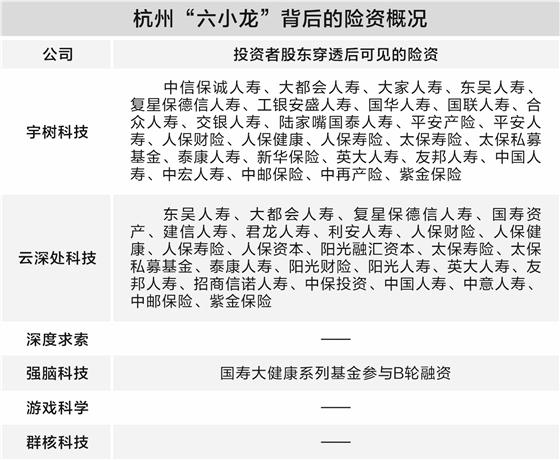
Core Insights - The article highlights the increasing involvement of insurance capital in the investment landscape of emerging technology companies, particularly in the "Six Little Dragons" of Hangzhou, which contrasts with the common perception that insurance funds primarily invest in mature enterprises [1] Group 1: Insurance Capital Involvement - Multiple insurance institutions have emerged as indirect investors in the "Six Little Dragons," participating through state-owned fund investments, indicating a shift towards technology innovation investments [1] - A total of at least 38 insurance capital institutions are linked to companies like Yushu Technology and Yundong Technology, with 27 and 25 insurance entities respectively investing in these firms [1] Group 2: Specific Investments - Yushu Technology has 27 insurance investors as indirect shareholders, while Yundong Technology has 25, with 14 insurance institutions investing in both companies [2] - The article lists various insurance companies involved, including CITIC Prudential Life, MetLife, and others, showcasing a diverse range of insurance capital participating in these technology ventures [2]
杭州“六小龙”背后隐现险资身影38家机构“借道”国资基金布局
Zheng Quan Shi Bao· 2025-10-22 17:28
Core Insights - Insurance capital is increasingly participating in the investment of early-stage technology innovation companies, contrary to the common perception that it primarily invests in mature enterprises [1][3]. Group 1: Investment Landscape - The "Six Little Dragons" in Hangzhou have attracted significant attention, with at least 38 insurance institutions identified as indirect investors in these companies [2]. - Notable insurance companies involved include MetLife, Dongwu Life, and China Life, among others, indicating a broad interest in the technology sector [2][3]. - Insurance capital is primarily investing through limited partnership (LP) structures in private equity funds, mainly those led by state-owned enterprises [3]. Group 2: Strategic Approaches - Insurance funds are leveraging government-led funds to align with policy needs and market trends, indicating a shift towards more market-driven investment strategies [3]. - The involvement of insurance capital in venture capital (VC) and private equity (PE) funds allows for targeted investments in early-stage "hard tech" companies, addressing the gap in early project identification [4]. Group 3: Challenges and Opportunities - Insurance asset management faces challenges in investment philosophy, capability, and mechanisms, particularly in comparison to top-tier VC/PE firms [5]. - Recommendations include enhancing research capabilities to understand both financial metrics and technological landscapes, fostering a competitive edge in the market [5][6]. - A proposed investment strategy involves a combination of mother funds, secondary fund shares, and direct investments to diversify risks and optimize returns in technology investments [6].