
虹吸效应

Search documents
中信证券:232关税落地促铜价回归 后续有望恢复稳健上行
Mei Ri Jing Ji Xin Wen· 2025-08-01 00:52
Group 1 - The U.S. has implemented a 50% import tariff on copper products, while exempting refined copper and copper raw materials, leading to significant fluctuations in COMEX copper prices [2][3][9] - The unexpected exemption of refined copper from tariffs has resulted in a narrowing of the COMEX-LME price spread, with COMEX copper prices experiencing a notable decline [3][4] - The anticipated "siphon effect" in the U.S. market may have already been realized, and concerns about inventory returning to the U.S. are premature, suggesting that copper prices may stabilize and rise due to tight supply and improving global economic conditions [2][5][9] Group 2 - The 232 tariff is expected to benefit Chinese copper processing companies by creating higher product premiums in the U.S. market, stimulating demand for domestically produced copper products [7][9] - U.S. refined copper imports have surged, with a 130% year-on-year increase in the first five months of 2023, indicating a high dependency on imports [4][5] - The copper processing market in the U.S. shows a significant import dependency, with nearly 30% of copper semi-finished products being imported, which could lead to price premiums for domestic products if tariffs are applied [4][5]

再见了!又一知名APP宣布:关停!
Sou Hu Cai Jing· 2025-07-30 00:40
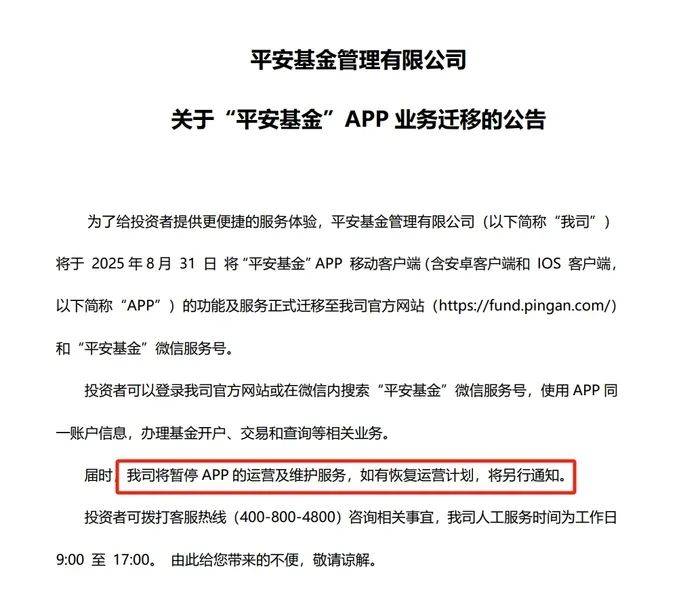
Core Viewpoint - Ping An Fund announced the migration of its "Ping An Fund" APP services to its official website and WeChat service account, effective August 31 this year, leading to the suspension of the APP's operation and maintenance [1][2]. Company Overview - Ping An Fund was established in 2011, headquartered in Shenzhen, with a registered capital of 1.3 billion RMB. It is controlled by Ping An Group [4]. - The fund has three shareholders: Ping An Trust Co., Ltd. (68.19%), Dahua Asset Management Co., Ltd. (17.51%), and Sanya Yingwan Tourism Co., Ltd. (14.3%) [4]. - As of the second quarter of this year, Ping An Fund's managed public fund scale reached 660.225 billion RMB, with a significant portion (403.739 billion RMB) in money market funds, accounting for 61.15% of the total [4]. Industry Context - The decision to shut down the APP is attributed to the high operational costs associated with direct sales APPs, which have low download and usage rates among individual investors [6]. - The operational cost of maintaining an APP is estimated to be between 2 to 3 million RMB annually, while the funds generated from the APP are minimal, leading to an unfavorable cost-benefit ratio [6]. - The competitive landscape shows a trend where third-party distribution giants dominate, making it increasingly difficult for small and medium-sized public funds to conduct direct sales [7]. - In response to high operational costs, some public funds are shifting towards lower-cost alternatives like podcasts to engage with investors and enhance brand recognition [7].

高铁织网,释放区域经济新活力
Zhong Guo Xin Wen Wang· 2025-05-27 10:09
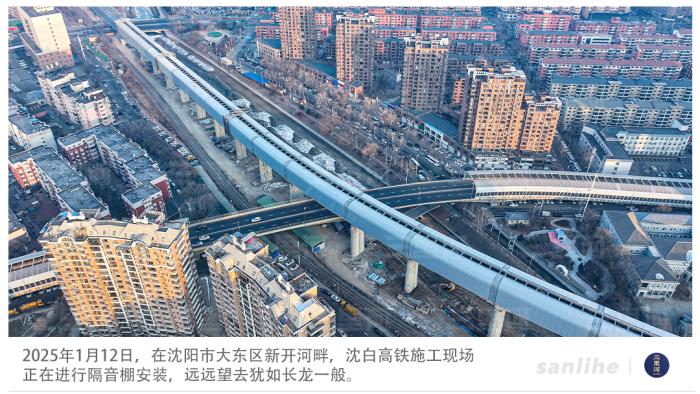
Core Viewpoint - The recent advancements in high-speed rail projects in Guizhou and Liaoning are pivotal for regional economic restructuring and connectivity, enhancing the flow of economic factors and fostering development in previously underserved areas [3][4][5]. Group 1: High-Speed Rail Developments - The Panxing High-Speed Railway in Guizhou has completed all sleeper pre-fabrication tasks, laying a solid foundation for its expected operation in November 2025 [1]. - The Shenyang to Changbai Mountain (Shenbai) High-Speed Railway has also completed its track laying, with an anticipated completion by the end of September [1]. Group 2: Economic Impact - The full connectivity of the high-speed rail network is expected to significantly enhance the efficient movement of people, goods, and information within the "hour economy circle" [5][6]. - The Panxing High-Speed Railway will connect Guiyang to eight central cities in the province within 1 to 2 hours, while the Shenbai Railway will create a 1-hour urban circle centered around Shenyang [4][8]. Group 3: Regional Development Challenges - Guizhou's unique karst topography presents significant construction challenges for the Panxing Railway, which has the highest proportion of bridges and tunnels among Guizhou's high-speed lines [6][8]. - The economic output of the connected regions, such as the combined GDP of Guizhou's Qianxinan and Liupanshui, is currently only 14% of the province's total, indicating a need for accelerated development through high-speed rail [8]. Group 4: Urbanization and Industrial Synergy - High-speed rail is expected to facilitate urbanization by reducing commuting times between major cities to 1-2 hours, thus promoting regional integration and collaboration [9][10]. - The Shenbai Railway will enhance the industrial synergy between Shenyang and Fushun, with the potential for closer collaboration in manufacturing and processing industries [10].
哪条老街最“沸腾”?| SAE逛吃指数之“老街”八方客
Jing Ji Guan Cha Bao· 2025-05-22 10:53
Core Insights - The report highlights the significant tourist traffic in historical cultural streets during the 2025 "May Day" holiday, with a focus on the dominance of first-tier and new first-tier cities in attracting visitors [1][2]. Group 1: Tourist Traffic Data - Guangzhou's Beijing Road emerged as the most popular historical street, attracting 1.826 million visitors during the holiday [1]. - Chengdu's Daci Temple and Shanghai's Nanjing West Road also exceeded one million visitors, showcasing the appeal of these urban areas [1]. - The top ten streets are predominantly located in first-tier and new first-tier cities, which combine historical heritage protection with commercial space development [1]. Group 2: Urban Characteristics - Beijing Road, with a history of 2,200 years, exemplifies the "ancient-modern coexistence" model, featuring daily average foot traffic of 183,000 [1]. - The streets in these major cities serve as essential public spaces, attracting both tourists during holidays and local residents for leisure activities [2]. - Notably, Dali, a regular prefecture-level city, also made it into the top ten, indicating the growing popularity of its cultural tourism [3].