都市圈协同发展

Search documents
长三角万亿城市排位生变,南通逆袭超过合肥
2 1 Shi Ji Jing Ji Bao Dao· 2025-08-12 14:39
Core Insights - The economic data for 41 cities in the Yangtze River Delta has been released, with Shanghai leading in GDP at 26,222.15 billion yuan, and Zhoushan showing the highest growth rate at 6.9% [1][2] - The nine trillion-yuan cities in the Yangtze River Delta have all surpassed 5,000 billion yuan in GDP, with Wenzhou and Xuzhou being close to the trillion-yuan mark [1][5] - The ranking of trillion-yuan cities has seen minimal changes compared to 2024, with Nantong surpassing Hefei in economic total, while Hefei leads in growth rate at 6% [1][9] Economic Performance - In the first half of the year, 34 cities in the Yangtze River Delta achieved GDP growth rates above the national average of 5.3%, with 17 cities exceeding 6% [2][12] - Shanghai's GDP growth rate was 5.1%, supported significantly by the information service sector, which accounted for 79.1% of its GDP [6][11] - Suzhou's GDP reached 13,002.35 billion yuan, with over 45% of its growth attributed to the secondary industry, particularly advanced manufacturing [8][11] Industrial Insights - The industrial sector remains a key driver for cities like Suzhou, where both traditional and emerging industries are thriving [7][11] - Hangzhou has seen significant growth in its industrial robot production, with a year-on-year increase of 125.4%, and a 117.8% rise in new energy vehicle production [8][11] - Zhoushan's economy is bolstered by its marine economy, with substantial growth in power production, shipbuilding, and petrochemical industries [13] Urban Development - The six metropolitan areas in the Yangtze River Delta are increasingly influential, promoting coordinated development among large, medium, and small cities [4][14] - The integration of infrastructure and public services within these metropolitan areas is improving, paving the way for better collaboration in technology innovation and industrial clusters [4][14] - The development of marine economies and the emphasis on service industries are seen as vital for future growth in the region [12][13]

长三角万亿城市排位生变,南通逆袭超过合肥
21世纪经济报道· 2025-08-12 14:13
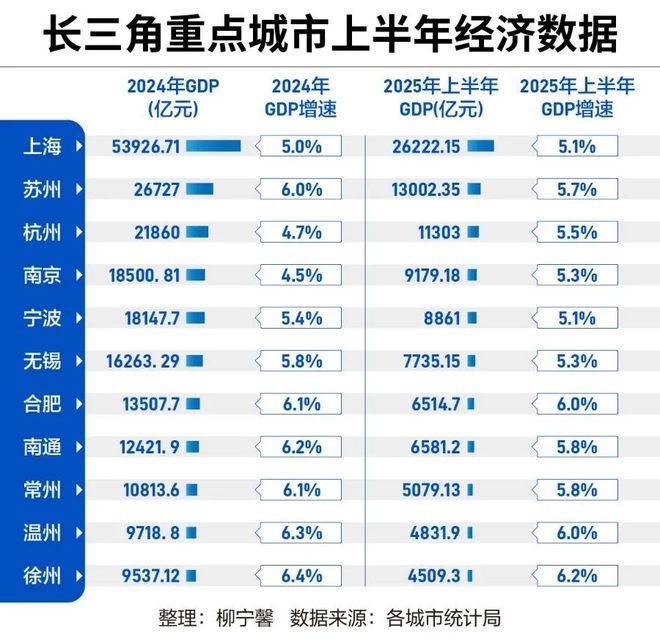
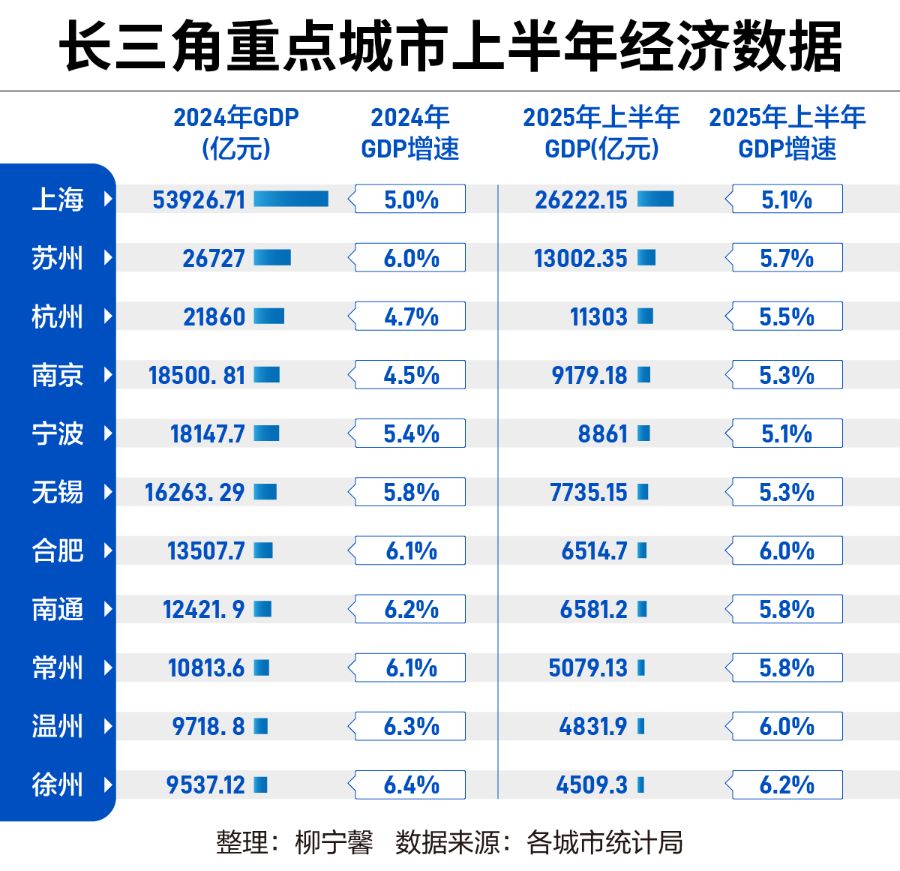
Core Viewpoint - The economic performance of the Yangtze River Delta (YRD) region shows strong growth, with Shanghai leading in GDP, while cities like Zhoushan and Hefei demonstrate significant growth rates, indicating a robust economic landscape supported by both traditional and emerging industries [1][4][9]. Economic Data Summary - In the first half of the year, the GDP of Shanghai reached 26,222.15 billion yuan, maintaining its position as the top city in the YRD [1][6]. - Zhoushan recorded the highest GDP growth rate at 6.9%, while Hefei led among the trillion-yuan cities with a growth rate of 6% [1][12]. - The nine trillion-yuan cities in the YRD all surpassed 5,000 billion yuan in GDP, with notable performances from Suzhou and Hangzhou, which reported GDPs of 13,002.35 billion yuan and 11,303 billion yuan respectively [6][7]. Industry Insights - The industrial sector remains a key driver of economic growth in the YRD, with both traditional and emerging industries contributing significantly [4][9]. - Shanghai's service sector, particularly in information technology, has shown remarkable growth, with a 14.6% increase in the value added from the information transmission, software, and IT services sector [6][9]. - Suzhou's economy is bolstered by advanced manufacturing, with high-tech industries accounting for 56.4% of its industrial output [7]. Urban Development and Collaboration - The YRD features six metropolitan areas that enhance collaboration among cities, promoting coordinated development and resource sharing [14]. - Cities like Zhoushan leverage their coastal advantages to develop marine economies, contributing to their rapid economic growth [13]. - The emphasis on urbanization and the integration of smaller cities into the economic framework of larger cities is expected to foster further growth and innovation [14].

长三角城市半年报:南通超合肥,“破6”中小城黑马频出
2 1 Shi Ji Jing Ji Bao Dao· 2025-08-12 13:17
Economic Overview - In the first half of the year, the economic data of 41 cities in the Yangtze River Delta has been released, with Shanghai leading in GDP at 26,222.15 billion yuan, and Zhoushan showing the highest GDP growth rate at 6.9% [1][14] - The nine trillion-yuan cities in the Yangtze River Delta all surpassed 5,000 billion yuan in GDP, with Wenzhou and Xuzhou as "quasi-trillion cities" at 4,831.9 billion yuan and 4,509.3 billion yuan respectively [1][6] GDP Growth and Rankings - The ranking of trillion-yuan cities has seen minimal changes compared to 2024, with only Nantong surpassing Hefei in economic total, while Hefei leads in growth rate at 6% [1][12] - A total of 34 cities in the Yangtze River Delta achieved GDP growth rates above the national average of 5.3%, with 17 cities exceeding 6% [4][14] Sector Contributions - Shanghai's economy is significantly supported by the information service industry, with the tertiary sector accounting for 79.1% of its GDP and a notable 14.6% increase in the information transmission, software, and IT services sector [7] - Suzhou's GDP reached 13,002.35 billion yuan, with over 45% of its growth attributed to the secondary industry, particularly advanced manufacturing [9] - Hangzhou's GDP totaled 11,303 billion yuan, with industrial robots and new energy vehicles showing remarkable growth rates of 125.4% and 117.8% respectively [10] Emerging Economic Trends - Zhoushan has emerged as a strong performer due to its marine economy, with significant growth in power production, shipbuilding, and petrochemical industries [15][16] - The development of urban agglomerations in the Yangtze River Delta is enhancing collaborative growth among cities, with a focus on integrating infrastructure and public services [17][18] Future Outlook - The economic competition between Nantong, known for its shipbuilding, and Hefei, recognized for its automotive industry, is expected to continue in the second half of the year [12][13] - The emphasis on traditional and emerging industries working in tandem is crucial for sustained economic growth in the region [4][13]
专访肖金成:闲置土地收回价差难题待解,深圳改革经验有望向全国推广
2 1 Shi Ji Jing Ji Bao Dao· 2025-06-13 11:00
Group 1: Core Insights - Shenzhen is celebrating its 45th anniversary as an economic special zone and the 5th anniversary of comprehensive reform pilot implementation, with new measures introduced to enhance reform and innovation [1][4] - The focus on education, technology, and talent system reform is prioritized to drive high-quality development and support new productive forces [5][6] - Shenzhen's experience in reform is intended to serve as a model for other cities across the country, emphasizing the importance of localized innovation and reform [4][7] Group 2: Land Management and Utilization - The reform of idle land disposal and recovery mechanisms aims to address land resource constraints and improve land utilization efficiency [2][8] - Shenzhen's land management reform includes linking idle land fees to the duration of idleness, which is expected to create a framework for other cities to follow [2][10] - The transition from a dual land ownership system to a unified national ownership model facilitates better land planning and utilization [9][10] Group 3: Urban Development and Collaboration - The deepening of the Shenzhen-Dongguan cooperation zone is aimed at enhancing urban integration and development within the Greater Bay Area [14][15] - Establishing a cooperative mechanism is crucial for breaking down administrative barriers within the urban area, facilitating infrastructure development and resource sharing [15] - The focus on major industrial project land guarantees reflects the need for flexible land management to support rapid urban growth and development [13][14]
城市24小时 | 冲刺10万亿,山东“双子星”再联手
Mei Ri Jing Ji Xin Wen· 2025-04-21 09:36
Core Points - The meeting held on April 18 in Jinan emphasized the collaborative development of the Jinan and Qingdao urban agglomerations, focusing on infrastructure connectivity, modern industrial system construction, and high-level openness [1][5] - The integration of the Jinan and Qingdao urban circles is seen as a crucial strategy to enhance regional economic competitiveness, especially as Shandong approaches a GDP of 10 trillion yuan [2][4] - The two urban circles account for over 25% of Shandong's land area and more than 50% of its GDP, indicating their significant role in the province's development [4] Group 1 - The meeting proposed a framework for "inner circle," "dual circle," and "three-circle" development, aiming for coordinated growth among Jinan, Qingdao, and Zhengzhou urban areas [6] - The strategy includes establishing mechanisms for collaborative promotion, shared innovation resources, joint industrial systems, and interconnected infrastructure [5][6] - Experts suggest that this shift from individual to collective action will optimize resource allocation and enhance the efficient flow of factors within the Shandong Peninsula urban cluster [6] Group 2 - The Shandong provincial government has accelerated the dual-circle development layout, as highlighted in the 2025 government work report [5] - The emphasis on regional integration aligns with national trends of urban agglomeration and collaborative development seen in other major economic regions like the Yangtze River Delta and the Guangdong-Hong Kong-Macau Greater Bay Area [2][3] - The successful collaboration between urban circles is expected to create a more influential cultural and tourism brand while promoting equal access to public services [1][4]