
量化增强

Search documents
博道红利智航股票A:2025年上半年利润1670.32万元 净值增长率3.28%
Sou Hu Cai Jing· 2025-09-04 15:52
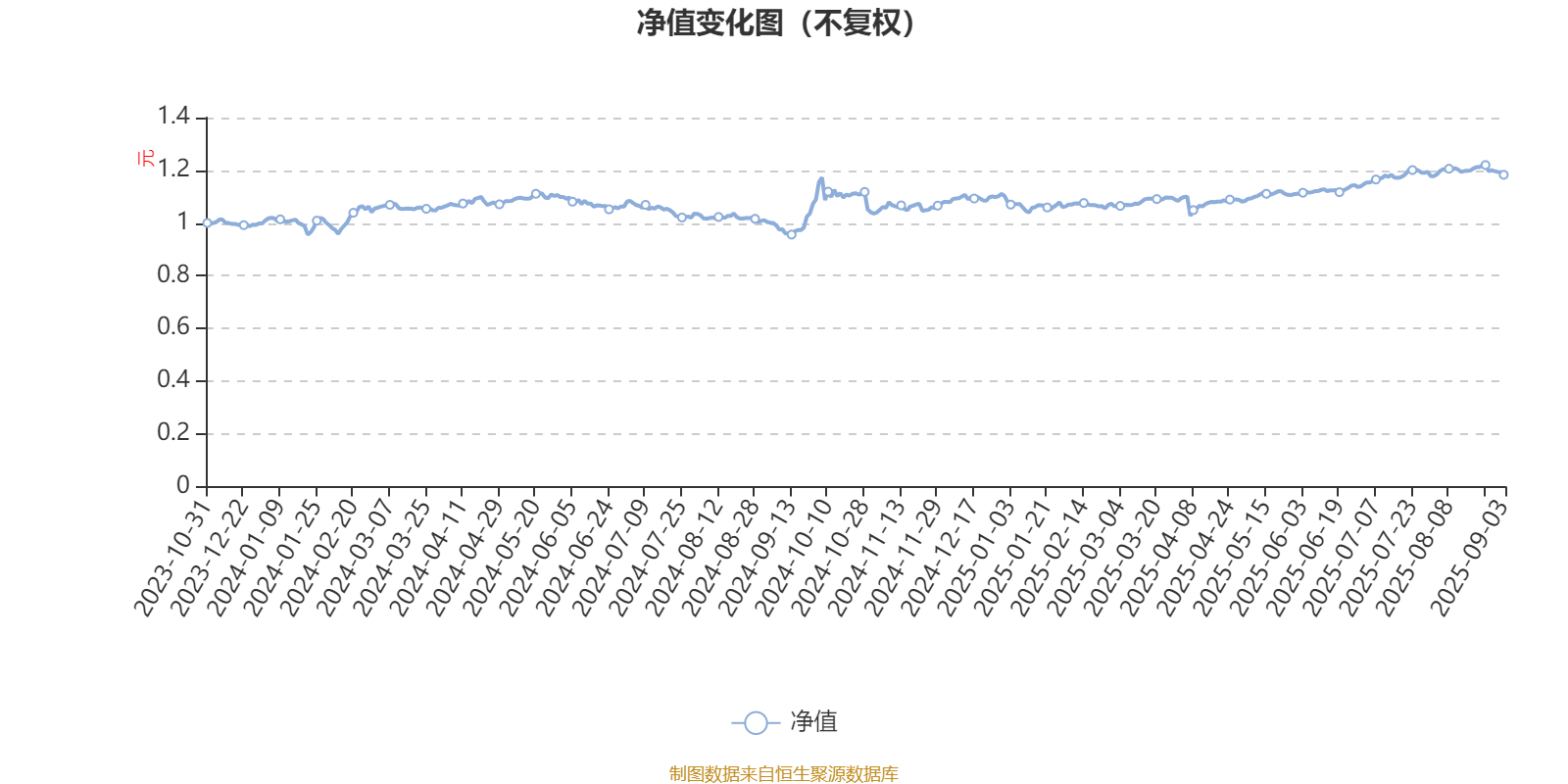
Core Viewpoint - The AI Fund Baodao Dividend Smart Navigation Stock A (019124) reported a profit of 16.70 million yuan for the first half of 2025, with a weighted average profit per fund share of 0.0418 yuan, and a net value growth rate of 3.28% during the reporting period [3] Fund Performance - As of September 3, the fund's unit net value was 1.183 yuan, with a fund size of 500 million yuan [3][32] - The fund's performance over the past three months showed a net value growth rate of 6.12%, ranking 12 out of 18 in its category; over the past six months, it was 11.23%, ranking 11 out of 18; and over the past year, it achieved a growth rate of 23.30%, ranking 10 out of 16 [5] Investment Strategy and Market Outlook - The fund manager indicated that the outlook for the market remains positive due to changes in U.S. economic policy and the gradual emergence of structural growth in the domestic market, suggesting that the allocation value of quantitative enhancement products is worth attention [3] - The fund will continue to adhere to a systematic investment approach, aiming to achieve competitive excess returns for investors [3] Valuation Metrics - As of June 30, 2025, the fund's weighted average price-to-earnings ratio (TTM) was approximately 10.33 times, compared to a peer average of -24.05 times; the weighted average price-to-book ratio (LF) was about 0.82 times, against a peer average of 1.4 times; and the weighted average price-to-sales ratio (TTM) was around 0.51 times, while the peer average was 0.86 times [10] Growth Metrics - For the first half of 2025, the weighted average revenue growth rate (TTM) of the stocks held by the fund was -0.09%, and the weighted average net profit growth rate (TTM) was -0.1%, with a weighted annualized return on equity of 0.08% [16] Fund Composition and Shareholder Structure - As of June 30, 2025, the fund had 1,824 holders, with a total of 439 million shares held; management employees held 312,500 shares (0.07%), institutions held 75.07%, and individual investors held 24.93% [35] - The fund's top ten holdings included companies such as Jizhong Energy, Agricultural Bank of China, COSCO Shipping Holdings, and China Shenhua Energy [41]

中信保诚基金姜鹏:把握中证A500指数赔率优势构建动态量化增强框架
Shang Hai Zheng Quan Bao· 2025-08-24 15:36
Group 1 - The core viewpoint is that the recent recovery in the equity market presents an opportunity for the CITIC Prudential CSI A500 Index Enhanced Fund, which aims to leverage the index's potential for higher odds and returns [1][2] - The fund manager, Jiang Peng, believes that the A-share market is undergoing structural changes, with mid-cap assets that have been undervalued likely to see a return to normal winning rates [1][2] - The CSI A500 Index combines characteristics of both large-cap and mid-cap stocks, with about 70% of its constituent stocks overlapping with the CSI 300, making it a favorable choice in the current market environment [2] Group 2 - Jiang Peng emphasizes the importance of balancing three key aspects in index enhancement: factors, risk control, and trading [2][3] - The factor selection strategy includes approximately 60% fundamental factors, focusing on profitability quality and growth stability, while the remaining 40% targets trading behavior and volume-price factors [2] - In risk control, a dynamic approach is adopted, allowing for greater deviations for fundamentally strong companies while tightening constraints for those with poor liquidity or negative sentiment [3] Group 3 - The trading aspect is described as a long-term project requiring continuous optimization of execution details, with public quantitative trading facing more constraints compared to private equity [3] - Recent efforts include incorporating unstructured information into factor research, utilizing sentiment analysis and semantic judgment to extract quantifiable factors from historical reports [3] - The fundamental investment logic revolves around two main strategies: identifying and extending momentum in strong fundamentals and capitalizing on rebounds from low points [3]
最强宽基ETF出现!这只小而美ETF一年翻倍
Sou Hu Cai Jing· 2025-08-07 03:49
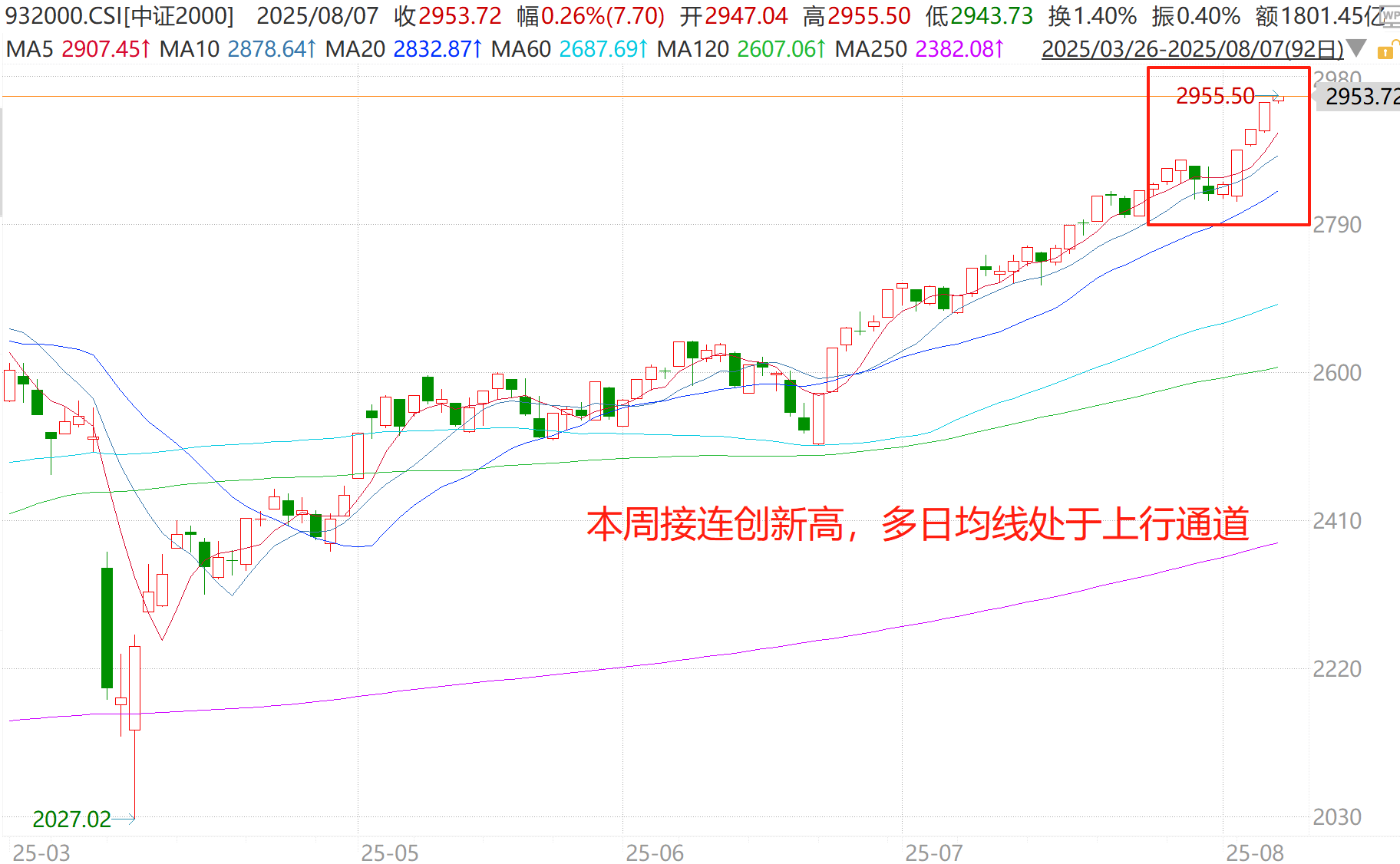
Core Viewpoint - The China Securities 2000 index has significantly outperformed major indices, achieving a year-to-date increase of 25.76% and a one-year increase of 66.64%, far surpassing the Nasdaq's performance [1][3]. Group 1: Index Performance - The China Securities 2000 Enhanced ETF (159552) has seen a remarkable one-year increase of over 100%, making it the top performer among broad-based ETFs [3]. - The ETF has recorded over 33% excess returns relative to the China Securities 2000 index, consistently outperforming the index each quarter [3]. - In the last three trading days, the ETF has attracted over 1.8 billion in net inflows, indicating strong investor interest [3]. Group 2: Market Dynamics - The combination of quantitative enhancement and the small-cap stock trend has positioned the China Securities 2000 as the leading index in the current liquidity-driven market [4]. - The surge in margin trading balances, which have risen to 2 trillion since May, has been a significant driver for the small-cap stock rally [5]. Group 3: Quantitative Enhancement Mechanism - The ETF's excess returns are derived from three mechanisms: 1. Signal network capturing pricing deviations by exploiting the slow information transmission and liquidity segmentation in small-cap stocks [6]. 2. Dynamic balancing to mitigate volatility, allowing the ETF to adjust its holdings to defensive factors during downturns [7]. 3. The rapid growth in the ETF's scale, which has increased 40 times this year, has created a positive feedback loop with liquidity [8].
指数增强的6大方式,都是如何做“增强”的?
银行螺丝钉· 2025-07-24 05:35
Core Viewpoint - Index enhancement funds are a specialized subset of index funds, aiming to achieve excess returns relative to a benchmark index through various enhancement strategies [1][4]. Group 1: Types of Enhancement Strategies - There are six common enhancement strategies: fundamental enhancement, quantitative enhancement, IPO subscription, ETF premium/discount arbitrage, ETF futures arbitrage, and index enhancement return swaps [6][69]. - Fundamental enhancement involves overweighting stocks with strong profitability and favorable outlooks, similar to active fund stock selection [5][7]. - Quantitative enhancement utilizes various quantitative factors to capture investment opportunities, including valuation, fundamental, price-related, and sentiment factors [13][15][21]. - IPO subscription allows funds to participate in new stock offerings, typically yielding profits on the first trading day [31][34]. - ETF premium/discount arbitrage exploits price discrepancies between the net asset value and market price of ETFs [37][42]. - ETF futures arbitrage takes advantage of price differences between ETF spot prices and futures prices [55][58]. Group 2: Advantages and Disadvantages of Strategies - Fundamental enhancement has a flexible scale requirement, but may experience volatility in excess returns during unusual market conditions [10][12]. - Quantitative enhancement can yield good excess returns when fund sizes are small, but larger fund sizes may dilute these returns [27][28]. - IPO subscription can provide good excess returns for funds sized between 200 million to 1 billion, but larger funds may see diminished returns [35][36]. - ETF premium/discount arbitrage is flexible and offers stable excess returns, but the effectiveness can be impacted by the scale of participating funds [54]. - ETF futures arbitrage provides stable excess returns but is susceptible to regulatory changes [61]. Group 3: Application of Strategies in Financial Products - Different financial products utilize various enhancement strategies, with public funds commonly employing fundamental and quantitative enhancements, while private funds have more flexibility [66][71]. - Public funds often use IPO subscription and ETF premium/discount arbitrage as auxiliary strategies, while ETF futures arbitrage and index enhancement return swaps are less common [67]. Group 4: Investment Considerations - Investing in small-cap indices tends to yield better enhancement results due to higher retail investor participation and greater price inefficiencies [79][84]. - The scale of the enhancement fund is crucial; funds sized between 200 million to 1 billion are more likely to achieve excess returns [88]. - Investing during undervalued phases of indices can mitigate risks associated with high valuations [90][92]. Group 5: Summary of Findings - The primary source of returns for index enhancement products is the underlying index's profit growth, supplemented by various enhancement strategies [95][96]. - The six enhancement strategies each have unique advantages and disadvantages, with common applications in public and private index enhancement funds [97][98].

兴证全球中证沪港深500指增基金正在发行 布局三地核心资产
Xin Jing Bao· 2025-07-08 07:39
Group 1 - The fund launched on June 27 is the first enhanced product tracking the CSI Hong Kong-Shenzhen 500 Index, selecting 500 quality stocks from the three markets to provide an innovative tool for investors [1] - The CSI Hong Kong-Shenzhen 500 Index covers 500 highly liquid and large-cap stocks, achieving comprehensive coverage of core assets in A-shares and Hong Kong stocks, with a balanced industry distribution across 31 sectors as of March 2025 [2] - The index has shown a cumulative return of 50.45% over the past 10 years, outperforming the CSI 300 Index (38.68%) and the Hang Seng Index (-15.02%), with characteristics of "high elasticity + low volatility" [2] Group 2 - The fund employs "index replication + quantitative enhancement" strategies, aiming to achieve investment returns that exceed the benchmark through multi-factor quantitative stock selection and portfolio optimization [3] - The proposed fund manager, Tian Dawei, has 15 years of experience and has managed multiple enhanced index funds, indicating a strong background in quantitative investment [3] - The quantitative team at the company emphasizes industry and style neutrality, focusing on controlling tracking error to avoid risk exposure from style drift [4]