长牛

Search documents
十万亿场外资金蠢蠢欲动
Sou Hu Cai Jing· 2025-08-20 19:14
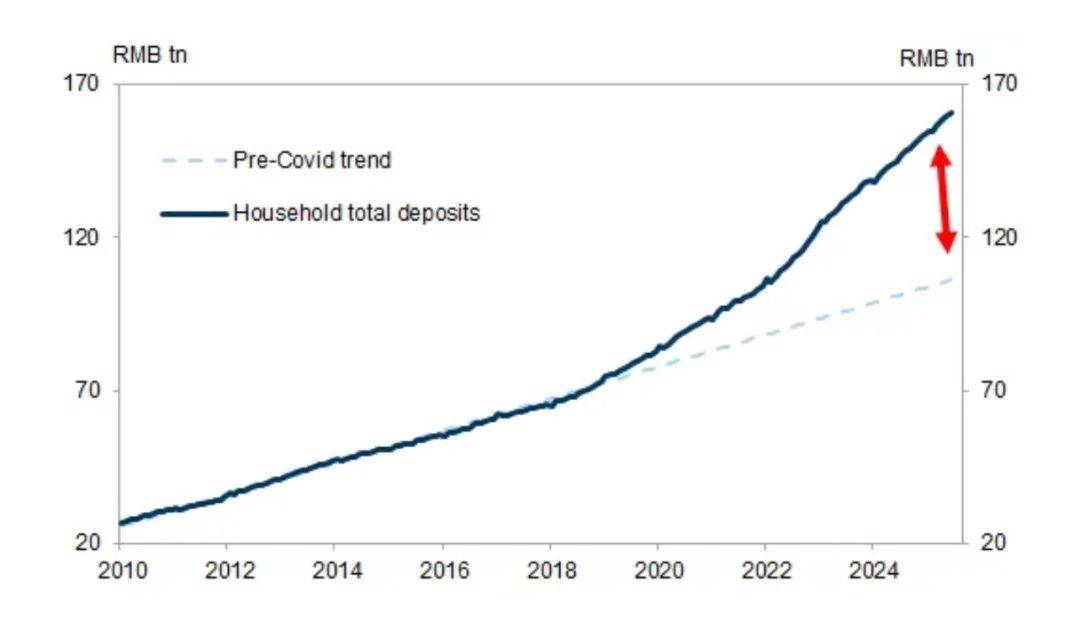
Group 1 - The current stock market is causing anxiety among seasoned investors who have memories of bear markets, leading many to withdraw and observe [1] - The market experienced a surprising recovery, closing up 1.04%, marking the first time in August that the index rose over 1%, driven by the semiconductor and consumer sectors [2] - Goldman Sachs estimates that there is approximately 10 trillion yuan of off-market funds ready to enter the A-share market, calculated from the excess savings accumulated post-pandemic [2] Group 2 - Concerns are raised about the optimism of the 10 trillion yuan estimate, as the rapid increase in savings post-pandemic was primarily a response to uncertainty and lower investment returns [4] - A comparison of household deposits to total market capitalization shows that the ratio has been mostly between 1.1 and 2.0 since 2010, indicating potential for further market movement [4] - The report from Guosen Securities suggests that a long-term bull market requires specific conditions, referencing historical bull markets in Japan, India, and the US [6] Group 3 - The US stock market is widely regarded as a long-term bull asset, with the S&P 500 index rising from approximately 1400 points in 2000 to 6380 points by August 2025, reflecting an annualized growth rate of about 8% [8] - The Indian Sensex index has shown extreme long-term bull characteristics, increasing from 3000 points in 2002 to 80687 points by August 2025, with a cumulative increase of 26 times and an annualized return of 15% [9] - The Japanese stock market has also exhibited a localized long-term bull market since 2014, with the Nikkei 225 index rising from 16000 points to 42050 points by August 2025, demonstrating a 163% increase over 11 years [9]

差一点,慢牛变成疯牛!| 谈股论金
水皮More· 2025-08-19 10:00
Core Viewpoint - The article emphasizes the need for caution in the current market environment, highlighting the risks of excessive speculation and rapid price increases that could jeopardize the ongoing bull market [3][4][5]. Market Performance - The three major indices in the A-share market experienced slight declines, with the Shanghai Composite Index down 0.02% to 3727.29 points, the Shenzhen Component down 0.12% to 11821.63 points, and the ChiNext down 0.17% to 2601.74 points [2][3]. - The total trading volume in the Shanghai and Shenzhen markets was 25,884 billion, a decrease of 1,758 billion from the previous day [2]. Recent Trends - Over the past five trading days, the ChiNext rose from 2409 points to 2634 points, a gain of 9.3%, while the Shenzhen Component increased from 11351 points to 11919 points, a rise of approximately 5% [3]. - The trading volume surged by 40%, indicating a rapid increase in market activity, which raises concerns about sustainability [3]. Speculative Behavior - There has been a notable trend of speculative trading in concept stocks and micro-cap stocks, with significant price movements observed in companies like Cambrian Biologics, which saw a nearly 50% increase in five days [4]. - The article warns that such speculative behavior could lead to severe market corrections if the trend continues [4]. Sector Performance - The article notes that consumer and real estate sectors showed strength, with stocks like Kweichow Moutai and Wuliangye rising by 0.67% and 0.53%, respectively [5]. - Conversely, sectors such as insurance, securities, and new energy faced declines, with stocks like SMIC and CATL dropping by 3.11% and 1.84% [5]. Company Analysis - The performance of Dongfang Fortune, which reported a 37% increase in half-year earnings, is contrasted with its high price-to-earnings ratio of 38 times, raising questions about its valuation amidst a competitive market [6]. - The article highlights the disparity in performance among brokerage firms, with many experiencing significant year-on-year growth, yet facing challenges in maintaining high valuations [6]. External Market Influences - The Hang Seng Index showed little movement, remaining stable, while the stock of Oriental Selection experienced extreme volatility, with a 50% price swing within an hour, indicating potential market manipulation [7].

十年新高,有人跑步进场,A股将迎来1万点还是昙花一现?
首席商业评论· 2025-08-19 03:38
Core Viewpoint - The article discusses the emergence of a bull market in the A-share market, highlighting the significant rise in the Shanghai Composite Index and the influx of new retail investors, while also cautioning that not all investors may benefit from this market trend [4][8]. Market Performance - On August 18, the Shanghai Composite Index reached a ten-year high of 3741.29 points, marking a 22.6% increase from the low in April [4]. - The A-share market's total market capitalization surpassed 100 trillion yuan for the first time, with 4625 stocks rising and 104 hitting the daily limit [4]. Bull Market Indicators - Key indicators for determining a bull market include a sustained index increase of over 20%, broad participation from various stocks, stable trading volumes averaging 1-2 trillion yuan, and a significant rise in new retail investors [6]. - In July, 196.36 million new A-share accounts were opened, a 31.72% increase from June, contributing to a total of 1456.13 million new accounts in 2023, a 36.88% year-on-year increase [6]. Market Sentiment and Economic Implications - While the current market sentiment suggests a bull market, the transition from a rising stock market to improved economic conditions is complex and uncertain [8]. - Historical examples of "fast bull" markets show that rapid increases can lead to severe corrections, as seen in 2007 and 2015, where declines reached 70% and over 50%, respectively [9]. Slow Bull vs. Fast Bull - A slow bull market, characterized by gradual increases and lower volatility, allows for better investment strategies and risk management compared to a fast bull market, which is often driven by speculation [11]. - The current market shows signs of a slow bull, with a shift in financing towards technology and industrial sectors, reducing the risk of capital idling seen in previous bull markets [14]. Monetary Policy and Economic Activity - Recent improvements in monetary indicators, such as M2 growth at 8.8% and M1 growth at 5.6%, suggest increased liquidity and economic activity, with M1 growth indicating a shift towards more active capital [12]. - The current financing landscape shows 66% of funds directed towards technology, industrial, and material sectors, with over 45% focused on hard technology areas like semiconductors and renewable energy [14]. Long-term Market Outlook - The potential for a prolonged bull market similar to the U.S. market is uncertain, as domestic companies still face challenges in achieving high profitability and consistent dividends [15]. - The article emphasizes the importance of a comprehensive approach to capital management, including buybacks and dividends, to sustain investor confidence and market stability [16]. Investment Strategies - Investors are advised to focus on industry leaders and niche market players, emphasizing the importance of risk management and the potential for future recovery even in a slow bull market [27]. - The article highlights the need for investors to maintain a disciplined approach, avoiding emotional trading behaviors that can lead to losses [21][26].