
韩元贬值

Search documents
韩元过去三个月贬值超3%,成亚洲表现最差的货币之一
Huan Qiu Wang· 2025-10-29 01:09
Group 1 - The core point of the article highlights that South Korea's GDP grew by 1.2% in Q3, the highest since Q1 2024, driven by strong exports and manufacturing performance, surpassing the Bank of Korea's expectation of 1.1% growth [1] - Analysts have revised their economic growth forecasts for next year, with Samsung Securities and Korea Investment Securities increasing their projections from 2.0% and 1.8% to 2.2% and 1.9% respectively [1] - Key growth drivers include consumption vouchers, a strong stock market, increased semiconductor exports, reduced trade uncertainties, and potential interest rate cuts by the Federal Reserve, although high interest rates and investment uncertainties may limit equipment investment and investments in certain sectors [1] Group 2 - The Korean Composite Stock Price Index (Kospi) has surged nearly 70% this year, making it one of the best-performing indices globally, significantly outperforming returns from U.S. stock indices [1] - Concerns over the potential erosion of asset values due to agreements between South Korea and the U.S. have led retail investors in South Korea to invest heavily in dollar-denominated stocks and gold, exacerbating fears of the won's depreciation [1] - The South Korean won has depreciated over 3% in the past three months, becoming one of the worst-performing currencies in Asia [1] Group 3 - A researcher from the Bank of Korea indicated that the weak trend of the won is expected to continue in the short term, particularly due to the unclear interest rate outlook from the Bank of Japan [5] - The won's depreciation has led to upward pressure on the dollar, with expectations that it will stabilize around 1430 won [5]

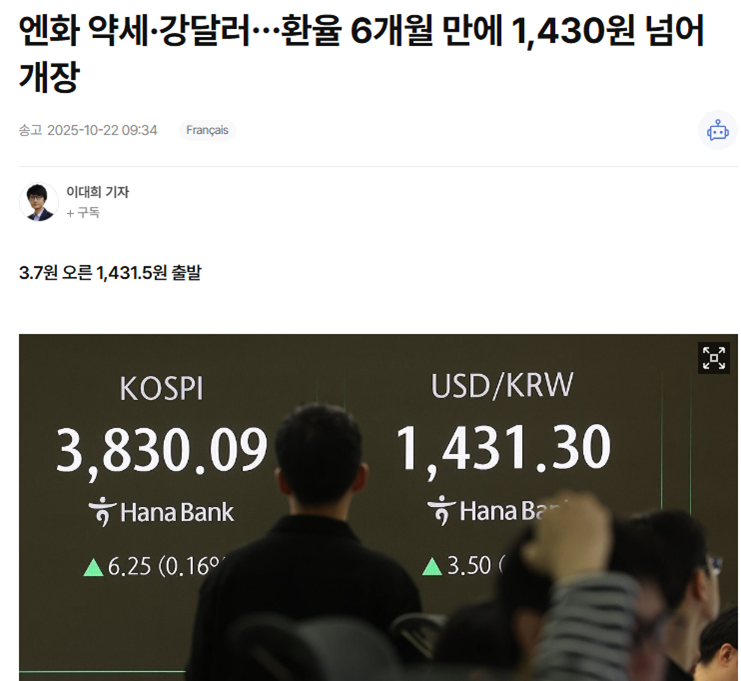
“韩元变成卫生纸”!忧虑美韩3500亿美元投资协议,韩国民众猛买美股和黄金
Hua Er Jie Jian Wen· 2025-10-28 02:15
Group 1 - A $350 billion investment commitment to the U.S. is causing significant capital outflow from South Korea, negatively impacting investor sentiment [1][8] - The South Korean won has depreciated over 3% in the past three months, making it one of the worst-performing currencies in Asia [2][3] - Retail investors in South Korea are increasingly moving their funds into U.S. dollar-denominated stocks and gold due to fears of asset devaluation [1][5] Group 2 - Despite a remarkable bull market in the South Korean stock market, local retail investors remain unconvinced and are withdrawing their investments [6][7] - The uncertainty surrounding the U.S.-South Korea investment agreement and concerns about the South Korean economy are driving market anxiety [8][9] - The South Korean economy is projected to grow only 0.9% this year, the slowest growth since the COVID-19 pandemic, with rising household debt and real estate bubble concerns limiting monetary policy effectiveness [10]
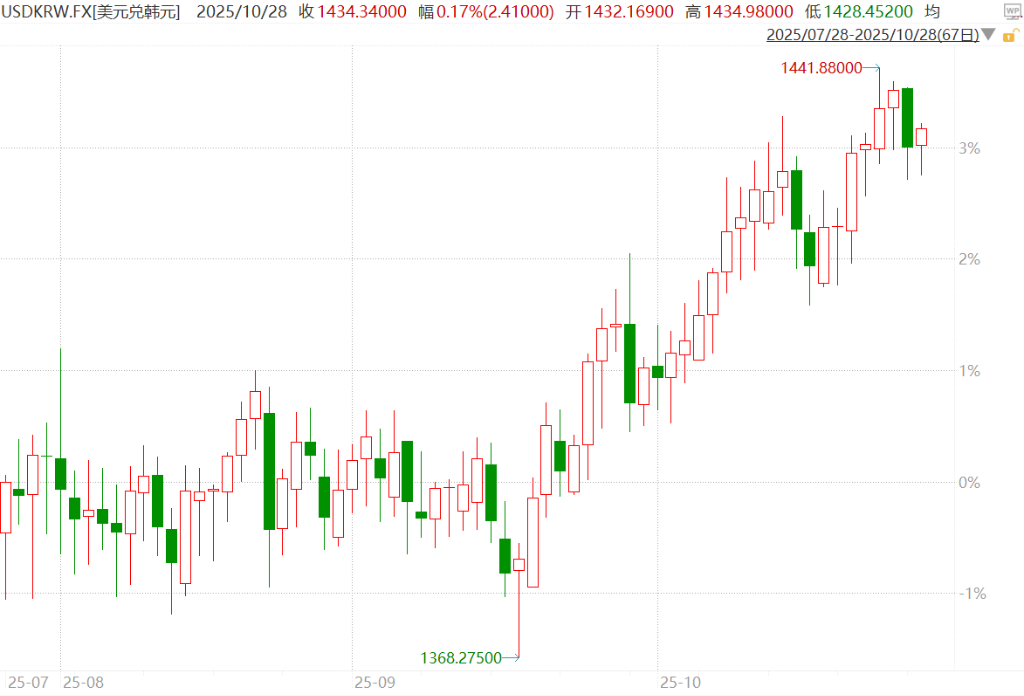
花旗:韩3500亿美元对美投资或加剧韩元贬值压力
Xin Hua Cai Jing· 2025-09-11 07:17
Core Viewpoint - South Korea's commitment to invest $350 billion in the U.S. may exert pressure on the Korean won [1] Financing Needs - Due to lessons learned from the 1997-1998 financial crisis, South Korea is unlikely to utilize its $416 billion foreign exchange reserves [1] - Public institutions may need to raise $20 billion to $30 billion in foreign currency annually [1] Bond Market Impact - The remaining financing requirement of $86 billion to $96 billion may need to be sourced from the bond market [1] - Large-scale bond issuance could increase financing costs and put additional pressure on the Korean won [1] Currency Risk - Even if private enterprises share part of the financing burden, the shift of dollar export revenues to won may lead to depreciation risks [1] U.S. Engagement - Citi expects South Korea to seek solutions from the U.S. for potential foreign exchange shocks and to request an extension of the investment commitment timeline [1]
