高铁发展

Search documents
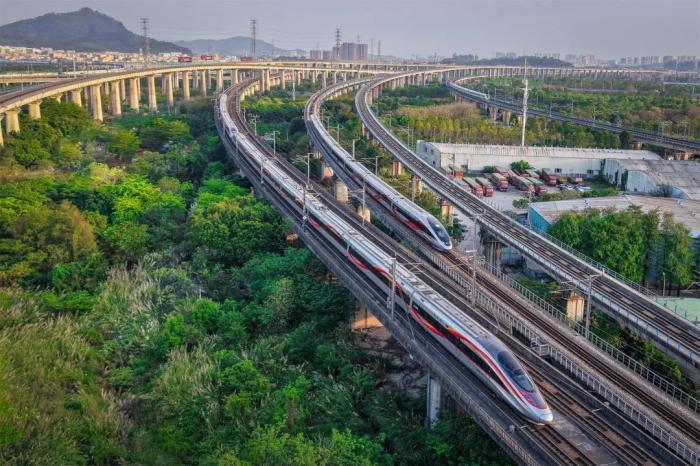
超过世界其他国家里程总和!中国高铁营业里程突破5万公里
Zhong Guo Xin Wen Wang· 2025-12-26 04:19
Core Insights - China's high-speed rail (HSR) operational mileage has surpassed 50,000 kilometers, exceeding the total mileage of all other countries combined [1][2] - During the 14th Five-Year Plan period, China constructed and put into operation 12,000 kilometers of high-speed rail, marking a 32% increase from the end of 2020 [2] Group 1: Achievements and Developments - The high-speed rail network now covers 97% of cities with a population of over 500,000, maintaining the world's largest operational mileage [2] - The number of high-speed trains has reached 5,233, with the Fuxing train series increasing by 117% compared to the end of the 13th Five-Year Plan [2] - High-speed rail accounts for 80% of passenger volume and 69% of passenger turnover in China's railway system, becoming the main mode of transportation for medium and long-distance travel [2] Group 2: Passenger Services and Innovations - A total of 12.8 billion passengers were transported by high-speed trains during the 14th Five-Year Plan, a 39.2% increase from the previous period [2] - The new generation of the 12306 ticketing system has the largest access volume and transaction scale globally, with a daily ticket sales capacity exceeding 20 million [2] - Various passenger-friendly services have been introduced, including lightweight travel options, pet transportation, and services tailored for the elderly [2] Group 3: International Collaboration - China is sharing its high-speed rail development achievements with other countries, benefiting many nations involved in the Belt and Road Initiative [2] - The Jakarta-Bandung high-speed rail project in Indonesia has reduced travel time from over three hours to 46 minutes, serving over 13 million passengers [2] - The Serbia section of the Hungary-Serbia railway has commenced operations, marking Serbia's entry into the high-speed rail era in the Balkans [2]

5万公里!中国高铁运营里程新突破
证券时报· 2025-12-26 04:16
Core Viewpoint - The opening of the Xi'an to Yan'an high-speed railway marks a significant milestone in China's high-speed rail development, enhancing connectivity and economic integration in the region [4]. Group 1: High-Speed Rail Development - The high-speed rail network in China has surpassed 50,000 kilometers, making it the largest in the world and capable of transporting 16 million passengers daily [4]. - The Xi'an to Yan'an high-speed railway, which opened on December 26, 2023, is a crucial part of the "Eight Vertical and Eight Horizontal" high-speed rail network, covering a distance of 299 kilometers with a design speed of 350 km/h [4]. - The travel time between Xi'an and Yan'an has been reduced from over 2 hours to approximately 1 hour, significantly improving accessibility [4]. Group 2: Economic Impact - The opening of the Xi'an to Yan'an high-speed railway integrates Yan'an into the "one-hour economic circle" of Xi'an, facilitating logistics, tourism, and talent acquisition [5]. - The Hangzhou to Quzhou high-speed railway also commenced operations on the same day, further enhancing the intercity rapid transport network in the Yangtze River Delta region [5]. - The Hangzhou to Quzhou line, spanning 131 kilometers with a design speed of 350 km/h, will reduce travel time from Hangzhou to Quzhou to as little as 73 minutes, promoting regional integration [5].

5万公里!中国高铁运营里程新突破
中国基金报· 2025-12-26 02:53
Group 1 - The core viewpoint of the article highlights that China's high-speed rail (HSR) operational mileage has surpassed 50,000 kilometers, marking a significant milestone in the country's transportation infrastructure [1] - The opening of the Xi'an to Yan'an high-speed rail line signifies the entry of the revolutionary old area of Yan'an into the "high-speed rail era" [1] - China's high-speed rail network is characterized by the "eight vertical and eight horizontal" layout, facilitating a transportation radius of 500 kilometers for city clusters, enabling 1 to 2-hour travel times between cities [1] Group 2 - The high-speed rail system can accommodate the transportation of 16 million passengers daily, equivalent to the population movement of a large city [1] - Currently, high-speed rail covers 97% of cities with a population of over 500,000 in China, making it the country with the largest operational mileage in the world [1] - China's high-speed rail not only leads in operational mileage but also boasts the highest operational speeds globally, surpassing the combined mileage of all other countries [1]

新华社权威快报丨5万公里!中国高铁运营里程新突破
Xin Hua She· 2025-12-26 02:31
Core Viewpoint - The opening of the Xi'an to Yan'an high-speed railway marks a significant milestone in China's high-speed rail development, pushing the total operational mileage of high-speed rail in the country to over 50,000 kilometers, further enhancing connectivity and transportation efficiency [3]. Group 1: High-Speed Rail Development - The Xi'an to Yan'an high-speed railway officially commenced operations on December 26, 2025, with the C9309 "Fuxing" intelligent train departing from Yan'an station [3]. - This development signifies the entry of the revolutionary old area of Yan'an into the "high-speed rail era" [3]. - China's high-speed rail network now features a comprehensive "eight vertical and eight horizontal" layout, facilitating a 1 to 2-hour travel circle for cities within a 500-kilometer radius [3]. Group 2: Operational Capacity and Coverage - The high-speed rail system can transport up to 16 million passengers daily, equivalent to the population of a large city moving through the rail network [3]. - Currently, high-speed rail covers 97% of cities with a population of over 500,000 in China [3]. - China holds the world's largest high-speed rail operational mileage, surpassing the combined total of all other countries, and boasts the highest operational speeds globally [3].

再上新台阶!中国高铁运营里程突破5万公里
Xin Hua She· 2025-12-26 02:14
Core Viewpoint - The opening of the Xi'an to Yan'an high-speed railway marks a significant milestone in China's high-speed rail development, bringing the total operational mileage to over 50,000 kilometers [1] Group 1 - The C9309 "Fuxing" intelligent train departed from Yan'an station at 10 AM on December 26, indicating the commencement of operations for the new high-speed rail line [1] - This development signifies the entry of the revolutionary base area of Yan'an into the "high-speed rail era," enhancing connectivity and transportation options for the region [1] - The expansion of high-speed rail infrastructure represents a new stage in the growth of China's high-speed rail network [1]
西延高铁迎来首批“护路体验官”
Shan Xi Ri Bao· 2025-12-09 23:22
Core Points - The Xi'an to Yan'an high-speed railway has welcomed its first batch of over 550 "railway experience officers" who participated in a public trial run while learning about railway safety [1] - The railway is currently over halfway through its trial operation phase, with steady progress in various debugging tasks, and is ready for passenger safety experiences [1] - The high-speed railway significantly reduces travel time between Xi'an and Yan'an from over 2 hours to approximately 1 hour, enhancing connectivity between the Guanzhong Plain and the revolutionary old areas of northern Shaanxi [1] Summary by Sections Experience and Feedback - Passengers expressed satisfaction with the spacious and comfortable train environment, highlighting the smooth ride comparable to sitting on a sofa [1] - Local residents noted the convenience of having a high-speed train station close to home, allowing for quick travel to Xi'an in just 1 hour [1] Significance of the Railway - The Xi'an to Yan'an high-speed railway is not only a transportation line but also a vital lifeline for the local population, fulfilling their expectations for improved living conditions [2] - The initiative aims to allow participants to experience the convenience and safety of the high-speed railway before its official opening, encouraging them to become witnesses and beneficiaries of its development [2]
高铁开到家门口!这五年,400多座新车站为小城发展按下加速键
Yang Shi Xin Wen Ke Hu Duan· 2025-10-20 07:29
Core Insights - The expansion of China's high-speed rail network has significantly improved connectivity, with an addition of 10,000 kilometers over the past five years, bringing the total to over 50,000 kilometers by the end of this year [1] - The number of train stations has increased by over 400 along 160,000 kilometers of railway, enhancing accessibility for more people [1] Group 1: Economic Impact - In the small town of Gacha County, with a population of over 20,000, up to 800 people use the train daily, allowing local products like fresh caterpillar fungus to reach Lhasa at prices 20-30% higher than dried fungus [3] - The introduction of high-speed rail has enabled local entrepreneurs, such as Feng Tianfeng, to expand their market reach, allowing products to be quickly shipped to major cities like Beijing and Shanghai [10] Group 2: Social Changes - The high-speed rail has transformed the lifestyle of residents in remote areas, such as Zhuangzhai, which now connects to provincial capitals, providing greater opportunities for local youth [8] - The Dongxing border station, which connects with ASEAN, has seen over 14 million inbound and outbound travelers and hosted more than 700 Vietnamese tourist groups since its opening [12] Group 3: Cultural Exchange - The high-speed rail network facilitates cultural exchange, as evidenced by Vietnamese tourists visiting China to experience its diverse culture, including plans to see the Terracotta Army in Xi'an [14]

“这是梦吗?”欧洲议员分享中国高铁之旅,外国网友惊了
Guan Cha Zhe Wang· 2025-06-16 03:48
Core Viewpoint - The experience of a European politician on China's high-speed rail has sparked significant discussion on social media, highlighting the stark contrast between China's advanced rail system and the struggles of European rail services [1][2][4]. Group 1: High-Speed Rail Experience - The high-speed train journey from Beijing to Hong Kong covered 2,439 kilometers in 8 hours and 10 minutes, with comfortable conditions and attentive service [2]. - The train's environment was described as pleasant, with a temperature of 25 degrees Celsius inside while it was 38 degrees Celsius outside, showcasing the efficiency of the service [2]. - The experience was likened to a dream by many European commenters, who expressed disbelief at the level of service and technology available in China [4][5]. Group 2: Perception of China vs. Europe - Many European commenters acknowledged their misconceptions about China, with some stating that the country is far more advanced than they had previously thought [4][5]. - Comparisons were made between the smooth operation of Chinese high-speed trains and the often problematic services in Germany, where delays and poor conditions are common [5][6]. - The discussion highlighted a significant difference in high-speed rail usage, with approximately 8 million people using high-speed trains in China daily compared to only about 280,000 in Germany [6]. Group 3: Broader Implications - The rapid development of China's high-speed rail network is evident, with projections indicating that by the end of 2024, the total railway operating mileage will reach 162,000 kilometers, including 48,000 kilometers of high-speed rail [6]. - The achievements of China's high-speed rail have drawn international attention, with figures like Elon Musk acknowledging the superiority of China's rail services compared to those in the United States [7].

特朗普政府拒绝拨款,美国加州高铁还建得成吗?
Di Yi Cai Jing· 2025-05-07 08:58
Core Points - The California high-speed rail project has faced significant criticism from President Trump, who claims it exemplifies Democratic failure and has resulted in wasted taxpayer money, with costs exceeding $100 billion and delays in completion [1][3] - The project, initially approved in 2008 with a budget of $33 billion, has seen its estimated costs balloon to between $88 billion and $128 billion, with completion now pushed to between 2030 and 2033 [5][6] - Despite federal funding challenges, California high-speed rail officials assert that the project is making progress, with ongoing civil engineering work creating over 15,000 construction jobs [4] Federal Funding and Political Context - Trump announced that the federal government would no longer provide funding for the California high-speed rail project, criticizing Governor Newsom's management [1][3] - The U.S. Department of Transportation is investigating the use of federal funds by the California High-Speed Rail Authority, which could lead to a halt in funding if the investigation confirms misuse [3] - The California High-Speed Rail Authority downplayed the potential impact of federal funding cuts, stating the project could withstand the loss of federal support [4] Historical Context and Challenges - The project has been plagued by delays due to land acquisition, environmental assessments, and legal challenges, leading to a significant extension of the timeline for completion [5] - Historical underinvestment in high-speed rail in the U.S. is highlighted, with only $10 billion allocated to high-speed rail from 1949 to 2017, compared to $777 billion for aviation and over $2 trillion for highways during the same period [6]