黄金重估

Search documents
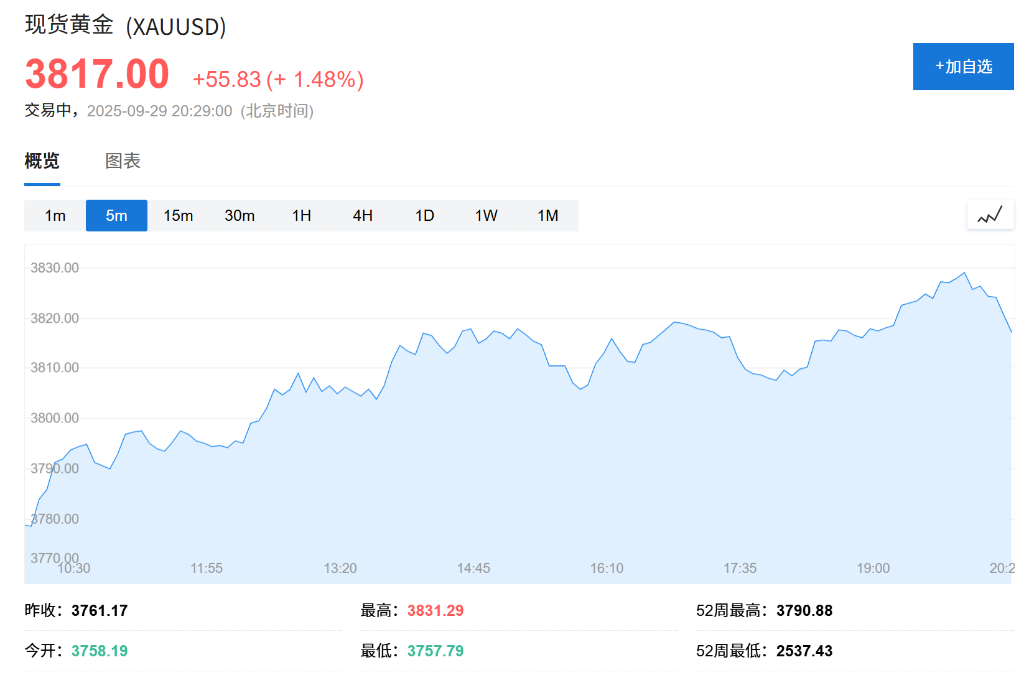
创纪录涨势后,美国黄金储备价值触及1万亿美元
Hua Er Jie Jian Wen· 2025-09-29 13:30
Core Viewpoint - The market value of the U.S. Treasury's gold reserves has surpassed $1 trillion for the first time, driven by a significant increase in gold prices, which have risen by 45% this year, reaching a peak of $3,824.5 per ounce [1][6]. Group 1: Gold Price Dynamics - The surge in gold prices is attributed to investors seeking safe-haven assets amid trade wars, geopolitical tensions, and concerns over potential U.S. government financing crises [1][6]. - The Federal Reserve's resumption of interest rate cuts has further enhanced the attractiveness of gold by lowering the opportunity cost of holding non-yielding assets [6][10]. - Institutional and official buying has provided solid support for gold prices, with gold ETFs experiencing strong demand, marking one of the strongest years on record [6][7]. Group 2: Valuation Discrepancies - The official value of gold on the U.S. government's balance sheet remains fixed at just over $11 billion, based on a price set by Congress in 1973, creating a disparity where the market value is over 90 times the book value [3][12]. - A revaluation of the gold reserves at current market prices could theoretically release approximately $990 billion in funds for the U.S. Treasury, which is particularly enticing given the current debt ceiling constraints [4][12]. - Discussions around the potential revaluation of gold reserves have emerged, although U.S. Treasury Secretary Yellen has denied that such a move is being seriously considered [4][12][13]. Group 3: Market Sentiment and Technical Analysis - Current market sentiment indicates that speculative long positions in gold have increased but have not reached extreme levels, suggesting that the market has not entered a "panic buying" phase [10]. - Technical analysis points to a potential target price of around $4,000 per ounce, based on trend lines connecting previous highs, indicating that there may still be room for price increases [9][10]. Group 4: Historical Context and Storage - The U.S. gold reserves total approximately 261.5 million ounces, with over half stored at Fort Knox, Kentucky, and the remainder in various locations, including West Point and Denver [14]. - There have been public speculations regarding the existence of the gold at Fort Knox, fueled by comments from notable figures, highlighting ongoing interest and concern about the U.S. gold reserves [14].

【UNFX 课堂】美联储报告引爆 “危险话题”黄金价值或被严重低估
Sou Hu Cai Jing· 2025-08-11 04:26
Group 1 - The core viewpoint of the articles revolves around the re-evaluation of gold's value in the context of rising U.S. federal debt and interest payments, which poses systemic risks to the economy [1][2] - Recent trends show that despite a significant rise in real interest rates, gold prices have increased by over 4% in the past 45 days, indicating a break from traditional pricing models [1][2] - The latest Federal Reserve report highlights the uncertainty surrounding the trajectory of U.S. federal debt, particularly emphasizing the escalating burden of interest payments [1][2] Group 2 - Key indicators of debt risk include public debt as a percentage of GDP, currently near 100%, which increases repayment pressure and constrains government spending [2] - Interest payments as a percentage of GDP are expected to rise significantly over the next decade, potentially leading to more borrowing to service existing debt [2] - Concerns from Goldman Sachs regarding the long-term fiscal path being "unsustainable" could undermine confidence in sovereign debt and fiat currency systems [2] Group 3 - The notion of "gold price re-evaluation" is emerging, questioning whether current gold prices accurately reflect the inherent risks of a heavily indebted dollar system [2] - Historical context shows that during the last significant gold price re-evaluation (1970-80), U.S. macro debt levels rose from 140% to over 170%, while current levels exceed 304% [2] - Prominent investors like Stanley Druckenmiller and Ray Dalio are reassessing their gold allocations, viewing it as a hedge against inflation and a vote against excessive national credit expansion [2] Group 4 - For ordinary investors, the implications are profound, emphasizing the importance of gold as a "non-debt asset" in an era of rising debt [3] - Investors are encouraged to look beyond short-term fluctuations and focus on the macroeconomic shifts driving gold prices [3] - The volatility in the gold market presents opportunities for long-term positioning, as significant adjustments often signal favorable entry points [3]
美国诺克斯堡仓库里的“压箱底宝贝”,为什么不敢用?
Sou Hu Cai Jing· 2025-07-15 02:11
Core Viewpoint - The article discusses the implications of the U.S. not utilizing its gold reserves at Fort Knox, suggesting that a revaluation of gold could potentially alleviate the $26 trillion debt crisis, while raising concerns about the actual availability of gold reserves [1][4][6]. Group 1: Historical Context - The U.S. dollar decoupled from gold in 1971, leading to a system where the dollar became the global reserve currency, resulting in persistent trade deficits and reliance on foreign investments [3]. - Countries like China, Saudi Arabia, and Japan have started selling U.S. Treasury bonds, indicating a shift in foreign investment behavior [3][4]. Group 2: Current Financial Dynamics - The U.S. is increasingly relying on domestic institutions, such as the Federal Reserve and commercial banks, to purchase its debt, leading to a "fiscal internal circulation" [4]. - The cost of borrowing is rising as the U.S. government struggles to find buyers for its debt, forcing the Federal Reserve to print more money [4][6]. Group 3: Gold Valuation and Implications - The U.S. holds the largest gold reserves globally, officially recorded at 8,133.5 tons, valued at only $42.22 per ounce, while the current market price exceeds $3,000 per ounce [4][6]. - A revaluation of gold at market prices could create an additional $26 trillion in assets, significantly improving the debt-to-GDP ratio [4][6]. Group 4: Risks of Gold Revaluation - There are concerns that the gold reserves may not be as substantial as reported, leading to fears of a potential loss of confidence in the U.S. dollar if the truth were revealed [6][12]. - The article suggests that the U.S. is avoiding gold revaluation due to the risk of exposing potential discrepancies in its gold holdings [6][12]. Group 5: Shift to Cryptocurrencies - With the gold route deemed risky, the U.S. is increasingly turning to cryptocurrencies like Bitcoin and stablecoins as alternative financial instruments [8][12]. - The rise of stablecoins poses a risk to monetary sovereignty, as they are not directly controlled by the Federal Reserve, potentially leading to a loss of regulatory power over the broader monetary system [8][12]. Group 6: Global Implications - The article highlights the strategic importance of gold for non-U.S. countries, positioning it as a counterbalance to the dollar-centric financial system [12]. - The ongoing competition between gold and cryptocurrencies represents a significant shift in the global financial landscape, with potential long-term consequences for the U.S. dollar's dominance [12].