
AI辅助药物发现

Search documents
速递|歌礼制药Amylin减肥新药向FDA申报!进入临床开发阶段
GLP1减重宝典· 2025-10-31 09:55
Core Viewpoint - The article discusses the development of ASC36, a novel amylin receptor agonist by the company, which is expected to be a leading candidate for obesity treatment with a monthly subcutaneous injection regimen. The company plans to submit an IND application to the FDA in the second quarter of 2026 [5]. Group 1: Product Development - ASC36 is developed using AI-assisted structure-based drug discovery and ultra-long-acting drug development platforms, resulting in a longer apparent half-life and higher bioavailability per milligram of peptide, supporting monthly administration [5][6]. - The optimized characteristics of ASC36 lead to lower production costs, making it a competitive option in the market [6]. Group 2: Efficacy Studies - In head-to-head studies with diet-induced obesity (DIO) rats, ASC36 demonstrated a weight loss of 10.01%, compared to 5.25% for petrelintide, indicating a 91% relative improvement in weight loss efficacy [7]. - The superior weight loss effect per milligram of peptide may further enhance ASC36's cost-effectiveness in large-scale production [7].


港股异动 | 歌礼制药-B(01672)现涨超4% 皮下注射胰淀素受体激动剂ASC36进入临床开发阶段
智通财经网· 2025-10-31 02:45
Core Viewpoint - The company, Gilead Sciences-B (01672), has selected ASC36 as a clinical development candidate, which is expected to be a best-in-class monthly subcutaneous injection amylin receptor agonist for obesity treatment, with plans to submit an IND to the FDA by Q2 2026 [1] Group 1: Product Development - ASC36 is developed using Gilead's AI-assisted drug discovery and long-acting drug development platform technology [1] - The optimized design of ASC36 allows for a longer apparent half-life and higher bioavailability per milligram of peptide, supporting monthly subcutaneous administration with an injection volume not exceeding 1 milliliter [1] - These optimized characteristics are expected to reduce costs in large-scale production [1] Group 2: Market Reaction - Following the announcement, Gilead's stock rose over 4%, specifically by 4.62%, reaching HKD 9.74, with a trading volume of HKD 12.814 million [1]
歌礼制药-B(01672.HK):选定同类最佳每月一次皮下注射胰淀素受体激动剂ASC36进入临床开发阶段
Ge Long Hui· 2025-10-30 00:12
Core Insights - The company has selected ASC36 as a clinical development candidate, which is expected to be a best-in-class monthly subcutaneous injection amylin receptor agonist for obesity treatment [1][2] - ASC36 is developed using the company's AI-assisted drug discovery and ultra-long-acting drug development platforms, featuring optimized properties for longer half-life and higher bioavailability [1] - The company plans to submit an Investigational New Drug (IND) application to the FDA in Q2 2026 [1] Drug Development and Efficacy - ASC36 has an observed half-life of approximately 15 days in non-human primate studies, which is three times longer than petrelintide, supporting the potential for monthly dosing in humans [2] - In diet-induced obesity rat studies, ASC36 demonstrated a weight reduction of 10.01%, compared to 5.25% for petrelintide, indicating a 91% relative improvement in weight loss efficacy [2] - The optimized characteristics of ASC36 may lead to lower manufacturing costs and improved dosing regimens for patients [2]
歌礼制药-B(01672)选定同类最佳每月一次皮下注射胰淀素受体激动剂 ASC36进入临床开发阶段
智通财经网· 2025-10-30 00:10
Core Viewpoint - The company has selected ASC36 as a promising candidate for clinical development, expected to be submitted for FDA approval in Q2 2026 for obesity treatment [1] Group 1: Product Development - ASC36 is an amylin receptor agonist developed using AI-assisted structure-based drug discovery and ultra-long-acting platform technologies [1] - The optimized design of ASC36 allows for a longer apparent half-life and higher bioavailability per milligram, supporting monthly subcutaneous administration with a volume not exceeding 1 milliliter [1] - The scalability advantages in manufacturing are highlighted, indicating lower production costs for ASC36 [1] Group 2: Clinical Research Findings - In head-to-head studies with non-human primates, ASC36 demonstrated an average observed half-life of approximately 15 days, three times longer than petrelintide, supporting its potential for monthly dosing in humans [2] - In diet-induced obesity rat studies, ASC36 achieved a weight reduction of 10.01%, compared to 5.25% for petrelintide, indicating a relative improvement of 91% in weight loss effectiveness [2] - The superior weight loss effect per milligram of peptide may further enhance the cost-effectiveness of ASC36 in large-scale production [2]
歌礼制药-B选定同类最佳每月一次皮下注射GLP-1R/GIPR双靶点激动剂多肽 ASC35进入临床开发阶段
Zhi Tong Cai Jing· 2025-10-13 00:24
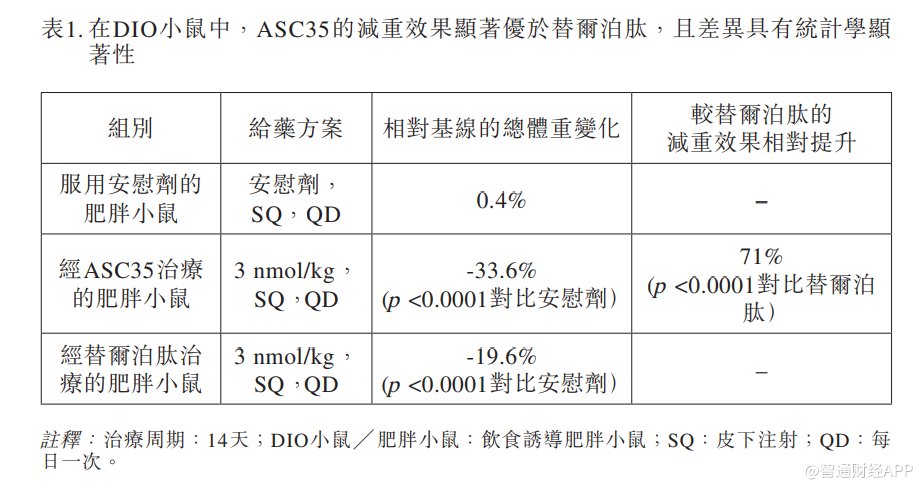
Core Viewpoint - The company has selected ASC35, a dual-target GLP-1R/GIPR agonist, as a clinical development candidate, expected to submit an IND application to the FDA by Q2 2026 for obesity treatment [1] Group 1: Drug Development and Characteristics - ASC35 is developed using the company's AI-assisted structure-based drug discovery and ultra-long-acting drug development platforms, showing approximately 4 times stronger agonistic activity on GLP-1R and GIPR compared to Tirzepatide [2] - ASC35 has a longer apparent half-life and higher bioavailability per milligram compared to Tirzepatide, allowing for monthly subcutaneous administration with a volume not exceeding 1 milliliter [2] - In non-human primate studies, ASC35's observed half-life is about 14 days, which is 6 times longer than that of FDA-approved Tirzepatide, indicating a potential human half-life of at least 30 days [3] Group 2: Efficacy and Comparative Studies - In diet-induced obesity mouse studies, ASC35 achieved a weight reduction of 33.6%, compared to 19.6% for Tirzepatide, representing a 71% relative improvement in weight loss [4][5] - ASC35 demonstrates superior in vitro agonistic activity, apparent half-life, subcutaneous bioavailability, and weight loss effects compared to Tirzepatide, suggesting it may become a best-in-class obesity therapy [5] Group 3: Strategic Development Plans - The company plans to develop ASC35 as a monotherapy and in combination with other agents for treating metabolic diseases, including obesity and diabetes [6] - ASC35 is intended to be combined with ASC36, an amylin receptor agonist, and ASC47, a THRβ agonist, for treating obesity and metabolic dysfunction-related fatty liver disease [6][7] - The proprietary ULAP technology allows the company to design various release rates for subcutaneous peptides, enhancing clinical efficacy and patient compliance [7]
歌礼制药-B(01672)选定同类最佳每月一次皮下注射GLP-1R/GIPR双靶点激动剂多肽 ASC35进入临床开发阶段
智通财经网· 2025-10-13 00:24
Core Viewpoint - The company has selected ASC35, a potential best-in-class monthly subcutaneous injection GLP-1R/GIPR dual agonist peptide, as a clinical development candidate, with plans to submit an IND to the FDA by Q2 2026 for obesity treatment [1]. Group 1: Product Development - ASC35 is developed using the company's AI-assisted structure-based drug discovery (AISBDD) and ultra-long-acting platform (ULAP) technologies, showing approximately 4 times stronger agonistic activity on GLP-1R and GIPR compared to Tirzepatide [2]. - ASC35 has a longer apparent half-life and higher bioavailability per milligram compared to Tirzepatide, enabling monthly subcutaneous administration with a volume not exceeding 1 milliliter, which also supports cost-effective large-scale production [2]. Group 2: Preclinical Data - In non-human primate studies, ASC35's depot formulation has an average observed half-life of about 14 days, which is 6 times longer than that of FDA-approved Tirzepatide [3]. - ASC35 demonstrated approximately 80% and 70% higher drug exposure compared to Tirzepatide via intravenous and subcutaneous administration, respectively, suggesting a potential human half-life of at least 30 days based on preclinical data [3]. - In diet-induced obesity (DIO) mouse studies, ASC35 resulted in a weight reduction of 33.6%, compared to 19.6% for Tirzepatide, indicating a relative improvement of 71% in weight loss efficacy [4][5]. Group 3: Strategic Vision - The development of ASC35 reflects the company's commitment to innovation and complements its small molecule drug pipeline for treating obesity and other metabolic diseases [6]. - ASC35 is being developed as both a monotherapy and in combination with other agents, including ASC36 and ASC47, for treating obesity, diabetes, and metabolic dysfunction-related fatty liver disease [6]. Group 4: Technological Advantages - The company's AISBDD and ULAP technologies allow for the design and optimization of multiple long-acting peptides for monthly subcutaneous injection, enhancing clinical efficacy by precisely controlling the release rates of the peptides [7].
以HCAb技术助力下一代生物制剂研发 和铂医药登上Nature旗下期刊
Zheng Quan Shi Bao Wang· 2025-09-17 00:18
Core Insights - The article highlights the recognition of HAPO Pharmaceutical and its subsidiary Nona Bio for their innovative human-derived heavy chain antibody (HCAb) technology, which addresses the challenges of long development cycles, high costs, and significant risks in the biopharmaceutical industry [1][2] - HAPO's HCAb technology is seen as a key to unlocking the next generation of biopharmaceuticals, with advantages in molecular size, antigen recognition, and tissue penetration [2][4] - The company has established a flexible and diverse business model that enhances its competitive edge, attracting partnerships with major pharmaceutical companies like AstraZeneca and Pfizer [4][5] Technology and Innovation - HAPO's proprietary Harbour Mice platform is a rare human antibody development platform capable of generating both dual light chain (H2L2) and heavy chain (HCAb) monoclonal antibodies [2] - The HCAb Plus™ platform has been developed to support the creation of complex molecules such as bispecific antibodies and antibody-drug conjugates (ADCs) [2][5] - The company has launched an AI-assisted drug discovery engine, Hu-mAtrIx™, to accelerate antibody discovery across various therapeutic areas [7] Business Model and Partnerships - HAPO has successfully engaged in over ten licensing agreements with major pharmaceutical companies, leveraging a License-out model [4] - The NewCo model allows HAPO to deepen collaborations through joint ventures, exemplified by its partnership with Boston Children's Hospital [4] - A notable partnership with AstraZeneca includes a $4.575 billion deal and a $105 million equity investment, marking a shift from single transactions to strategic partnerships [4] Financial Performance - HAPO has achieved profitability in 2023 and 2024, with a reported net profit of approximately 523 million yuan in the first half of the year, reflecting a 51-fold year-on-year increase [5][8] - The company aims to become a global leader in antibody drug development, targeting a growth trajectory similar to that of Regeneron [7][8] Future Goals - HAPO's strategic focus is on "platform monetization + pipeline breakthroughs," with plans to solidify its position as a "new infrastructure" in global antibody drug development [7] - The company has developed over 20 innovative products with differentiated competitive advantages, including the core product HBM9161, which received breakthrough therapy designation from the National Medical Products Administration [7][8]