
VIX

Search documents
Tech selloff breaks major S&P 500 support — but here's when stocks really unravel
MarketWatch· 2025-11-07 18:16
Core Insights - Technical indicators suggest a potential for increased market weakness, indicating a bearish sentiment among investors [1] Group 1 - The VIX, a measure of market volatility, is highlighted as a key indicator to monitor for signs of market stress [1]


'Fast Money' traders talk AI valuation fears rattling the markets
CNBC Television· 2025-11-06 22:43
Market Concerns & Potential Correction - The Fed's concern about the labor market is validated by recent numbers, but high ISM services data suggests persistent inflation, putting the Fed in a difficult position [1] - Bitcoin's underperformance and VIX trends indicate a risk-off sentiment [2] - Stock price action of companies like Oracle, Amazon, and Apple suggests potential for further market decline [2][3] - The market retracement is considered a normal pullback after a significant run, but further selling is anticipated [4] - White-collar job losses are a concern, potentially impacting consumer spending and companies exposed to consumer lending [5][6] Economic Indicators & Fed Policy - Conflicting signals from the Fed regarding inflation vs job losses create tension in the market [7] - The S&P 500 was 13% above its 200-day moving average, and the Roundhill Magnificent Seven ETF was trading around 30 times forward earnings, indicating overextended valuations [8] - Concerns about a slowing economy raise questions about justifying high valuations [9] - Investors are taking profits and moving into safety trades like treasuries [10] Investor Sentiment & Future Outlook - There's a prevailing "buy the dip" mentality among investors, but the sustainability of this strategy is questioned [10][11][13] - Expectation that the VIX is headed to 25, suggesting another wave to the downside [12] - The current dip is not significant enough, a larger dip is expected before considering it a buying opportunity [13] - Expectation that the VIX could go much higher, potentially exceeding levels seen during Liberation Day or last year with Japan [14]

4 great indicators to help investors survive market turmoil
Yahoo Finance· 2025-11-06 20:18
Market Trends and Historical Context - The dot-com bubble peaked on March 10, 2000, with the Nasdaq closing at 5,048.62, marking a minimal increase of 1.76 points from the previous day [1] - The Dow reached an all-time high of 2,722.42 on August 25, 1987, but fell 17.4% by October 16, 1987, and experienced a significant crash of 22.6% on October 19, 1987 [2] - Current market performance shows the S&P 500 Index up 15.5% year-to-date, the Dow Jones up 11.2%, and the Nasdaq Composite up 21.7%, indicating a strong market but not at bubble levels compared to the 85% increase in the Nasdaq in 1999 [3] Investment Strategies and Indicators - Berkshire Hathaway is selling stocks, raising questions about Warren Buffett's concerns ahead of his retirement and the company's strategy to avoid high-risk investments [4] - The S&P 500 p/e multiple recently hit around 30, then fell to 22, with a long-term average of 20 or lower, indicating potential overvaluation [11] - The VIX, known as the Fear Index, spiked 58% in mid-February and tripled before the April tariff announcement, reflecting increased market volatility and investor anxiety [13][14] Technical Analysis Metrics - The Relative Strength Index (RSI) measures stock price changes over time, with levels above 70 indicating overbought conditions; Alphabet had an RSI of 77, while Meta Platforms dropped to 27 [15][16] - The S&P 500 Index's RSI dropped below 30 in early October 2023, prompting heavy buying, which led to a 64% increase following the Federal Reserve's interest rate policy change [17] ETF and Risk Management - Short ETFs are designed for professional investors to manage portfolio risk, with the Pro Shares Short S&P 500 ETF being a notable example for small investors to study [18] - The performance of a specific ETF rose rapidly from about 41 in mid-February to above 50, then fell back to around $36 after the market bottomed in April [19]
Final Trade: SLB, MS, CME, UBER
Youtube· 2025-11-05 01:43
Group 1 - The discussion highlights a positive sentiment towards SLB as a strategic investment choice in the current market phase [1] - Morgan Stanley is noted as a favorable option following recent merger activities, indicating strong performance from investment banks [1] - CME Group is expected to perform better if market volatility increases, particularly with a VIX above 20, suggesting a correlation between market conditions and CME's performance [2]


基差改善VIX回落,市场情绪升持续温修复
Xinda Securities· 2025-10-25 09:54
- The report introduces the **Cinda-VIX volatility index**, which reflects investors' expectations of future volatility in the options market. The index is structured to capture volatility across different time horizons, providing insights into market sentiment and risk expectations[62][61][64] - The methodology for constructing the Cinda-VIX index is based on overseas practices and adjusted to fit the characteristics of China's options market. The calculation is detailed in the research series "Exploring Market Sentiment Embedded in the Options Market"[62][61] - As of October 24, 2025, the 30-day Cinda-VIX values for major indices are: 19.23 for SSE 50, 19.32 for CSI 300, 27.76 for CSI 500, and 24.15 for CSI 1000[62][63][64] - The report also introduces the **Cinda-SKEW index**, which measures the skewness of implied volatility across different strike prices of options. This index helps investors understand market expectations regarding the distribution of future returns and potential tail risks[66][67][61] - The SKEW index is particularly useful for identifying market concerns about extreme negative events, often referred to as "black swan" risks. A SKEW value above 100 indicates heightened investor concern about significant downside risks[67][66] - As of October 24, 2025, the SKEW values for major indices are: 101.75 for SSE 50, 103.69 for CSI 300, 102.25 for CSI 500, and 102.63 for CSI 1000[67][68][66]
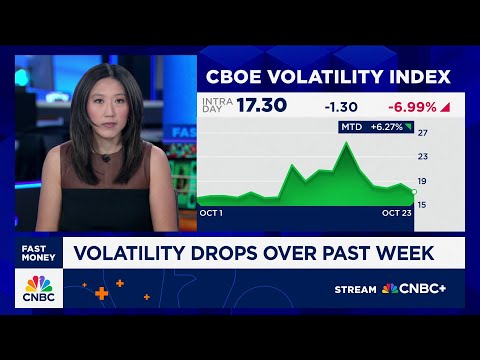
Market volatility reflects AI trade anxiety ahead of Mag 7 earnings, says Cboe's Xu
CNBC Television· 2025-10-23 21:56
Volatility Analysis - SIBO Global Markets notes that individual stocks exhibit higher volatility compared to the overall market index [2] - The spread between the single stock volatility index (VIX EQ) and the broad market volatility index (VIX) recently reached an all-time high, indicating heightened anxiety around earnings and valuations, particularly for high-flying AI and tech stocks [3][4] - The VIX EQ index primarily reflects the volatility of the top 80-90 stocks in the S&P 500 by market cap, excluding meme stocks with extraordinary volatility [7] Options Market and Investor Sentiment - There has been a noticeable increase in hedging demand, with investors buying downside protection, especially for year-end, to secure year-to-date gains [9] - The one-month options pricing for the SPY ETF (tracking the S&P 500) suggests an expected move of 3% in either direction, with the cost of at-the-money calls or puts being 1-15% of the ETF's value [14][15] - The VIX one-day index, reflecting the next 24 hours, prices in approximately 80 basis points for the upcoming CPI data, indicating relatively low expectations for significant market movement [17] Bond Market and Economic Outlook - The bond market indicates that the Federal Reserve may prioritize a softening labor market over inflation risks, leading to a decline in real rates [12] - The loosening of financial conditions, even before potential Fed rate cuts, has been supporting positive performance across various asset classes [13]
Detrick: The VIX is giving us a really interesting signal
CNBC Television· 2025-10-22 11:30
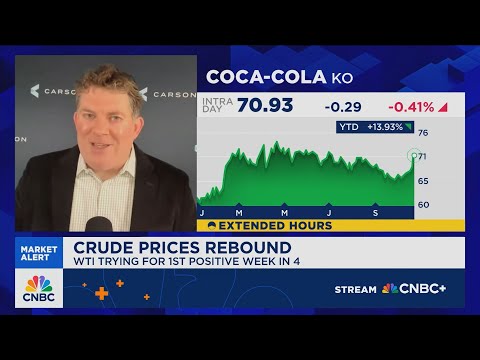
Market Performance & Earnings - Dow Jones outperformed S&P 500 and NASDAQ over the last week and month, partly due to 3M and Coca-Cola earnings [1] - The market is experiencing record earnings and profit margins with continued strong guidance [2] - The market anticipates a good size fourth quarter rally [3] Bull Market Analysis - Since 1950, the average bull market lasts about eight years, and the current bull market is in its fourth year [4] - The shortest bull market lasted 5 years, suggesting the current bull market may continue despite feeling old [5] - High volatility (VIX around 29) with a strong S&P 500 is similar to December 1998 and October 2020, which were good times to consider long equities [5] - A 10-point drop in the VIX in two days historically signals an "all clear" [6] Potential Risks & Concerns - There are cracks in the market, including regional banks and housing [7] - Lending concerns could be a potential speed bump [8] - High yield bonds weakened and regional banks have been lagging [11] Market Indicators - S&P 500's advanced decline line hit an all-time high, which historically peaks and goes lower, indicating potential underlying cracks [9] - Credit spreads are not showing massive stress [10]
SP500: Retail Investor Buys The Dip And Crushes The VIX, Yet Risks Remain High
Seeking Alpha· 2025-10-21 17:51
Core Insights - The article discusses the investment position of the analyst in SPX, indicating a beneficial short position through various financial instruments [1]. Group 1 - The analyst expresses personal opinions regarding SPX and clarifies that no compensation is received for the article, aside from Seeking Alpha [1]. - There is no business relationship with any company mentioned in the article, emphasizing the independence of the analysis [1]. Group 2 - The article highlights that past performance does not guarantee future results, indicating a cautious approach to investment recommendations [2]. - It notes that the views expressed may not reflect those of Seeking Alpha as a whole, suggesting a diversity of opinions among analysts [2].
X @Bloomberg
Bloomberg· 2025-10-19 00:36
South Korean investors are embracing leveraged VIX bets after years of piling into Big Tech and crypto https://t.co/MGpodVtlHy ...
VIX普涨至70%分位,大盘尾部风险预期升高
Xinda Securities· 2025-10-18 08:39
- The report introduces the **Cinda-VIX volatility index**, which reflects investors' expectations of future volatility in the options market. The index is based on methodologies from international practices and adjusted for the characteristics of China's options market. It includes a term structure to capture volatility expectations across different time horizons. As of October 17, 2025, the 30-day Cinda-VIX values for major indices are: 22.97 for SSE 50, 24.07 for CSI 300, 35.47 for CSI 500, and 30.70 for CSI 1000[61][62][63] - The report also discusses the **Cinda-SKEW index**, which measures the skewness of implied volatility across different strike prices of options. This index helps investors understand market expectations regarding the distribution of future returns and potential tail risks. Higher SKEW values indicate increased concerns about significant market downturns. As of October 17, 2025, the SKEW values for major indices are: 103.13 for SSE 50, 102.83 for CSI 300, 99.44 for CSI 500, and 99.76 for CSI 1000[68][72][74] - The report evaluates **four futures hedging strategies** based on CSI 500, CSI 300, SSE 50, and CSI 1000 indices. These strategies include "continuous monthly hedging," "continuous quarterly hedging," and "minimum discount hedging." The strategies are tested over the period from July 22, 2022, to October 17, 2025. Key metrics such as annualized return, volatility, maximum drawdown, net value, annual turnover, and year-to-date returns are analyzed for each strategy. For example, the minimum discount strategy for CSI 500 futures achieved an annualized return of -1.54%, a volatility of 4.60%, and a maximum drawdown of -7.97%[44][47][46] - The **annualized basis adjustment model** is introduced to account for the impact of dividend expectations on futures basis. The formula used is: $ Annualized\ Basis = (Actual\ Basis + (Expected\ Dividend\ Points))/Index\ Price \times 360/Days\ to\ Maturity $ This adjustment ensures that the basis reflects the dividend impact during the contract's lifetime[19][20][21] - The report provides **dividend point forecasts** for the next year for major indices: CSI 500 (81.96), CSI 300 (83.80), SSE 50 (68.34), and CSI 1000 (62.81). Additionally, the dividend points for specific contracts are estimated, such as 2.16 for IC2511, 3.95 for IF2511, 4.91 for IH2511, and 1.19 for IM2511[9][11][15][17] - The **performance of the hedging strategies** for each index is detailed. For example, the minimum discount strategy for CSI 300 futures achieved an annualized return of 1.23%, a volatility of 3.07%, and a maximum drawdown of -4.06%. For SSE 50 futures, the minimum discount strategy achieved an annualized return of 1.73%, a volatility of 3.05%, and a maximum drawdown of -3.91%. For CSI 1000 futures, the minimum discount strategy achieved an annualized return of -4.17%, a volatility of 5.55%, and a maximum drawdown of -11.11%[52][56][58]
