大模型

Search documents
AI 硬件的上半场:失败、共识与进行中的探索
芯世相· 2026-02-26 07:06
Core Viewpoint - The article discusses the evolution of the AI hardware market in China, highlighting the shift from being a follower in global consumer electronics to taking a proactive role in defining future AI hardware products. This transformation is driven by the collaboration between model vendors and traditional hardware manufacturers, as well as elite entrepreneurs with backgrounds in large companies seeking to create native AI hardware solutions [6][20]. Group 1: Market Dynamics - Historically, Chinese companies have played a "follower" role in global consumer electronics, waiting for demand validation before leveraging manufacturing capabilities [6]. - The emergence of DJI has demonstrated that Chinese engineers can lead in new categories by solving novel problems, marking a shift in confidence and capability in AI hardware [6]. - The AI hardware market in China has seen a surge of interest, with two main forces shaping it: alliances between model vendors and traditional hardware, and elite entrepreneurs aiming to create original AI hardware [6][8]. Group 2: Initial Drivers - The initial push in the AI hardware sector was sparked by model vendors seeking commercialization pathways, particularly ByteDance, which catalyzed interest in integrating AI with hardware [8]. - By the end of 2024, ByteDance's model token costs dropped significantly, leading to collaborations with chip manufacturers and hardware solution providers to explore AI integration [8][12]. - The first product to gain traction was an AI toy, which was chosen due to its lower technical requirements and existing market validation [9][12]. Group 3: Market Challenges - Despite initial excitement, the AI toy market faced rapid decline after a peak during the 618 shopping festival, revealing high return rates and low consumer interest beyond initial novelty [14]. - The average usage time for AI toys was found to be less than two months, indicating a lack of sustained demand [14]. - The market quickly became saturated, leading to intense competition and diminishing returns for many companies involved [14][16]. Group 4: Investment Trends - A significant shift occurred in 2025, with investors increasingly favoring AI hardware startups over traditional software projects, driven by the perceived potential for quicker commercialization [20][22]. - Notable investments included Looki and Odyss, which attracted significant funding as investor interest in hardware surged [22][24]. - The consensus among investors is that AI hardware can provide more contextual data in the physical world compared to purely software solutions, leading to a renewed focus on hardware investments [24]. Group 5: Entrepreneurial Exploration - Entrepreneurs in the AI hardware space are divided on whether to focus on AI as a physical carrier or to create smarter consumer hardware with AI capabilities [26]. - Companies like Looki and Lightwear are exploring diverse applications of AI, while others like Odyss focus on specific, practical problems to justify consumer purchases [26][28]. - The challenge remains for these products to establish clear value propositions to consumers, as many current offerings lack compelling reasons for purchase [27][31].



江浙沪县城独生女的科技年
投中网· 2026-02-26 06:27
将投中网设为"星标⭐",第一时间收获最新推送 轮到县城围剿科技财富盛宴了。 作者丨 韦香惠 来源丨 投中网 催婚、催育,这些往年春节餐桌上的"保留节目",今年几乎一夜之间失声。取而代之的,是机器人、具身智能和大模型。这样的转向放在北上广深或许 顺理成章,但发生在我所在的江苏小县城,多少让人感到诧异。 春节期间走亲访友,话题不时绕到我的工作,几位长辈竟然主动聊起我写的科技类报道。大舅关心的是"现在买哪只股票更有机会",小姨则替堂妹打 听"文科生毕业后能不能进AI大厂"。那一刻,我一边受宠若惊,一边也真切感受到某种情绪的涌动。每个人都在想尽办法加入到这场科技创新的盛宴当 中。 这或许是2026年春晚效应的外溢。这一年春晚可能是有史以来春晚科技含量最高的一届。多家具身智能公司,在同一时间窗口,面向14亿观众,集中 展示自己的机器人产品。其实不光具身智能,元宝、千问、豆包掀起的"红包"大战,也成为了大家新的谈资,进一步加速了AI在下沉市场的普及和应 用。 撒钱总是最有效的方式。 比如当时元宝发10亿红包,千问帮你买奶茶,我是实实在在薅了几十块的羊毛和两杯奶茶。中国太大了,不要小看这几十块钱的威力,它意味着两杯奶 茶, ...

蚂蚁阿福,为啥不是王小川最先做出来?
Sou Hu Cai Jing· 2026-02-26 05:57
Core Insights - The article discusses the contrasting fortunes of AI companies in the medical field, particularly focusing on Baichuan Intelligence and Ant Group's Aifu, highlighting the challenges faced by specialized firms against generalist giants [2][3][20]. Group 1: Market Dynamics - Baichuan Intelligence, led by Wang Xiaochuan, is recognized for its deep understanding of the medical sector, yet it struggles to produce a standout product in the medical AI space [2][3]. - Ant Group's Aifu, despite its financial background, has rapidly gained traction in the medical application market, showcasing a significant user growth and effective pre-diagnosis suggestions [3][20]. - The emergence of Aifu raises questions about why a company with extensive medical resources like Baichuan has not achieved similar success, suggesting a harsh reality in the AI landscape where foundational model capabilities are crucial [3][20]. Group 2: Model Capabilities - The article emphasizes that the effectiveness of AI models is not solely dependent on the quantity of medical data but rather on the foundational model's capabilities, likening it to a high-stakes examination where foundational knowledge determines success [6][8]. - A comparison is made between two hypothetical students, illustrating that a strong foundational model (like Ant's Qwen series) can outperform a specialized model with weaker logic capabilities [7][10]. - The article argues that Baichuan's reliance on accumulating medical data without a strong foundational model limits its potential, as seen in the competitive landscape dominated by companies with superior foundational capabilities [8][9]. Group 3: Industry Challenges - The medical AI sector is characterized by a low tolerance for errors, similar to the financial industry, which gives Ant Group an advantage due to its rigorous standards for accuracy [11][12]. - Aifu benefits from being integrated into a comprehensive ecosystem (Alipay), allowing it to address real medical needs directly, unlike Baichuan, which lacks such a direct connection to users [12][13]. - The financial backing and resources of Ant Group enable it to rapidly iterate and improve its models, creating a significant competitive edge over smaller firms like Baichuan [14][15]. Group 4: Future Directions - The article suggests that vertical-focused companies must rethink their strategies, moving away from data accumulation towards enhancing algorithmic efficiency and embracing top-tier foundational models [16][17]. - The future of medical AI will depend on the integration of strong foundational logic with industry-specific applications, emphasizing the need for a robust coupling of these elements [17][18]. - The narrative concludes that the competition in AI is evolving, with a clear indication that the distinction between sectors like medical and financial will blur as general AI capabilities advance [21][22].

大/小/微模型赋能先进制造:实践与思考
大连理工大学机械工程学院· 2026-02-26 05:15
Investment Rating - The report does not explicitly state an investment rating for the industry. Core Insights - The report emphasizes the significance of AI4M (Artificial Intelligence for Manufacturing) as a core technology in Industry 4.0, highlighting its role in enhancing manufacturing processes and efficiency [12][14]. - The report outlines various national strategies aimed at advancing manufacturing through AI, including China's "Made in China 2025" and the U.S. "National Advanced Manufacturing Strategy" [10][12]. - AI4M is identified as a key driver for innovation and competitiveness in the manufacturing sector, with a focus on integrating AI technologies into production systems [8][12]. Summary by Sections 1. Background Significance of AI4M - Advanced manufacturing is defined as the use of high-tech and advanced equipment to improve manufacturing processes and productivity, serving as a crucial indicator of a country's technological development [8]. - The report references global initiatives, such as "Made in China 2025" and the U.S. strategy, which aim to enhance the manufacturing sector through technological advancements [10][12]. 2. Basic Knowledge of AI4M - AI4M encompasses various AI technologies that can be applied throughout the manufacturing lifecycle, fundamentally reshaping traditional manufacturing practices [14]. 3. Research Progress of AI4M - The report discusses the evolution of AI technologies and their integration into manufacturing, noting significant advancements in machine learning and data analytics that facilitate smarter manufacturing solutions [19][22]. 4. Case Studies of AI4M - Several case studies are presented, showcasing successful implementations of AI technologies in manufacturing settings, demonstrating tangible benefits such as increased efficiency and reduced operational costs [12]. 5. Bottlenecks in AI4M - The report identifies challenges in the widespread adoption of AI4M, including technological limitations, workforce readiness, and the need for robust data infrastructure [12]. 6. Scientific Issues in AI4M - Key scientific questions are raised regarding the optimization of AI algorithms for manufacturing applications and the integration of AI with existing manufacturing systems [12]. 7. Development Directions of AI4M - Future directions for AI4M are proposed, focusing on enhancing AI capabilities, fostering collaboration between industry and academia, and promoting policy support for AI integration in manufacturing [12]. 8. Thoughts and Conclusions - The report concludes with reflections on the transformative potential of AI4M in manufacturing, urging stakeholders to embrace AI technologies to remain competitive in the global market [12].
中国医疗AI战事:十年To B血泪史,从改变医生转向亲近患者
Xin Lang Cai Jing· 2026-02-26 04:14
Core Insights - Ant Group's AI product, Aifu, is making significant strides in the healthcare sector by directly engaging consumers, marking a shift from traditional B2B models to a more consumer-oriented approach in the AI healthcare landscape [2][5] - The Chinese government is actively promoting the integration of AI in healthcare, with plans to establish a comprehensive data infrastructure by 2027, which will facilitate the growth of AI applications in the sector [3][4] - The competitive landscape is intensifying, with major players like Ant Group and Baichuan vying for dominance in the consumer-facing AI healthcare market, indicating a potential shift in how healthcare services are delivered [5][6] Group 1: Ant Group's Strategy - Ant Group has invested several billion yuan in marketing Aifu, resulting in over 100 million users, with a significant portion of new users coming from lower-tier cities [1] - The company aims to integrate its existing online healthcare services with Aifu, providing users with health consultations and recommendations for medical facilities, which could lead to new business models [5][6] - Ant Group's rapid actions in talent acquisition and product development reflect its commitment to becoming a leader in the consumer healthcare AI space [5][6] Group 2: Government Initiatives - The National Health Commission's guidelines for AI in healthcare outline eight key areas for application, aiming for widespread implementation by 2030 [3][4] - The establishment of a personal health insurance cloud is expected to create a vast database of health-related information, which will be crucial for AI applications in healthcare [4] Group 3: Market Dynamics - The healthcare AI market has seen a shift from B2B to B2C, with companies now focusing on direct consumer engagement rather than solely targeting hospitals and healthcare providers [2][5] - Despite the potential for AI to enhance healthcare delivery, there are concerns about the sustainability of business models in the face of regulatory and financial challenges within the healthcare system [11][12] - The competitive landscape is characterized by a mix of established players and new entrants, all seeking to leverage AI technology to improve healthcare outcomes and efficiency [5][6][17]
传阶跃星辰将赴港IPO,最快年内上市
Sou Hu Cai Jing· 2026-02-26 03:04
Group 1 - The company Jueyue Xingchen is considering an IPO on the Hong Kong Stock Exchange, aiming to raise approximately $500 million (around 3.4 billion RMB) [2] - Jueyue Xingchen was founded in 2023 by former Microsoft global vice president Jiang Daxin and has released the Step series of general large model matrices, covering comprehensive capabilities from language to multimodal and reasoning [2] - The company has completed two rounds of financing, with the latest round in January raising over 5 billion RMB, setting a record for the largest single financing in China's large model sector in 2025 [2] Group 2 - Under the leadership of Chairman Yin Qi, the company released its strongest open-source base model, Step 3.5 Flash, which approaches the capabilities of closed-source models in agent scenarios and mathematical tasks [3] - Jueyue Xingchen may become the third large model enterprise to be listed on the Hong Kong Stock Exchange [3]
AI发展日新月异,恒生科技ETF易方达(513010)近12个交易日累计“吸金”超40亿元
Mei Ri Jing Ji Xin Wen· 2026-02-26 02:37
Core Viewpoint - The Hong Kong stock market is experiencing short-term adjustments, with the Hang Seng Technology Index down by 1.4% and the China Securities Hong Kong Stock Connect Internet Index down by 0.9% as of 10:20 AM on February 26 [1] Group 1: AI Development and Market Trends - The rapid development of AI is leading to strong demand for computing power, driven by continuous upgrades of large models [1] - The commercial monetization path for large models is transitioning from a "low-cost/free user acquisition" phase to a "high-quality paid" phase [1] Group 2: Index and Valuation Insights - The Hang Seng Technology Index consists of the 30 largest stocks related to technology themes listed in Hong Kong, balancing both "hard technology" and "soft technology" [1] - The China Securities Hong Kong Stock Connect Internet Index focuses on Hong Kong internet platform companies, gathering core Chinese AI enterprises [1] - Both indices have rolling price-to-earnings ratios below 25 times, positioned at the 21.3% and 14.5% percentiles since their inception [1] Group 3: Investment Products and Market Activity - Investment products such as the E Fund Hang Seng Technology ETF (513010) and the E Fund Hong Kong Stock Connect Internet ETF (513040) track the aforementioned indices, facilitating investor access to the Hong Kong technology sector [1] - The E Fund Hang Seng Technology ETF (513010) has seen a net inflow of over 4 billion yuan over the past 12 trading days, with a total size reaching 30.7 billion yuan [1]
港股半导体、科网股,集体上涨
Di Yi Cai Jing Zi Xun· 2026-02-26 01:48
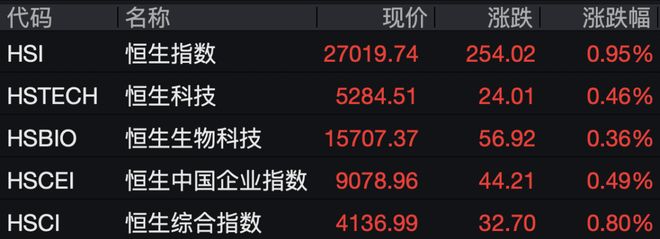
Market Overview - The Hang Seng Index opened up by 0.95%, reaching 27,019.74, with an increase of 254.02 points [2] - The Hang Seng Technology Index rose by 0.46%, closing at 5,284.51 [2] Sector Performance - The technology sector saw a general increase, with notable gains from JD Health, which rose over 2%, and other major companies like Tencent, SMIC, Alibaba Health, Kuaishou, and Baidu also experiencing collective gains [2] - The semiconductor sector strengthened, with companies like Zhaoyi Innovation increasing by over 3%, alongside other firms such as Lattice Semiconductor and Tianxu Zhixin also showing positive performance [3][4] Individual Stock Highlights - JD Health: Current price at 58.30, up by 2.82% [3] - Tencent Holdings: Current price at 529.00, up by 1.24% [3] - Zhaoyi Innovation: Current price at 425.00, up by 3.01% [4] - MINIMAX-WP: Current price at 779.00, up by 3.38% [5] Emerging Trends - The large model concept stocks collectively rose, with companies like Zhiyu and MINIMAX-WP both increasing by over 3% [5]





印奇刚挂帅,阶跃星辰被曝赴港IPO,最早今年
3 6 Ke· 2026-02-26 00:12
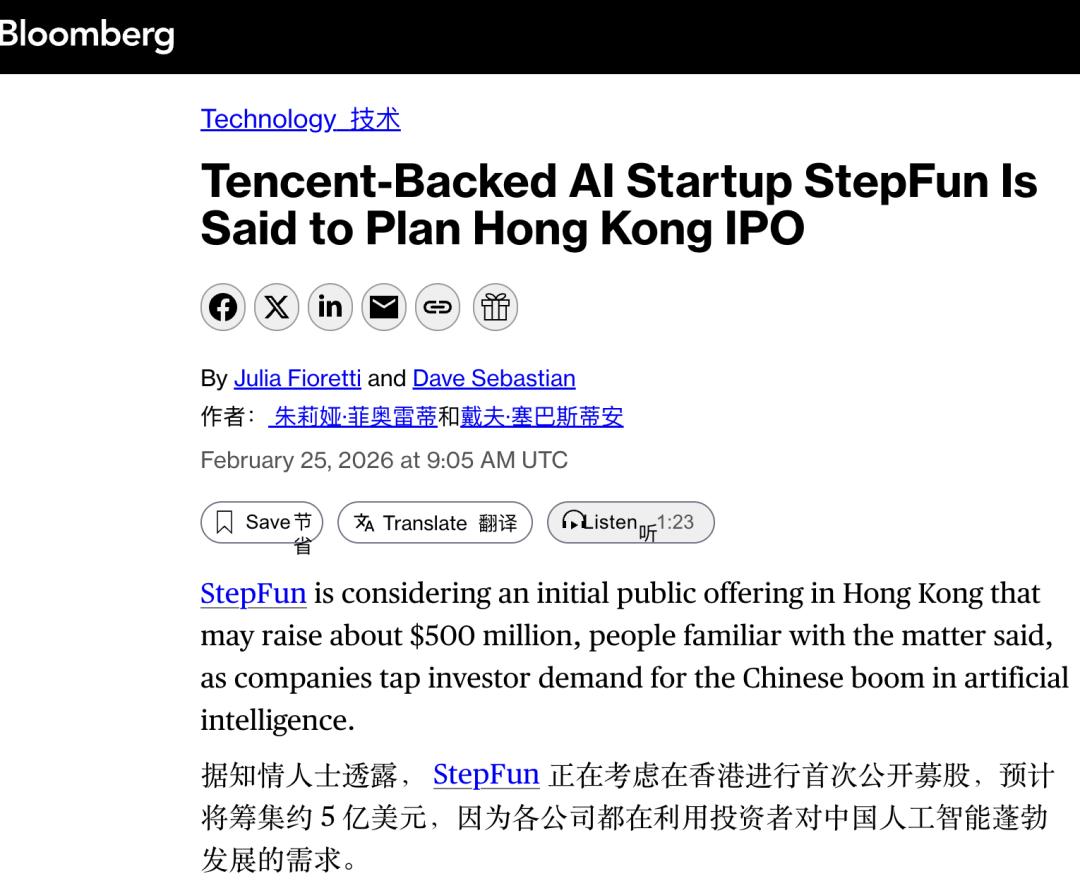
Core Viewpoint - Shanghai-based AI startup Jieyue Xingchen is considering an IPO on the Hong Kong Stock Exchange, aiming to raise approximately $500 million (around 3.4 billion RMB) [1] Company Overview - Jieyue Xingchen was founded in 2023 by former Microsoft global vice president Jiang Daxin and has released the Step series of general large models, covering language, multimodal, and reasoning capabilities [3][5] - The company has received significant funding, including over 5 billion RMB in a Series B round in January 2026, marking the highest single financing record in China's large model sector for 2025 [5][6] Recent Developments - The company recently launched its latest open-source MoE model, Step 3.5 Flash, which competes with top closed-source models in complex tasks and has received positive feedback from developers [3][5] - In January 2024, the company appointed Yin Qi, co-founder of Megvii Technology, as chairman to oversee strategic direction and technology [3] Market Context - Jieyue Xingchen could become the third large model enterprise to list on the Hong Kong Stock Exchange, following the IPOs of Zhiyu and MiniMax, which raised over 4.3 billion HKD (approximately 3.8 billion RMB) and 5.54 billion HKD (approximately 4.9 billion RMB) respectively [8]
谷歌封杀OpenClaw?封号、薅羊毛与巨头焦虑
3 6 Ke· 2026-02-26 00:01
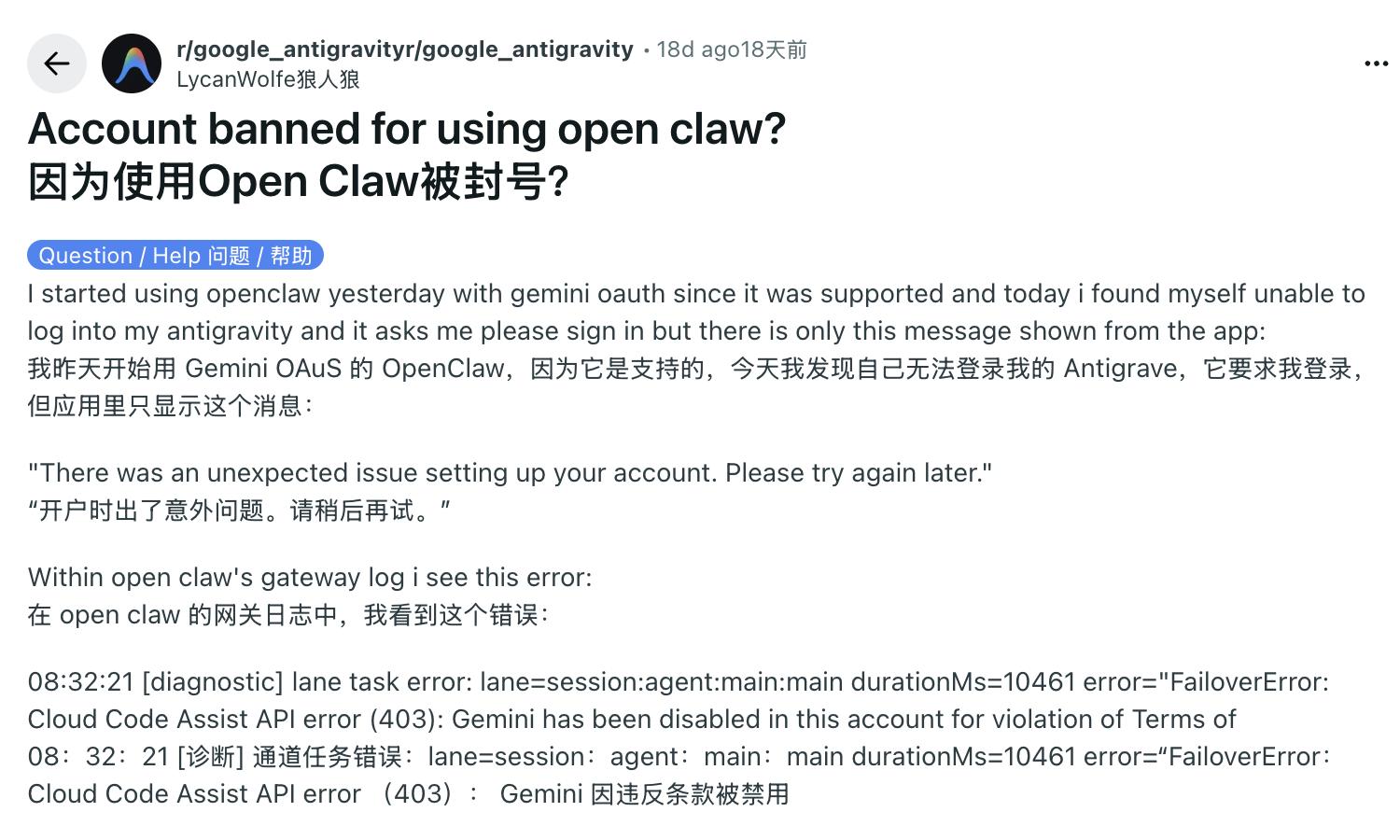
Core Viewpoint - The recent actions by Google to ban accounts using OpenClaw to access its AI services have sparked significant backlash from users, raising questions about the company's decision-making and user communication strategies [1][4][5]. Group 1: Google’s Actions and User Reactions - Google has implemented widespread account bans for users accessing its AI services through OpenClaw, leading to user frustration and criticism on platforms like Reddit and X [1][2][4]. - Many users reported being unable to log into their accounts after using OpenClaw, with some receiving vague error messages without prior warning about potential violations [2][4][5]. - The founder of OpenClaw, Peter Steinberger, criticized Google's harsh measures and noted that other companies, like Anthropic, have been more cooperative in addressing similar issues [4][6]. Group 2: OAuth Authorization Abuse - The primary trigger for Google's account bans is identified as "OAuth authorization abuse," where users exploit the authorization mechanism to access services without proper payment [5][7]. - OAuth allows users to grant third-party applications access to their accounts without sharing passwords, but its misuse has led to significant service quality issues for Google [7][11]. - The combination of OpenClaw and OAuth has enabled users to utilize Google’s AI services in a cost-effective manner, undermining the traditional subscription and API payment models [11][12]. Group 3: Competitive Landscape and Industry Response - In contrast to Google’s restrictive approach, Chinese AI companies are embracing OpenClaw, integrating it into their products and enhancing user experience [17][25]. - The recent release of domestic AI models, such as Kimi K2.5, has positioned them as strong competitors in the AI landscape, focusing on capabilities that align with the needs of intelligent agents [24][25]. - The differing strategies between Google and Chinese firms highlight a fundamental divergence in how AI services are structured, with Google favoring tight integration and control, while Chinese companies adopt a more open and service-oriented approach [25].