
Agent时代

Search documents
腾讯龙虾化战略:All in Agent时代:传媒
Huafu Securities· 2026-03-30 06:30
Investment Rating - The industry rating is "Outperform the Market," indicating that the overall return of the industry is expected to exceed the market benchmark index by more than 5% in the next 6 months [13]. Core Insights - Tencent is fully implementing its "Lobsterization" strategy, focusing on the "All in Agent" era, which emphasizes the development of AI agents and their integration into its product ecosystem [2][3]. - The WeChat ClawBot serves as a super entry point for agents, compatible with mainstream OpenClaw products, leveraging WeChat's massive user base to capture the AI agent market [4]. - QClaw and WorkBuddy are the two main products under Tencent's agent strategy, with QClaw focusing on low-threshold deployment of OpenClaw and WorkBuddy providing a secure agent framework with task management capabilities [4][5]. Summary by Sections Industry Dynamics - Since March, Tencent has launched a comprehensive "Lobster" product matrix, including the WeChat ClawBot plugin and the QClaw and WorkBuddy products, indicating a strong push into the AI agent space [3][4]. Agent Super Entry Point - The WeChat ClawBot is designed to connect with all OpenClaw products, aiming to dominate the user entry point in the AI agent era, supported by WeChat's traffic advantage [4]. Agent Product Base - QClaw aims to simplify the deployment of OpenClaw with features like one-click installation and a visual interface, while WorkBuddy offers two operational modes for task management, enhancing user interaction and security [4][5]. Skill Store - Tencent is developing SkillHub, a localized skills marketplace that mirrors the OpenClaw ecosystem, optimizing user experience for Chinese users and launching over ten official skills to enhance its software ecosystem [6].

Claude龙虾化: Agent时代的苹果
Huafu Securities· 2026-03-29 13:49
Investment Rating - The industry rating is "Outperform the Market," indicating that the overall return of the industry is expected to exceed the market benchmark index by more than 5% in the next 6 months [13]. Core Insights - Claude is continuously launching new features, showcasing a "lobsterization" characteristic, which enhances its capabilities in remote control and task scheduling [2][3]. - The introduction of Dispatch and Channel represents a dual-track layout for remote control, with Dispatch focusing on secure one-to-one encrypted remote control and Channel extending control through IM channels like Telegram and Discord [4][5]. - The new Computer Use feature adds visual control capabilities, allowing Claude to operate any graphical interface application, thus broadening its operational scope [5][6]. - The Schedule and Auto Mode features enable natural language scheduling for tasks and automated permission reviews, enhancing user experience while maintaining security [6]. Summary by Sections Industry Dynamics - Since mid-March, Claude has introduced multiple new features, addressing previous shortcomings compared to OpenClaw in areas such as remote control and task scheduling [3]. Remote Control - Dispatch offers a secure one-to-one encrypted remote control solution, with user commands sent through the Claude App to the Anthropic cloud for task planning [4]. - Channel utilizes a whitelist mechanism to extend control to IM channels, ensuring lower risk through mandatory manual confirmation for high-risk operations [5]. Agent Capability Enhancement - The Computer Use feature now includes visual control, allowing it to interact with various software applications directly, creating a complementary relationship with code control [5][6]. Scheduling and Automation - The Schedule feature allows users to input natural language commands for task scheduling, while Auto Mode automates permission reviews to balance freedom and risk [6]. Investment Recommendations - The report expresses optimism about Claude's growth potential as a closed-source "Apple" in the Agent era, emphasizing the value of the overseas computing power supply chain and the domestic Agent entry points based on OpenClaw [7].
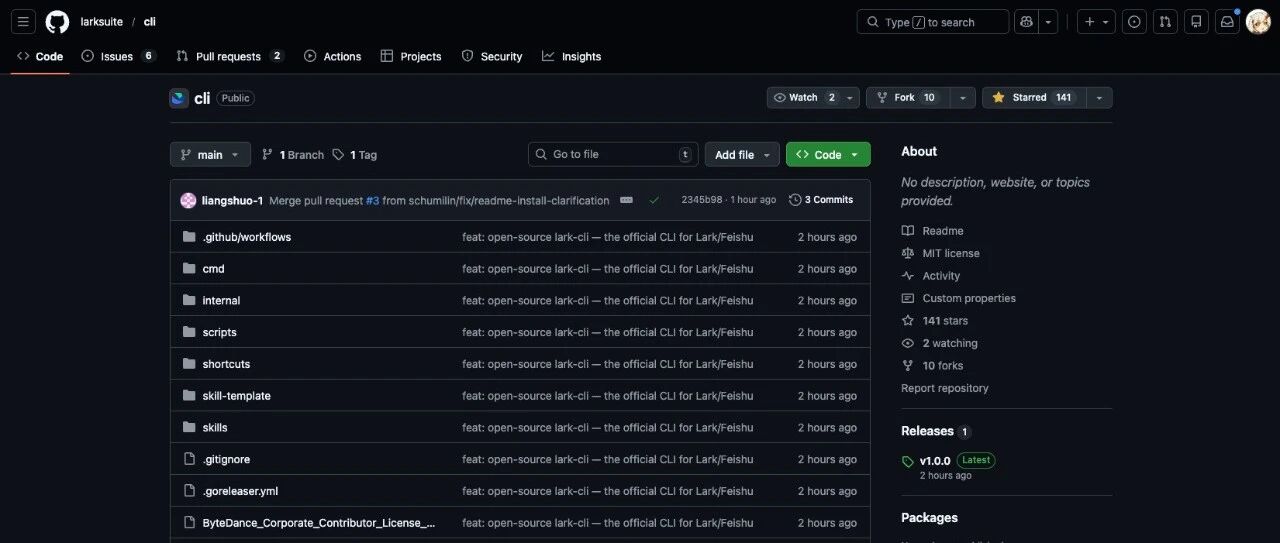
刚刚,飞书CLI开源,Claude Code也可以丝滑操控飞书了。
数字生命卡兹克· 2026-03-28 09:23
Core Viewpoint - The article discusses the significance of Lark (Feishu) open-sourcing its Command Line Interface (CLI), marking a transformative shift in how users interact with the software, particularly emphasizing the role of AI agents in this new paradigm [1][30]. Group 1: Significance of Lark CLI - The open-sourcing of Lark CLI is compared to the day OpenClaw first integrated with Lark, highlighting its importance in the evolution of productivity tools [1]. - Lark CLI allows users to interact with their data and information in a new, streamlined way, emphasizing a shift from graphical user interfaces (GUI) to command line interfaces (CLI) [3][4]. Group 2: Future of Software Interaction - The article posits that all products will evolve into two forms: GUI for general users and CLI for developers and AI [5][6]. - CLI is described as being inherently more suitable for AI manipulation, allowing for more efficient and direct interactions with software [21][22]. Group 3: User Experience and Design - The transition from GUI to CLI is framed as a response to the needs of AI agents, which require straightforward command-based interactions rather than complex graphical interfaces [60][61]. - The article critiques traditional UX design principles, suggesting that the focus should shift towards creating interfaces that facilitate AI operations [60][62]. Group 4: Practical Applications of Lark CLI - The article provides examples of how Lark CLI can be utilized to automate tasks, such as sending messages to colleagues or analyzing data, showcasing its efficiency [48][54]. - It emphasizes the ease of installation and configuration of Lark CLI, making it accessible for users to integrate into their workflows [31][37]. Group 5: Broader Implications - The author suggests that if all software could be CLI-enabled, it would lead to a realization of a highly efficient AI assistant, transforming the way users interact with technology [72][76]. - The article concludes with a vision of a future where software is designed with AI in mind, fundamentally changing the landscape of productivity tools [68][70].

国信证券晨会纪要-20260325
Guoxin Securities· 2026-03-25 02:50
Macro and Strategy - In March 2026, net capital outflow totaled 33.9 billion yuan, contrasting with a net inflow of 13 billion yuan in the previous week [7] - Short-term sentiment indicators are at a mid-high level since 2005, while long-term sentiment indicators are at a mid-low level [8] - The highest trading volume sectors in the past week were power equipment, communication, and semiconductors, while textiles, real estate, and food processing had the lowest [8] Computer Industry - Alibaba Cloud reported Q3 FY2026 revenue of 43.284 billion yuan, a year-on-year increase of 36%, with external commercialization revenue growing by 35% [9] - AI-related product revenue has seen triple-digit growth for ten consecutive quarters, with a target of exceeding 100 billion USD in annual revenue from cloud and AI commercialization over the next five years [9] - The growth driver for Alibaba Cloud has shifted from internal support to a resonance of internal and external demand, confirming a structural upward trend driven by AI [9] Internet Industry - Tencent's QClaw has officially entered public testing, and Xiaomi has launched three large models aimed at the Agent era [10] - The AI sector is witnessing significant investments, with major companies increasing their capital expenditures, talent recruitment, and marketing expenses related to AI [11] - The report suggests maintaining observation on internet giants, particularly those leading in large models and computing power supply chains [11] Gold Mining Industry - Zijin Mining International reported a revenue of 5.383 billion USD for 2025, a year-on-year increase of 80.05%, with a net profit of 1.602 billion USD, up 232.71% [12] - The company plans to produce approximately 59.2 tons of gold in 2026, a 26% increase from 2025, not accounting for potential acquisitions [13] - The report highlights the company's focus on both organic growth and external acquisitions to sustain rapid growth in gold production [13] Real Estate and Asset Management - China Merchants Jinling reported a revenue of 19.27 billion yuan for 2025, a 12.2% increase, but a net profit decline of 22.1% due to one-time impairments [15] - The property management segment achieved a revenue of 18.6 billion yuan, growing by 12.8%, while asset management revenue slightly decreased [15] - The company secured new contracts worth 4.48 billion yuan in the residential sector, marking a 59.6% increase [16] Chemical Industry - Yuntianhua's Q4 2025 revenue was 10.82 billion yuan, down 27% year-on-year, with a net profit decline of 53% due to reduced demand and high raw material costs [18] - The company reported a significant increase in sulfur prices, which pressured profitability, while maintaining a strong cost control capability across its supply chain [19] - The report indicates that Yuntianhua's phosphate rock supply remains tight, supporting its competitive position in the market [19]
OpenClaw 是一场「无限进化」|大湾区龙虾义诊
锦秋集· 2026-03-24 09:46
Core Insights - The article emphasizes the evolution of AI agents and their integration into real-world applications, highlighting the shift from traditional software to agent-centric solutions [2][3][5][7]. Group 1: Investment and Market Trends - The focus has shifted from creating products that people want to those that agents want, indicating a transformation in software development priorities [7]. - The ability to create valuable products is increasingly tied to the creator's taste and judgment rather than just technical skills, leading to a potential oversaturation of low-quality AI outputs [9]. - The milestone of 1 billion tokens consumed signifies a shift in perspective for investors, moving from passive observation to active engagement with digital products [10][11]. Group 2: AI Context and Decision-Making - The integration of various data sources into AI systems enhances their contextual understanding, allowing for more personalized and relevant decision-making [13][14]. - AI systems like OpenClaw can provide nuanced recommendations based on health data and other contextual factors, marking a transition from simple tools to intelligent assistants [14]. Group 3: Security and Risk Management - OpenClaw faces significant security risks, with 82 disclosed CVE vulnerabilities and over 469,000 public instances exposed to potential threats [20]. - Major security risks include excessive permissions, prompt injection, and malicious skills, necessitating a focus on security measures such as the principle of least privilege and zero trust [21][22]. Group 4: Ecosystem Development - The article discusses the transition from leveraging human labor to harnessing agent productivity, with a vast potential for growth in the agent ecosystem [26][27]. - A robust entrepreneurial support system is crucial for startups aiming to develop secure and optimized AI products [29]. Group 5: Context as a Key Element - The article posits that the future of software development lies in the ability to create systems through natural language, eliminating traditional coding barriers [32]. - The distinction between ToB and ToC AI applications highlights the need for enterprise-level AI tools to deliver clear efficiency value without trial and error [33]. Group 6: Future Outlook - The article suggests that 2023 may be a pivotal year for the transition from single-agent to multi-agent systems, with significant investments in various agent-native applications [42].

OpenAI桌面SuperApp:ChatGPT+Browser+Codex三合一
海通国际· 2026-03-22 14:51
Investment Rating - The report does not explicitly provide an investment rating for the industry or specific companies involved. Core Insights - OpenAI plans to create a desktop super app that integrates ChatGPT, the Atlas AI browser, and Codex into a single product to enhance user experience and reduce internal inefficiencies amid increasing competition in AI coding and agent-based applications [1][6]. - This integration aims to form a closed task loop for users, combining conversation, workflow execution, and information retrieval, which were previously developed as separate products [2][7]. - The move signals a shift in AI competition from model capabilities to operating-system-level entry points, with the potential to dominate high-frequency user interactions [3][9]. - The evolution of coding tools into general-purpose agent capabilities is highlighted by the rapid growth of Codex and OpenAI's acquisition of Astral to enhance its developer ecosystem [3][9]. - The super app format is expected to improve delivery efficiency and account value for enterprise clients, as demand shifts from simple Q&A to more complex scenarios [3][9]. Summary by Sections Event - OpenAI is developing a desktop super app that combines ChatGPT, Atlas, and Codex to streamline user experience and enhance productivity [1][6]. Commentary - The integration of high-frequency desktop capabilities into a unified workspace aims to reduce context switching for users [2][7]. - The product timeline shows continuity in development, with Codex's launch and subsequent enhancements leading to the current super app initiative [2][8]. Industry Signals - The integration indicates a competitive shift towards operating-system-level entry points in AI, with the potential for significant user engagement [3][9]. - The evolution of coding tools into general-purpose agents is underscored by OpenAI's strategic acquisitions and growth in user engagement [3][9]. - A unified desktop entry point is anticipated to enhance enterprise delivery efficiency and reduce tool-switching costs [3][9]. Defensive Strategy - OpenAI's integration of chat, coding, and browsing reflects a defensive strategy against rising competition in the AI coding space [4][10]. - The super app aims to create a robust platform for developers and enterprise users, enhancing workflow stickiness and data accumulation [4][10]. Long-term Vision - OpenAI's push towards a desktop super app is seen as a strategic move to capture the next-generation productivity entry point in the AI era [4][11]. - The initiative is expected to strengthen user retention and increase average revenue per user (ARPU) across high-value scenarios [4][11].
黄仁勋:龙虾就是新操作系统,英伟达7种芯片拼出算力怪兽,放话2027营收万亿美元
3 6 Ke· 2026-03-17 07:27
Core Insights - NVIDIA's GTC 2026 showcased a significant shift in the AI industry, with CEO Jensen Huang emphasizing the company's projected revenue of at least $1 trillion by 2027, up from $500 billion last year [4][12][36] Group 1: Event Overview - The GTC 2026 featured 450 sponsoring companies, 1,000 technical sessions, 2,000 speakers, and 110 robots, resembling an annual pilgrimage for the AI industry rather than a typical tech conference [1] - Huang's keynote included a historical overview of NVIDIA's technology evolution, from the GeForce graphics card to the current AI advancements [4][36] Group 2: Token Economy - Huang introduced a comprehensive business model based on token economics, highlighting different pricing tiers for token usage, ranging from free access to $150 per million tokens for advanced tasks [9][12] - The model emphasizes the importance of token throughput and generation rates, which are critical for AI performance [9][12] Group 3: Technological Advancements - The new Vera Rubin AI computing system is described as NVIDIA's most complex, featuring seven types of chips and achieving 3.6 exaflops of computing power [15][20] - Innovations include a 100% liquid cooling solution and the introduction of Co-Packaged Optics (CPO) technology, which enhances data transmission efficiency [21][24][25] Group 4: Integration of Groq - NVIDIA's acquisition of Groq aims to enhance AI inference capabilities, with Groq's architecture designed for high-speed processing, complementing NVIDIA's GPU offerings [29][31] - The integration strategy involves separating inference tasks between Groq and Vera Rubin to optimize performance [33][35] Group 5: Future Developments - Huang announced the upcoming Feynman architecture, which will introduce new GPUs, LPUs, and CPUs, emphasizing the need for higher capacity and bandwidth in future computing solutions [44][47] - The company is also exploring the concept of "space computing" with plans for a data center in space, addressing unique challenges such as heat dissipation in a zero-gravity environment [49][50]


——计算机行业周报(03.09-03.15):OpenClaw破圈:Agent时代的催化剂-20260315
Xiangcai Securities· 2026-03-15 07:21
Investment Rating - The report maintains a "Buy" rating for the computer industry [7][11]. Core Insights - OpenClaw is seen as a catalyst for the AI industry moving towards the Agent era, enhancing public awareness of the Agent concept and reshaping the commercialization path for large model vendors [2][11]. - The introduction of OpenClaw has created new consumption scenarios for models, significantly increasing C-end users' willingness to pay for personal assistant functionalities [4][11]. - The Agent model is expected to drive a new wave of demand for computing power, as the token consumption per user will be significantly higher than traditional dialogue scenarios, impacting the cloud computing supply-demand landscape [5][11]. Summary by Sections OpenClaw's Impact - OpenClaw has successfully transitioned from a niche technology to mainstream awareness, marking a significant shift in the AI landscape [2][3]. - It enables AI to perform complex tasks across platforms, evolving from a simple information tool to a productivity tool that users can directly interact with [3][4]. Market Review - The Shenwan Computer Index fell by 0.92%, ranking 17th among Shenwan's primary industries [18]. - The overall PE-TTM for the Shenwan Computer Industry was reported at 54.7 as of March 13, 2026 [25]. Investment Recommendations - Focus on domestic large model vendors that have high consumption ratios within the OpenClaw ecosystem, as their API call volumes and token revenues are expected to grow rapidly [11][28]. - Attention should be given to leading cloud service providers that offer one-click deployment solutions for Agents and control application distribution [11][28]. - The surge in demand for inference-side computing power will benefit domestic AI chip manufacturers, server providers, and related hardware suppliers [11][28].
从 OpenClaw 到 Alice 27:金融人真正需要的,是能“干”的AI
Wind万得· 2026-03-13 23:34
Core Viewpoint - The article discusses the evolution of AI in the financial industry, emphasizing that the true value lies not in AI's ability to communicate but in its capacity to execute complex financial tasks and deliver results [3][4]. Group 1: Financial AI's Distinction - The critical distinction for financial AI is its ability to "do" rather than just "speak," highlighting the need for AI to integrate with financial data, tools, methodologies, and workflows to produce actionable outcomes [4][5]. - Financial professionals require a system that can break down complex financial analysis, access data, utilize tools, self-correct, and ultimately deliver results [4][5]. Group 2: Alice 27's Capabilities - Alice 27 is presented as a task execution system tailored for financial scenarios, transforming user inputs into actionable goals rather than simple responses [5][6]. - The introduction of "Skills" in Alice 27 allows financial professionals to encapsulate their methodologies and decision-making processes into reusable systems, enhancing efficiency and consistency in output [5][6]. Group 3: Unique Features of Alice Skills - Alice Skills differentiate themselves by leveraging a wide array of financial tools and resources, enabling users to achieve professional-grade outputs without relying solely on basic search capabilities [7][8]. - The Skills are designed to directly deliver results based on user-defined objectives, moving beyond traditional Q&A formats [8]. Group 4: Practical Applications - The article illustrates practical applications of Alice 27, such as generating investment memorandums and providing tailored fund recommendations based on specific client needs, significantly reducing the time required for analysis [9][10][13]. - The "Bond Yield Trend Analysis" Skill encapsulates the expertise of seasoned bond traders, allowing users to make informed trading decisions based on comprehensive analytical frameworks [16][17]. Group 5: Conclusion - The emergence of Alice 27 signifies a shift in the financial industry towards AI systems that understand professional methodologies, connect with specialized data, and execute complex tasks, marking the beginning of a transformative phase in financial operations [18].

AI产业进程点评:“西虾东养”:OpenClaw的中美发展对比
Guolian Minsheng Securities· 2026-03-11 03:17
Investment Rating - The report suggests a positive investment outlook for companies involved in the AI sector, particularly those leveraging OpenClaw and related technologies, indicating a potential for significant revenue growth from API calls and model applications [3][11]. Core Insights - The emergence of OpenClaw has sparked a "lobster craze" in China, with domestic companies rapidly adopting and localizing the technology, reflecting a shift in AI application dynamics between China and the West [2][3]. - Domestic AI models are significantly cheaper, with API call costs approximately 1/6 of their overseas counterparts, driven by lower electricity costs and competitive pricing among model providers [3][4]. - The report highlights a growing trend of "FOMO" (Fear of Missing Out) among major Chinese tech firms, leading to increased participation in the OpenClaw ecosystem and a focus on capturing new distribution rights in the Agent era [3][9]. Summary by Sections OpenClaw Development - OpenClaw, launched by Zhiyu, offers a local version of the AI model with over 50 pre-installed skills for various applications, emphasizing local deployment and flexibility [2]. - The report notes a diverse deployment strategy among domestic competitors, including local, cloud, and hybrid models, catering to different user needs [2][9]. Market Dynamics - The report identifies a significant increase in token consumption for domestic models, indicating a robust demand for AI applications in China, with recent data showing a steep growth curve [7][9]. - Major tech companies are not only focusing on revenue from Agent business but also on the potential for new user engagement and market expansion through OpenClaw [3][9]. Policy Support - Local governments, such as Shenzhen and Wuxi, are actively promoting OpenClaw through supportive policies, including financial incentives for companies that facilitate its deployment [3][9]. Investment Recommendations - The report recommends focusing on companies with model or application capabilities that are likely to benefit from accelerated API call revenues, such as Minimax and Zhiyu [3]. - It also suggests monitoring platform-based internet companies like Alibaba and Tencent, which possess computational resources and model capabilities [3].