
TRAE

Search documents
字节跳动豆包大模型2.0发布,多数基准达SOTA水平
Sou Hu Cai Jing· 2026-02-14 15:57
Core Insights - ByteDance announced the official launch of Doubao 2.0, which has undergone systematic optimization for large-scale production environments, enhancing its capabilities in efficient reasoning, multimodal understanding, and complex instruction execution [1] Model Features - Doubao 2.0 includes three general agent models: Pro, Lite, and Mini, as well as a Code model, designed to adapt flexibly to various business scenarios [1] - Doubao 2.0 Pro is now available on the Doubao App, desktop, and web versions, allowing users to experience the "expert" mode for interactive dialogue [1] Performance Enhancements - Doubao 2.0 has significantly upgraded its multimodal capabilities, achieving state-of-the-art (SOTA) levels in various visual understanding tasks, with Doubao 2.0 Pro scoring highest in most relevant benchmark tests [2] - The model has improved its understanding of time series and motion perception, leading in key assessments like TVBench and surpassing human scores in the EgoTempo benchmark [4] Long-Range Task Execution - Doubao 2.0 Pro has enhanced long-range task execution capabilities, outperforming GPT 5.2 in SuperGPQA and achieving first place in HealthBench, with overall performance comparable to Gemini 3 Pro and GPT 5.2 in scientific domains [5] - In reasoning and agent capability evaluations, Doubao 2.0 Pro achieved gold medal results in IMO, CMO math competitions, and ICPC programming contests, demonstrating strong mathematical and reasoning skills [5] Cost Efficiency - Doubao 2.0 has reduced inference costs significantly, with model performance comparable to top industry models while lowering token pricing by approximately an order of magnitude [8] Code Model Features - The Doubao 2.0 Code model is optimized for programming scenarios, enhancing code library interpretation and application generation capabilities, and has been integrated into TRAE for improved functionality [9] - An example project, "TRAE Spring Festival Town · Year of the Horse Temple Fair," illustrates the model's ability to construct complex applications efficiently with minimal prompts [9]

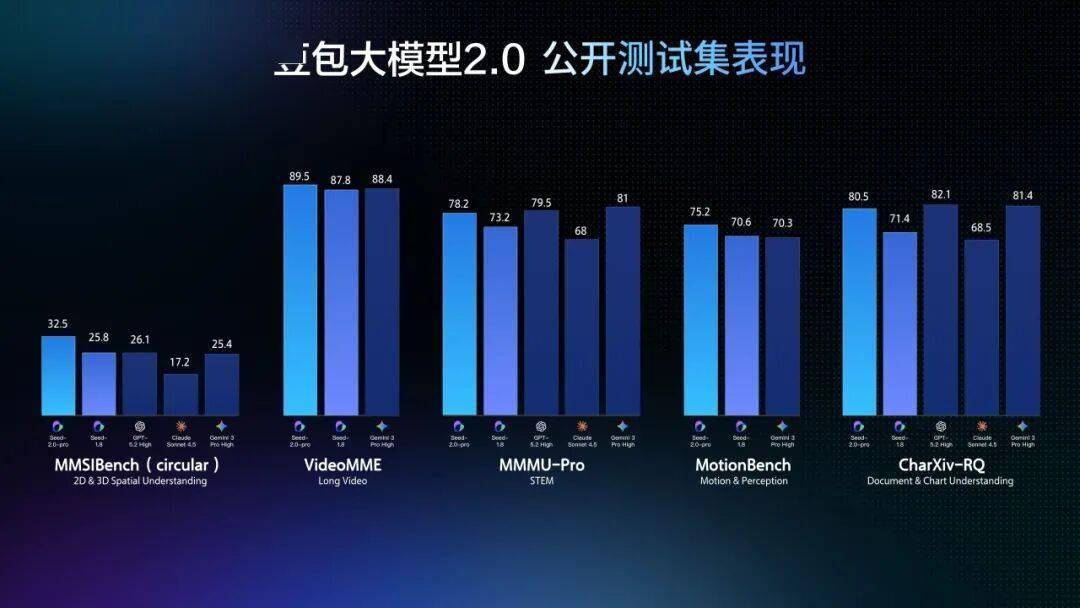
字节豆包2.0发布:推理成本降一个数量级,正面对标GPT-5和Gemini 3
硬AI· 2026-02-14 11:37
Core Viewpoint - ByteDance's Doubao 2.0 has officially entered a new phase, launching a systematic upgrade version aimed at the Agent era, significantly reducing reasoning costs while maintaining performance comparable to GPT-5.2 and Gemini 3 Pro [3][12]. Group 1: Model Features - Doubao 2.0 includes three models: Pro, Lite, and Mini, along with a specialized Code model, with the flagship Doubao 2.0 Pro directly competing with GPT-5.2 and Gemini 3 Pro [3]. - The model has achieved top-tier performance in visual understanding benchmarks and has won gold medals in mathematics and programming competitions [3][10]. - Doubao 2.0 has enhanced multimodal capabilities, excelling in visual reasoning, perception, spatial reasoning, and long-context understanding tasks [6]. Group 2: Cost Efficiency - The reasoning cost of Doubao 2.0 has been reduced by approximately an order of magnitude, which is crucial for large-scale reasoning and long-chain generation scenarios [4][12]. - This cost advantage is expected to become a key competitive edge in the commercial application of large models [4]. Group 3: Performance Metrics - Doubao 2.0 Pro outperformed GPT-5.2 in the SuperGPQA benchmark and ranked first in HealthBench, demonstrating strong performance in scientific fields [10]. - The model achieved a score of 54.2 in the HLE-text evaluation and excelled in tool invocation and instruction-following tests [10]. Group 4: Application and Integration - Doubao 2.0 Pro has been integrated into the Doubao App, desktop, and web versions, featuring an "Expert" mode for end-users [17]. - The Code model has been optimized for programming scenarios, enhancing code library interpretation and application generation capabilities, and is now available in the TRAE product [15][17]. - An intelligent customer service agent has been built on the Doubao 2.0 Pro model, capable of handling customer interactions and proactively seeking human assistance when needed [13].

豆包再扔王炸!2.0发布:推理成本降一个数量级,正面对标GPT-5和Gemini 3
华尔街见闻· 2026-02-14 10:53
Core Viewpoint - ByteDance's Doubao model has officially entered the 2.0 phase, offering a systematic upgrade that maintains performance comparable to GPT-5.2 and Gemini 3 Pro while reducing reasoning costs by approximately an order of magnitude, providing a competitive solution for complex tasks in large-scale production environments [2][12]. Group 1: Model Features and Performance - The Doubao 2.0 series includes Pro, Lite, Mini general-purpose agent models, and a specialized Code model, with the flagship Doubao 2.0 Pro achieving top scores in visual understanding benchmarks and winning gold medals in math Olympiads (IMO, CMO) and programming competitions (ICPC) [2][9]. - Doubao 2.0 has significantly upgraded its multimodal capabilities, excelling in tasks such as visual reasoning, perception, spatial reasoning, and long-context understanding [2]. - In dynamic scene understanding, Doubao 2.0 leads in key assessments like TVBench and surpasses human scores in EgoTempo, demonstrating stable capture of changes, actions, and rhythms [4]. - In long video scenarios, Doubao 2.0 outperforms other top models in most evaluations and excels in real-time Q&A video benchmark tests [5]. Group 2: Cost Efficiency and Application - Doubao 2.0 Pro has enhanced long-tail domain knowledge, scoring higher than GPT-5.2 on SuperGPQA and ranking first on HealthBench, with overall performance comparable to Gemini 3 Pro and GPT-5.2 in scientific fields [8]. - The model achieved a top score of 54.2 on HLE-text (Human Last Exam) and demonstrated excellent performance in tool invocation and instruction-following tests [10]. - The significant cost advantage of Doubao 2.0, with token pricing reduced by about an order of magnitude, will be crucial in large-scale reasoning and long-chain generation scenarios [12]. Group 3: Development and Integration - ByteDance has built an intelligent customer service agent on Feishu based on the OpenClaw framework and Doubao 2.0 Pro model, capable of handling customer dialogues and proactively seeking human assistance when faced with challenges [13][14]. - The Doubao 2.0 Code model is optimized for programming scenarios, enhancing code library interpretation and application generation capabilities, and has been integrated into the TRAE product [15][16]. - Developers using TRAE with Doubao 2.0 Code can create interactive projects with minimal prompts, showcasing the model's efficiency in project development [16][17]. - Doubao 2.0 Pro is now available to end-users on the Doubao App, desktop, and web versions, while API services for enterprises and developers have been launched on the Volcano Engine [18].

字节豆包2.0发布:推理成本降一个数量级,正面对标GPT-5和Gemini 3
Hua Er Jie Jian Wen· 2026-02-14 09:29
Core Insights - ByteDance's Doubao model has officially entered its 2.0 phase, offering a systematic upgrade that maintains performance comparable to GPT-5.2 and Gemini 3 Pro while reducing reasoning costs by approximately an order of magnitude, making it a competitive solution for complex tasks in large-scale production environments [1][7] Model Features - The Doubao 2.0 series includes three general-purpose agent models (Pro, Lite, Mini) and a specialized Code model, with the flagship Doubao 2.0 Pro achieving top scores in visual understanding benchmarks and winning gold medals in mathematics and programming competitions [1][5] - Doubao 2.0 has significantly upgraded its multimodal capabilities, excelling in visual reasoning, perception, spatial reasoning, and long-context understanding tasks [2] Performance Metrics - In dynamic scene understanding, Doubao 2.0 leads in key assessments like TVBench and surpasses human scores in EgoTempo, demonstrating stable capture of information related to changes, actions, and rhythms [4] - The model outperforms other leading models in long video scenarios and excels in real-time video question-answering benchmarks, enabling it to function as an AI assistant for real-time video stream analysis and proactive guidance [4] Cost Efficiency - Doubao 2.0 Pro has surpassed GPT-5.2 in SuperGPQA and achieved first place in HealthBench, with overall performance in scientific fields comparable to Gemini 3 Pro and GPT-5.2 [5] - The model's token pricing has been reduced by approximately an order of magnitude, enhancing its competitive edge in large-scale reasoning and long-chain generation scenarios [7] Application and Integration - The Doubao 2.0 Code model has been optimized for programming scenarios, improving code library interpretation and application generation capabilities, and is integrated into the TRAE product [8] - Developers can create interactive projects with minimal prompts, showcasing the model's efficiency in generating complex applications [8] - Doubao 2.0 Pro is now available to end-users through the Doubao App and web platforms, while API services for enterprises and developers have been launched via Volcano Engine [8]
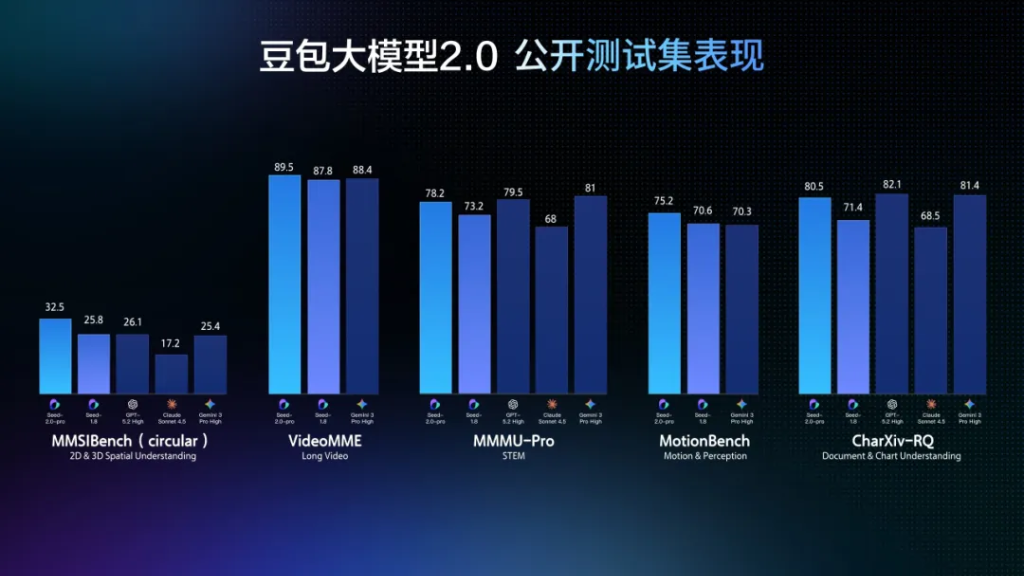
整整21个月,豆包大模型正式进入2.0时代!
量子位· 2026-02-14 08:13
Core Insights - The article discusses the launch of Doubao Model 2.0, which is the largest update in 21 months, showcasing significant advancements in AI capabilities [2][8]. Group 1: Model Enhancements - Doubao Model 2.0 exhibits improvements in multi-modal understanding, enterprise-level agent capabilities, reasoning, and coding skills [9][10]. - The model achieved top scores in various benchmarks, including MathVista and LogicVista, outperforming its predecessor Seed1.8 and competing models like GPT-5.2 and Claude [11][12]. Group 2: Performance Metrics - In mathematical reasoning benchmarks, Doubao Model 2.0 scored 89.8 in MathVista and 90.5 in MathKangaroo, indicating a significant performance boost [11]. - The model also excelled in perception and recognition tasks, achieving 98.6 in VLMsAreBlind and 86.0 in RealWorldQA, showcasing its advanced capabilities [12]. Group 3: Practical Applications - Doubao Model 2.0 demonstrates strong performance in complex tasks such as coding and physics simulations, effectively handling intricate projects like a 3D Monopoly game and interactive applications [16][21]. - The model's enhanced reasoning and coding abilities allow it to solve complex mathematical problems and assist in project completion, indicating its potential for enterprise applications [28][30]. Group 4: Market Positioning - The timing of the Doubao Model 2.0 release suggests a strategic move to capitalize on advancements in data quality and training efficiency, positioning it favorably in the competitive AI landscape [33]. - The model's cost-effectiveness is highlighted, as it maintains high performance without significant delays, making it suitable for enterprise use in customer service and data analysis [35][36].

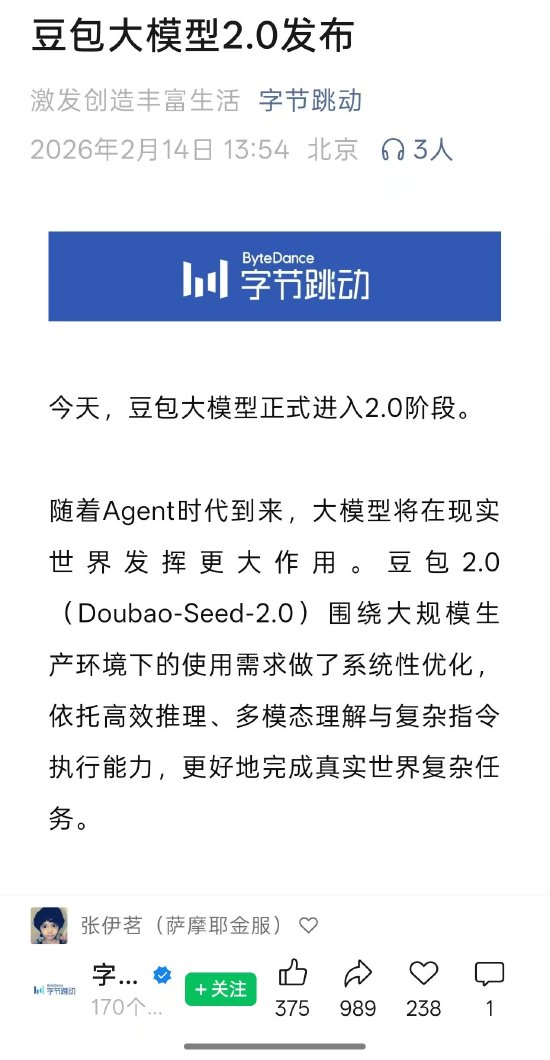
字节跳动:豆包大模型2.0正式发布
Xin Lang Cai Jing· 2026-02-14 06:29
Core Insights - ByteDance officially launched Doubao Model 2.0, which includes Pro, Lite, Mini, and Code models, designed to adapt flexibly to various business scenarios [1][6][4] Model Specifications - Doubao 2.0 Pro targets deep reasoning and long-chain task execution, directly competing with GPT 5.2 and Gemini 3 Pro [1][6] - Doubao 2.0 Lite balances performance and cost, surpassing the capabilities of the previous main model, Doubao 1.8 [1][6] - Doubao 2.0 Mini is optimized for low latency, high concurrency, and cost-sensitive scenarios [1][6] - The Code version (Doubao-Seed-2.0-Code) is specifically designed for programming tasks and works best in conjunction with the AI programming product TRAE [1][6] Availability and Integration - Doubao 2.0 Pro is now available on the Doubao App, desktop, and web versions, allowing users to experience it in 'expert' mode [1][6] - Doubao 2.0 Code has been integrated with the AI programming product TRAE, and the Volcano Engine has launched API services for the Doubao 2.0 series aimed at enterprises and developers [1][6]
年度AI产品十大赛道TOP 3|量子位智库AI 100
量子位· 2026-01-31 07:30
Core Insights - The article discusses the significant evolution of AI products in 2025, highlighting a shift from merely "talking" to "doing" [3][4] - The focus is on the transformation of interaction paradigms and the integration of AI into both digital and physical realms [5][6] - The article introduces the "AI 100" product list, categorizing AI products into flagship and innovative segments, along with five major application categories [6][9] Group 1: AI Product Development - AI products have shown differentiated growth across various sectors, with strong demand in general scenarios and AI efficiency, while AI life products are exploring better user experiences [14] - The common goal across all sectors is moving towards end-to-end delivery of productivity, shifting the value measurement from "how well it answers" to "how completely it delivers" [14][15] Group 2: Flagship AI Products - The "Flagship AI 100" and "Innovative AI 100" categories represent the strongest and most promising AI products, respectively [7][13] - The article outlines ten core tracks for AI applications, including AI smart assistants, AI agents, AI browsers, AI workstations, Vibe Coding, AI education, AI entertainment, AI health, multimodal creation, and AI consumer hardware [9][10] Group 3: AI Smart Assistants - AI smart assistants are the most traffic-intensive and revenue-near segment, evolving from answering questions to solving problems [16] - Top products in this category include: - Doubao from ByteDance, with over 57 million daily active users [18] - DeepSeek, known for its innovative interaction method that showcases AI reasoning [20] - Tencent Yuanbao, integrating various social networks for enhanced user experience [22] Group 4: AI Agents - AI agents have transitioned from mere conversational tools to executing tasks [23] - Notable products include: - Nano AI from 360 Group, which integrates over 80 large models for task execution [24] - Kouzi, a one-stop AI office space from ByteDance, automating complex workflows [26] - Xingliu, a new generation AI creation tool from Singularity Star, facilitating end-to-end creative processes [30] Group 5: AI Browsers - AI browsers are evolving from passive information displays to active task executors [32] - Key products include: - QQ Browser from Tencent, which integrates AI capabilities to understand user intent [33] - Quark from Alibaba, combining search, reading, and creation functionalities [36] - Fellou, focusing on a unified search and task experience [40] Group 6: AI Workstations - The competition in AI workstations has shifted from the number of features to complete workflow integration [41] - Leading products include: - Baidu Wenku, transforming from a document tool to a knowledge productivity platform [42] - Feishu, integrating AI capabilities into team workflows [46] - Tiangong, focusing on enhancing office and creative efficiency [50] Group 7: AI Education - AI education products are evolving to provide personalized tutoring and enhance learning experiences [61] - Top products include: - KuaiDui AI from Zuoyebang, focusing on personalized tutoring [62] - XiaoYuan AI from Yuanfudao, assisting parents and teachers in managing homework [65] - CapWords, an innovative language learning tool [69] Group 8: AI Entertainment - AI entertainment products are exploring how to provide unique value beyond traditional non-AI products [70] - Notable products include: - Kapi Camera, which enhances user photography experiences [73] - Xingye, a platform for emotional companionship and content creation [76] - DouDou Game Partner, focusing on gaming companionship [79] Group 9: AI Health - The AI health sector is cautiously exploring compliance and user experience [80] - Key products include: - Antifufu, a health management assistant from Ant Group [81] - XiaoHe AI Doctor, providing health consultations based on authoritative medical data [85] - OtterLife, a gamified health management product [88] Group 10: Multimodal Creation - AI creation tools are becoming integral to daily workflows for content creators [90] - Leading products include: - Jidream AI, focusing on video creation processes [91] - Liblib AI, a comprehensive AI creation platform [95] - Keling AI, a creative productivity platform leveraging short video and advertising [97] Group 11: AI Consumer Hardware - The AI consumer hardware sector is characterized by rapid innovation and high turnover [98] - Notable products include: - Plaud Note, an AI note-taking tool [99] - Thunderbird V3 AI glasses, integrating various functionalities [102] - CocoMate, an emotional companion toy [107]
Node.js之父:手写代码已死
3 6 Ke· 2026-01-21 11:08
Core Viewpoint - The era of human-written code is coming to an end, as AI is fundamentally changing programming practices and roles within the industry [1][4][14]. Group 1: Key Figures and Contributions - Ryan Dahl, the creator of Node.js, emphasized that the age of human coding is over, having previously revolutionized backend development with his framework [3][4]. - Salvatore Sanfilippo, co-founder of Redis, highlighted that programming has been permanently altered by AI, marking a significant shift in the industry [4][5]. - The AI programming tool Copilot, based on OpenAI Codex, has reportedly accelerated development speed by over 50% [8]. Group 2: AI Programming Trends - AI programming and concepts like Vibe Coding have gained significant traction, with tools like Claude Code enabling full-stack development and optimization [8][9]. - ByteDance's native programming tool TRAE generated 100 billion lines of code in 2025, equivalent to the output of 3 million programmers working continuously for a year [10]. - A Stack Overflow report indicated that 84% of developers use AI tools, with 69% believing these tools enhance productivity [10]. Group 3: Future of Programming Roles - The programming landscape is shifting from syntax-focused coding to intent-driven development, where human roles are evolving from code writers to requirement editors [7][20]. - Despite the rise of AI, industry leaders assert that programmers will not be replaced but will instead focus on maintaining and improving AI-generated code [16][20]. - Linus Torvalds, initially critical of AI-generated code, acknowledged its potential as a valuable entry point for new programmers, reinforcing the idea that human oversight remains essential [18][20].
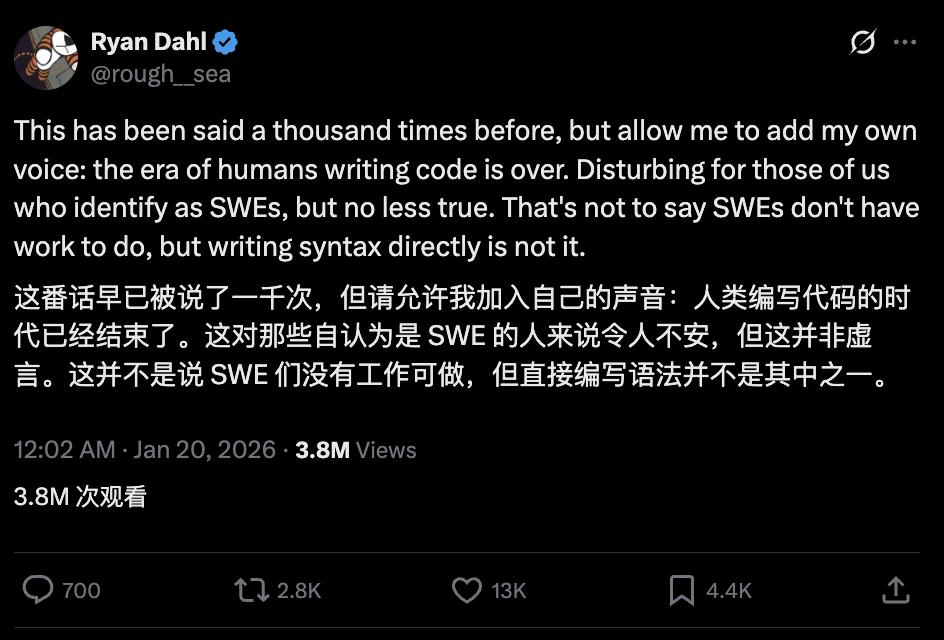
Node.js之父:手写代码已死
量子位· 2026-01-21 10:00
Core Viewpoint - The era of human-written code is coming to an end, as AI programming tools are increasingly taking over coding tasks, fundamentally changing the programming landscape [1][28]. Group 1: Influential Figures and Their Statements - Ryan Dahl, the creator of Node.js, stated that the era of human coding is over, which garnered significant attention with over four million views [2][4]. - Salvatore Sanfilippo, the creator of Redis, echoed this sentiment by asserting that programming has been permanently altered by AI [7][8]. - Linus Torvalds, initially critical of AI-generated code, has shifted his stance, acknowledging the effectiveness of AI in coding while emphasizing that programmers will still be needed for maintenance and oversight [30][34]. Group 2: AI Programming Tools and Their Impact - AI programming tools like OpenAI Codex's Copilot have accelerated development speed by over 50% [15]. - Companies are increasingly adopting AI tools for development, with ByteDance's TRAE generating 100 billion lines of code in 2025, equivalent to the output of 3 million programmers working continuously for a year [22][23]. - A Stack Overflow report indicated that 84% of developers use AI tools, with 69% believing these tools enhance productivity [24]. Group 3: Future Trends and Predictions - Gartner predicts that by 2030, over 80% of enterprises will deeply integrate AI for coding tasks [26]. - The demand for programmers is evolving, with companies now seeking candidates proficient in AI programming tools [28]. - The shift in programming focus is moving from syntax to intent, indicating a transformation in how coding is approached in the AI era [12].
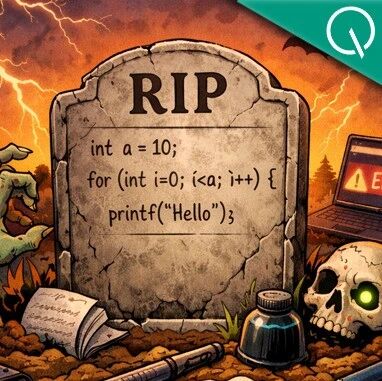
慢雾余弦:VS Code 系 IDE 自动执行 tasks 存在安全风险
Xin Lang Cai Jing· 2026-01-18 04:03
Core Viewpoint - The article highlights a potential security risk associated with IDEs based on VS Code, including Cursor, VS Code, Antigravity, and TRAE, which may automatically execute tasks, potentially triggering malicious code when opening directories [1] Group 1: Security Risks - Slow Fog's Yu Xian warns users about the risk of automatic task execution in VS Code-based IDEs [1] - Users are advised to disable the "automatic task running" feature to prevent malicious code execution [1] - Suggested security measures include setting task.allowAutomaticTasks to off and enabling Workspace Trust in Cursor for risk confirmation when opening new projects [1] Group 2: Mitigation Strategies - The article recommends confirming risks even when choosing to trust the workspace to avoid automatic execution of commands hidden in .vscode/tasks.json [1]