
新型能源体系

Search documents
首台全国产商用300兆瓦级重型燃机在苏投运
Su Zhou Ri Bao· 2025-12-31 00:38
项目5号机组是国家第一批燃气轮机创新发展示范项目,由中国华电联合上海电气等产业链上下游 单位协同攻关,攻克核心部件制造、系统自主可控、大容量全氢冷发电机、低氮燃烧优化、机组可靠性 提升等多项关键技术难题,累计产生30余项创新成果,实现了从核心部件研发应用到整机运维的自主可 控。这一里程碑式突破,为我国重型燃机产业向高端化、智能化、绿色化方向进阶注入强劲动力。 位于苏州的华电望亭发电厂二期燃机项目,共建设2台494兆瓦燃气、蒸汽联合循环机组,均采用全 球首批500兆瓦全氢冷发电机,其中,6号机组已于今年7月正式投运。随着5号机组投运后,二期燃机项 目年发电量可达24.4亿千瓦时,不仅能为江苏地区能源保供提供坚实支撑,满足230万居民一年用电需 求,每年还可节约标煤20万吨,减排二氧化碳约90万吨,为江苏地区今冬明春电力保供提供清洁能源保 障。 近日,首台全国产商用300兆瓦级重型燃机项目——华电望亭发电厂二期燃机5号机组,顺利通过 168小时满负荷试运行并正式投运,标志着我国首次实现商用燃机国产化制造产业链全线贯通。 作为装备制造业领域"皇冠上的明珠",300兆瓦级重型燃机集高精尖技术、新型材料与复杂工艺于 一 ...
实施新标准对重点行业和领域有哪些影响?丨《环境空气质量标准》与配套技术规范修订系列解读④
Zhong Guo Huan Jing Bao· 2025-12-30 23:28
Group 1: Air Quality Standards and Their Impact - The Ministry of Ecology and Environment is soliciting public opinions on the revised "Ambient Air Quality Standards" (GB 3095—2012) and related technical specifications [1] - The new standards aim to promote the construction of a new energy system in China, facilitating the safe and orderly replacement of fossil energy and the development of renewable energy sources [3][4] Group 2: Power Industry Developments - The installed capacity of wind power in China is projected to grow from 76 million kW in 2013 to 520 million kW by 2024, a 580% increase, while solar power capacity is expected to rise from 19 million kW to 890 million kW, a 4580% increase [2] - By the end of 2024, 96% of coal-fired power generation capacity will have completed ultra-low emission upgrades, significantly improving the cleanliness of coal power [2][3] Group 3: Steel Industry Transformation - The steel industry has eliminated 300 million tons of outdated capacity, with advanced equipment capacity significantly increasing, leading to a 25.4% reduction in PM2.5 concentration in ten major steel-producing cities from 2018 to 2024 [5][6] - The implementation of new air quality standards will drive the steel industry to adopt a reduction-focused development model, enhancing the competitiveness of high-quality enterprises [6][7] Group 4: Petrochemical Industry Progress - The petrochemical industry has seen a more than 20% reduction in major air pollutant emissions from 2017 to 2024, despite a 60% increase in crude oil processing capacity [9][10] - The new standards will accelerate the green and low-carbon transformation of the petrochemical industry, promoting comprehensive governance of emissions [10] Group 5: Automotive Industry Advancements - Since 2012, the implementation of air quality standards has led to a 90% reduction in nitrogen oxides and particulate matter emissions from vehicles, significantly enhancing the international competitiveness of China's automotive products [11][12] - In 2024, the sales of new energy vehicles reached 12.87 million units, with a market penetration rate of 40.9%, maintaining China's position as the global leader in this sector [11][12]
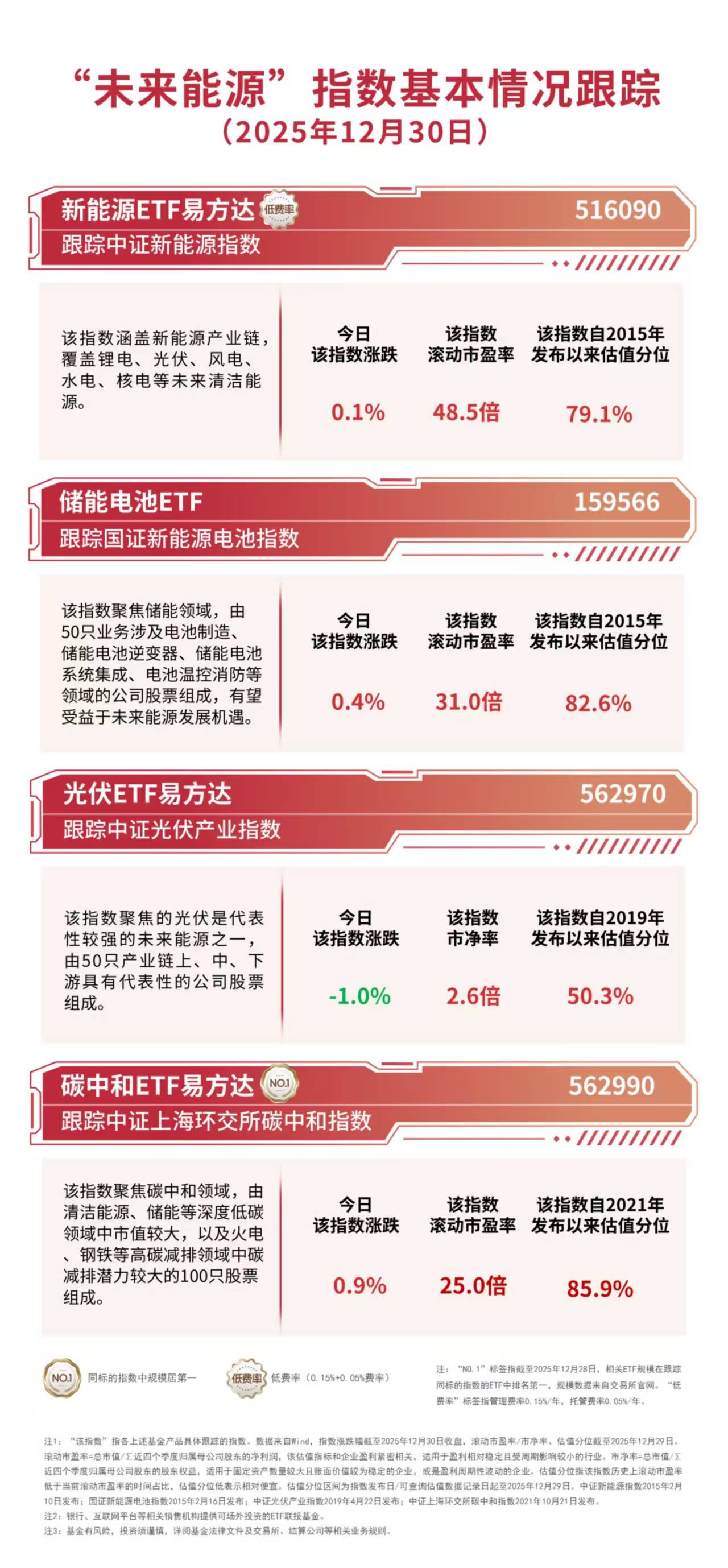
新能源板块震荡分化,储能电池ETF(159566)全天净申购达700万份
Sou Hu Cai Jing· 2025-12-30 10:19
Group 1 - The core viewpoint of the news highlights the mixed performance in the new energy sector, with battery concept stocks leading gains while photovoltaic concept stocks experienced a pullback [1] - The China Carbon Neutrality Index rose by 0.9%, the National New Energy Battery Index increased by 0.4%, and the China New Energy Index saw a slight increase of 0.1%, while the China Photovoltaic Industry Index fell by 1.0% [1] - The Storage Battery ETF (159566) attracted significant investor interest, with a net subscription of 7 million units throughout the day [1] Group 2 - Huatai Securities emphasizes the importance of accelerating the construction of a new energy system during the 14th Five-Year Plan, which includes the development of new energy storage and the acceleration of smart grid construction [1] - The outlook remains positive for the development of new energy and the increase in electrification rates, with companies in the storage, wind power, and grid sectors expected to continue benefiting [1]

华电巴塘120万千瓦光伏项目正式投产发电
Zhong Guo Dian Li Bao· 2025-12-30 07:23
Core Viewpoint - The Huadian Batang 1.2 million kilowatt photovoltaic power generation project has officially commenced operation, marking a significant step in China's clean energy initiatives and the implementation of the energy strong nation strategy in high-altitude regions [1][2]. Group 1: Project Overview - The project is located in the snow-capped highlands of Batang, Sichuan, at an altitude of 4000 to 5100 meters, featuring 2.17 million photovoltaic modules spread over 25,000 acres [1]. - It includes the construction of 122 kilometers of transmission lines and two 220 kV smart booster stations [1]. - The project set industry records during construction, including daily installation of 1,600 string units and the establishment of 15,800 piles [1]. Group 2: Technological Achievements - The project successfully overcame several technical challenges related to high-altitude conditions, such as ice resistance, seismic stability, and frozen soil foundation stability [1]. - It has accumulated valuable experience for the construction of large-scale photovoltaic projects in high-altitude areas [1]. Group 3: Economic and Environmental Impact - The project is expected to deliver 2.1 billion kilowatt-hours of green electricity annually to Central China, saving approximately 640,000 tons of standard coal and reducing carbon dioxide emissions by over 1.7 million tons [2]. - It plays a crucial role in ensuring national energy security, optimizing energy structure, promoting regional coordinated development, and supporting the achievement of carbon neutrality goals [2]. Group 4: Socioeconomic Contributions - During its construction, the project provided over 2,000 jobs for the local community, demonstrating a successful integration of engineering development with ecological protection and improvement of local livelihoods [1].
全国产大F级商用燃机在中国华电投运
Xin Hua Cai Jing· 2025-12-30 05:57
Core Insights - The successful commissioning of the 5th unit of the Huadian Wangting Power Plant marks a significant advancement in China's large F-class gas turbine project, which is crucial for the new energy system and national energy security [1] Group 1: Project Overview - The 5th unit of the Huadian Wangting Power Plant has completed a 168-hour full-load trial run and is now officially in operation [1] - The project includes the construction of two large F-class gas-steam combined cycle units, each with a capacity of 494 MW, utilizing a 500 MW all-hydrogen cold generator [1] Group 2: Technological Achievements - The project has overcome several key technological challenges, including core component manufacturing, system autonomy, large-capacity all-hydrogen cold generators, low nitrogen combustion optimization, and enhanced unit reliability [1] - More than 30 innovative achievements have been generated, contributing to the high-end, intelligent, and green development of China's heavy-duty gas turbine industry [1] Group 3: Environmental Impact - The annual electricity generation capacity of the project is expected to reach 2.44 billion kWh, which can meet the electricity needs of 2.3 million residents for a year [1] - The project is projected to save 200,000 tons of standard coal annually and reduce carbon dioxide emissions by approximately 900,000 tons [1]

我国首台!全国产大F级商用燃机在中国华电投运
Ke Ji Ri Bao· 2025-12-30 03:16
华电望亭发电厂二期燃机项目位于江苏省苏州市,共建设2台大F级494兆瓦燃气—蒸汽联合循环机组, 均采用全球首批500兆瓦全氢冷发电机。5号机组投产后,项目年发电量可达24.4亿千瓦时,不仅能为江 苏地区能源保供提供坚实支撑,满足230万居民一年用电需求,每年还可节约标煤20万吨、减排二氧化 碳约90万吨,为江苏地区今冬明春电力保供提供清洁能源保障。 (文章来源:科技日报) 作为装备制造业领域"皇冠上的明珠",大F级燃气轮机集高精尖技术、新型材料与复杂工艺于一体,是 构建新型能源体系、保障国家能源安全的关键核心装备。项目5号机组是国家第一批燃气轮机创新发展 示范项目,由中国华电联合上海电气等产业链上下游单位协同攻关,成功攻克核心部件制造、系统自主 可控、大容量全氢冷发电机、低氮燃烧优化、机组可靠性提升等多项关键技术难题,累计产生30余项创 新成果,实现了从核心部件研发应用到整机运维的自主可控。这一里程碑式的突破,为我国重型燃机产 业向高端化、智能化、绿色化方向进阶注入强劲动力。 12月29日,我国首台全面国产的大F级商用燃机项目——华电望亭发电厂二期燃机5号机组,顺利通过 168小时满负荷试运行并正式投产。这标 ...
全市新能源企业营收突破500亿元!枣庄加快构建新型能源体系
Qi Lu Wan Bao· 2025-12-29 14:01
Group 1 - The core viewpoint of the news is that Zaozhuang is accelerating the construction of a new energy system and promoting green low-carbon development, achieving significant progress in the renewable energy sector [1][2] - Zaozhuang has been recognized for four consecutive years as an excellent performer in the transformation evaluation of resource-depleted cities and has received the title of "China's New Energy Battery City" [1][2] - The city has achieved a total installed capacity of 4.4 million kilowatts for renewable energy and energy storage, which is 2.5 times that of 2020, accounting for 45.86% of the total power installed capacity, an increase of 18.54 percentage points [1] Group 2 - Zaozhuang has established a complete lithium battery industry chain with 280 new energy enterprises and revenue exceeding 50 billion yuan, positioning itself as a manufacturing hub for new energy [2] - The city has built 184 innovation platforms for new energy batteries, with over 2,800 authorized patents, showcasing significant technological advancements [2] - Zaozhuang has successfully transformed from a "century-old coal city" to "China's New Energy Battery City," receiving recognition from industry associations for its achievements [2] Group 3 - The city has invested 860 million yuan in intelligent construction for 13 coal mines, achieving a 71% rate of intelligent mining, and has closed 19 small coal-fired power units with a total capacity of 511,000 kilowatts [3] - Zaozhuang has built 7,676 public charging facilities, exceeding the targets set in the 14th Five-Year Plan, and has achieved full coverage of public charging stations in towns [3] - The city has established three provincial-level coal storage bases with a total storage capacity of 2.6 million tons, ensuring stable energy supply and meeting social energy demands [3]
我国首台全国产商用300兆瓦级重型燃机投运
Yang Shi Xin Wen· 2025-12-29 10:54
Core Viewpoint - The commissioning of the first domestically produced 300 MW heavy-duty gas turbine project in China marks a significant milestone in the country's gas turbine localization industry chain [1] Group 1: Project Overview - The Huadian Wangting Power Plant Phase II Unit 5, located in Suzhou, Jiangsu Province, consists of two 494 MW gas-steam combined cycle units, utilizing the world's first 500 MW hydrogen-cooled generator [1] - Unit 5 is part of the national first batch of gas turbine innovation development demonstration projects [1] Group 2: Energy Production and Environmental Impact - The annual electricity generation capacity of Unit 5 is expected to reach 2.44 billion kWh, sufficient to meet the annual electricity needs of 2.3 million residents [1] - The project will save 200,000 tons of standard coal annually and reduce carbon dioxide emissions by approximately 900,000 tons, providing clean energy support for electricity supply in Jiangsu during the upcoming winter and spring [1] Group 3: Technological Achievements - The project was developed through collaboration between China Huadian and Shanghai Electric, overcoming key technical challenges in core component manufacturing and system autonomy [1] - More than 30 innovative achievements have been generated, achieving self-controllability from core component research and application to overall machine operation and maintenance [1] - This project provides solid equipment support for building a new energy system and ensuring national energy security [1]

海博思创三大电网侧独立储能项目成功并网
Zheng Quan Ri Bao Wang· 2025-12-29 10:41
Core Insights - Three large-scale energy storage projects in Inner Mongolia, with a total capacity of 7.4GWh, have successfully been connected to the grid, setting a record for rapid construction in the sector [1][3] - The projects utilize Haibo Sichuang's flagship liquid-cooled energy storage system, showcasing high capacity, quality, and speed in construction [1][3] Project Details - The Ordos Gushanliang project, which was the first to connect to the grid on December 18, features Haibo Sichuang's second-generation energy storage converter (PCS) that is fully controllable and designed for complex operational conditions [2] - The Baotou Weijun project, connected on December 24, has a capacity of 3GWh, making it one of the largest energy storage plants globally, equipped with multi-level electrical protection and a dedicated fire protection system [2] - The Baotou Bulhantu project, which went online on December 27, employs a new generation 7MWh energy storage system with 587Ah large-capacity cells, designed for modular configuration to meet varying grid demands [2] Industry Impact - The successful integration of these projects will significantly enhance the Inner Mongolia grid's ability to accommodate renewable energy sources like wind and solar, alleviating peak-load pressure and ensuring system stability [3] - The projects are expected to stimulate local development of the energy storage industry and provide new pathways for regional energy structure transformation [3] - Haibo Sichuang aims to continue driving high-quality development of new energy systems through technological innovation and industry upgrades [3]
12月工商业储能订单达580MWh 东方日升光储结合开启“十五五”增长新局面
Quan Jing Wang· 2025-12-29 08:13
Core Insights - The energy storage industry continues to thrive, creating significant growth opportunities for related companies, with new storage order sizes becoming a key indicator of core competitiveness in the capital market [1][2] - Oriental Risen has achieved notable success in the commercial energy storage sector, signing a total of 580MWh in contracts in December, reflecting strong market interest and recognition of its product capabilities [1] - The company has established strategic partnerships with influential firms in Jiangsu, Zhejiang, and Shandong, aiming to enhance customer service and project delivery efficiency [1] Industry Trends - The integration of energy storage systems with renewable energy is essential for achieving carbon neutrality goals and ensuring energy security, as highlighted in the "14th Five-Year Plan" [2] - The global energy storage market is projected to grow from $668.7 billion in 2024 to $5.12 trillion by 2034, with a CAGR of 21.7% from 2025 to 2034 [2] - Oriental Risen is focusing on addressing pain points in the energy storage market through technological innovation and customized solutions, creating a comprehensive value chain from green energy generation to smart operation [2][3] Product Solutions - The company has launched a refined "Shengqi" integrated energy storage solution for parks, factories, and commercial complexes, which combines various technologies to reduce electricity costs and enhance operational efficiency [3] - The Risen Cloud smart energy management platform offers real-time monitoring and intelligent operation, supporting businesses in optimizing their energy usage and ensuring continuous production [3] - The deployment of photovoltaic and energy storage systems is crucial for businesses to mitigate high electricity prices and improve competitiveness in the green energy market [3]
